The World Health Organization (WHO, 2001) defines probiotics as live microorganisms that provide a health benefit on the host when consumed in adequate amounts.¹ Each living microbe is called by its full strain designation, because the health benefits when consumed depend entirely on which strain is used. The term covers probiotic bacteria from the Lactobacillus and Bifidobacterium genera, as well as yeasts like Saccharomyces boulardii. Through food or supplementation, these organisms can provide health benefits that complement a balanced diet.²
Probiotics, Prebiotics and Postbiotics: What's the Difference?
Probiotics
Live Microorganisms
Bacteria and yeasts that act directly in the gut. The effect is strain-specific: L. rhamnosus GG has different properties from a generic L. rhamnosus.³
Prebiotics
Non-Digestible Fibres
Substrates like inulin and fructo-oligosaccharides (FOS) that selectively nourish beneficial gut bacteria. They amplify the effect of probiotics.⁴
Postbiotics
Bacterial Metabolites
Short-chain fatty acids (butyrate, propionate), antimicrobial peptides and enzymes produced by probiotic activity. An emerging research field.⁵
Synbiotics
Pro + Pre Combined
A combination of probiotics and prebiotics in one formula. The synergy improves colonisation and efficacy according to several meta-analyses.⁶
How Do Probiotics Work in the Gut?
💊
Step 01
Ingestion
The probiotic is ingested as a capsule, sachet or fermented food. Gastric protection determines how many bacteria survive the stomach's acidity.
→
🛡️
Step 02
Gastric Passage
Without enteric coating, up to 90% of live cultures are destroyed by stomach acid (pH < 2). The capsule technology is therefore critical.⁷
→
🦠
Step 03
Gut Colonisation
The bacteria reactivate in the small intestine, adhere to the gut lining and compete with pathogens for nutrients and space.⁸
→
⚡
Step 04
Biological Action
Production of lactic acid, strengthening of the intestinal barrier, modulation of the immune system and production of short-chain fatty acids. Action begins within hours.⁹
Section 02
Gut Microbiome: Why Probiotics Matter
Our gastrointestinal tract — the human gut — harbours approximately 100 trillion microorganisms: bacteria, yeasts and fungi, collectively known as gut microbes.¹⁰ This complex ecosystem plays a central role in gut health, digestion, immunity and vitamin synthesis. Among the common species found in most people, some are beneficial while others can be bad for the host when they overgrow. A healthy microbiome is characterised by its diversity: the more varied the gut flora, the more resilient the body.¹¹
The Role of the Microbiome
The gut microbiome contributes to digestion of dietary fibre, production of vitamins (B12, K2), regulation of the immune system — approximately 70% of immune cells reside in the gut — and communication with the brain via the gut-brain axis.¹² It also influences energy metabolism, body weight and even mood. The balance of gut flora is therefore a fundamental parameter of overall health.
Dysbiosis: When Balance Is Disrupted
Factor 01
💊 Antibiotics
Eliminate beneficial bacteria alongside pathogens — the gut flora can take months to recover.¹⁴ A supportive probiotic treatment is frequently recommended.
Factor 02
😰 Chronic Stress
Increases intestinal permeability and promotes pathogenic bacteria through cortisol.¹⁵ The impact on mental health partly occurs via the gut-brain axis.
Factor 03
🍔 Poor Diet
A diet low in fibre and high in refined sugars reduces bacterial diversity. Ultra-processed foods are particularly harmful to the microbiome.¹⁶
Factor 04
👴 Ageing
Bacterial diversity naturally decreases from age 65. Regular probiotic courses can help maintain the balance of gut flora.¹⁷
Section 03
Key Probiotic Strains and Their Proven Benefits
The effectiveness of a probiotic depends primarily on the strain used — not simply the genus or species. Among the Lactobacillus species, for example, each strain has unique properties documented by specific clinical trials. Here are the most thoroughly researched families in the scientific literature.¹⁸
Family
Key Strains
Characteristics
Documented Indications
Lactobacillus
L. acidophilusL. rhamnosus GGL. reuteriL. plantarumL. casei
Lactic acid bacteria natural to the digestive system. Produce lactic acid that inhibits harmful bacteria.
Used in yogurt production. Aids lactose digestion and strengthens the intestinal barrier.
Lactose digestion²⁶, immune stimulation
Saccharomyces
S. boulardii
Unique probiotic yeast. Remains active during antibiotic use — antibiotics target bacteria, not yeasts.
Antibiotic-associated diarrhoea²⁷, traveller's diarrhoea²⁸, C. difficile infection²⁹
Key point: The effect of a probiotic is always strain-specific. Results from a study on L. rhamnosus GG cannot be transferred to another strain of the same genus.³⁰ Always check the full strain name on the label (genus + species + strain designation).
Section 04
Probiotics Benefits: What Does the Science Say?
Probiotics work through three main mechanisms: microbiome regulation, intestinal barrier strengthening and immune function modulation.³¹ Multiple systematic reviews have stated that these beneficial effects extend across digestive health and inflammation management. Here are the key documented benefits — with the level of evidence for each.
🍎
Digestion and Regular Transit
Probiotics support nutrient absorption and transit regulation. A multi-strain formula helps prevent constipation, diarrhoea and bloating. Convergent meta-analyses.³²
✓ Well established
🛡️
Immune Response
Certain strains stimulate IgA antibody production and activate NK cells. A 2024 systematic review (10 RCTs, 1,560 participants) shows that lactobacilli significantly improve vaccine response in older adults.³³
✓ Well established
🩹
Irritable Bowel Syndrome
B. infantis and L. rhamnosus may alleviate symptoms such as abdominal pain and bloating after 6–8 weeks. A 2023 meta-analysis of 82 randomized controlled trials (10,332 patients) confirms the efficacy of certain probiotic combinations.³⁴
✓ Well established
🧠
Mental Health (Gut-Brain Axis)
Via the gut-brain axis, certain strains influence serotonin and GABA production. A 2025 meta-analysis (23 RCTs, 1,401 patients) shows a significant reduction in depressive symptoms (SMD: −0.96) and a moderate reduction in anxiety (SMD: −0.59).³⁵
⚠ Promising
🌸
Women's Health (Vaginal Flora)
Lactobacilli play a dominant role in healthy vaginal flora. L. rhamnosus and L. reuteri show efficacy in preventing recurrent urinary tract infections and bacterial vaginosis.³⁶
⚠ Promising
🌿
Skin Health
Via the gut-skin axis, probiotic strains may ease inflammatory conditions like atopic dermatitis (eczema) and acne. Encouraging preliminary studies, particularly in infants.³⁷
⚠ Promising
⚖️
Weight Management
L. gasseri SBT2055 was associated with a modest reduction in visceral fat in a double-blind trial.³⁸ Not a substitute for a balanced diet and regular physical activity.
⚠ Exploratory
Beyond these primary areas, emerging evidence points to potential beneficial effects on blood pressure, upper respiratory tract infections and conditions such as ulcerative colitis and Crohn's disease. In neonatal care, certain strains have shown promise for reducing the risk of necrotizing enterocolitis in premature infants.⁴⁵ Researchers have also explored whether probiotics could support immune resilience during COVID-19, though results remain preliminary.
🔍
Limitations of Current Research
Study Size
Many RCTs include fewer than 200 participants — generalisability remains limited.
Study Duration
Most clinical trials last 4 to 12 weeks. Long-term effects are poorly documented.
Individual Variation
Every person's microbiome is unique — the response to the same strains varies considerably.³⁹
Publication Bias
Positive studies are published more frequently — negative results remain under-represented.
Section 05
How to Choose a Good Probiotic
There is no universal formula — effectiveness depends on strain selection, colony forming units (CFU) dosage and individual circumstances.⁴⁰ Not all probiotic products are equally helpful, as probiotic supplements are not required to demonstrate clinical efficacy before sale — only safety and labelling are regulated. Here are the 5 essential quality criteria to check before purchasing a probiotic supplement.
The 5 Quality Criteria
Criterion 01
CFU Count Per Day
The recommended daily dose is at least 10 billion CFU for prevention. For antibiotic-associated conditions, studies recommend 25 billion+.⁴¹
Doses that are too low don't reach the gut in sufficient numbers.
Criterion 02
Strain Diversity
Multiple documented strains that don't inhibit each other.⁴² Multi-strain for prevention, single-strain for specific indications.
Check the full strain name on the label.
Criterion 03
Gastric Resistance
Enteric coating is essential — without protection, up to 90% of live cultures don't survive gastric passage.⁷
Look for "enteric-coated capsule" or "HPMC capsule".
Criterion 04
Clinical Documentation
Each strain should have been tested in at least one published RCT (randomised controlled trial).⁴³
The effect is strain-specific — not transferable.
Criterion 05
Stability and Traceability
CFU count must be guaranteed until the expiry date, not just at the time of manufacture. Freeze-dried strains offer the best stability at room temperature. Store below 25°C, away from light.⁴⁴
Many products lose up to 50% of their bacteria before expiry.
Find Your Probiotic in 3 Steps
Personal Recommendation
3 questions · about 1 minute
Step 1 of 30%
Question 01 / 03
What is your main goal?
Question 02 / 03
Do you have specific symptoms?
Question 03 / 03
For whom?
Your recommendation
Recommended Strains
⚠️ Warning: If you are taking immunosuppressants or other prescription medications, consult your doctor before starting a probiotic course.
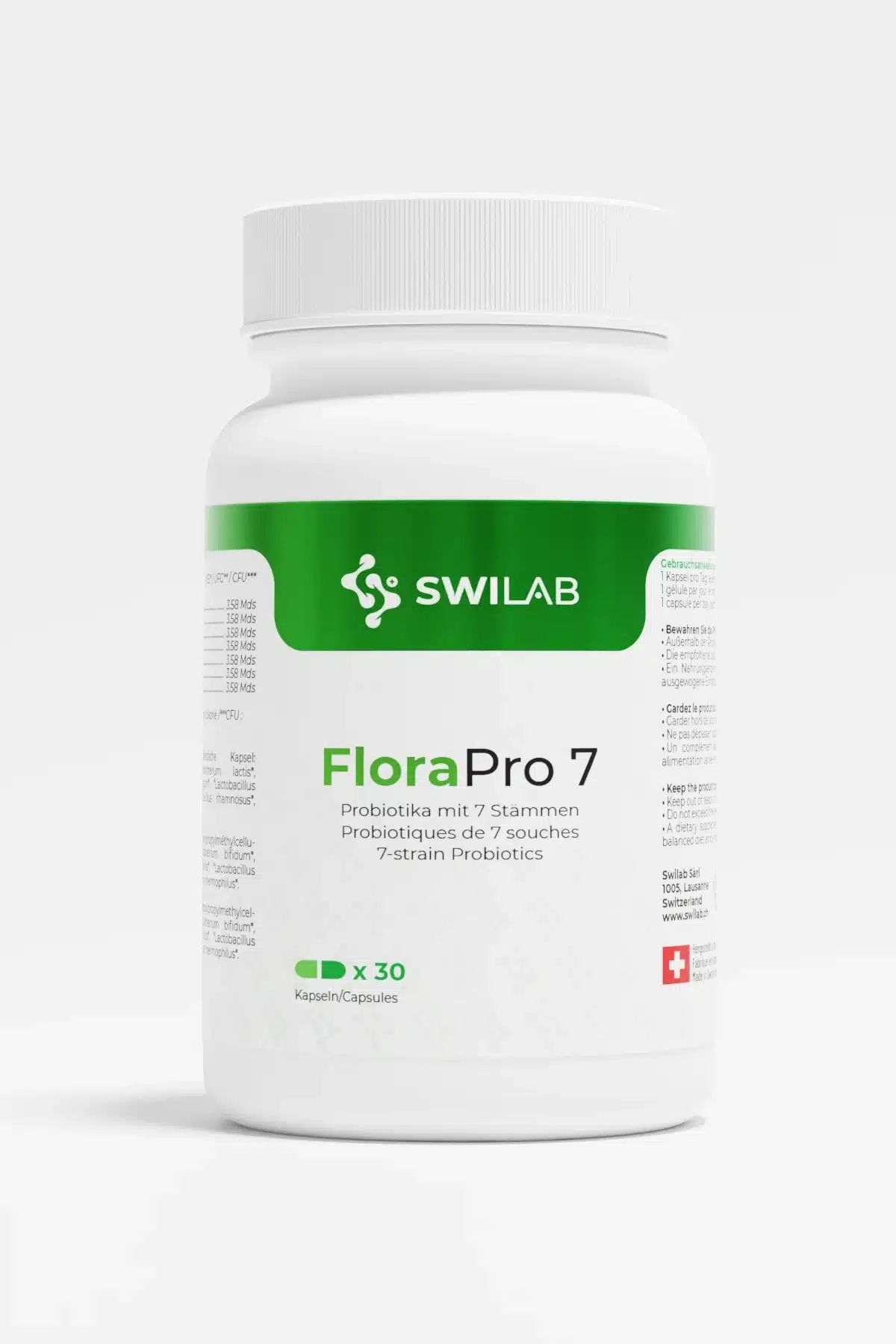
FloraPro 7 contains 7 carefully selected strains from the Lactobacillus, Bifidobacterium and Streptococcus families. With 25 billion CFU per enteric-coated HPMC capsule and freeze-dried cultures, it meets all 5 quality criteria detailed above.
7 clinically documented strains
25 billion CFU per enteric-coated capsule
Freeze-dried strains — viability controlled until expiry
FSVO-compliant — manufactured and quality-controlled in Switzerland
⚠️ Dietary supplement. For specific medical conditions, consult a healthcare professional.
Section 06
When and How to Take Probiotics
Effectiveness doesn't depend solely on strain selection — the timing, dosage and storage directly influence how many live cultures actually reach the gut. Poor intake can reduce the effect by up to 90%.⁴⁶
The Right Time to Take Probiotics
During a meal with water
High survival — food buffers stomach acid
✓✓ Optimal
30 min before a meal (fasting)
Medium survival — acid still elevated
✓ Acceptable
2 hours after a meal
Low survival — acid elevated again
✗ Not recommended
With a hot drink (>40°C)
Very low — heat destroys live cultures
✗ Avoid
Practical tip: Take your probiotic during a meal with a glass of lukewarm water (max. 30°C). Never with coffee or hot tea. Consistency (same time each day) matters more than the exact moment.⁴⁷
Treatment Duration
4 weeks
First Measurable Effects
First detectable changes in microbiome composition. Don't stop early.
8 weeks
Significant Effect
Documented symptom reduction in clinical trials. Tangible results.
12 weeks
Optimal Effect (IBS)
Optimal duration for irritable bowel syndrome and chronic digestive issues.
⚠️ Important
No Permanent Colonisation
Strains don't establish permanently — they disappear after stopping.⁴⁸ Regular courses are necessary.
Section 07
Natural Probiotics: Fermented Foods
Before the era of dietary supplements, probiotics came exclusively from food. Fermented dairy products such as yogurt, kefir and milk-based drinks have been part of daily life and nutrition for centuries. These foods remain an important source of beneficial live microorganisms with recognised nutritional value. However, their concentration and diversity have limits.⁴⁹
Food
Strains Present
Concentration
Advantage
Yogurt
S. thermophilusL. bulgaricus
10⁶–10⁸ CFU/g
Accessible, daily, well tolerated
Kefir
L. kefiriVarious yeasts
10⁷–10⁹ CFU/ml
Great strain diversity
Raw sauerkraut
L. plantarumL. brevis
10⁶–10⁸ CFU/g
Rich in prebiotic fibres
Kimchi
L. plantarumLeuconostoc
10⁷–10⁹ CFU/g
High diversity, vitamins
Kombucha
GluconobacterYeasts
Variable
Drink, easy to integrate
Miso
AspergillusLactobacilli
Variable
Amino acids, umami
Food vs supplementation: Fermented foods provide interesting strain diversity, but their concentration is 100 to 1,000 times lower than that of a dosed supplement. A 2025 meta-analysis (16 RCTs, 1,264 patients) confirms the efficacy of fermented foods in IBS, especially fermented milk.⁴⁹ᵇ For targeted therapeutic goals, supplementation with a documented product is preferable. Ideally, combine both approaches.⁵⁰
Section 08
Side Effects and Precautions
Probiotics are considered safe for the vast majority of healthy individuals. Side effects are rare and generally transient.⁵¹
Transient Effects
During the first 5–7 days, mild digestive discomfort, bloating or gas may occur — these are not a sign of digestive disorders but indicate that the microbiome is adapting to the new strains. They resolve spontaneously in the vast majority of cases. If discomfort persists beyond two weeks, consult with a healthcare provider and report any unusual reaction. People with underlying health conditions should schedule an appointment with their doctor before starting any probiotic course.
Contraindications
⚠️ High Risk
Severe Immunosuppression
Immunocompromised patients (chemotherapy, transplant, advanced HIV) have a rare but documented risk of bacteraemia. Medical consultation mandatory.⁵² In Switzerland, the gastroenterology departments at Inselspital Bern and University Hospital Zurich (USZ) are reference centres for complex cases.
ℹ️ Caution
Pregnancy and Breastfeeding
Data is reassuring for most studied strains, but consult your doctor as a precaution, especially in the first trimester.
ℹ️ Caution
Premature Infants
Specific strains are documented for infants, but prescription must be supervised by a paediatrician.⁴⁵
💊 Interactions
Medications
Immunosuppressants: consult your doctor. Antifungals: may reduce the efficacy of S. boulardii. Antibiotics: S. boulardii can be taken simultaneously.
Section 09
Regulation and Quality in Switzerland
In Switzerland, the regulatory framework for probiotics differs from that of the European Union. Understanding these specifics enables informed choices.⁵³
⚖️
FSVO: The Legal Framework
The Federal Food Safety and Veterinary Office (FSVO) regulates dietary supplements in Switzerland under food law. An FSVO-compliant product guarantees that all label claims are scientifically substantiated — unauthorised health claims are prohibited.
🏥
Supplement vs Medicine
A probiotic marketed as a dietary supplement does not need to prove therapeutic efficacy before market launch (unlike a Swissmedic-registered medicine). This is why the clinical documentation of strains is a decisive selection criterion.
💳
Health Insurance Coverage
Probiotics as dietary supplements are not covered by mandatory health insurance (KVG/LAMal). Prices range from 25 to 60 CHF per month. Some supplementary insurance policies (VVG/LCA) may partially reimburse — check your individual policy.
🔍
What to Look For
Favour products manufactured in Switzerland with documented quality control, FSVO compliance, strains identified on the label with CFU count per strain, and viability guaranteed until expiry date.
For international reference, the National Institutes of Health (NIH) and its National Center for Complementary and Integrative Health (NCCIH), the Mayo Clinic and Harvard Medical School all provide expert resources on probiotics. In the United States, the Food and Drug Administration (FDA) classifies most probiotics as dietary supplements — a national regulatory approach similar to the Swiss framework.
FAQ
Frequently Asked Questions About Probiotics
Probiotics are live microorganisms — bacteria or yeasts — that confer a health benefit when consumed in adequate amounts (WHO, 2001). The most studied genera are Lactobacillus, Bifidobacterium and Saccharomyces boulardii. The effect is always strain-specific. For education on strains and dosage, expert resources are available from major health services; for personalised advice, consult your healthcare provider. More in Section 1.
Probiotics are beneficial live microorganisms. Prebiotics are non-digestible fibres (inulin, FOS) that feed the good bacteria already in your gut. The two are complementary, and their combination (synbiotic) is more effective than either alone.
At least 10 billion CFU per day for prevention. For antibiotic-associated diarrhoea, 25 billion+. A higher dose isn't automatically better — enteric coating is equally important. Details in Section 5.
Optimal intake is during a meal with a glass of water at room temperature. Food buffers stomach acid and protects the bacteria. Avoid hot drinks (>40°C). Consistency matters more than exact timing. See Section 6.
Minimum 4 weeks for a measurable effect. For IBS, 8–12 weeks. Strains don't permanently colonise the gut — regular intake is necessary to maintain the balance of gut flora.
B. infantis, B. breve and L. reuteri are documented for infants. Paediatric consultation is mandatory. Never use adult-dosed preparations in children.
Side effects are mild and transient: digestive discomfort, bloating or gas in the first days. These reactions resolve within 5–7 days. Immunocompromised individuals must consult a doctor. In regulatory terms, probiotics are not intended to treat disease but to support general wellbeing. Details in Section 8.
Yes, and it's even recommended. Starting simultaneously significantly reduces the risk of antibiotic-associated diarrhoea. S. boulardii is unaffected by antibiotics (yeast, not bacteria). Continue the course for 4 weeks after the antibiotics end.
B. infantis alleviates IBS symptoms after 6–8 weeks²³
A diverse gut microbiome correlates with stronger immunity¹¹
The combination of probiotics + prebiotics is more effective⁶
Enteric coating is critical for efficacy⁷
⚠️ Promising but Needs Confirmation
Gut-brain axis and mental health³⁵
Weight management (modest effect)³⁸
Skin health (eczema, acne)³⁷
Support in inflammatory bowel disease²⁴
Women's health and vaginal flora³⁶
📌 Key Principles
The effect is strain-specific — always check the full name on the label³⁰
CFU dosage and course duration are as important as strain selection⁴⁶
Probiotics do not replace medical treatment or a balanced diet
Immunocompromised: only with medical advice⁵²
In Switzerland: favour FSVO-compliant products with documented traceability⁵³
References
Scientific Sources
Definition, Mechanism and Microbiome (Sections 1–2)
1 Hill C, et al. ISAPP consensus statement on probiotics. Nat Rev Gastroenterol Hepatol. 2014;11(8):506–514. → DOI
2 Zheng J, et al. Taxonomic note on Lactobacillus. Int J Syst Evol Microbiol. 2020;70(4):2782–2858. → DOI
3 Sanders ME. Impact of probiotics on colonizing microbiota. J Clin Gastroenterol. 2011;45(Suppl):S115–S119. → DOI
4 Gibson GR, et al. ISAPP consensus on prebiotics. Nat Rev Gastroenterol Hepatol. 2017;14(8):491–502. → DOI
5 Salminen S, et al. ISAPP consensus on postbiotics. Nat Rev Gastroenterol Hepatol. 2021;18(9):649–667. → DOI
6 Swanson KS, et al. ISAPP consensus on synbiotics. Nat Rev Gastroenterol Hepatol. 2020;17(11):687–701. → DOI
7 Corcoran BM, et al. Survival of probiotic lactobacilli in acidic environments. Appl Environ Microbiol. 2005;71(6):3060–3067. → DOI
8–9 Thursby E (Biochem J, 2017); Guarner F (WGO Global Guidelines, 2023).
10 Sender R, et al. Revised estimates for human and bacteria cells. Cell. 2016;164(3):337–340. → DOI
11 Lozupone CA, et al. Diversity and resilience of gut microbiota. Nature. 2012;489:220–230. → DOI
12–17 Vighi G (Clin Exp Immunol, 2008); Petersen C (Cell Microbiol, 2014); Jernberg C (ISME J, 2007); Moloney RD (Mamm Genome, 2014); Sonnenburg JL (Nature, 2016); Claesson MJ (Nature, 2012).
Strains and Benefits (Sections 3–4)
18 Sanders ME, et al. Probiotics and prebiotics in intestinal health. Nat Rev Gastroenterol Hepatol. 2019;16(10):605–616. → DOI
19 Goldenberg JZ, et al. Probiotics for C. difficile diarrhoea. Cochrane Database Syst Rev. 2017;(12). → DOI
20–22 Stapleton AE (Clin Infect Dis, 2011); Pakdaman MN (Nutr J, 2016); Liu Y (Front Cell Infect Microbiol, 2023).
23 Whorwell PJ, et al. B. infantis 35624 in IBS. Am J Gastroenterol. 2006;101(7):1581–1590.
24–30 Sood A (Clin Gastroenterol Hepatol, 2009); Ford AC (Am J Gastroenterol, 2014); Levri KM (J Fam Pract, 2005); McFarland LV (Am J Gastroenterol, 2006; Travel Med Infect Dis, 2007); Surawicz CM (Gastroenterology, 1989); McFarland LV (Front Med, 2018).
31–32 Guarner F (WGO 2023); Garzon Mora N (Cureus 2024, → DOI).
33 Arioz Tunc H, et al. Oral probiotics and vaccination response in older adults: systematic review of RCTs. Age Ageing. 2024;53(Suppl 2):ii70–ii79. 10 RCTs, 1,560 participants. → DOI
34 Goodoory VC, et al. Efficacy of Probiotics in IBS: Systematic Review and Meta-analysis. Gastroenterology. 2023;165(5):1206–1218. 82 RCTs, 10,332 patients. → DOI
35 Asad A, et al. Prebiotics and Probiotics on Depression and Anxiety: Systematic Review and Meta-analysis of RCTs. Nutr Rev. 2025;83(7):e1504–e1520. 23 RCTs, 1,401 patients. → DOI
36–39 Reid G (FEMS 2003); Bowe WP (Gut Pathogens 2011); Kadooka Y (Eur J Clin Nutr 2010); Zmora N (Cell 2018, → DOI).
49 Marco ML, et al. Health benefits of fermented foods. Curr Opin Biotechnol. 2017;44:94–102. → DOI
49b Ding L, et al. Efficacy of fermented foods in IBS: systematic review and meta-analysis of RCTs. Front Nutr. 2025;11:1494118. 16 RCTs, 1,264 patients. → DOI
50 Roberfroid M, et al. Prebiotic effects. Br J Nutr. 2010;104(Suppl 2):S1–S63. → DOI
51 Didari T, et al. Probiotics in IBS meta-analysis. World J Gastroenterol. 2015;21(10):3072–3084. → DOI
52 Hempel S, et al. Safety of probiotics. Evid Rep Technol Assess. 2011;(200):1–645.
53 FSVO — Federal Food Safety and Veterinary Office. Swiss food law, dietary supplement ordinance.