
Made in Switzerland
Traceability
OriginSecure payment
Twint, Visa, Mastercard, PostFinance
3-D SecureSwiss Post 24-48 h
Fast dispatch
FastResponsive support
Clear answers
HelpWhey protein is the protein fraction of milk separated during cheese-making, then concentrated by filtration. It is a complete, leucine-rich and rapidly digested protein. Whey accounts for about 20 % of milk protein, casein for the remaining 80 %; it comes from cheese-making (cheese whey) or directly from filtered milk (native whey). There are essentially three types of whey: concentrate, isolate and hydrolysate, detailed in the “How to choose?” section. This page is for anyone who wants to top up their protein intake and understand the value, choice and use of a whey before discovering our formula.
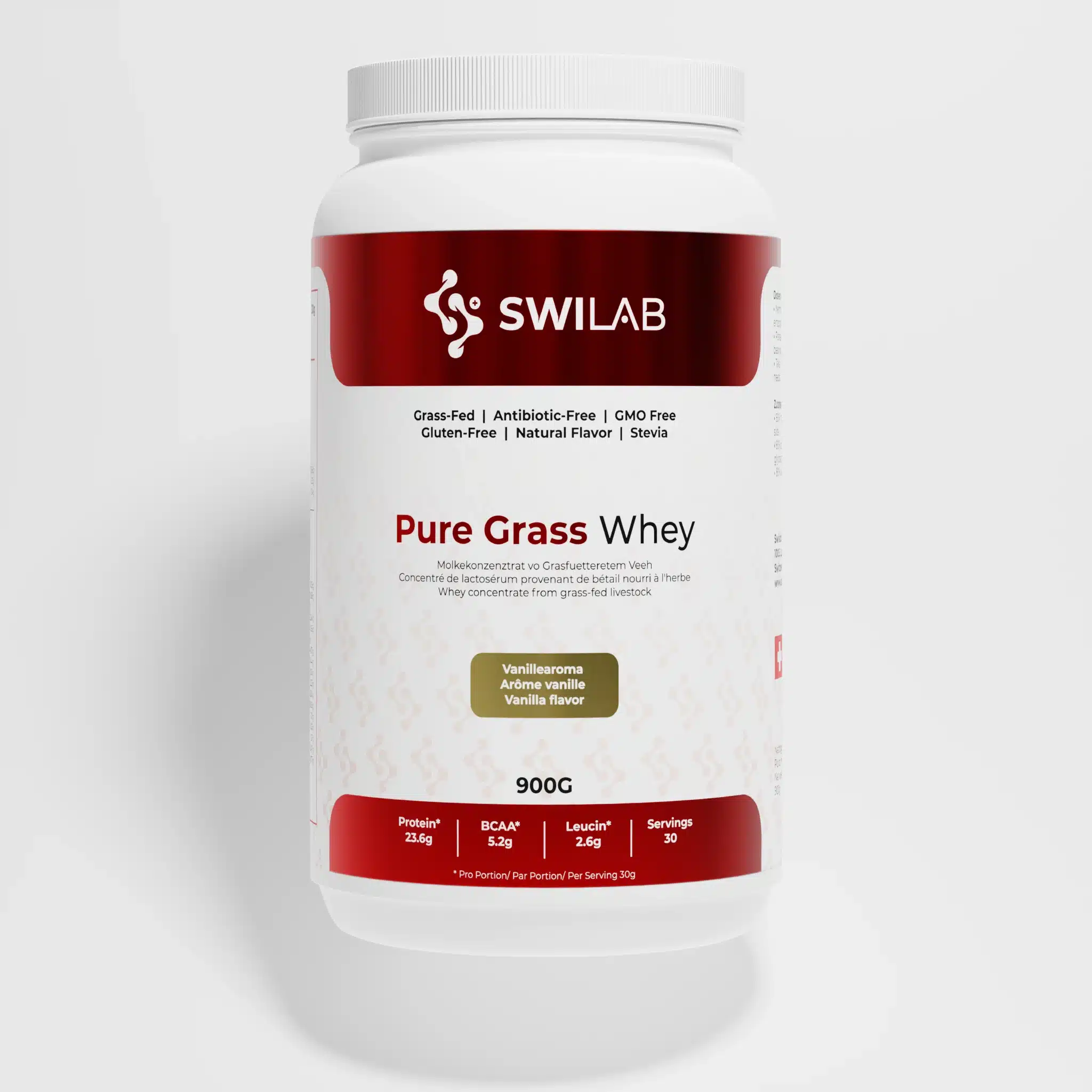
A whey concentrate from grass-fed cows, with no synthetic sweetener and no artificial flavour. The claims below are authorised under Annex 14 of the OFI for protein: they describe a nutrient that supports the body's normal functions, without treating any disease.
What sets us apart from a standard whey
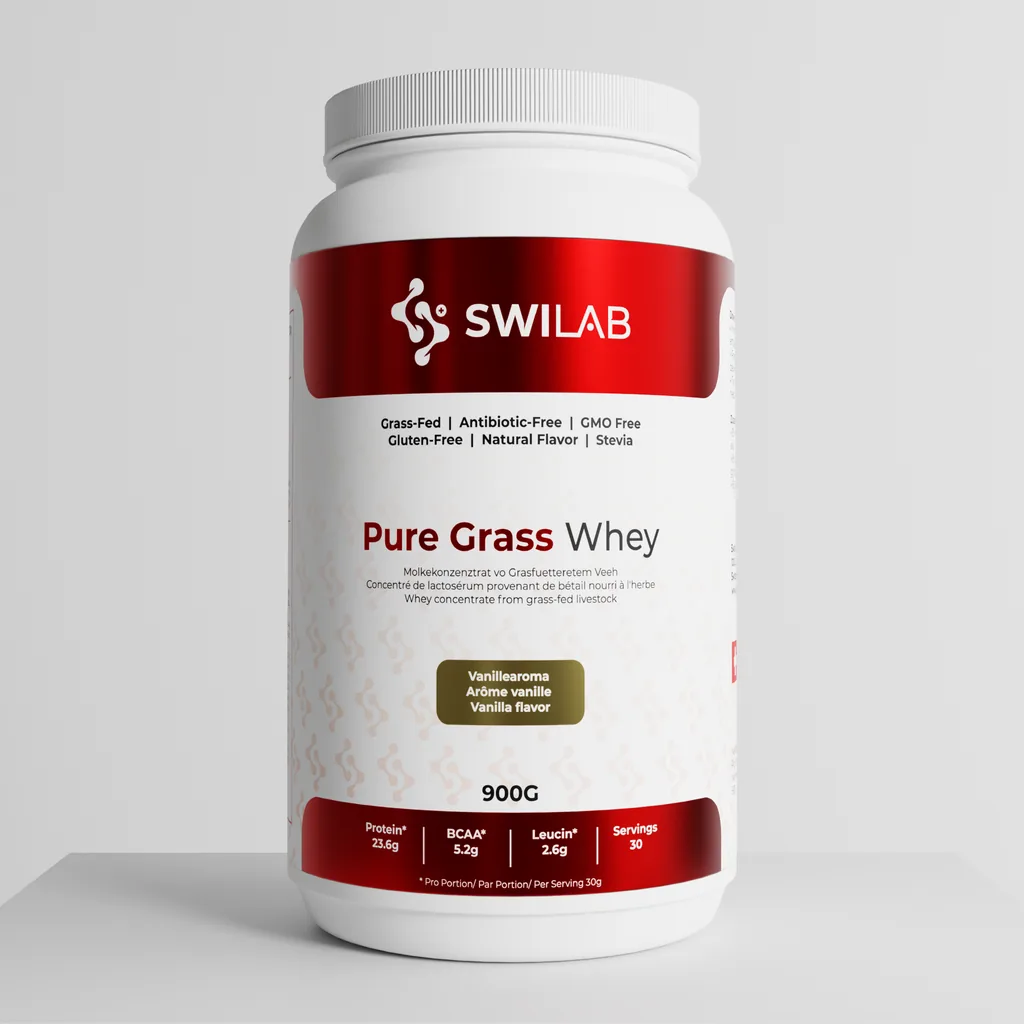
23.6g of protein per 30 g serving, from the milk of grass-fed cows
| Criterion | Our formulaSwiLab | Standard whey |
|---|---|---|
| Milk source | 100 % grass-fed cows | Not specified |
| Protein per serving | 23.6 g per 30 g | 18 to 24 g |
| Leucine and BCAAs per serving | 2.66 g · 5.23 g | Often not stated |
| Sweetener | Steviol glycosides | Sucralose, acesulfame K |
| Natural flavours only | Yes | Variable |
| No detectable hormones or antibiotics | Tested | Variable |
| Ingredient list | 3 ingredients (4 for chocolate) | Thickeners, emulsifiers, colourings |
| Made in Switzerland | Yes | No |
| Price for 900 g | CHF 44.60 | CHF 30 to 70 |
Indicative comparison based on the common product categories on the Swiss market (September 2026). The characteristics of third-party products may vary.
Five questions first establish the need. Five criteria then set the products apart, beyond the promise printed on the tub.
A whey is judged on the protein it actually delivers per serving and on its ingredient list, not on the weight of the tub. Worth checking before buying, whatever the range or brand. To read a label and spot marketing traps: our whey protein guide.
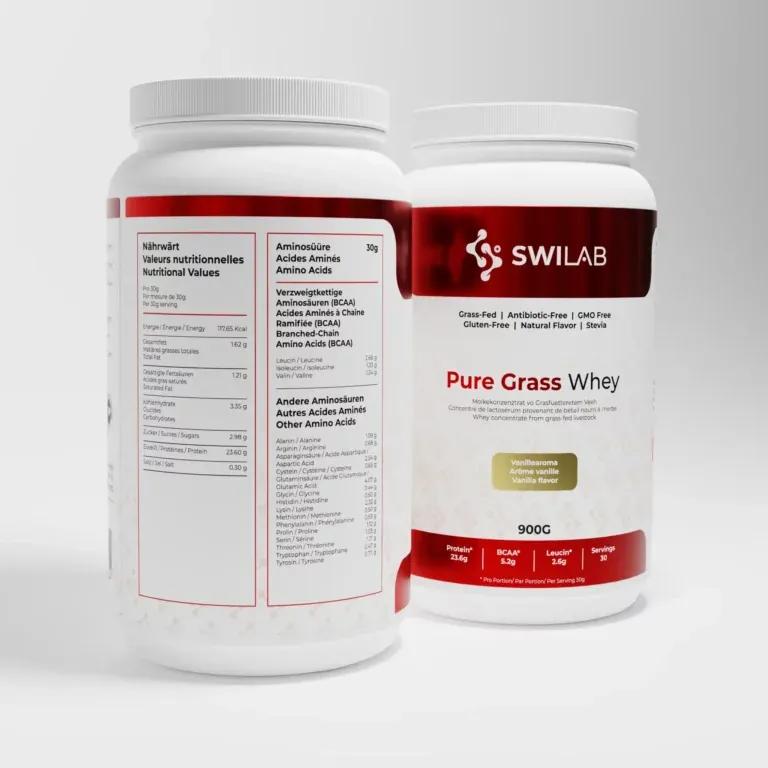
Two figures to read together. Protein per 100 g measures the purity of the powder; protein per serving tells you what you actually drink. A bigger serving can hide a diluted powder. Here: 23.6 g of protein for a 30 g serving, that is 80 g per 100 g. A protein-rich powder like ours (80 % protein, 1.6 g fat per serving) also provides all nine essential amino acids (EAA). Most powders provide 20 to 25 g of protein per serving; ours, 23.6 g per 30 g.
Leucine is the amino acid that triggers muscle protein synthesis; the International Society of Sports Nutrition recommends 0.7 to 3 g of leucine per serving. A full amino acid profile on the label is a sign of seriousness. Here: 2.66 g of leucine and 5.23 g of BCAAs per serving.
All three deliver quality protein; the difference lies in filtration, lactose and price. Concentrate keeps a little lactose and fat, and the best taste; isolate makes sense for lactose sensitivity or a very low-calorie diet; hydrolysate costs a lot for an absorption gain that hardly matters outside competition. Whey isolate remains the option to consider for marked lactose intolerance; for most people, concentrate is the simplest and least processed alternative.
Sucralose, acesulfame K, colourings, thickeners and emulsifiers often lengthen the ingredient list of a flavoured whey. A short list reads in one line: here, whey protein concentrate, natural vanilla flavour and steviol glycosides; the chocolate adds low-fat cocoa. Ours contains none of them: three ingredients, no palm oil and no added emulsifiers. Every ingredient is listed in full on the label.
Where does the milk come from, how are the cows fed, and who checks for residues? Whey from grass-fed cows, tested with no detectable growth hormones or antibiotics, then formulated and batch-controlled in Switzerland, answers all three questions.
Resistance training and an intake of 1.4 to 2.0 g of protein per kilo per day build muscle together. A serving after the session or during the day helps you reach that total: protein contributes to a growth in muscle mass. In strength training, the daily total matters more than the shake right after the session for recovery; muscle protein synthesis is maximally stimulated from about 20 g of protein per meal (Moore, 2009).
Running, cycling, swimming: protein needs rise with training volume. An easy-to-digest shake tops up intake after a long session without weighing you down. Carbohydrates remain the priority in endurance sport. For running as for trail, a 30 g portion fits in the bag without refrigeration.
When you eat less, muscle is the first thing at risk. Protein contributes to the maintenance of muscle mass: 23.6 g for 117.65 kcal is a dense intake that helps you stay on course without blowing the calorie budget. In other words, limiting muscle loss during a cut.
Skipped breakfast, lunch on the go, late dinner: protein intake piles up in the evening. A serving in your morning porridge or smoothie spreads protein better across the day, as the scientific societies recommend. A home-mixed protein shake costs CHF 1.49 per serving and complements the diet without replacing it.
With age, muscle responds less to protein and appetite drops. The PROT-AGE expert group recommends at least 1.0 to 1.2 g/kg a day. A leucine-rich, easy-to-drink whey helps you get there; with kidney disease, seek medical advice first.
Without meat or fish, reaching 1.2 g/kg takes planning. A complete milk protein with all 9 essential amino acids complements eggs, pulses and dairy without changing your diet.
This information is descriptive and does not constitute therapeutic claims. If you have kidney or liver disease, are pregnant or breastfeeding, or have a diagnosed condition, consult a doctor before use. Contains milk.
A complete, fast protein. At an equal dose of essential amino acids, whey stimulated muscle protein synthesis 93 % more than casein at rest and 122 % more after exercise (Tang, 2009). Its richness in leucine and rapid digestion explain this advantage (Devries and Phillips, 2015).
The dose that counts. Twenty grams of protein are enough to maximally stimulate muscle synthesis after a session in young adults of 80 kg (Moore, 2009; Witard, 2014). The International Society of Sports Nutrition recommends 20 to 40 g per serving, 1.4 to 2.0 g/kg a day, every 3 to 4 hours (Jäger, 2017).
Favourable controlled trials. Across 49 studies and 1,863 participants, protein supplementation increased the lean mass and strength gained through training (Morton, 2018). These results from clinical research only hold with an adequate total protein intake and regular training. Combined with resistance training, whey added 2.24 kg of lean mass in 14 trials (Miller, 2014), and 0.37 kg on average in women, with or without resistance training (Bergia, 2018).
Updated: September 2026.
In young men given 10 g of essential amino acids as whey, casein or soy, whey produced the strongest stimulation of muscle protein synthesis, at rest as after exercise (Tang, 2009). The review by Devries and Phillips (2015) attributes this advantage to digestibility, essential amino acid content and above all leucine, of which each serving of Pure Grass Whey provides 2.66 g. Whey is generally well tolerated and digested, except in cases of milk protein allergy or severe lactose intolerance; a concentrate also retains minor milk fractions such as lactoferrin and immunoglobulins, described here without any health claim. Whey protein has a high biological value (reference value above 100): biological value describes how well the body can convert a dietary protein into its own protein.
Muscle synthesis plateaus at around 20 g of quality protein per serving in young adults of 80 kg; beyond that, the surplus is oxidised (Moore, 2009; Witard, 2014). The ISSN position (Jäger, 2017) draws practical benchmarks from this: 0.25 g/kg or 20 to 40 g per serving, 0.7 to 3 g of leucine, servings spaced 3 to 4 hours apart. The anabolic effect of a session lasts at least 24 hours: the famous 30-minute window is greatly overstated.
Morton's meta-analysis (2018) of 49 randomised trials shows that protein supplementation increases the strength (+2.49 kg on the one-repetition maximum) and lean mass (+0.30 kg) gained through training, with a plateau around 1.6 g/kg a day. Miller (2014) puts the gain at 2.24 kg of lean mass when whey accompanies resistance training; Bergia (2018) confirms a modest lean mass gain in women, clearer under calorie restriction.
Used in place of other calories in overweight adults, whey was associated with lower body weight (−4.2 kg) and fat mass (−3.7 kg) in the trials analysed by Miller (2014), always within a calorie deficit. The meta-analysis by Mollahosseini (2017) observes a modest long-term reduction in appetite. In 380 people over 65 with low muscle mass, a leucine- and vitamin D-enriched whey improved appendicular muscle mass and the chair-stand test in 13 weeks (Bauer, 2015).
Without training, whey does not build muscle; it does not cause weight loss outside a calorie deficit; and in healthy adults a high protein intake does not change kidney function (Devries, 2018), with caution still warranted in kidney disease. As for pasture milk, it mainly changes the fat profile of milk (omega-3, CLA) according to Alothman (2019); on a concentrate with 1.6 g of fat per serving, the value lies first in the quality of the raw material and the farming. The authorised claims remain those of Annex 14 of the OFI.
Milk from grass-fed cows (Austria), tested with no detectable growth hormones or antibiotic residues. The quality of a whey starts in the barn.
The whey is separated during cheese-making, then concentrated by low-temperature ultrafiltration: the protein fractions are preserved, with 23.6 g of protein per serving.
Natural vanilla or chocolate flavour, steviol glycosides, nothing else. Formulation, production and batch controls carried out in Switzerland. Swiss dairy expertise applied to the powder. Two flavours, two references: vanilla and chocolate, both with no added sugar.
Whey is a protein-concentrated food, not an anabolic and not a fat burner. Above about 1.6 g of protein per kilo per day, training no longer converts the surplus into muscle: there is no point stacking servings.
Ask for advice before starting if you have kidney or liver disease, are pregnant or breastfeeding, or for a teenager. Pure Grass Whey contains milk and is formulated for adults.
Food supplements do not replace a varied and balanced diet or a healthy lifestyle: most of your protein should come from your plate (eggs, fish, meat, pulses, dairy). Before regular supplementation, the advice of a healthcare professional is recommended.
In Switzerland, food supplements are regulated by the Foodstuffs Act and the food supplements ordinance. A food supplement does not replace a varied diet or medical advice, and does not prevent, treat or cure any disease. Pure Grass Whey is not a medicine.
Whey protein is the protein fraction of milk, separated during cheese-making. It is a complete protein: it contains all nine essential amino acids and is rich in leucine, the amino acid that triggers muscle building.
It is also rapidly digested. According to the international society of sports nutrition, it is one of the most effective sources for stimulating muscle protein synthesis. Pure Grass Whey comes from the milk of grass-fed cows.
The authorised claims are clear: proteins contribute to the growth and maintenance of muscle mass, and to the maintenance of normal bones.
Beyond that, whey protein is mainly a practical way to reach your daily intake of quality protein, without excess calories. Its value comes from its richness in essential amino acids and leucine, and its fast digestion. It is not a magic product: it is a complement to a diet.
All three provide quality protein; the difference is purity and lactose. Concentrate (70 to 80 % protein) contains some lactose and fat. Isolate is more filtered (about 90 %), with very little lactose, useful for lactose sensitivity or when cutting. Native whey is extracted directly from milk. Clear whey is a clarified isolate, at 85 to 90 % protein with a juice-like texture, usually more expensive.
For most people, concentrate offers the best value; isolate is mainly worthwhile for digestion or a low-calorie diet.
To maintain or build muscle, the international society of sports nutrition recommends about 1.4 to 2.0 g of protein per kilo per day (from all sources), spread across the day. Per serving, 20 to 40 g of quality protein is enough to stimulate muscle building.
Whey protein does not add to this total: it helps you reach it. Most protein should come from food, with whey filling the gap if needed.
The famous “anabolic window” right after training is largely overstated: the effect of exercise on muscle lasts at least 24 hours. What matters most is total protein intake across the day, spread every 3 to 4 hours.
Taking whey protein around training works and is convenient, but morning, as a snack or in the evening are just as fine. Choose the moment that helps you reach your daily total.
Yes, with one condition. A large meta-analysis (49 studies, nearly 1,900 people) shows that protein supplementation significantly increases strength and muscle mass, but only when combined with resistance training (weights). Without effort, whey protein does not “build” muscle.
The effect also plateaus above about 1.6 g/kg/day. Whey protein is a tool to reach that intake, not an anabolic.
Indirectly, yes. In people who are overweight, a meta-analysis found that whey supplementation, used in place of other calories, reduced body weight and fat mass. The reason: protein is satiating and helps preserve muscle during a diet.
But whey protein does not cause “extra” weight loss: it is only useful within an overall calorie deficit. It is not a fat burner.
In a healthy person, a high protein intake, including whey protein, has not been shown to harm the kidneys or liver. The idea that “protein damages the kidneys” comes from studies in people who already have kidney disease, whose intake must be managed.
For everyone: stay within the recommended ranges and hydrate well. If you have kidney or liver disease, seek a doctor's advice before use.
Often yes, depending on the form. Whey protein isolate contains very little lactose and is usually well tolerated. Concentrate contains more and may cause discomfort with marked intolerance.
In case of severe lactose intolerance or a milk protein allergy (two different things), whey is not suitable: a plant protein is preferable. When in doubt, start with a small dose.
Yes. The mechanisms are the same: in women as in beginners, combining quality protein with resistance training improves muscle mass and body composition.
Whey protein does not “masculinise” and does not cause unwanted bulk: building a lot of muscle requires specific, prolonged training. For female athletes, the intake recommendations (1.4 to 2.0 g/kg/day) are identical.
Both work; whey protein has a few advantages. It is a complete protein, rapidly digested and rich in leucine, so very effective for muscle building.
Plant proteins (pea, rice, soy) also work, often better in a blend to cover all essential amino acids, and suit vegans or those with lactose intolerance. The choice depends on your diet and tolerance, not on absolute superiority.
Yes, if it helps you reach your daily protein intake rather than exceed it. A 30 g serving provides 23.6 g of protein; count it within a total of 1.4 to 2.0 g/kg per day if you train, 0.83 g/kg for a sedentary adult. In healthy adults, clinical trials lasting several weeks to months have not reported notable adverse effects; in case of kidney disease, seek medical advice.
“Protein” is the nutrient; whey is one particular source of protein, obtained from the whey of milk. It differs from other sources (casein, egg, pea, rice) by its rapid digestion and its leucine content. A whey powder is therefore not “more than a protein”: it is a complete protein, easy to dose, that complements the diet without replacing it.
Yes: whey is a food, not a product reserved for athletes. Without training it does not build muscle; it then serves to top up an insufficient protein intake, for example in older people, in those who eat little meat, or on busy days. Protein contributes to the maintenance of muscle mass, which matters outside sport too.
“Very high quality and, above all, the taste is just incredible. I recommend it 100 %.”
Mathilde S. · customer review
“I chose vanilla to try it out and it is really great: no lumps, and the taste is very good. I recommend it.”
Emma T. · customer review
“The best whey I have tried so far. The vanilla flavour is perfect, even with just water. Very easy to digest, no stomach issues at all.”
Jonas Frei · customer review
“Great product! I take the whey after my workouts and it mixes very well. The chocolate flavour is excellent, not sickly at all. I recommend it.”
Luca Meier · customer review
900 g, that is 30 servings of 30 g, in vanilla or chocolate. Shipped from Switzerland within 24 hours, free delivery from CHF 99.–