

Made in Switzerland
Traceability
OriginSecure payment
Twint, Visa, Mastercard, PostFinance
3-D SecureSwiss Post 24-48 h
Fast dispatch
FastResponsive support
Clear answers
HelpMagnesium (bis)glycinate is a chelated form of magnesium: each magnesium ion is bound to two molecules of glycine, an amino acid. The gut absorbs it through dipeptide transporters, a different route from inorganic salts such as oxide. This page is for anyone whose needs are higher and who wants to understand the value, choice and use of a magnesium supplement before discovering our formula.
Other common spellings: magnesium bisglycinate, magnesium glycinate or magnesium diglycinate refer to the same chelate. Its advantages lie in absorption and digestive tolerance.
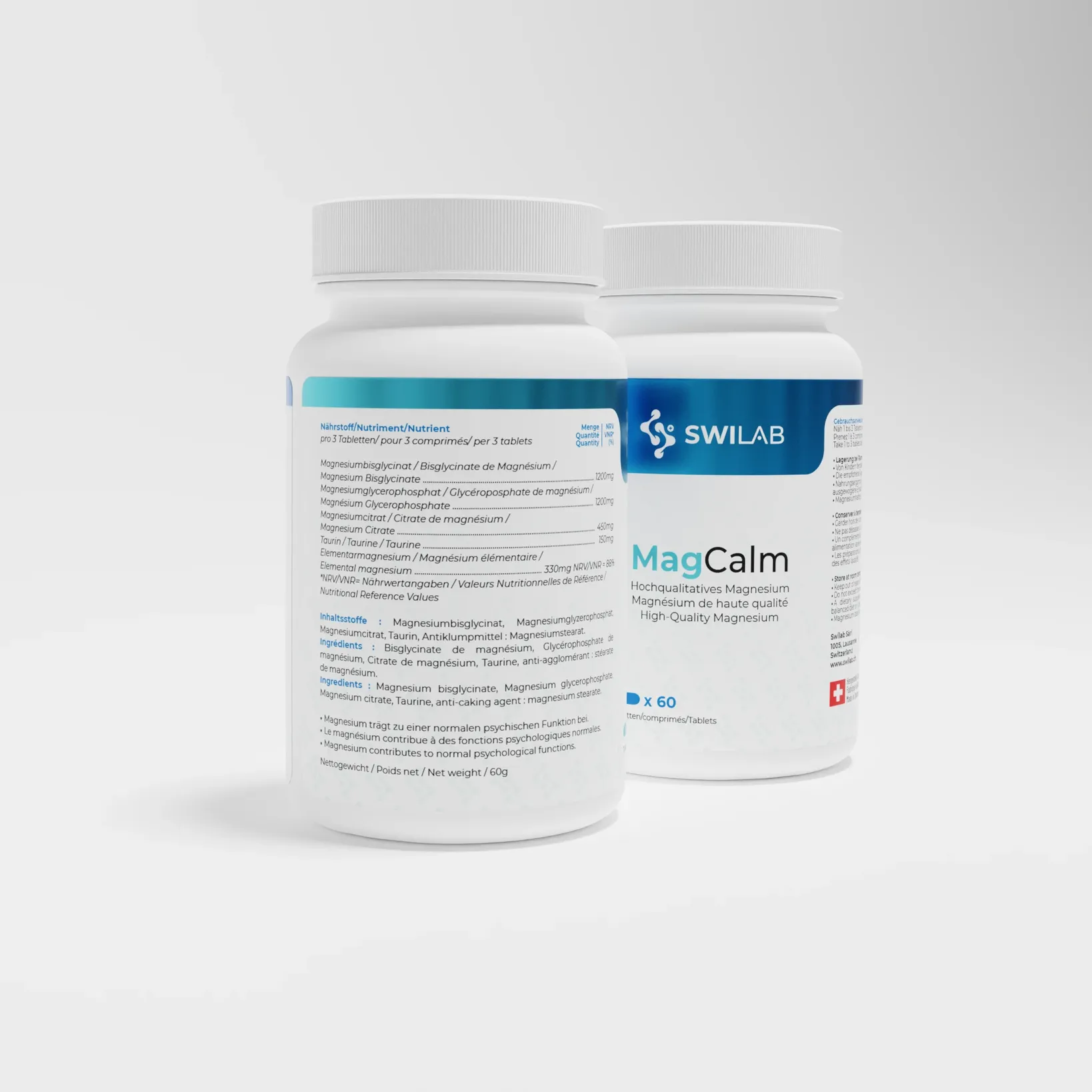
A triple-magnesium formula enriched with taurine, designed for high bioavailability and excellent digestive tolerance. The claims below are authorised under Annex 14 of the OFI: a mineral that supports the body's normal functions, without treating any disease.
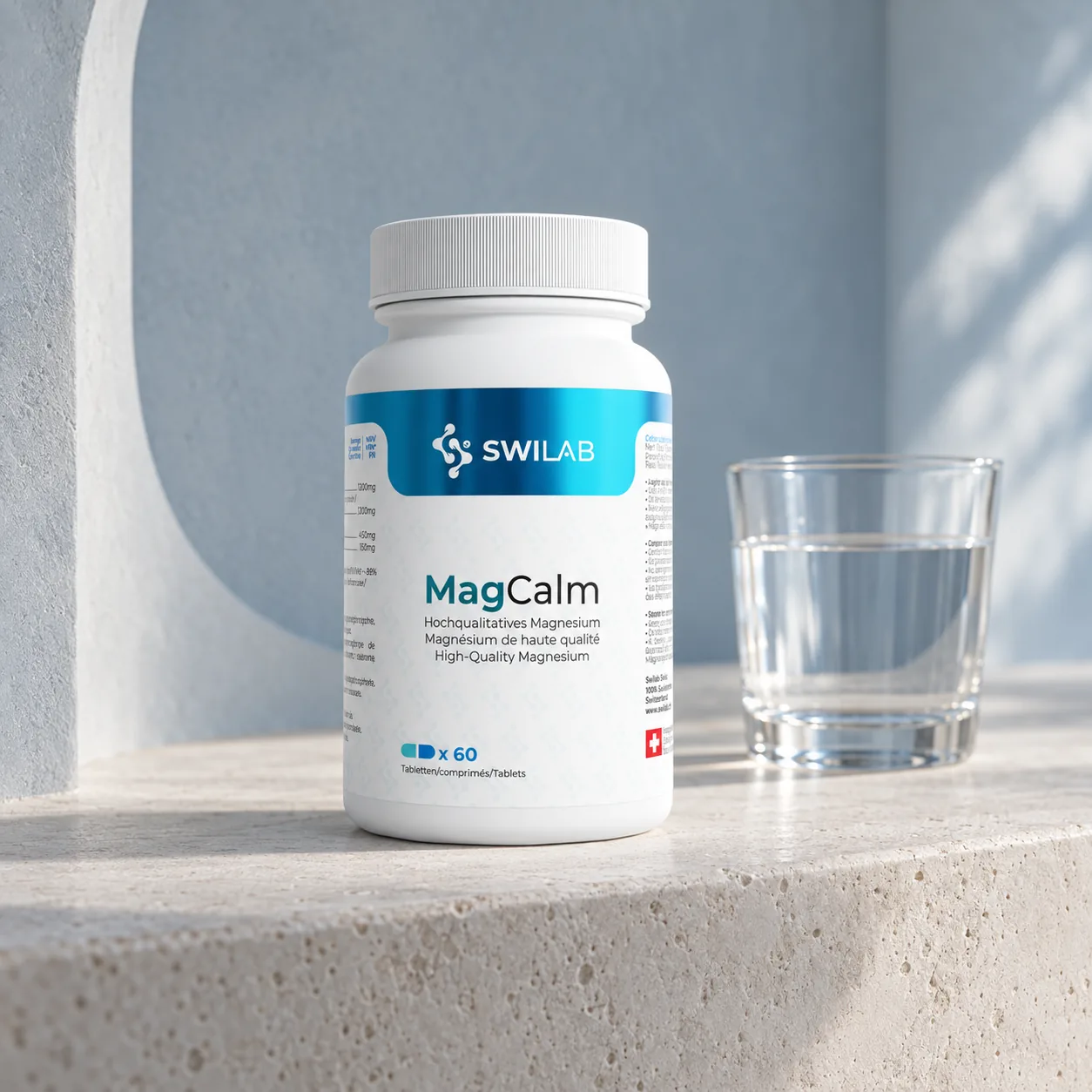
What sets us apart from a single-form standard magnesium
3Forms of magnesium plus taurine in a single tablet
| Criterion | Our formulaSwiLab | Standard magnesium |
|---|---|---|
| Forms of magnesium | Triple form: (bis)glycinate, glycerophosphate, citrate | 1 single form, often oxide |
| Elemental magnesium per dose | 330 mg · 88 % NRV | 50 to 300 mg |
| Chelated (bis)glycinate | Yes | Variable |
| Added taurine | 150 mg per dose | No |
| Digestive tolerance | Organic and chelated forms | Variable, oxide is poorly tolerated at high doses |
| Plant-based tablet, gelatine-free | Yes | Variable |
| Fine dosing | 110 mg per tablet, 1 to 3 a day | Variable |
| Made in Switzerland | Yes | No |
| Price per box of 60 tablets | CHF 27.90 | CHF 15 to 50 |
Indicative comparison based on the common product categories on the Swiss market (September 2026). The characteristics of third-party products may vary.
Five questions first establish the need. Five criteria then set the products apart, beyond the salt weight printed on the box.
A magnesium is judged on the elemental magnesium it actually delivers, not on the salt weight. To read a label and spot marketing traps: our magnesium guide.
Magnesium never comes alone: it is always bound to a salt or an amino acid. Organic forms (citrate, glycerophosphate) and chelates ((bis)glycinate) are better absorbed than oxide, the most widespread and cheapest form. (bis)glycinate also uses the dipeptide transporters, a route distinct from the classic ionic pathway.
“1,200 mg of magnesium (bis)glycinate” does not deliver 1,200 mg of magnesium: only a fraction of the salt is elemental magnesium. That is the figure to compare, expressed as a percentage of the nutrient reference values (375 mg a day). Here: 110 mg per tablet, 330 mg for three tablets, that is 88 % of the NRV.
The only common side effect of supplemental magnesium is looser stools, mostly above around 350 mg a day or with a poorly absorbed form. A 110 mg tablet lets you spread intake across the day, which improves both absorption and digestive comfort.
A tablet packs more active material than a capsule and needs no gelatine shell: it suits vegetarian and vegan diets. What remains is the list of excipients: here, a single anti-caking agent, magnesium stearate, with no gluten and no GMOs.
In Switzerland these preparations fall under the Foodstuffs Act and the food supplements ordinance, which set a maximum quantity of magnesium per daily dose. Batch-by-batch documented manufacturing makes it possible to trace every raw material.
Full days, constant demands, short nights: magnesium contributes to normal functioning of the nervous system and to normal psychological function. (bis)glycinate, combined with taurine, fits into a 4 to 8 week routine.
Magnesium contributes to the reduction of tiredness and fatigue and to normal energy-yielding metabolism. A supplement is a boost to cover intake, not a cure: tiredness that lasts calls for a blood test and medical advice.
Sweating increases mineral losses. Magnesium contributes to normal muscle function, electrolyte balance and normal protein synthesis. Citrate and glycerophosphate complement (bis)glycinate during training periods.
Magnesium contributes to normal functioning of the nervous system. Taking it in the evening, with a large glass of water, fits easily into an end-of-day ritual. It is not a sleeping pill: sleep studies show modest effects.
Needs stay high with age while intake often drops. Magnesium contributes to the maintenance of normal bones and to normal muscle function. If you are on medication or have reduced kidney function, your doctor's advice is essential.
Irregular meals, an intense pace of life, few pulses and nuts on the menu: a finely dosed supplement, 1 to 3 tablets depending on the day, fits easily into a wellness routine.
This information is descriptive and does not constitute therapeutic claims. If you are on medication, have kidney insufficiency, are pregnant or breastfeeding, or have a diagnosed condition, consult a doctor before use.
A mineral at the heart of metabolism. Magnesium takes part in over 600 enzymatic reactions: energy production, nerve transmission, muscle contraction, protein synthesis (de Baaij, 2015). With age, intake falls and absorption declines (Barbagallo, 2021).
The form makes the difference. In 46 adults followed for 60 days, organic forms were better absorbed than oxide, which did no better than a placebo (Walker, 2003). (bis)glycinate is partly absorbed intact through the dipeptide transporters, and better tolerated (Schuette, 1994).
Favourable controlled trials. 300 mg a day improved the physical performance of older women (mean age 71) in 12 weeks (Veronese, 2014) and cut the stress score of stressed adults by 42 % in 8 weeks (Pouteau, 2018). With 250 mg of magnesium (bis)glycinate, insomnia severity fell within 4 weeks (Schuster, 2025).

Updated: September 2026.
In Walker (2003), 300 mg a day as citrate or chelate was better absorbed than oxide, which was no different from placebo. (bis)glycinate is partly absorbed intact through the dipeptide route and is better tolerated (Schuette, 1994). Since absorption falls as the dose rises, spreading intakes remains the right strategy (Pardo, 2021).
In 139 women aged 71, 300 mg a day for 12 weeks improved physical performance, chair rise and walking speed, especially when intakes were insufficient (Veronese, 2014). Magnesium status is also linked to grip strength (Zhang, 2017).
In 264 stressed adults, 300 mg a day cut the stress score by 42 % in 8 weeks (Pouteau, 2018). In older adults with insomnia, 500 mg improved sleep onset and sleep efficiency (Abbasi, 2012); with 250 mg of (bis)glycinate the effect remains modest (Schuster, 2025).
EFSA has recognised since 2009 the link between magnesium intake and the maintenance of normal bones; Rondanelli (2021) reviews 28 studies on it. In older people a mild deficit often goes unnoticed (Barbagallo, 2021).
On cramps, the Cochrane review considers a benefit unlikely in adults (Garrison, 2020); on sleep, the gain in falling asleep tops out at 17 minutes with weak evidence (Mah and Pitre, 2021). The authorised claims remain those of Annex 14 of the OFI.
(bis)glycinate for absorption through the dipeptide transporters, glycerophosphate and citrate for the classic ionic route. Taurine, a sulphur-containing amino acid naturally present in the body, completes the formula.
110 mg of elemental magnesium per tablet: 3 tablets provide 330 mg, that is 88 % of the NRV, below the Swiss maximum of 375 mg per daily dose. Fine dosing, with no megadose and no unnecessary laxative effect.
Gelatine-free, with a single excipient (magnesium stearate). Development, manufacturing and controls carried out in Switzerland, batch by batch.
Benchmark: international references put an adult's daily needs at 300 to 420 mg of magnesium from all sources; the Swiss NRV is 375 mg. MagCalm provides 330 mg per 3 tablets, as a complement to your diet.

Three tablets a day: that is the maximum dose stated on the label. Taking more adds nothing, the excess being removed by the kidneys in healthy people, and brings you closer to the threshold where magnesium loosens stools. Chelated, (bis)glycinate stays gentle on the digestive system. There is therefore no point exceeding the recommended daily dose.
Ask for advice before starting if you are pregnant or breastfeeding, have kidney insufficiency or are on medical treatment, in particular with certain antibiotics or diuretics. MagCalm is formulated for adults.
Food supplements do not replace a varied and balanced diet or a healthy lifestyle: most of your magnesium should come from your plate (pulses, nuts and seeds, whole grains, green vegetables). Before regular supplementation, the advice of a healthcare professional is recommended.
In Switzerland, food supplements are regulated by the Foodstuffs Act and the food supplements ordinance. A food supplement does not replace a varied diet or medical advice, and does not prevent, treat or cure any disease. MagCalm is not a medicine.
Magnesium is an essential mineral involved in hundreds of reactions in the body. The claims authorised in Switzerland and the EU are specific: it contributes to the reduction of tiredness and fatigue, to normal energy-yielding metabolism, to the normal functioning of the nervous system and muscles, and to normal psychological function.
These are the only benefits that can be stated. MagCalm provides 330 mg of elemental magnesium per dose (88 % of the reference values), in three complementary forms.
Because the form determines what the body actually receives. In (bis)glycinate, magnesium is bound to two glycine molecules: this chelate is partly absorbed intact through the dipeptide route, unlike oxide, and is considered gentle on the stomach.
It is the right choice when your diet falls short of the 375 mg daily reference value, during periods of stress or intense training, or with age. MagCalm combines it with glycerophosphate and citrate for 330 mg of elemental magnesium per 3-tablet dose.
Not all forms deliver magnesium the same way. A 2021 systematic review concludes that organic forms, (bis)glycinate, citrate, glycerophosphate, are better absorbed than inorganic ones (oxide), with absorption also depending on the dose.
(bis)glycinate, in which magnesium is bound to an amino acid (glycine), is considered gentle on the stomach. MagCalm combines three organic forms to pair absorption with tolerability.
The recommended dose is 3 tablets a day, providing 330 mg of elemental magnesium (88 % of the reference values).
There is no need, and it is not advised, to exceed the dose: above around 350 mg of magnesium from supplements, the main effect is looser stools. Spreading intake across the day can improve digestive comfort.
All doses comply with the Swiss ordinance on food supplements (FsO, Annex 1): the maximum dose of 3 tablets stays under the legal ceiling of 375 mg of magnesium per day, and each 110 mg tablet lets you fine-tune the dose.
There is no universal time: magnesium can be taken in the morning or the evening; what matters is consistency. Many take it in the evening with dinner, out of habit; others spread it out.
Taking it with a meal improves digestive tolerance. No study shows that a specific time changes its effectiveness: choose the moment you can keep to over time.
Magnesium contributes to normal psychological function (an authorised claim). Beyond that, the evidence for an effect on anxiety remains limited: reviews suggest a possible benefit for mild anxiety, especially when magnesium status is low to begin with, but the studies are small and inconsistent.
In other words: a useful baseline support if intake is lacking, not a treatment. For persistent anxiety, consult a healthcare professional.
Caution here too. A 2021 meta-analysis (3 trials, about 150 older adults) observed falling asleep roughly 17 minutes faster, but with no significant increase in total sleep time, and with low quality of evidence.
Magnesium supports the normal functioning of the nervous system, which may aid relaxation, but it is not a sleeping pill. An effect is more likely if your intake is insufficient to begin with.
This is the most stubborn misconception. A Cochrane review concludes that magnesium supplementation is unlikely to prevent muscle cramps in a clinically useful way in adults, particularly older adults; in pregnant women the data are contradictory.
Magnesium contributes to normal muscle function, but it is not a treatment for cramps. It remains worthwhile if your intake is lacking: not as a universal anti-cramp remedy.
From food, there is no risk of overdose in healthy people (the kidneys remove the excess). For supplements, the only common effect is digestive: looser stools when the dose is too high or the form poorly absorbed.
That is why the safety limit for supplemental magnesium is set at 350 mg per day. Well-absorbed organic forms, like those in MagCalm, are generally better tolerated.
Mostly practical ones. The chelate is heavy for little magnesium: you need three tablets for 330 mg where an oxide fits in one, and the price per tablet is higher than for inorganic forms.
Like any magnesium, exceeding the dose can loosen stools, and it adds nothing for people whose intake is already sufficient. Finally, it replaces neither a balanced diet nor a treatment: with kidney disease or medication, seek advice before starting.
There is no single timeframe: it depends mainly on your starting status. If intake is insufficient, regular daily use rebuilds reserves over a few weeks.
For fatigue or nervous tension, some feel better within one to two weeks, others later. Magnesium is a baseline support: consistency matters more than speed.
Magnesium needs rise during pregnancy, but self-medication is not recommended: supplements should be assessed case by case. On pregnancy cramps, the data are moreover contradictory.
If you are pregnant or breastfeeding, ask your doctor or midwife before taking MagCalm.
Sensitive stomach: organic forms, (bis)glycinate, glycerophosphate, are gentler than oxide; taking the tablets with a meal and spreading the dose helps further. Children: MagCalm is formulated for adults, not for children without medical advice.
Medication: magnesium can interact with certain medicines (for example some antibiotics, which should be spaced apart). If you are on treatment or have kidney disease, seek professional advice before use.

“This magnesium is of exceptional quality. I feel the difference after just a few days.”
Thomas · customer review
“Very high quality, I think it is the most effective magnesium I have tried so far.”
Christine · customer review
“I have been taking MagCalm for two weeks and I feel a real difference. I am less stressed and my mood has improved. I recommend it 100 %!”
Léa Zimmermann · customer review
“I feel calmer since I started taking MagCalm. But you need to wait a few days for it to take effect.”
Chloé Meier · customer review
60 plant-based tablets, 1 to 3 tablets a day depending on your needs. Shipped from Switzerland within 24 hours, free delivery from CHF 99.– and tracked shipping. Our team remains at your disposal before and after your purchase.