
Everything the science establishes about whey: from production to practical use, with a comparison table of the forms and honest dosage guidance.
Summarykey takeaway
A complete whey protein, rich in leucine and quickly absorbed. It helps you reach a sufficient daily protein intake: the truly decisive lever for the growth and maintenance of muscle mass; the timing of the serving matters less than this total. A quality whey protein is chosen according to lactose tolerance (concentrate, isolate or hydrolysate), your goal and purity.
Whey, or whey protein, is a by-product of cheese production. When cow’s milk coagulates, it separates into two parts: the curd, which becomes cheese, and the whey: a liquid fraction rich in proteins of high biological value. It is this fraction, purified and then dried, that yields whey protein powder: a complete protein, quickly absorbed and particularly rich in leucine, valued as a convenient source of protein.
During cheese production, cow’s milk separates into curd (solid) and whey (liquid). The whey concentrates the soluble milk proteins, including beta-lactoglobulin, alpha-lactalbumin and serum albumin.
Ultrafiltration or microfiltration removes part of the fat and lactose, concentrating the proteins. The more thorough the filtration, the higher the protein content.
The liquid concentrate is sprayed into hot air and turned into a fine, soluble powder, while preserving the quality of the proteins.
Flavours, any sweeteners and texturing agents are added before packaging. The powder is then ready to mix into water or milk.
Depending on how fine the filtration is, you obtain three main forms of whey protein powder, which differ chiefly in their protein content and their amount of residual lactose.6 Whey protein concentrate keeps a little fat and lactose; whey protein isolate (WPI) is filtered further to exceed 90% protein; and hydrolysed whey is partially hydrolysed, or pre-digested, for faster uptake. All three remain complete proteins and rank among the most studied protein sources.
| Form of whey | Protein content | Lactose / fat | Relative price | Typical use |
|---|---|---|---|---|
| Concentrate | 70-80% | Small residual amount | € | Versatile, good value for money, pleasant taste |
| Isolate | > 90% | Very low | €€ | Lactose sensitivity, cutting, seeking purity |
| Hydrolysate | > 90% (pre-digested) | Very low | €€€ | Very fast absorption; modest additional benefit |
Milk provides two families of protein: whey, quickly digested, and casein, which forms a gel in the stomach and releases slowly. For an equal amount of amino acids, whey raises blood leucine more and faster and more strongly stimulates muscle protein synthesis just after a serving; casein, for its part, supports a prolonged supply, which makes it a useful option before bed.3 Neither is “better” in absolute terms: they suit different moments.
From milk to powder, every processing step matters. Whether you reach for a whey protein concentrate, a whey protein isolate or hydrolysed whey, you are choosing between whey protein powders that share the same milk origin but differ in refining. We detail the process and the differences between forms in our dedicated article on how whey works and how it is made.
Whey is a high-quality source of protein, prized by athletes and fitness enthusiasts alike. Under the European framework of authorised claims, protein contributes to the growth and maintenance of muscle mass as well as to the maintenance of normal bones.7 Here are the documented health benefits of whey: each with its level of evidence.
Combined with resistance and strength training, protein supplementation meaningfully increases gains in lean muscle and muscle strength. A broad synthesis of the available trials confirms this effect on muscle growth, with a plateau beyond about 1.6 g of protein per kg per day.1 The benefit holds when paired with strength training; on its own, whey does not build muscle. This remains the best-established claim for protein.7
Rich in leucine and quickly absorbed, whey supports muscle protein synthesis and muscle recovery after exercise and makes it easier to meet daily protein needs, helping to repair the fibres that have been worked. Over time, this supports muscle growth and a favourable body composition when energy intake is matched to your goal.2,3
Protein increases the feeling of fullness in the short term and helps preserve lean body mass during a calorie-restricted diet.5 Replacing a sugary snack with a shake can support the control of calorie intake: without being a slimming product. Weight loss depends on the overall energy deficit.
Whey contains immunoglobulins and lactoferrin, fractions studied for their biological role. As the data remain limited and inconsistent, this benefit should not be presented as an established health claim: it is better seen as a promising avenue.
Muscle growth, muscle recovery, satiety, immunity: each effect rests on its own level of evidence, and the gains in muscle strength remain tied to consistent strength training rather than to the powder alone. We review them, study by study, in our overview of the benefits of whey that are genuinely supported.
Whey fits into several moments of the day, whether as a pre-workout top-up or a post-workout serving. Essential reminder: the timing of the serving influences results less than your total protein intake over 24 hours: reaching your daily target matters more than any single slot.2 The table below places each slot according to its practical relevance.
Depending on whether you train in the morning or the evening, fasted or not, the ideal slot varies. We take stock of the best time to take whey.
Faced with the range of products, a few simple criteria help you narrow things down. The key: match the form and purity to your digestive tolerance, your goal (muscle gain, cutting or simple maintenance) and your budget.
Concentrate for versatile, economical use; isolate if you tolerate lactose poorly or are seeking purity; hydrolysate for very fast absorption.
Check the amount of protein per serving on the label and the ingredient list. Be wary of powders heavily loaded with sugars, flavourings or bulking agents.
Milk from grass-fed cows is valued for its traceability and profile. The nutritional advantage remains modest, but transparency of origin is a good marker of seriousness.
A pleasant flavour, vanilla, chocolate or a neutral version, encourages consistency. For sensitive stomachs, a plain formula (few sweeteners) is often better tolerated.
Whey is not designed for children: their protein needs are normally met through food. If there is any doubt about the growth or needs of an active child, the advice of a paediatrician or dietitian takes precedence over any supplementation.
One last useful marker: whey is not a gainer. A “mass gainer” (or weight gainer) is far richer in carbohydrates and designed for weight gain, whereas a good whey protein powder is low in fats and carbohydrates and concentrates dietary protein above all: a lean source of protein rather than an energy-dense one.
Cross-referencing the form, the origin and your goal takes a little method. We detail this step by step to help you select the whey suited to your profile.

Whey has no ‘magic’ edge: its strength comes down to two concrete things: it digests fast and it is very rich in leucine, the amino acid that triggers muscle building.
A landmark study compared, after a resistance workout, three proteins delivering the same amount of essential amino acids: whey, casein and soy. The faster whey raised blood leucine more and stimulated muscle protein synthesis almost twice as much as casein (and more than soy).³ Leucine acts here like a switch: above a certain threshold, it turns muscle building on.
But the key is not perfect timing: a large analysis pooling 49 trials showed that what matters most is total daily protein intake: the muscle benefit plateauing around 1.6 g per kilogram of body weight per day.¹ In other words, whey is not a potion to drink within 30 minutes: it is a convenient, fast and leucine-rich way to reach your daily total effortlessly.
Whey is valuable for what it is: a complete, quickly absorbed and leucine-rich protein, ideal around training as well as at breakfast to top up intake. Aim first at your total daily protein; whey helps you get there effortlessly. Protein contributes to the growth and maintenance of muscle mass: whey is a convenient, high-quality source.
A cornerstone of sports nutrition, whey is simple to use: a serving of 20 to 30 g (about 0.25 to 0.4 g per kg of body weight) covers the needs of one serving and provides enough leucine to stimulate muscle synthesis.2 Beyond that, the shaker is just one option among many.
Mix 20 to 30 g into 200 to 300 ml of water. Fast absorption, minimal calorie intake: ideal around training.
Milk adds casein and extra calories, for a more substantial shake and a slightly slower release.
Enough for most adults. No need to stack servings: it is the spread-out daily total that counts.
The powder blends into yoghurt, oats or a smoothie to enrich a snack with protein.
Whey is not limited to the shaker. You can fold it into protein pancakes, muffins or porridge, add it to a warm coffee (“proffee”) or a fruit smoothie, or even use it in home baking to raise the protein content of a recipe. For a vegetarian diet, whey is perfectly suitable since it is derived from milk: a useful point for anyone limiting meat while still consuming dairy products.
Servings, recipes, fitting it into meals: we give concrete examples and proportions in our guide on ways to consume whey day to day.
In healthy people, whey is well tolerated and considered safe at usual doses.6 The drawbacks, when they occur, are mainly digestive and linked to lactose or to excess.
Whey concentrate contains a little lactose; in intolerant people, it can cause bloating, gas or intestinal discomfort. The solution is simple: opt for an isolate, almost free of lactose, which is generally well tolerated.
An intake far above your needs brings no additional muscle benefit: beyond about 1.6 g/kg/day, the gains linked to supplementation plateau.1 Excess mainly translates into digestive discomfort and surplus calories. It is better to match your intake to your actual needs.
Whey comes from milk: it is contraindicated in cases of cow’s milk protein allergy (distinct from lactose intolerance), which can trigger genuine allergic reactions. A plant-based alternative is then indicated.
Whey is not dangerous in itself, but as needs are specific during this period, ask your doctor or midwife for advice before adding a supplement.
If kidney failure is known, protein intake must be adjusted and medically monitored. Do not supplement without professional advice.
No major interaction is known at dietary doses. In the case of chronic treatment or any doubt, medical advice remains recommended.
Intolerance, allergy, pregnancy, medical conditions: each of these profiles calls for specific precautions, which we detail case by case on our page about side effects and the profiles to watch. For any particular situation, consult a healthcare professional.
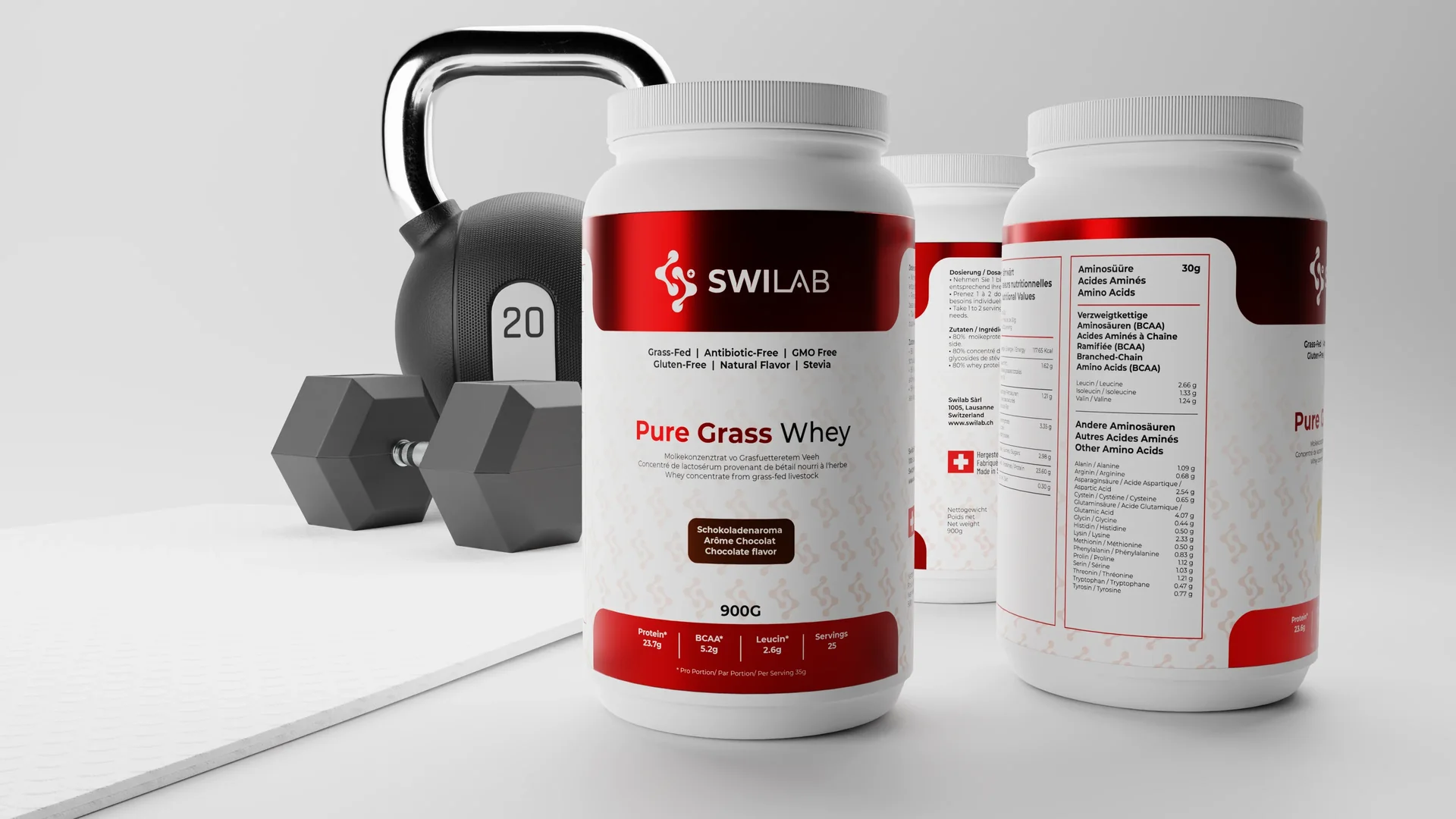
Pure Grass Whey is a whey protein made from grass-fed cows’ milk, rich in leucine and designed to fit simply into your daily protein intake. Traced milk origin, a plain ingredient list and a taste designed for consistency.
⚠️ Food supplement. It does not replace a varied and balanced diet or a healthy lifestyle. In the case of milk protein allergy or kidney disease, seek the advice of a healthcare professional.
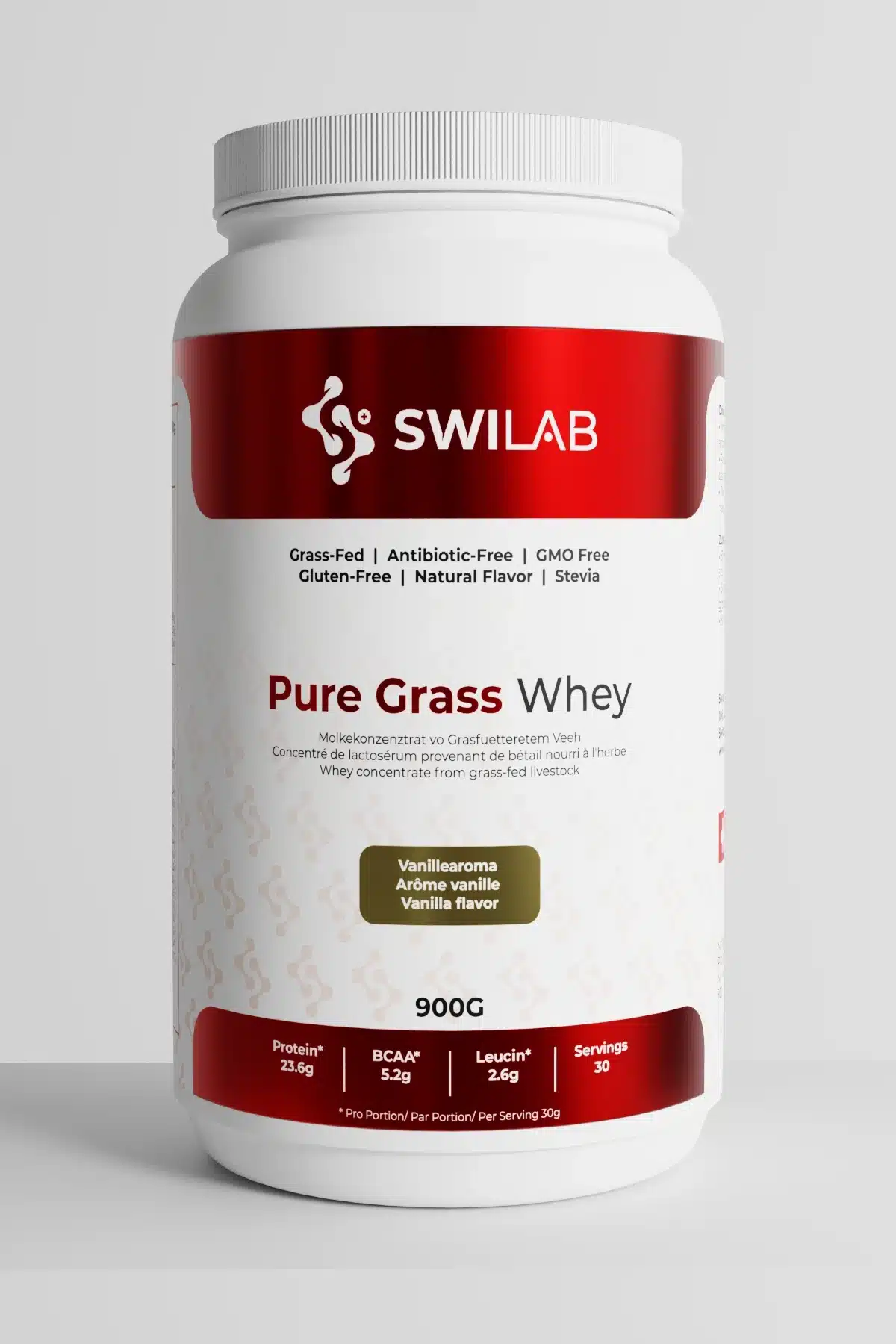
Mix 20 to 30 g of powder into 200 to 300 ml of water or milk, then shake. Whey can be taken at any time of day: after training, at breakfast or as a snack. It is your total protein intake across the day that matters most for muscle mass, more than the precise timing of the serving. Whey is a complete, quickly absorbed protein, rich in leucine.
Protein increases satiety and helps preserve muscle mass during a calorie-restricted diet: replacing a sugary snack with a whey shake can make it easier to control calorie intake. Whey is not, however, a slimming product; weight loss depends above all on an overall energy deficit and regular physical activity.
In healthy people, whey is well tolerated and a high protein intake does not impair kidney function. Excessive consumption may cause bloating or digestive discomfort, especially in cases of lactose intolerance; an isolate, low in lactose, is then better tolerated. People allergic to milk protein should avoid it, and those with pre-existing kidney disease should consult a healthcare professional before taking any supplement.
There are three main forms. Whey concentrate contains 70 to 80% protein with a little lactose and fat, offering good value for money. Isolate exceeds 90% protein with very little lactose. Hydrolysate is partially pre-digested for very fast absorption. All three are complete proteins; the choice depends on lactose tolerance, budget and goals.
Yes: whey is derived from milk, so it suits vegetarians who consume dairy products, but not vegans. For a fully plant-based diet, pea, rice or soy proteins are alternatives; at an equivalent intake, a plant protein well dosed in leucine supports comparable gains in mass and strength.
No, it isn’t essential. The ‘anabolic window’ is much wider than often claimed: a large analysis of 49 trials showed that total daily protein intake matters more than the exact timing. Take whey whenever it suits you, around training, at breakfast, to top up your intake easily.
Because it digests fast and is very rich in leucine, the amino acid that triggers muscle protein synthesis. A landmark study showed that, at an equal amount of essential amino acids, whey stimulates muscle building almost twice as much as casein. A convenient, high-quality protein source to reach your daily total.