

Made in Swiss
Full traceability
QualitySecure payment
Twint, Visa, Mastercard, PostFinance
3-D SecureSwiss Post 24-48 h
Fast dispatch
FastResponsive support
Clear answers
HelpProbiotics are live micro-organisms, most often lactic-acid bacteria and bifidobacteria, natural inhabitants of the digestive tract, which complement the gut flora when taken in adequate amounts. The FAO and WHO define them by their benefit to the host organism; as no health claim is authorised in Switzerland for probiotics, this page describes the basics of gut health, without promises.
They are commonly called “good bacteria”: lactic acid bacteria and bifidobacteria that have their place throughout the digestive tract, from the oral flora to the colon.
In practice, a probiotic supplies live bacteria that pass through the gut and interact with the resident microbiome without settling there permanently: hence the value of regular intake.
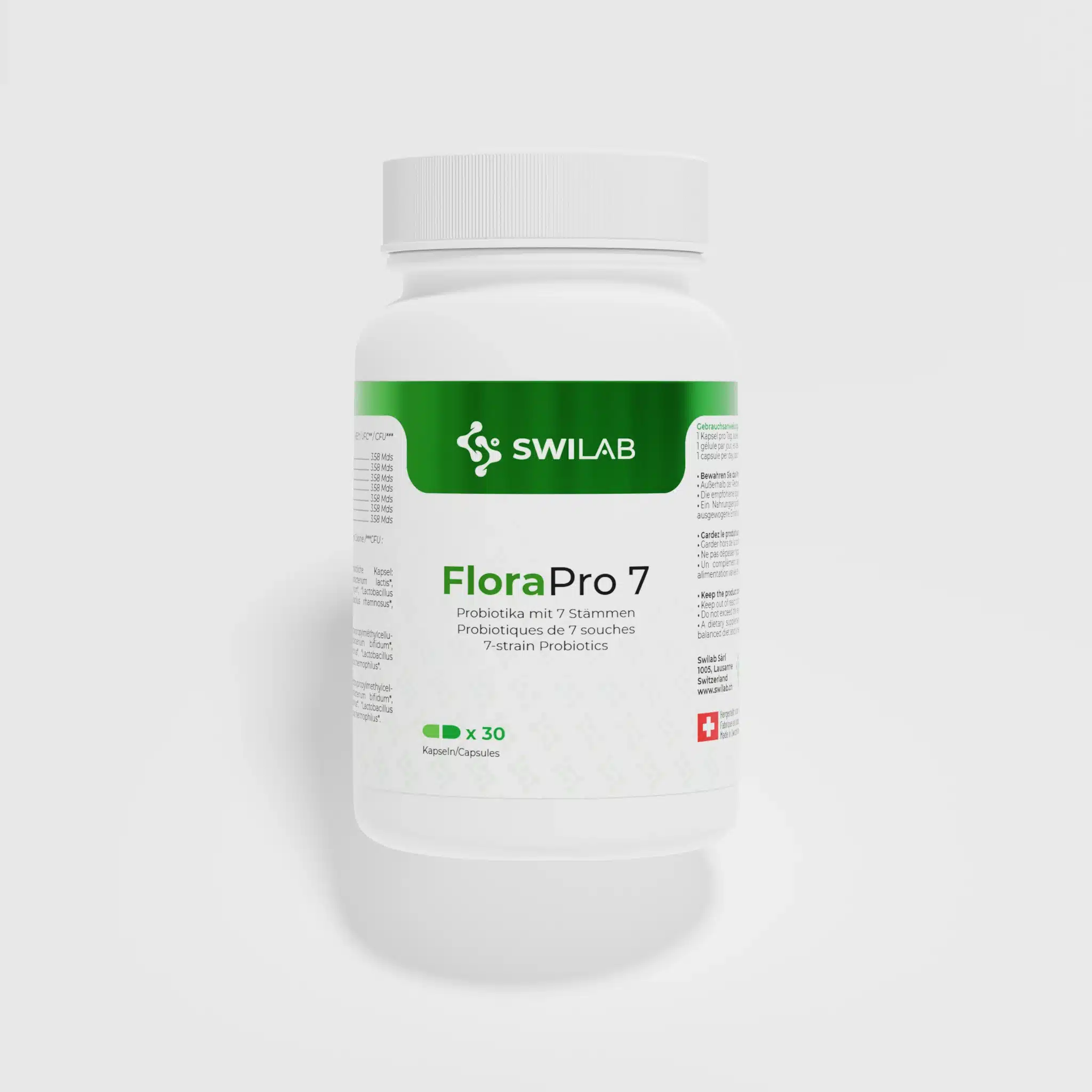
FloraPro 7 brings together 7 documented strains, selected for the gut flora and dosed at 25 billion CFU per gastro-resistant capsule. The points below describe the product's composition and design: in Switzerland no health claims are authorised for probiotics, so we make none.

Who is this formula for? The “For whom?” tab describes typical use situations.
What sets FloraPro 7 apart from standard probiotics
7Strains in a single capsule
| Criterion | Our formulaSwiLab | Standard probiotics |
|---|---|---|
| CFU per capsule | 25 billion | 1 to 15 billion |
| Number of strains | 7 | 1 to 5 |
| Strains listed on the label | Yes | Partial |
| Gastro-resistant capsule | Yes | Varies |
| Viability guaranteed until expiry | Yes | No |
| Plant-based HPMC capsule | Yes | Varies |
| FSVO-compliant | Yes | Varies |
| Swiss manufacture | Yes | No |
| Price per capsule | CHF 1.08 | CHF 0.30 to 2.00 |
Indicative comparison based on common product categories on the Swiss market (March 2026). Third-party product characteristics may vary. FloraPro 7 is a food supplement.
That leaves choosing with full knowledge: the “How to choose?” tab asks five questions before comparing formulas.
Five points genuinely set two products apart, beyond the billions printed on the box.
A probiotic is judged by its strain, its CFU and its capsule, not by the number of billions on the box. Reading a label and spotting marketing traps: our probiotics guide.
A serious product names every strain on the label, with its CFU count. Research shows that the effects studied are strain- and situation-specific: two products carrying the same species can behave differently. That transparency is what sets quality probiotic products apart.
CFU stands for “colony-forming units”, the number of live bacteria per dose. The figure that matters is the one guaranteed at the expiry date, not the one measured at manufacture: strain viability declines over time.
Stomach acid can destroy some of the bacteria before they reach the intestine. A gastro-resistant capsule delays release until the intestine: in the laboratory, a suitable coating preserved about 95% of viable cells. This is also what sets the gastro-resistant capsule apart from powdered probiotics, exposed from the stomach onwards.
Combining several strains is not automatically more effective: the right choice is matching documented strains to a clear goal. A balanced multi-strain formula covers several complementary families in a single capsule.
In Switzerland these products fall under the LFoodA and the NFS Ordinance, overseen by the FSVO: verifiable labelling, safety, traceability. Batch-by-batch documented manufacturing makes it possible to trace every strain.
Antibiotics alter the composition of the microbiome. A course can be started simultaneously, spacing doses 2-3 hours apart. After a course of antibiotics, the composition of the microbiota generally takes several weeks to return to its previous state (Palleja et al., 2018).
Bloating, irregular digestion, sensitive stomach. Multi-strain support may contribute to better daily regularity.
A large proportion of immune cells reside in the gut. A diverse microbiome is associated with this in the scientific literature.
A change in diet and environment can put strain on digestion. Starting 5 days before departure is generally recommended.
Microbiome diversity changes with age. Regular courses can be integrated into a wellness routine.
Stress, irregular diet, busy daily life. Regular intake can be part of a daily wellness strategy.
This information is descriptive in nature and does not constitute a health claim in the sense of the FSVO and the Swiss NFS Ordinance. In case of diagnosed conditions, medication, pregnancy, breastfeeding or immunosuppression, consult a doctor before use. If in doubt, consulting a healthcare professional remains the right move.
Why this probiotic rather than another? The “Why?” tab compares it point by point with standard products.
A recognised definition. The international consensus (Hill et al., 2014), supported by the ISAPP, defines probiotics as live micro-organisms administered in adequate amounts; the human being is the host that harbours them.
Every strain is unique. Published studies cover precise strains at a given dose; two products of the same species can behave differently (Sniffen et al., 2018). That is why FloraPro 7 names each strain with its CFU count.
Arriving alive. A gastro-resistant coating remained intact in simulated gastric fluid, with around 95 % viable cells (Fredua-Agyeman, 2024). The strains then remain passing guests, hence the value of a daily intake.

Updated: September 2026.
The international scientific consensus (Hill et al., 2014) defines probiotics as live micro-organisms taken in adequate amounts. They complement the gut flora, also known as the microbiome: a community of several hundred bacterial species, different in every person, settled mainly in the colon. This consensus is carried by the International Scientific Association for Probiotics and Prebiotics (ISAPP). Practice guidelines from the World Gastroenterology Organisation follow the same strain-based logic.
Research stresses that every strain is unique: published studies always concern precise strains at a given dose, and two products carrying the same species can behave differently (Sniffen et al., 2018). That is why FloraPro 7 names each of its 7 strains on the label, with its CFU count. The works cited rely on randomised placebo-controlled trials and systematic reviews. Many of them are randomized double-blind studies and meta-analyses.
Passing the stomach is the critical step: its acidity can destroy a large share of the bacteria before the intestine. Laboratory work showed that a gastro-resistant coating stayed intact in simulated gastric fluid, with about 95% of viable cells preserved (Fredua-Agyeman, 2024). The strains then remain passing guests: their presence is transient, hence the value of regular daily intake. The tolerability of probiotic supplementation is documented too: across randomized controlled trials, healthy adults tolerated the strains well.
A large share of immune cells sits in the gut wall, and the gut and the brain communicate through nerves, hormones and chemical messengers (the gut-brain axis). Both fields are under active research; for probiotics, no health claim is authorised to date. The microbiome's role in the body goes beyond digestion: it interacts with the immune system and the nervous system. The benefits often attributed to probiotics are, however, not covered by any authorised claim in Switzerland.
The human gut is home to nearly 40,000 billion micro-organisms (Sender et al., 2016): bacteria and yeasts that live together, feed and interact like a true gut ecosystem. Most of them live in the colon, and their composition is unique to each person, like a fingerprint. The human gut microbiome is one of the densest ecosystems in the living world: these micro-organisms line the intestinal mucosa, in direct contact with the digestive wall.
This ecosystem builds up from birth and then evolves throughout life, shaped by diet, age, stress, travel or antibiotic treatments. The scientific literature links microbial diversity to the stability of the whole: the more varied the community, the better it withstands disturbances (Lozupone et al., 2012).
Talking about balance therefore means describing this diversity and this stability. A probiotic supplement like FloraPro 7 fits into that logic: every day it delivers documented live strains that come to enrich the existing ecosystem, without claiming to replace it.

The gut flora is the other name of the gut microbiome: all the micro-organisms settled along the digestive tract. Lactic-acid ferments (Lactobacillus) and bifidobacteria (Bifidobacterium) are part of it; these are precisely the families FloraPro 7 brings together, alongside Streptococcus thermophilus. Lactic acid bacteria owe their name to the lactic acid they produce; older texts also call this community the gut microflora.
Studies show it: ingested strains remain passing guests. They transit, interact with the resident bacteria, then fade a few days after intake stops (Derrien and van Hylckama Vlieg, 2015; Zmora et al., 2018). It is this transient character that calls for regular daily intake, as a course over several weeks.
The strains still need to arrive alive: stomach acid can destroy a large share of them. FloraPro 7's plant-based gastro-resistant capsule delays release until the intestine, where these micro-organisms settle.

The microbiome does not live on capsules: it feeds first on fibre. The prebiotic fibres of legumes, vegetables, fruit and whole grains serve as substrate for gut bacteria (Gibson et al., 2017), while fermented foods (yogurt, kefir, sauerkraut) naturally provide live ferments (Marco et al., 2021). Kimchi and kombucha are further examples, born of the same fermentation process with its lactic-acid production. Miso, tempeh and lacto-fermented pickles are further examples that people eat around the world. On the nutrition side, fibre supports the growth of gut bacteria and the nutrients in food remain the foundation: fermented foods are allies of the microbiome, not a substitute. A varied, fibre-rich diet therefore remains the basis for digestion: probiotic bacteria need these prebiotics to feed and maintain themselves in the gut.
Prebiotics are non-digestible substances, such as inulin or oligofructose, that serve as food for beneficial gut bacteria. Dairy products such as yoghurt and kefir (fermented from milk) or certain cheeses provide lactic acid bacteria, but with no strain or CFU stated; on probiotic preparations in capsule or powder form, both appear on the label.
A probiotic supplement adds to this dietary foundation without replacing it: it guarantees a precise daily intake, with identified strains in a known amount, which the plate cannot measure. A product combining probiotics and prebiotic fibres is known as a synbiotic; FloraPro 7 contains probiotic strains only.
FloraPro 7's synergy lies in its construction: 3 complementary families brought together in a single capsule, each strain dosed in equal parts (3.57 billion CFU). A balanced formula rather than one dominated by a single species, designed to mirror the diversity of the microbiome itself.

General, descriptive information about the microbiome and diet, with no health claim in the sense of the FSVO and the Swiss NFS Ordinance. A food supplement is not a substitute for a varied, balanced diet or a healthy lifestyle. Everyday balance rests first on diet and lifestyle habits.
Without adequate protection, up to 90% of probiotic bacteria do not survive the gastric passage. Here is how every FloraPro 7 capsule is designed.
7 strains cultivated under controlled conditions, purity and identity batch-verified.
Strains enter a dormant state, viability is preserved at room temperature until the expiry date.
The gastro-resistant plant-based capsule withstands stomach acid (pH below 2).
In the small intestine the strains are reactivated and integrate into the gut microbiome.
Descriptive information about product design. A food supplement is not a substitute for medical treatment or for a varied, balanced diet. The Composition tab details the 7 strains and their CFU.

One capsule a day is enough. Consistency, day after day, counts more than the exact hour: many people alternate courses of 1 to 3 months, repeated several times a year. Good to know: freeze-drying lets the capsules travel without a cold chain, and the shell protects the strains through the gastrointestinal tract.
Seek medical advice before starting in case of immunodeficiency, immunosuppressive treatment, pregnancy, breastfeeding or a diagnosed condition. This product is not intended for children without medical advice. In infants, only a specialist (paediatrician) can judge whether a probiotic is appropriate: without that advice, the risk is choosing an unsuitable strain or dose. Keep out of reach of children. If in doubt, consult a healthcare professional.
Finally, the Quality tab describes manufacturing and the regulatory framework.
In Switzerland, probiotics are regulated as food supplements under the LFoodA and the NFS Ordinance, overseen by the FSVO. FloraPro 7 is not a medicinal product: it does not prevent, treat or cure any disease. The frequently asked questions below cover the points that come up most often.
“Swiss” is not in itself a guarantee of efficacy, but a framework of quality and control: a supplement based on lactic-acid ferments falls under the Foodstuffs Act and the oversight of the FSVO: verifiable labelling, safety, traceability.
What matters most is what the label says: named strains, a guaranteed amount, documented manufacturing. FloraPro 7 is made in Switzerland under these rules, with 7 identified strains and 25 billion CFU per capsule.
CFU stands for “colony-forming units”: the number of live bacteria per dose. There is no universal threshold: the international scientific consensus defines probiotics by an adequate amount of live micro-organisms, with no fixed figure: the useful dose depends on the strain and the goal.
In clinical trials the range often runs from a few billion to several tens of billions of CFU per day. FloraPro 7 provides 25 billion CFU per capsule, guaranteed until the expiry date.
A single-strain product contains one species; a multi-strain product combines several. Contrary to a common belief, combining several strains is not automatically more effective: research shows that probiotic effects are strain- and situation-specific.
A key 2018 review stresses that the right approach is matching documented strains to a clear goal, not piling up species. FloraPro 7 brings together 7 identified strains of lactic-acid ferments (Lactobacillus and Bifidobacterium).
Because stomach acid can destroy some of the bacteria before they reach the intestine. A gastro-resistant capsule delays release until the intestine.
In the laboratory, 2024 work showed that gastro-resistant coated capsules stayed intact in simulated gastric fluid and released their contents in simulated intestinal fluid, with about 95% of viable cells preserved after coating. FloraPro 7 uses gastro-resistant plant-based HPMC capsules.
The dose is 1 capsule a day, at a regular time, with a glass of cool or lukewarm water (never a hot drink).
Taking it with or just before a meal helps, because food buffers stomach acid; the gastro-resistant capsule already protects the strains, though, so timing matters less. Consistency, day after day, counts more than the exact hour.
In healthy adults, probiotics are generally well tolerated. Mild digestive discomfort (bloating, gas) is possible in the first few days while the body adjusts, and usually settles.
Summaries of clinical trials have reported no serious adverse effects linked to intake. As a precaution, medical advice is recommended in case of immunodeficiency, immunosuppressive treatment, pregnancy, breastfeeding or illness; the product is not intended for children without medical advice.
The rare invasive infections described in the literature concern immunocompromised or hospitalised patients; cases of fungaemia have been reported with probiotic yeasts (Saccharomyces cerevisiae), a family absent from FloraPro 7, which contains only lactic acid bacteria and bifidobacteria. In case of fever, use is not advised without medical advice.
The caution of some professionals is aimed less at probiotics themselves than at the heterogeneity of the market. Research reminds us that many products lack solid clinical trials, that effectiveness depends on the strain and the indication, and that not all products are equal.
Hence the importance of named strains, a guaranteed dose and controlled manufacturing. A 2018 review indeed concludes that the choice should be guided by strain-specific evidence.
There are no universal probiotics: the right choice depends on your goal. The quality criteria are agreed upon: precisely named strains, a CFU dose guaranteed until expiry (not just at manufacturing), gastric protection, transparent labelling and controlled manufacturing.
FloraPro 7 meets these criteria: 7 documented strains, 25 billion CFU per capsule, gastro-resistant HPMC capsule, Swiss manufacturing under the FSVO framework.
There is no universal timeframe, and how it feels varies from person to person. Probiotics act mainly while you take them: they do not settle permanently in the gut, their presence is transient.
That is why consistency matters: a daily intake continued over several weeks. FloraPro 7 is designed for a course of at least 4 weeks, one capsule a day.
A cold chain is not required for purchase or transport: FloraPro 7 keeps at room temperature, below 25 °C, dry and away from light.
After opening, storing it in the fridge is recommended: laboratory work shows that a low temperature (around 4 °C) better preserves the strains’ viability over several months. Avoid warm or damp places such as the bathroom.
Yes, in healthy adults. Daily intake of a supplement based on lactic-acid ferments is common and well tolerated; summaries of clinical trials have reported no serious adverse effects, including with prolonged use.
Many people alternate courses of 1 to 3 months, repeated several times a year, rather than continuous year-round intake: both are possible. In case of treatment, pregnancy, breastfeeding or immunodeficiency, seek medical advice.
Probiotics are live microorganisms consumed in sufficient amounts: that is how the 2014 international scientific consensus describes them. Most are lactic acid bacteria: lactobacilli and bifidobacteria. Well-known examples from the literature are Lactobacillus casei, Lactobacillus rhamnosus or the yeast Saccharomyces boulardii: the strains a preparation actually contains are always stated on the label. Two points matter. First, such preparations are food supplements, not medicines: they are not intended to treat any disease. Second, there is no collective effect of “probiotics”: studies indicate that strains differ markedly from one another; what counts is the individual named bacterial strains, not the category. FloraPro 7 names its 7 strains one by one, each with its amount.
One letter, two different things. Probiotics are live bacteria. Prebiotics are not living organisms but non-digestible fibres: they are not absorbed in the small intestine, they reach the colon and serve there as food for the gut bacteria already present, which ferment them and produce certain vitamins along the way. The best-known prebiotics include inulin (from chicory or Jerusalem artichoke), fructo-oligosaccharides and resistant starch: found in foods such as onions, leeks, oats or cooled potatoes. A preparation combining both is called a synbiotic. The composition of the gut flora is, incidentally, different in every person. FloraPro 7 contains probiotics only: 7 strains, with no added fibre.
Fermented foods contain live bacterial cultures: yoghurt, kefir, sauerkraut, kimchi, miso or raw-milk cheeses. They belong to a varied diet, and the “good bacteria” of the human gut have long been a subject of research. Fermented foods are not, however, automatically probiotics in the strict sense. The scientific consensus requires named strains in a known amount guaranteed until consumption: information missing from a pot of yoghurt and which varies widely with batch, storage and production. Canned sauerkraut is also pasteurised: its cultures are no longer alive. A preparation with specific bacterial cultures and a documented amount is therefore something different from a food: neither replaces the other.
“No more bloating, flawless digestion. I am very satisfied”
Mélanie Z. · customer review
“Very helpful after a course of antibiotics, my transit went back to normal”
Emma F. · customer review
“Good product, the results can be felt quickly. I recommend it.”
Marc A. · customer review
“By far the best probiotics I have tried”
Maya R. · customer review
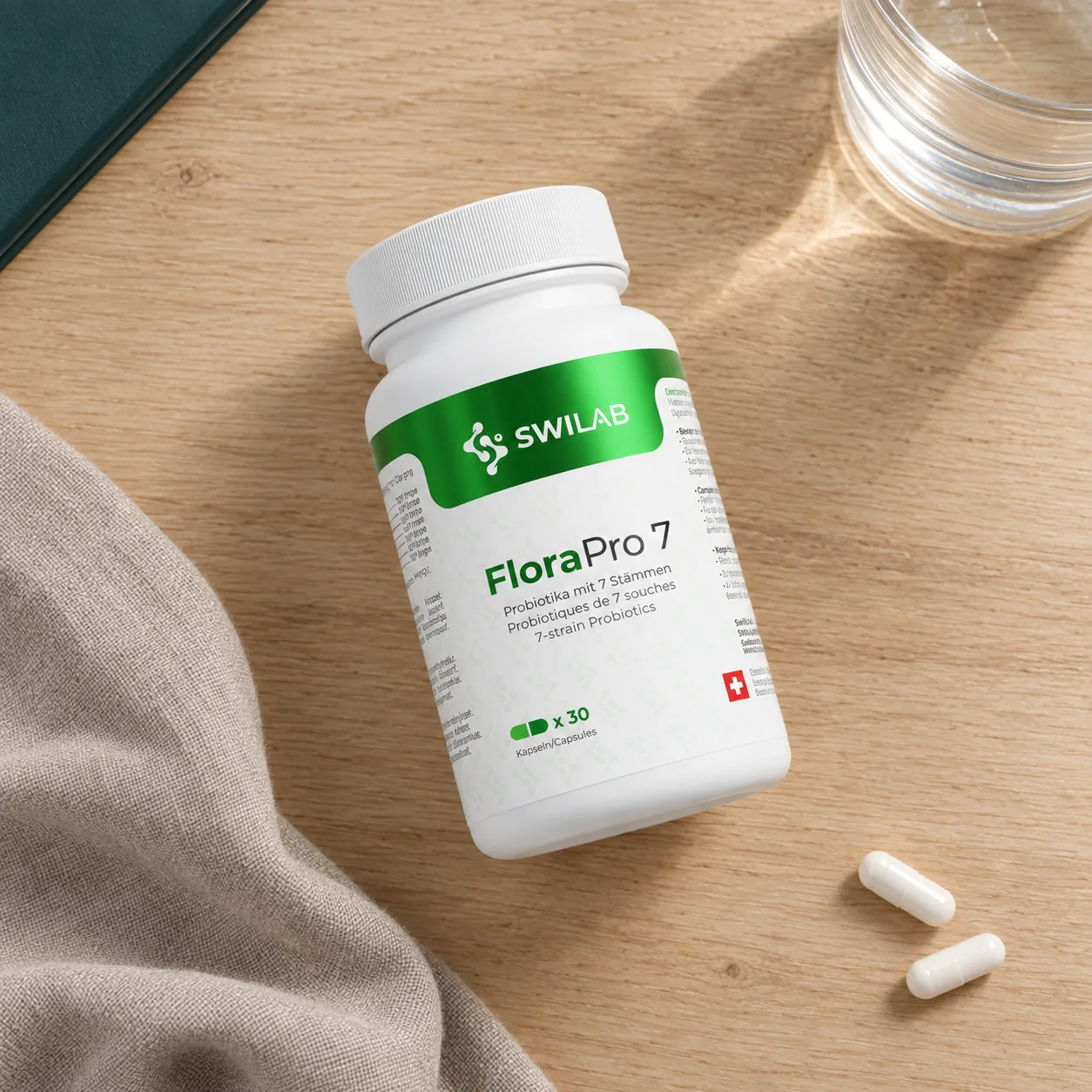
30 plant-based gastro-resistant capsules, about a month's course at one capsule a day. Shipped from Switzerland within 24 hours, free delivery from CHF 99.–