
Made in Switzerland
Traceability
OriginSecure payment
Twint, Visa, Mastercard, PostFinance
3-D SecureSwiss Post 24-48 h
Fast dispatch
FastResponsive support
Clear answers
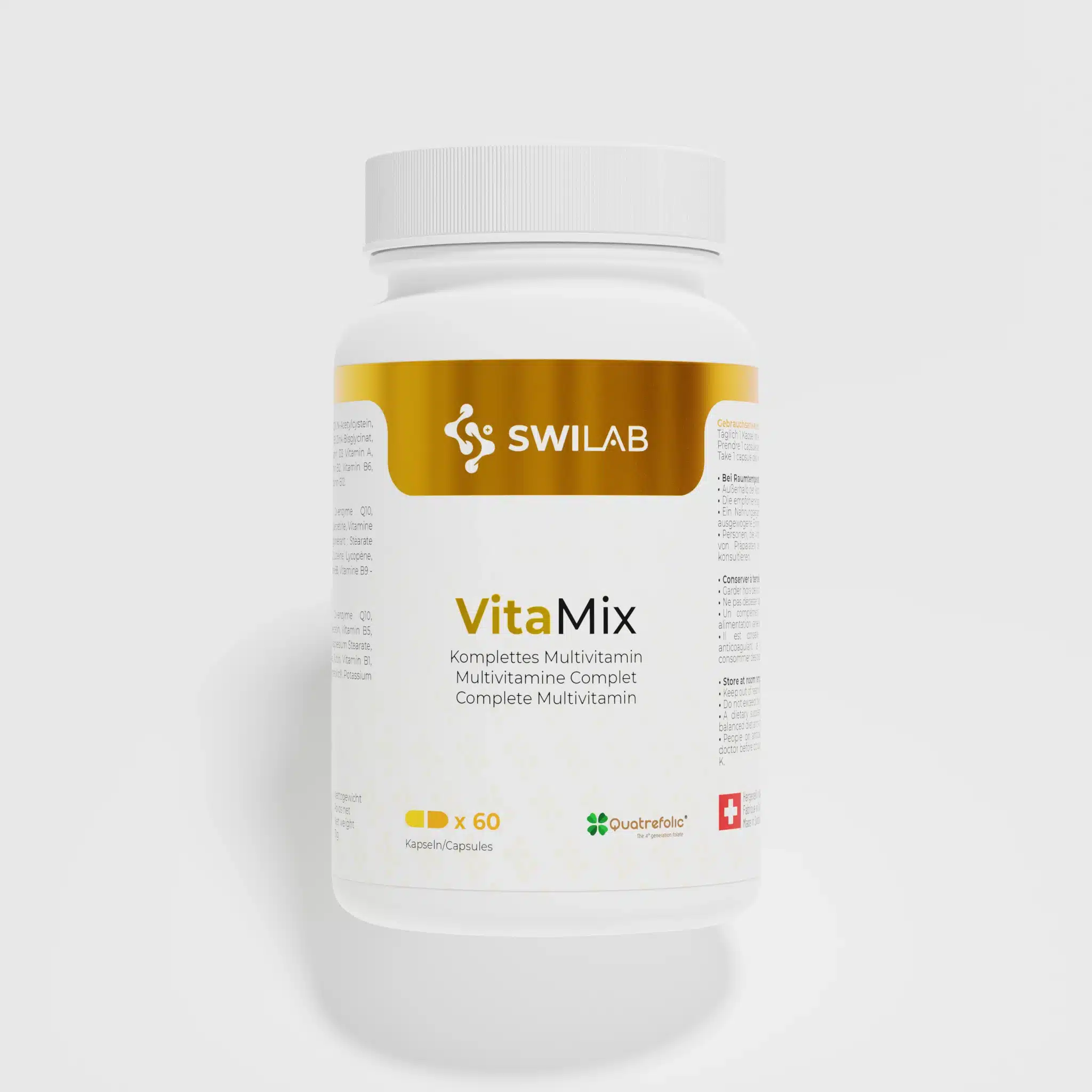
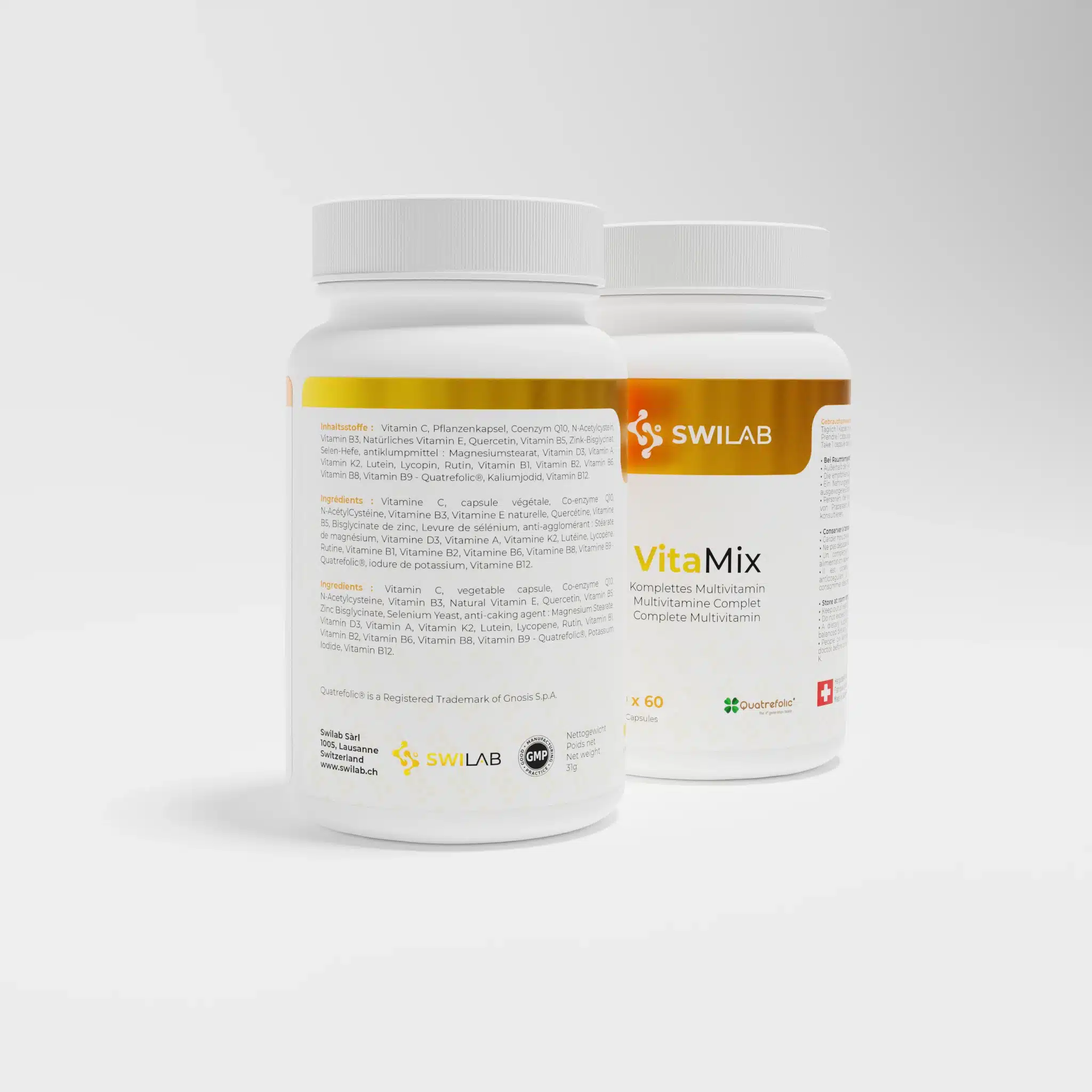
HelpA formula of 22 actives in bioactive forms, dosed within safety limits, without megadoses. The claims below are authorised under Annex 14 of the OFI. Formulated as a complete multivitamin-multimineral to help cover nutritional gaps: 13 vitamins, 3 minerals and 6 targeted actives.
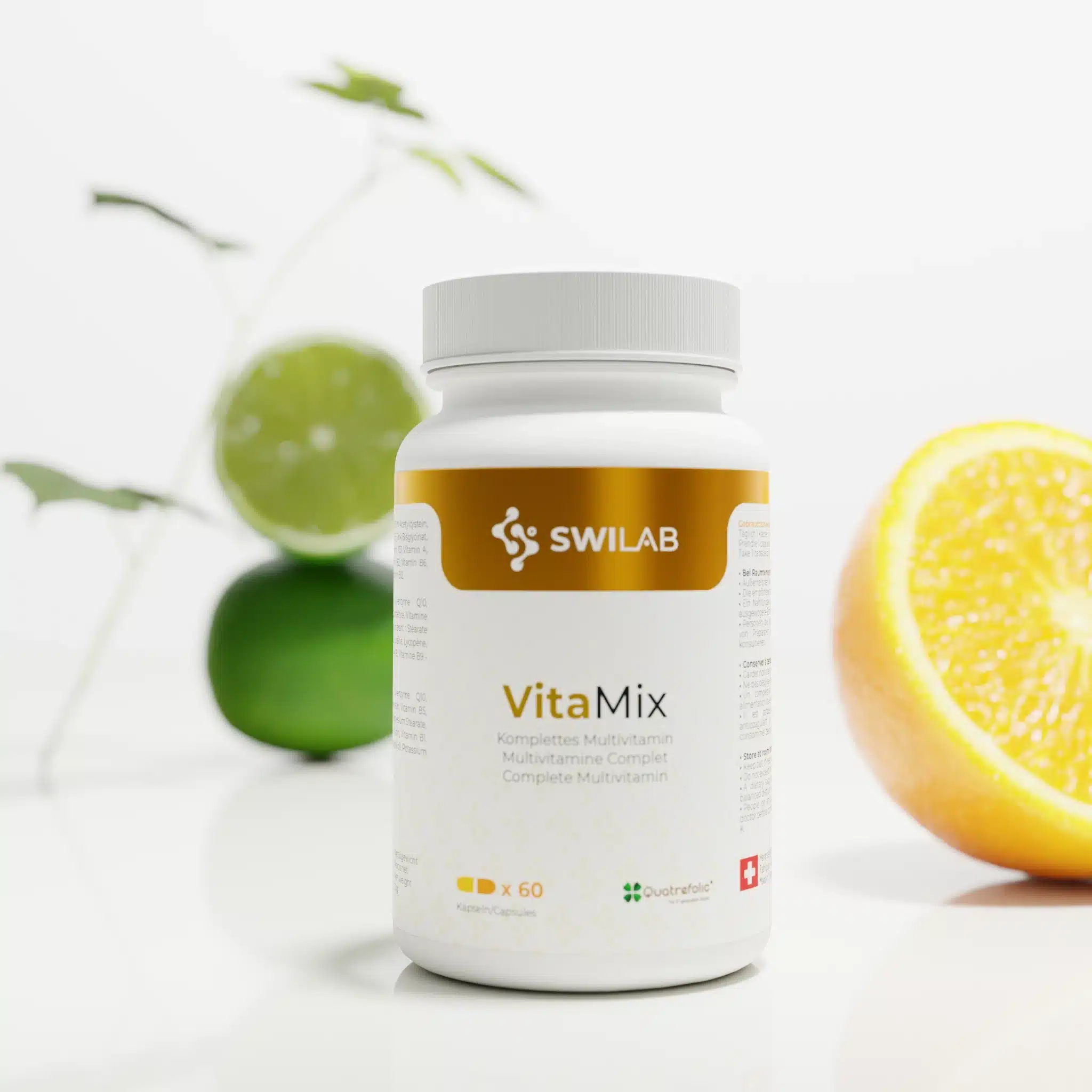
Busy days, short sleep, chronic stress: eating routines become less regular. One capsule a day secures a complete nutritional base.
Meals on the go, limited food choice, skipped meals: micronutrient intake can fall short even in a country with a high standard of living. A concrete example: a week without green vegetables or fruit sends folate, vitamin C and carotenoid intake tumbling; a capsule secures those intakes, but replaces neither the fibre nor the thousands of compounds in plants.
Vitamins B and C contribute to the reduction of tiredness and to a normal energy-yielding metabolism. A simple base, without stacking sources. Many formulas rely on iron and magnesium for this claim; ours relies on vitamins B2, B3, B5, B6, B9, B12 and C, with no iron or magnesium in the formula.
Physical activity raises micronutrient needs. Vitamin C contributes to the reduction of tiredness, zinc to normal protein synthesis and vitamin D to normal muscle function. Thiamine (B1) contributes to normal heart function. “Sport” formulas boosted with magnesium and iron are a different choice: ours contains neither.
Needs for vitamin D, B12 and folate change with age. Our capsules provide D3 at 500 % NRV and B12 as directly usable methylcobalamin.
A complete, stable and traceable composition for those who want to secure their intake without multiplying supplements.
This information is descriptive in nature and does not constitute therapeutic claims. If you are on medication (in particular anticoagulants, because of vitamin K2), pregnant, breastfeeding or living with a diagnosed condition, consult a doctor before use. The formula is the same for adult men and women; it is not intended for children.
What sets us apart from standard multivitamins
22Actives in a single formula
| Criterion | Our formulaSwiLab | Standard multivitamins |
|---|---|---|
| Number of actives | 22 | 10 to 15 |
| Form of B9 (folate) | Quatrefolic® 5-MTHF | Synthetic folic acid |
| Form of B12 | Methylcobalamin | Cyanocobalamin |
| Targeted actives (CoQ10, NAC…) | Yes | No |
| Zinc bisglycinate | Yes | Varies |
| Vitamin D3 | 25 µg · 500 % NRV | Varies |
| HPMC plant-based capsule | Yes | Varies |
| No added iron | Yes | Varies |
| Swiss manufacturing | Yes | No |
| Price per box of 60 capsules | CHF 42.00 | CHF 20 to 70 |
Indicative comparison based on the common product categories of the Swiss market (March 2026). The characteristics of third-party products may vary.
Five questions first settle whether you need one. Five criteria then separate the products, beyond the number of actives printed on the box. Choosing the right multivitamin means judging these five points; unlike single mineral supplements, a complete dietary supplement combines them.
To read a label and spot marketing traps: our vitamins and minerals guide. Some formulas add plant extracts, enzymes, fatty acids or probiotics; we stick to 13 vitamins, 3 minerals and 6 antioxidant actives, with no fatty acids or probiotics. Check the nutrition table before buying: amounts per capsule and % NRV matter, not the number of substances. The format affects how you take it: tablets, capsules or gummies; gummies are pleasant but often contain sugar and lower doses. We stick to one plant-based capsule a day.
Folate comes as folic acid or as 5-MTHF, the form the body uses directly. Vitamin B12 exists as cyanocobalamin or as methylcobalamin, a coenzyme form. The difference is about the chemical form selected, not about the amount stated on the label.
NRV percentages serve labelling, not safety assessment. The useful benchmark is the tolerable upper intake level, set separately for each nutrient. A dose at 300 % NRV can remain several times below that ceiling. Some nutrients, such as vitamin C or B12, have no established limit for lack of data: the absence of a limit is no guarantee of safety at high doses. For comparison: our capsule provides 100 mg of vitamin C (125 % NRV) and 25 µg of vitamin D (500 % NRV), where many tablets stay at 10 µg; B12 is at 2.5 µg, that is 100 % NRV, while some formulas go up to 4 µg with no established benefit.
This mineral and zinc use the same intestinal pathways and compete with each other when taken together as supplements. Outside a deficiency confirmed by a blood test, a formulation with no added iron avoids that competition. Some formulas also leave out copper, which can interfere with zinc absorption; ours contains neither iron nor copper. Many complexes also include calcium and magnesium in small amounts; we deliberately leave them out, because an effective dose does not fit in one capsule.
The shell of a multivitamin preparation is made either of animal gelatine or of plant-based HPMC. An HPMC capsule suits vegetarian and vegan diets, while helping to preserve sensitive actives from oxidation and moisture.
In Switzerland these preparations fall under the Foodstuffs Act and the Ordinance on food supplements, which set maximum amounts for each vitamin and mineral. Manufacturing documented batch by batch makes it possible to trace every raw material.
Multivitamins bring together in a single capsule the vitamins and minerals the body does not make, or does not make in sufficient amounts. These nutrients act as cofactors: without providing energy themselves, they take part in the reactions of metabolism.
A varied diet covers the needs of most healthy adults. The question mainly arises when meals are irregular, when a diet excludes whole food groups, or when needs for vitamin D and B12 change with age. Fruit, vegetables and whole grains people eat daily remain the foundation of diet and nutrition; oily fish adds omega-3 fatty acids, which this formula deliberately does not include. Official guidelines set both the reference values and the upper limits.
Cognitive abilities are also part of the areas covered: zinc and iodine contribute to normal cognitive function, and pantothenic acid (B5) to normal mental performance, claims authorised under Annex 14 of the OFI. Memory and cognitive function in older adults are also the focus of the large randomised trials cited in the references. Researchers have tested multivitamins in randomized controlled trials, prospective cohort studies and systematic reviews: that scientific evidence is what we cite.

Raw materials selected for their purity and their form: patented Quatrefolic® for B9, methylcobalamin for B12. Several targeted actives, such as lutein, quercetin or rutin, are usually obtained from plant extracts.
Each element is dosed within safety limits, with no pointless megadoses and no risky stacking. 22 balanced actives.
Stable HPMC plant-based capsule, helping to protect sensitive actives (fat-soluble vitamins, tocopherols) from oxidation and moisture.
Descriptive information about the design of the product. A food supplement does not replace a varied and balanced diet.

One capsule a day: that is the dose recommended on the label, and it is also the maximum. Taking two adds nothing and needlessly brings vitamin D and zinc closer to their safety limits.
Seek advice before starting if you take a vitamin K antagonist anticoagulant, if you are being monitored for your thyroid (150 µg of iodine, the full reference intake) or if you are pregnant, breastfeeding or planning a pregnancy, or if you smoke, as a precaution regarding beta-carotene. Before starting any supplementation, consult with a healthcare provider to weigh your needs; for pregnant women, official folate recommendations apply.
If you are on anticoagulant medication, vitamin K (here as K2, 75 µg) requires medical advice. Pregnant and breastfeeding women have a specific official recommendation on folates. The beta-carotene in the formula (1.5 mg per capsule) provides vitamin A.
Most nutrients should come from a varied diet: a multivitamin does not replace a balanced diet.
One more rule for taking multivitamins: the stated recommended daily dose must not be exceeded. Food supplements are no substitute for a varied, balanced diet or a healthy lifestyle. Keep out of reach of young children.
In Switzerland, food supplements are governed by the Foodstuffs Act and the Ordinance on food supplements. A food supplement replaces neither a varied diet nor medical advice, and does not prevent, treat or cure any disease. Dietary supplements, the US term for such products, sit alongside healthy eating and never replace it.
Here B9 is Quatrefolic® (5-MTHF), the form the body uses directly, without the MTHFR conversion step that folic acid requires. B12 is methylcobalamin, a coenzyme form, and not cyanocobalamin.
B6 is supplied as pyridoxal-5-phosphate. The choice is about the chemical form selected, not about the amount stated.
These vitamins come from three routes: synthesis, fermentation and extraction from natural sources. The tocopherol mix and the selenium yeast belong to the third.
What makes the difference is not that origin but the chemical form chosen. We selected the bioactive or organic forms: Quatrefolic® for B9, methylcobalamin for B12, pyridoxal-5-phosphate for B6, bisglycinate for zinc.
It is deliberately absent, and the corresponding statement appears on the label. This mineral uses the same intestinal pathways as zinc, and the two compete with each other when taken together as supplements.
A deficit is confirmed by a blood test and corrected with an appropriate dose. A daily all-round preparation is not the tool for that. Excess iron also causes digestive upset, one more reason to reserve it for established needs.
Calcium is deliberately absent. A useful calcium dose is counted in hundreds of milligrams a day, an amount that does not fit into a single capsule alongside 22 other substances.
We preferred to include none rather than an amount too small to matter. The “calcium D-pantothenate” that appears in the composition is the salt form of vitamin B5, not a source of calcium. Vitamin D, on the other hand, is present (25 µg per capsule) and contributes to the maintenance of normal bones and normal muscle function; it is the pairing of vitamin D with dietary calcium that matters, not calcium from a capsule.
Each capsule provides 1.50 mg, as a source of vitamin A. The published concerns about beta-carotene relate to supplemental doses of 20 to 30 mg a day, that is more than ten times this amount.
Beta-carotene is a precursor: the body converts it into vitamin A according to its needs. These concerns mainly involve smokers, in whom such high doses had unfavourable effects in two large trials; several authorities have since advised them to be cautious with any supplement containing it. If you smoke, ask your doctor or pharmacist before starting. Those two trials observed more lung cancers in smokers taking 20 to 30 mg of beta-carotene a day; preformed vitamin A (retinol) at high doses can also harm the liver, a risk that beta-carotene avoids.
NRVs are labelling benchmarks, not safety ceilings. The real ceiling is the tolerable upper intake level, set separately for each nutrient.
Multivitamin preparations sold in Switzerland must respect the maximum amounts set by the Ordinance on food supplements for each vitamin and mineral. Vitamin A, whose ceiling is the lowest, is supplied here as beta-carotene, which the body converts according to its needs.
With a meal, even a light one. Vitamins A, D, E and K are fat-soluble, and a randomised trial (Dawson-Hughes, 2013) measured it for vitamin D3: taken with a low-fat meal, it was absorbed better than on an empty stomach, while a high-fat meal added nothing. There is no need to look for fatty foods: the foods of an ordinary meal are enough. Over 30 and 90 days, vitamin D status did not differ between the groups either.
Morning or midday both work well. The exact hour matters less than regularity: it is repetition over several weeks that shifts a nutritional status, not the precise moment of the day.
Three separate things. Overdose first: at one capsule a day, vitamin D, vitamin E, B6, zinc, selenium and iodine stay below the limits set by EFSA, the European food safety authority. Other nutrients, such as vitamin C or B12, have no established limit for lack of data, which is not a guarantee. Interactions next: vitamin K2 and anticoagulants, iodine and thyroid care, detailed under contraindications. Individual tolerance last: a capsule taken on an empty stomach can cause nausea, and taking it in the evening can disturb sleep in sensitive people; both disappear when the capsule is taken with a meal, in the morning or at midday.
The risks documented with multivitamins involve heavily dosed preparations or the stacking of several products supplying the same fat-soluble vitamins (A, D, E, K). Hence the simple rule: one capsule a day, no more, and only one multivitamin complex at a time. If in doubt about a combination, ask your pharmacist.
No. A deficiency is confirmed by a blood test and corrected with a targeted dose, often well above what a daily all-round capsule contains. The two approaches are useful, but they do not serve the same purpose.
A daily complex is there to secure coverage over time, not to treat an established deficit. In case of persistent tiredness or an unusual sign, a blood test and the advice of a health professional come before any supplementation.
Three situations call for professional advice before starting. Anticoagulant treatment of the vitamin K antagonist type, because the vitamin K2 present here can interfere with that treatment. Thyroid monitoring, because these capsules provide 150 µg of iodine, that is the full daily reference intake. Pregnancy, breastfeeding or planning a pregnancy, because folate is then covered by a specific official recommendation, to be discussed with your doctor or your midwife.
Outside these cases, this preparation is designed for a healthy adult.
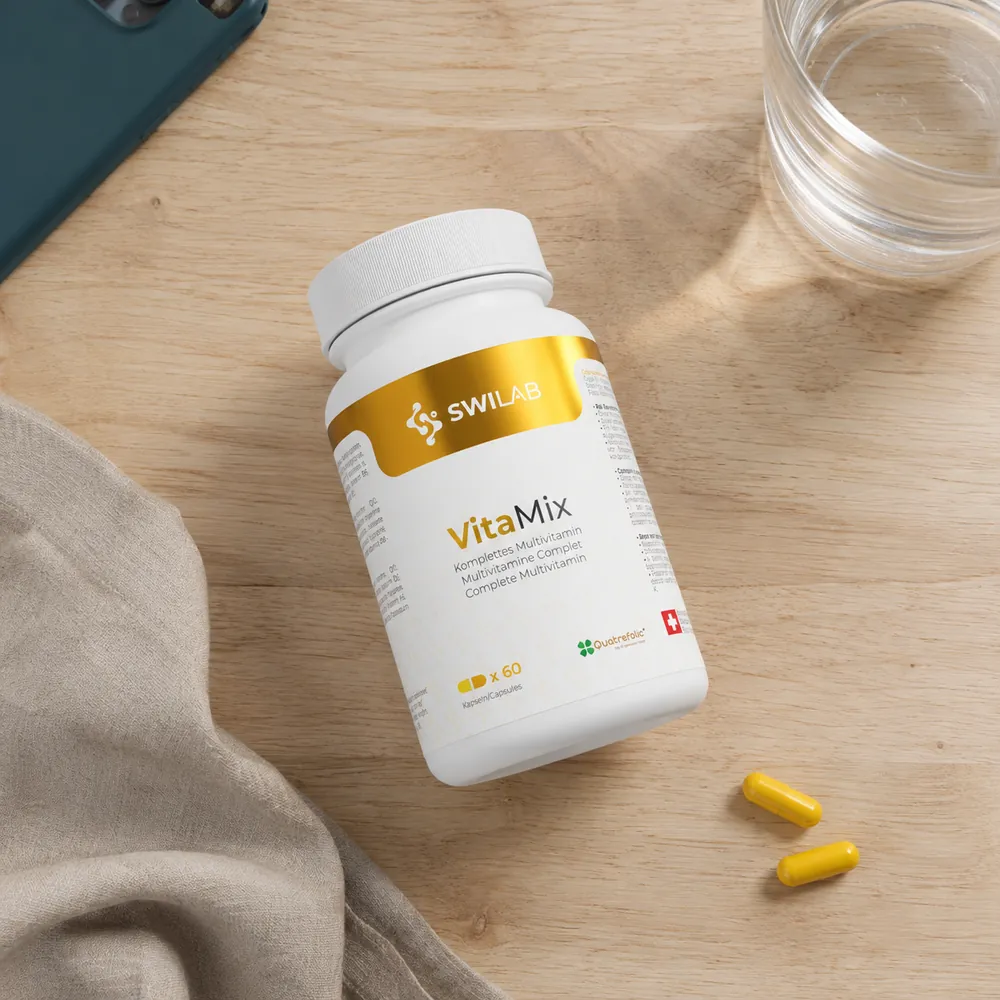
A box holds 60 plant-based capsules. At one capsule a day it lasts about two months, that is CHF 0.70 a day. A course of at least three months is recommended: restoring micronutrient levels usually takes 8 to 12 weeks. On the market, boxes range from 60 to 160 units.
“Three weeks in on this multivitamin, and I feel a real difference in my day-to-day energy.”
Marc Ziegler · customer review
“A quality product, made in Switzerland, and you can tell. Since I started taking it, my days have been far more energetic.”
Aline Weber · customer review
“Very good feeling so far: less tiredness and a sense of being in better shape.”
Sandra Tissot · customer review
“I was looking for a complete supplement to strengthen my immunity this winter, and this one is perfect!”
Patrick Dubois · customer review
60 plant-based capsules, about two months at one capsule a day. Dispatched from Switzerland within 24 hours, free delivery from CHF 99.–