
Probiotics for weight loss: what does the science really say?
18 PubMed studies analysed. Real results, documented strains, methodological limitations and evidence-based recommendations for Switzerland.

What the scientific studies actually say
The effectiveness of probiotics for weight management has been the subject of extensive research for several years. The largest meta-analysis to date (Saadati et al., 2024, Obesity Reviews, 200 RCTs, 12'603 participants) reports a reduction in body weight of 0.91 kg versus placebo, a waist circumference reduction of 1.14 cm and a decrease in body fat of 0.92 kg. No effect on lean mass was observed.
These figures are consistent with Pontes et al. (2021, Clinical Nutrition, 26 RCTs, 1'720 obese or overweight subjects): –0.70 kg body weight, –1.13 cm waist circumference, plus a reduction in TNF-α, insulin and cholesterol. An important point to note: these positive effects only appear at a dosage of ≥ 10⁹ CFU (i.e. 1 billion CFU per day) and a duration of ≥ 8 weeks.
The most recent meta-analysis (Guo et al., 2025, Scientific Reports) confirms the effect on body weight and reduction in abdominal fat, but shows no significant effect on BMI or LDL cholesterol.
Negative results also exist
The scientific reality is more nuanced than some brands suggest. Around 40% of clinical trials found no effect of probiotic bacteria on body weight (Tomé-Castro et al., 2021). For example, in post-bariatric surgery patients, probiotics provide no measurable benefit, regardless of the strain used (Wang et al., 2025).
Three biases highlighted by researchers
Industry funding: the landmark trials on Lactobacillus gasseri were funded by the manufacturer of the tested product (Megmilk Snow Brand). Non-representative populations: the most cited studies exclusively involve Japanese subjects, whose microbiome composition and dietary patterns differ from those of European populations. Reversibility: Kadooka et al. (2013) showed that the benefits disappear 4 weeks after discontinuation.
How do probiotics affect body weight?
Appetite regulation and satiety. Gut microbiome bacteria play a key role in the communication between the intestine and the brain. A meta-analysis of 26 RCTs (Noormohammadi et al., 2023) shows that probiotics help reduce circulating leptin levels and tend to increase adiponectin, a protein that promotes fat oxidation in the body. A paradoxical finding to note: they also slightly increase the desire to eat.
Gut health and inflammation. Obesity is linked to a weakening of the intestinal mucosa of the digestive tract, allowing bacterial fragments to pass through and sustain chronic inflammation in the body. The trial by Stenman et al. (2016) on Bifidobacterium lactis B420 showed a direct correlation between the restoration of this digestive barrier (measured by zonulin) and the reduction of abdominal fat.
Short-chain fatty acids (SCFAs). Gut flora bacteria ferment natural dietary fibres (vegetables, legumes) into butyrate, propionate and acetate. These SCFAs play a role in body weight regulation: they stimulate satiety hormones (PYY, GLP-1), support improved digestion and reduce lipid storage via the ANGPTL4 protein. This probiotic mechanism of action would explain why the effect is greater on visceral fat than on total body weight.
⚠️ Essential caveat
These mechanisms are primarily described in vitro or in animal models. In humans, the clinical translation remains modest. The idea of a "fat-burning" probiotic is more myth than scientific reality.
Which probiotic strains support weight loss?
There are many different bacterial families within the gut microbiome, and not all have the same effect on the body. Here are the strains studied in the context of weight loss programmes, with their respective level of evidence:
| Strain | Main effect | Key study | Limitation |
|---|---|---|---|
| L. gasseri SBT2055 | Visceral fat –4.6% to –8.5%, waist circumference –1.7 cm | Kadooka 2010, 2013 | Japanese cohorts, manufacturer-funded, reversible effect |
| L. gasseri BNR17 | Visceral fat –21.6 cm² | Kim 2018 | No effect on total weight or biochemical parameters |
| L. rhamnosus CGMCC1.3724 | Weight and fat mass loss in women only | Sanchez 2014 (Univ. Laval / Nestlé Lausanne) | No effect in men, formulated with prebiotics |
| L. plantarum | Weight reduction in combination with diet | Crovesy 2017 | Fragmentary data, often in multi-strain products |
| B. lactis B420 | Fat mass –4.5% (with prebiotic fibre) | Stenman 2016 | Not significant in ITT, only per protocol. DuPont-funded |
🔬 Strains to watch
The meta-analysis by Million et al. (2012, 82 scientific studies) showed that Lactobacillus acidophilus, taken as a single strain, is associated with weight gain in both humans and animals. Lactobacillus fermentum carries the same risk in animal models.
💡 Multi-strain nuance
These results relate to isolated strains. In multi-strain formulations, the behaviour may differ. Zarrati et al. (2014) showed that a blend containing L. acidophilus + Bifidobacterium + L. casei, combined with a diet, reduced BMI and body fat percentage. Lauw et al. (2023) observed similar results with L. acidophilus NCFM + B. lactis HN019. The interaction between strains remains an active area of research.
How to choose the right probiotic for weight management
Synbiotics (probiotics + prebiotics) promote a greater reduction in waist circumference (–1.31 cm vs. –0.53 cm for probiotics alone), but only pure probiotics contribute to a significant reduction in body fat (Saadati 2024, Peckmezian 2022). There are therefore notable differences depending on the formulation chosen.
Minimum effective dosage: 1 billion CFU per day (10⁹). Minimum duration: 8 to 12 weeks. Recommended form: gastro-resistant capsules, which protect the bacteria from stomach acidity and ensure they reach the intestine alive.
✅ 5 criteria for choosing a weight-management probiotic
1. Identified probiotic strain (genus + species + strain, e.g.: Lactobacillus gasseri BNR17) · 2. Dosage ≥ 10⁹ CFU per day (billions of CFU clearly stated) · 3. Gastro-resistant capsules (HPMC or DR Caps®) · 4. At least one clinical study cited on the packaging or website · 5. Realistic budget: expect 30 to 60 CHF/month for a 12-week course.
In Switzerland, food supplements are regulated by the FSVO (Federal Food Safety and Veterinary Office). Unlike medicines (regulated by Swissmedic), probiotics do not require market authorisation. Documented strains are available in Swiss pharmacies (Amavita, SunStore, Coop Vitality) and online. Natural probiotics can also be found in fermented foods such as yoghurt, kefir or sauerkraut, but the dosages remain far below those used in clinical studies.
Using probiotics for weight loss: the 5 most common mistakes
1. Believing in a magic bullet. The largest meta-analysis reports ~0.9 kg of body weight loss. A 500-calorie daily deficit produces ~0.5 kg/week. Probiotics only show significant effects when combined with a healthy diet or exercise (Peckmezian 2022).
2. Confusing marketing with scientific evidence. The EFSA has approved no health claim linking any probiotic to weight loss. Rankings of the "best probiotics for weight loss" with affiliate links are commerce, not scientific reality.
3. Taking a probiotic strain without checking the context. Lactobacillus acidophilus as a single strain is associated with weight gain (Million 2012), but in multi-strain formulations with other bacteria (Bifidobacterium, L. casei, L. rhamnosus), results differ (Zarrati 2014, Lauw 2023). Always check the full composition, not just a single strain.
4. Stopping too early. The probiotic effect on digestive health and weight appears after 8–12 weeks. A short 3-week course will produce nothing measurable. And the benefits fade within a month of stopping.
5. Ignoring a healthy lifestyle. A fibre-rich diet (vegetables, legumes), adequate water intake, exercise, stress management and sleep all play a role in gut flora balance and immune system health. Taking a food supplement without addressing these levers is like watering a plant sitting on concrete. In particular, natural fibre-rich foods such as vegetables or whole grains remain the primary lever for nourishing the bifidobacteria and lactobacilli already present in your gut.
Do probiotics help with weight loss for all profiles?
Profiles that may benefit: obese or overweight individuals (BMI > 25) with excess visceral fat, identified intestinal dysbiosis — for example following antibiotic therapy, chronic constipation or other intestinal disorders — and possibly women in particular (sex-dependent effect observed with L. rhamnosus). These microorganisms may help as a complement to a comprehensive weight management programme.
Profiles for which the evidence does not support use: normal-weight individuals seeking a "flat stomach" or slimmer figure, and post-bariatric surgery patients. The idea of using probiotics to lose weight without any other effort is a myth.
Precautions and risks: bloating and gas are possible during the first few days, related to the adaptation of the gut flora. Not recommended for immunocompromised individuals (rare risk of infection). Pregnant or breastfeeding women and children under 6 years of age: it is recommended to consult a healthcare professional before any supplementation.
Menopausal women: an active area of research. Menopause triggers a hormonal redistribution of fat linked to declining oestrogen levels and alters the composition of the gut microbiome. Certain bacteria from the Bifidobacterium family (particularly Bifidobacterium breve) and Lactobacillus are being studied, but no large-scale clinical trial exists to date.
Our verdict: do probiotics really help with weight management?
| Claim | Verdict |
|---|---|
| "Probiotics help you lose weight" | Modest effect ~0.9 kg vs. placebo |
| "Effects on a flat stomach" | More convincing Abdominal fat and waist circumference |
| "Lactobacillus gasseri is the best" | Most studied Industry bias and Japanese populations |
| "It works for everyone" | No Sex-dependent, no effect post-bariatric |
| "Some bacteria make you gain weight" | As a single strain L. acidophilus alone → weight gain. Multi-strain → different results |
| "The probiotic effect is lasting" | No Disappears 4 weeks after stopping |
📋 Summary
Probiotics are not a magic bullet, but a potential complementary support for weight management. The effect is real but marginal compared to a healthy diet and exercise. If you decide to try, choose a documented probiotic strain, a dosage of at least 1 billion CFU, gastro-resistant capsules, and stick with it for at least 12 weeks. The best help you can give your gut microbiome: eat vegetables, drink water, move and sleep. If you have digestive disorders, chronic constipation or immune issues, consult a healthcare professional before starting any supplementary programme.
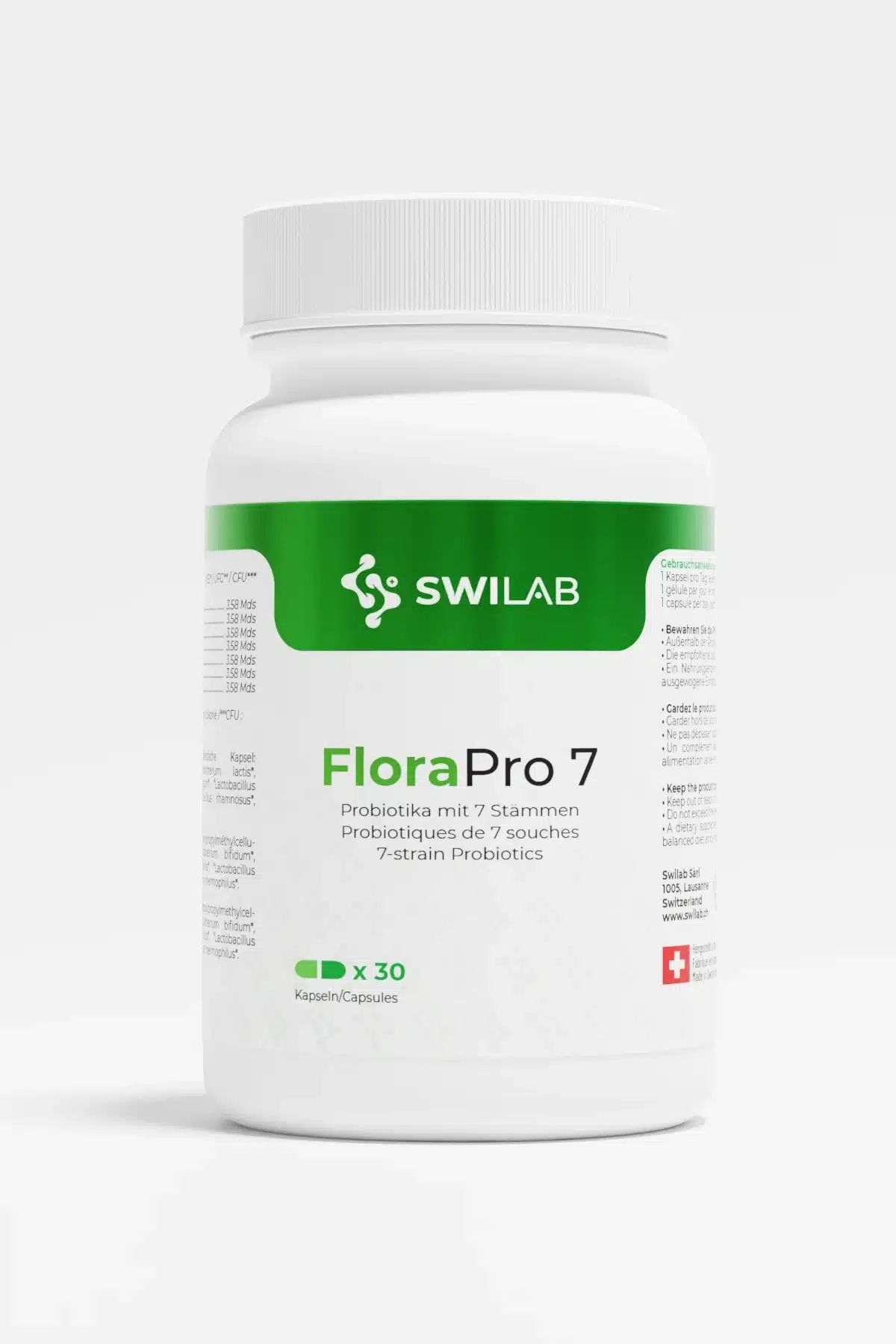
FloraPro 7 — Multi-strain probiotic by Swilab
FloraPro 7 is a multi-strain formulation containing 7 bacteria at 3.57 billion CFU each (25 billion CFU total per gastro-resistant vegetable HPMC capsule). Its composition includes strains studied in the research cited in this article:
- L. rhamnosus — strain studied in Sanchez et al. 2014
- L. plantarum — mentioned in Crovesy et al. 2017
- B. lactis — studied in Stenman et al. 2016
- B. bifidum · B. longum — Bifidobacterium family
- S. thermophilus — lactic ferment
- L. acidophilus — controversial results as single strain, studied in multi-strain formulations (Zarrati 2014, Lauw 2023)
⚠️ FloraPro 7 is a food supplement, not a slimming product. No health claims are made regarding weight loss. The cited studies relate to the bacterial strains in general, not to this product specifically. It does not replace a varied and balanced diet or a healthy lifestyle. Consult a healthcare professional in case of specific indications, pregnancy, breastfeeding or immunosuppression.
Scientific sources & references (PubMed)
Saadati S. et al. — Beneficial effects of probiotics and synbiotics supplementation on anthropometric indices and body composition in adults
Obesity Reviews, 2024, 25(3), e13667. 200 RCTs, 12'603 participants.
DOIPontes K.S.S. et al. — Effects of probiotics on body adiposity and cardiovascular risk markers in individuals with overweight and obesity
Clinical Nutrition, 2021, 40(8), 4915-4931. 26 RCTs, 1'720 subjects.
DOIGuo M. et al. — Effects of oral supplementation of probiotics on body weight and visceral fat in obese patients
Scientific Reports, 2025, 15(1), 6355. 8 RCTs, 412 patients.
DOIPeckmezian T. et al. — Microbiome-Targeted Therapies as an Adjunct to Traditional Weight Loss Interventions
Diabetes Metab Syndr Obes, 2022, 15, 3777-3798. 21 RCTs, 1'233 adults.
DOITomé-Castro X.M. et al. — Probiotics as a therapeutic strategy in obesity and overweight
Beneficial Microbes, 2021, 12(1), 5-15. 23 clinical trials.
DOIWang S. et al. — The effect of probiotics on weight management in patients with severe obesity undergoing bariatric surgery
Annals of Medicine, 2025, 57(1), 2551284. 13 RCTs, 693 patients.
DOINoormohammadi M. et al. — The effect of probiotic and synbiotic supplementation on appetite-regulating hormones
Pharmacological Research, 2023, 187, 106614. 26 RCTs, 1'536 participants.
DOIde Vos W.M. et al. — Gut microbiome and health: mechanistic insights
Gut, 2022, 71(5), 1020-1032. Comprehensive review.
DOIKadooka Y. et al. — Regulation of abdominal adiposity by probiotics (L. gasseri SBT2055)
Eur J Clin Nutr, 2010, 64(6), 636-43. RCT, 87 subjects.
DOIKadooka Y. et al. — Effect of L. gasseri SBT2055 in fermented milk on abdominal adiposity in adults
Br J Nutr, 2013, 110(9), 1696-703. RCT, 210 participants.
DOIKim J. et al. — L. gasseri BNR17 Reduces Visceral Fat Accumulation and Waist Circumference in Obese Adults
J Med Food, 2018, 21(5), 454-461. RCT, 90 volunteers.
DOISanchez M. et al. — Effect of L. rhamnosus CGMCC1.3724 supplementation on weight loss in obese men and women
Br J Nutr, 2014, 111(8), 1507-19. RCT, 125 participants. Univ. Laval / Nestlé Research Lausanne.
DOIStenman L.K. et al. — Probiotic With or Without Fiber Controls Body Fat Mass
EBioMedicine, 2016, 13, 190-200. RCT, 225 volunteers.
DOIMillion M. et al. — Comparative meta-analysis of the effect of Lactobacillus species on weight gain
Microbial Pathogenesis, 2012, 53(2), 100-8. 82 studies.
DOICrovesy L. et al. — Effect of Lactobacillus on body weight and body fat in overweight subjects
Int J Obes, 2017, 41(11), 1607-1614. 14 RCTs.
DOIPerna S. et al. — Is Probiotic Supplementation Useful for Body Weight Management in Adults with Metabolic Diseases?
Nutrients, 2021, 13(2), 666. 20 RCTs, 1'411 patients.
DOIZarrati M. et al. — Effects of probiotic yogurt on fat distribution in overweight and obese people
J Am Coll Nutr, 2014, 33(6), 417-25. RCT, 75 participants.
DOILauw S. et al. — Effects of synbiotic supplementation on metabolic syndrome traits in overweight and obese individuals
Nutrients, 2023, 15(19), 4248. RCT, 55 participants.
DOIFSVO — Food supplements: Swiss regulations and recommendations
Federal Food Safety and Veterinary Office. Regulatory framework FoodA / ordinance on food supplements.
FSVOThis content is provided for informational purposes only and does not constitute medical advice. Food supplements do not replace a varied and balanced diet or a healthy lifestyle. Before starting any supplementation, consult a doctor or qualified healthcare professional. In Switzerland, food supplements are governed by the FoodA and supervised by the FSVO. Swilab · Developed and manufactured in Switzerland 🇨🇭