
Probiotics for weight loss: what does the science really say?
18 studies reviewed. What probiotics really do for your weight, which strains matter, which limits to know — and practical pointers for Switzerland.

What the studies really say
Yes, probiotics can take off a little weight — but the effect is modest and conditional. The big analyses that pool all the trials agree: around 0.9 kg less than a placebo after two to three months, more on the belly than on the scales.
The largest analysis to date — pooling two hundred clinical trials and over twelve thousand participants — reaches a clear figure: around 0.9 kg less weight than a placebo, a waistline reduced by just over a centimetre, and almost a kilo less fat. Muscle mass, on the other hand, stays unchanged.
Another analysis, this time in people with overweight or obesity, finds similar results: around 0.7 kg and just over a centimetre off the waistline, plus a drop in inflammation, insulin and cholesterol. One condition recurs across all the studies: you need at least one billion live bacteria a day, for at least two months, for anything to show.
The most recent analysis, from 2025, confirms the effect on weight and belly fat — but finds no clear effect on BMI (body mass index) or on "bad" cholesterol.
Negative results exist too
The reality is more nuanced than some brands suggest. Nearly four trials in ten find no effect on weight at all. And in people who have had stomach surgery (weight-loss surgery), probiotics bring no measurable benefit, whatever the strain.
Three limits researchers point out
Industry funding. The main Lactobacillus gasseri trials were paid for by the maker of the tested product. Unrepresentative populations. The most-cited work involves only Japanese participants, whose diet and gut flora differ from ours. A reversible effect. The benefit seen fades about a month after you stop taking them.
How do probiotics affect weight?
Through several routes, but none is dramatic: they act on appetite, on inflammation in the gut, and on how fibre is digested. This mainly explains why the effect shows up more on belly fat than on total weight.
First, appetite. Gut bacteria take part in the constant dialogue between gut and brain — what researchers call the gut-brain axis. Studies show they lower leptin, the hormone that regulates hunger, and tend to raise another molecule that helps the body use its fat. But don't rely on them as an appetite suppressant: oddly enough, they also slightly increase the urge to eat. So the net effect on fullness stays modest.
Next, the gut barrier. With obesity, the gut lining — the wall that lines the digestive tract — becomes more permeable and lets through fragments of bacteria that sustain low-grade inflammation. One trial observed that, as this barrier repairs, belly fat decreases in parallel. A word of caution, though: this is a correlation, not proof of cause and effect.
Finally, fibre. By digesting the fibre in vegetables and pulses, the bacteria produce compounds that stimulate satiety hormones, improve digestion and transit, and slightly curb fat storage. This is probably why the effect mainly concerns deep belly fat, rather than the weight shown on the scales.
And the make-up of your gut flora. With overweight, the balance of gut bacteria is often shifted — broadly speaking, between two large groups, the Firmicutes and the Bacteroidetes. Probiotics may nudge this balance a little. Whether that genuinely helps with weight loss in humans, however, is still an open question.
⚠️ Key caveat
Most of these mechanisms have been observed in the lab or in animals. In humans, the concrete result stays modest. The idea of a "fat-burner" probiotic, or a "slimming microbiome" you simply need to repopulate, is more myth than science.
Which probiotic strains for weight loss?
A few stand out — chiefly Lactobacillus gasseri, L. rhamnosus and L. plantarum — but each has its limits. Not all bacteria act the same way, and the exact strain matters as much as the species. Here are the main ones, with what they have actually shown.
| Strain | What it has shown | The limit to know |
|---|---|---|
| L. gasseri SBT2055 | Less deep belly fat, waistline down about 2 cm | Trials in Japanese participants, funded by the maker; effect fades on stopping |
| L. gasseri BNR17 | Marked drop in deep belly fat | No effect on total weight or blood tests |
| L. rhamnosus CGMCC1.3724 | Weight and fat loss, but in women only | No effect in men; tested with added fibre |
| L. plantarum | Helps weight loss when paired with a diet | Still patchy data, often in strain blends |
| B. lactis B420 | Less fat mass (combined with a fibre) | Fragile result: visible in only part of the analysis; industry-funded |
🔬 Strains to watch
A large analysis pooling dozens of studies showed that Lactobacillus acidophilus, taken on its own, is linked to weight gain — in humans and in animals. Another strain, Lactobacillus fermentum, carries the same risk in animals.
💡 Multi-strain blends
These results apply to strains taken in isolation. In a blend, behaviour can change. One trial showed that a mix of L. acidophilus, bifidobacteria and L. casei, combined with a diet, lowered BMI and body-fat percentage. Another, more recent trial saw the same with a different blend. How strains interact remains an active research field.
How to choose the right probiotic?
Three criteria make the difference: a precisely identified strain, at least one billion live bacteria a day, and a course of at least two to three months. The rest — capsule form, pairing with fibre — fine-tunes the choice without changing the basic rule.
Synbiotics — probiotics paired with fibre that feeds them — reduce the waistline a little more (over a centimetre versus half a centimetre). To lower body fat, though, probiotics on their own work better. So the formula you choose matters.
The useful dose starts at one billion live bacteria a day — these are the "CFU", the unit that counts them. Then allow at least two to three months. And go for gastro-resistant capsules, designed to protect the bacteria from stomach acid and bring them alive to the gut.
✅ 5 criteria for choosing a "slimming" probiotic
1. Precisely identified strain (genus + species + number, e.g. Lactobacillus gasseri BNR17) · 2. At least 1 billion live bacteria a day (the "CFU", clearly stated) · 3. Gastro-resistant capsules · 4. At least one study cited on the pack or website · 5. A realistic budget: expect CHF 30 to 60 a month for a 12-week course.
In Switzerland, food supplements are overseen by the FSVO (the Federal Food Safety and Veterinary Office). Unlike medicines, overseen by Swissmedic, probiotics need no marketing authorisation. Documented strains are available in pharmacies (Amavita, SunStore, Coop Vitality) and online. Useful bacteria are also found in fermented foods — yoghurt, kefir, sauerkraut or kimchi — but at far lower doses than in the studies.
The 5 most common mistakes
Most disappointments come from five traps: expecting a miracle, mistaking marketing for science, judging a strain out of context, stopping too soon, and neglecting your lifestyle. Avoiding them changes everything.
1. Expecting a miracle solution. The largest analysis points to around 0.9 kg of weight loss. For comparison: a 500-calorie daily deficit takes off about half a kilo a week. Probiotics only have a real effect when combined with a healthy diet or exercise.
2. Mistaking marketing for science. In Europe, the EFSA (the European Food Safety Authority) has approved no claim linking a probiotic to weight loss. Rankings of the "best probiotics for weight loss" packed with affiliate links belong to commerce, not research.
3. Judging a strain out of context. Lactobacillus acidophilus on its own is linked to weight gain, but in a blend with other bacteria the results differ. Always look at the full composition of a formula, not a single strain.
4. Stopping too soon. The effect appears after 8 to 12 weeks. A short three-week course produces nothing measurable — and the benefits fade a month after you stop.
5. Neglecting your lifestyle. A fibre-rich diet (vegetables, pulses), good hydration, exercise, stress management and sleep all shape the balance of your gut flora. Taking a supplement without working on these levers is like watering a plant sitting on concrete. Fibre-rich foods remain, in fact, the first way to feed the good bacteria already in your gut.
Do probiotics help every profile?
No. They mainly make sense for people with overweight and excess belly fat, and possibly more so for women. In someone of normal weight, or after obesity surgery, the data don't support their use.
Profiles that might benefit: people with overweight or obesity (BMI above 25) and a lot of belly fat; people with an imbalanced gut flora — for example after antibiotics, with chronic constipation, or with other digestive complaints; and possibly women in particular, since a stronger effect has been observed in them with L. rhamnosus. In these cases, probiotics can help alongside an overall approach.
Profiles where the data don't support use: people of normal weight aiming for a "flat stomach" or a slimmer figure, and people who have had stomach surgery. The idea of losing weight with probiotics while changing nothing else is a myth.
Precautions and risks: bloating and gas are possible in the first few days, while your gut flora adjusts. Probiotics are not recommended for people with a weakened immune system (rare risk of infection). Pregnant or breastfeeding women and children under six should ask a healthcare professional before taking any supplement.
Women going through the menopause: an active research field. The menopause redistributes fat, owing to falling oestrogen, and alters the gut flora. Certain bacteria in the Bifidobacterium (notably Bifidobacterium breve) and Lactobacillus families are under study, but so far there's no large clinical trial.
Our verdict: do probiotics really help?
A complementary aid, not a treatment for excess weight. The effect is real but marginal next to a healthy diet and physical activity. The table below sums up, claim by claim, what the research lets us say.
| Claim | Verdict |
|---|---|
| "Probiotics help you lose weight" | Modest effect ~0.9 kg vs placebo |
| "Effect on the belly / belly fat" | More convincing Belly fat and waistline |
| "Lactobacillus gasseri is the best" | Most studied Maker-funded trials, Japanese populations |
| "It works for everyone" | No Stronger in women, nil after obesity surgery |
| "Some bacteria make you gain weight" | Taken on their own L. acidophilus alone → weight gain; in a blend → different results |
| "The effect is lasting" | No Fades about a month after stopping |
📋 In short
Probiotics are no miracle solution, but a possible complementary aid. The effect is real and marginal next to a healthy diet and exercise. If you decide to try them, choose a documented strain, a dose of at least one billion live bacteria, gastro-resistant capsules, and keep going for at least 12 weeks. The best thing for your gut flora stays simple: eat vegetables, drink water, move and sleep. If you have digestive complaints, chronic constipation or immune problems, consult a healthcare professional before starting.
Frequently asked questions
Do probiotics really help you lose weight?
A little, but they're not a miracle solution. Analyses pooling all the trials point to a loss of around 0.9 kg compared with a placebo, after two to three months. The effect is clearer on the waistline and belly fat than on total weight. Probiotics only really work alongside a balanced diet and physical activity.
Are probiotics an appetite suppressant?
No, not really. They slightly influence appetite hormones through the gut-brain axis, but can even increase the urge to eat a little. So don't rely on them as an appetite suppressant: any benefit comes through belly fat and metabolism, not through curbing hunger. For fullness during meals, fibre and protein work far better.
Which is the best probiotic for weight loss?
The best-studied strain is Lactobacillus gasseri, followed by L. rhamnosus and L. plantarum. But "best studied" doesn't mean "foolproof": the main L. gasseri trials involved Japanese participants and were funded by the maker of the tested product. Always check that the exact strain is shown on the label: genus, species and strain number.
How long do you need to take probiotics to see an effect?
Allow at least two to three months. Below that, nothing measurable shows up. You also need a sufficient dose: at least one billion live bacteria a day. Importantly, the effect fades about a month after you stop. It's a help that lasts as long as you take it, not a lasting reset of the body.
Are there probiotics that make you gain weight?
Yes, some strains taken on their own. Lactobacillus acidophilus as a single strain is linked to weight gain, in humans and in animals, according to a large analysis. In a blend with other bacteria, though, its behaviour changes, and several trials show the opposite — a drop in BMI. The context of the formula matters as much as the strain itself.
Do probiotics help with weight loss after obesity surgery?
No, the data don't show it. In people who have had stomach surgery, trials find no measurable benefit for weight, whatever the strain. In this case, it's more useful to rely on the nutritional follow-up recommended after the operation. Talk to the medical team looking after you.
Are yoghurt, kefir or sauerkraut enough?
They're good for your gut flora, but heavily under-dosed compared with the studies. Fermented foods provide useful live bacteria, but in far smaller amounts than the daily billion tested in clinical trials. See them as a good dietary habit, not a substitute for a targeted course. What matters most is fibre, which feeds the good bacteria already present.
Are probiotics safe?
For most people, yes. The most common effects are bloating or gas in the first few days, while your gut flora adjusts. Caution is needed if your immune system is weakened, because of a rare risk of infection. Pregnant or breastfeeding women and children under six should ask a healthcare professional before taking any supplement.
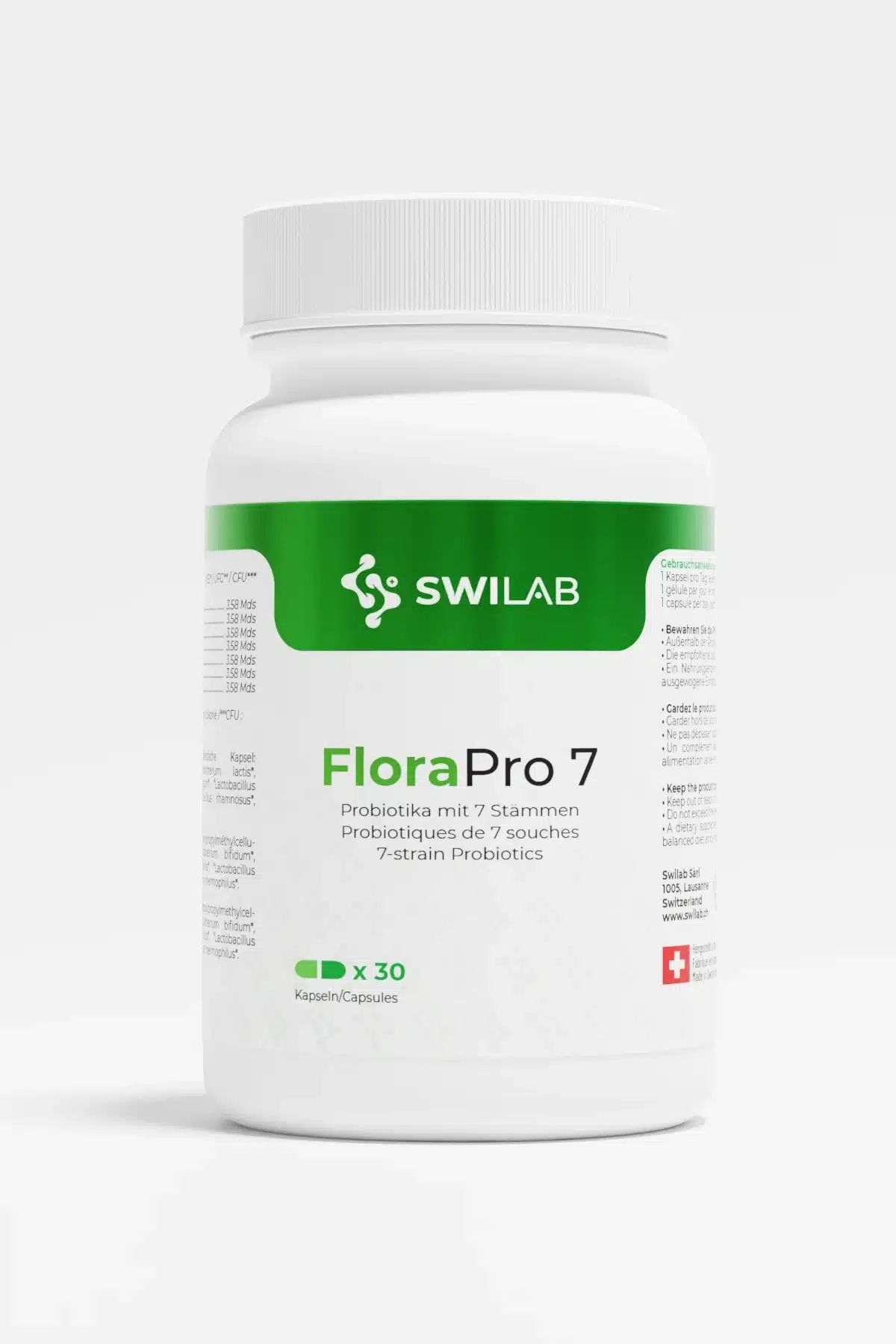
FloraPro 7 — Swilab multi-strain probiotic
FloraPro 7 is a multi-strain formula combining 7 bacteria, 3.57 billion live bacteria each (25 billion in total per gastro-resistant plant-based capsule). Several of these strains are among those cited in the studies above:
- L. rhamnosus — studied in a 2014 trial (see sources)
- L. plantarum — mentioned in a 2017 review (see sources)
- B. lactis — studied in a 2016 trial (see sources)
- B. bifidum · B. longum — bifidobacteria family
- S. thermophilus — lactic ferment
- L. acidophilus — controversial on its own, studied in a blend (see sources)
⚠️ FloraPro 7 is a food supplement, not a slimming product. It carries no health claim relating to weight loss. The cited studies concern bacterial strains in general, not this product specifically. It replaces neither a varied, balanced diet nor a healthy lifestyle. If you have specific needs, or are pregnant, breastfeeding or immunocompromised, consult a healthcare professional.
Scientific sources & references (PubMed)
The technical details of each study — study type, number of participants, journal and DOI — are gathered here, following good practice on transparency: the body of the article stays readable, the full sources stay verifiable.
Saadati S. et al. — Beneficial effects of probiotics and synbiotics supplementation on anthropometric indices and body composition in adults
Obesity Reviews, 2024, 25(3), e13667. Meta-analysis, 200 randomised trials, 12,603 participants: –0.91 kg weight, –1.14 cm waist, –0.92 kg fat vs placebo.
DOIPontes K.S.S. et al. — Effects of probiotics on body adiposity and cardiovascular risk markers in individuals with overweight and obesity
Clinical Nutrition, 2021, 40(8), 4915-4931. 26 randomised trials, 1,720 people: –0.70 kg, –1.13 cm, lower TNF-α, insulin and cholesterol (effects from ≥ 10⁹ CFU/day and ≥ 8 weeks).
DOIGuo M. et al. — Effects of oral supplementation of probiotics on body weight and visceral fat in obese patients
Scientific Reports, 2025, 15(1), 6355. 8 randomised trials, 412 patients: effect confirmed on weight and belly fat, but not on BMI or LDL cholesterol.
DOIPeckmezian T. et al. — Microbiome-Targeted Therapies as an Adjunct to Traditional Weight Loss Interventions
Diabetes Metab Syndr Obes, 2022, 15, 3777-3798. 21 randomised trials, 1,233 adults: effect tied to pairing with diet or physical activity.
DOITomé-Castro X.M. et al. — Probiotics as a therapeutic strategy in obesity and overweight
Beneficial Microbes, 2021, 12(1), 5-15. 23 clinical trials: nearly 40% show no effect on weight.
DOIWang S. et al. — The effect of probiotics on weight management in patients with severe obesity undergoing bariatric surgery
Annals of Medicine, 2025, 57(1), 2551284. 13 randomised trials, 693 patients: no measurable benefit after weight-loss surgery.
DOINoormohammadi M. et al. — The effect of probiotic and synbiotic supplementation on appetite-regulating hormones
Pharmacological Research, 2023, 187, 106614. 26 randomised trials, 1,536 participants: lower leptin, higher adiponectin, slightly higher appetite.
DOIde Vos W.M. et al. — Gut microbiome and health: mechanistic insights
Gut, 2022, 71(5), 1020-1032. Comprehensive review of gut–metabolism mechanisms.
DOIKadooka Y. et al. — Regulation of abdominal adiposity by probiotics (L. gasseri SBT2055)
Eur J Clin Nutr, 2010, 64(6), 636-43. Randomised trial, 87 people: reduced visceral fat and waist circumference.
DOIKadooka Y. et al. — Effect of L. gasseri SBT2055 in fermented milk on abdominal adiposity in adults
Br J Nutr, 2013, 110(9), 1696-703. Randomised trial, 210 participants: effect confirmed, but reversible ~4 weeks after stopping.
DOIKim J. et al. — L. gasseri BNR17 Reduces Visceral Fat Accumulation and Waist Circumference in Obese Adults
J Med Food, 2018, 21(5), 454-461. Randomised trial, 90 volunteers: lower visceral fat, no effect on total weight.
DOISanchez M. et al. — Effect of L. rhamnosus CGMCC1.3724 supplementation on weight loss in obese men and women
Br J Nutr, 2014, 111(8), 1507-19. Randomised trial, 125 participants (Univ. Laval / Nestlé Research Lausanne): weight loss in women only.
DOIStenman L.K. et al. — Probiotic With or Without Fiber Controls Body Fat Mass
EBioMedicine, 2016, 13, 190-200. Randomised trial, 225 volunteers (B. lactis B420): –4.5% fat mass, mainly with a fibre.
DOIMillion M. et al. — Comparative meta-analysis of the effect of Lactobacillus species on weight gain
Microbial Pathogenesis, 2012, 53(2), 100-8. 82 studies: L. acidophilus as a single strain linked to weight gain.
DOICrovesy L. et al. — Effect of Lactobacillus on body weight and body fat in overweight subjects
Int J Obes, 2017, 41(11), 1607-1614. 14 randomised trials: L. plantarum effect mainly when paired with a diet.
DOIPerna S. et al. — Is Probiotic Supplementation Useful for Body Weight Management in Adults with Metabolic Diseases?
Nutrients, 2021, 13(2), 666. 20 randomised trials, 1,411 patients: moderate effect in metabolic disease.
DOIZarrati M. et al. — Effects of probiotic yogurt on fat distribution in overweight and obese people
J Am Coll Nutr, 2014, 33(6), 417-25. Randomised trial, 75 participants: multi-strain blend + diet → lower BMI and fat.
DOILauw S. et al. — Effects of synbiotic supplementation on metabolic syndrome traits in overweight and obese individuals
Nutrients, 2023, 15(19), 4248. Randomised trial, 55 participants: favourable effects of an L. acidophilus + B. lactis blend.
DOIFSVO — Food supplements: Swiss regulation and recommendations
Federal Food Safety and Veterinary Office. Legal framework: Foodstuffs Act / Ordinance on food supplements.
FSVOThis content is provided for information only and does not constitute medical advice. Food supplements replace neither a varied, balanced diet nor a healthy lifestyle. Before taking any supplement, consult a doctor or healthcare professional. In Switzerland, food supplements are subject to the Foodstuffs Act and overseen by the FSVO. This article was written with the support of AI tools, based on studies indexed on PubMed, and reviewed by the editorial team. Swilab · Developed and made in Switzerland 🇨🇭