
Probiotics and antibiotics: when to take them, which strains, how long
Detailed protocol based on 12 PubMed studies. Which strains are effective, how to combine them with your treatment, and what probiotics don't do.
What probiotics don't do
A December 2024 review in Nature Reviews Gastroenterology (Szajewska et al.) concludes: probiotics reduce digestive symptoms, but no evidence proves they restore the bacterial diversity of the microbiome. A study in Cell (Suez et al., 2018) even showed that certain multi-strain probiotics could delay the reconstitution of the intestinal mucosa. Probiotics are a temporary shield — it is diet (fibre) and time that truly rebuild microbial diversity.
Which probiotic to take with an antibiotic? Comparison by strain
Not all strains are equal in the context of antibiotic therapy. Goodman et al. (2021) analysed strain-by-strain efficacy across 42 clinical trials. Here are the results for preventing antibiotic-associated diarrhoea (AAD):
| Strain | Type | Efficacy (RR) | No. of studies | Key note |
|---|---|---|---|---|
| B. longum | Bacterium | 0.46 | 4 | Best documented bacterial efficacy |
| L. casei | Bacterium | 0.59 | 11 | Good efficacy-to-evidence ratio |
| S. boulardii | Yeast | 0.63 | 9 | Antibiotic-resistant — simultaneous intake possible |
| L. acidophilus | Bacterium | 0.66 | 18 | The most studied strain |
| L. rhamnosus | Bacterium | 0.71 | 5 | Recommended by ESPGHAN for children |
| L. plantarum | Bacterium | NS | 3 | Not significant for AAD |
| B. bifidum | Bacterium | NS | 4 | Not significant for AAD |
| S. thermophilus | Bacterium | NS | 6 | Not significant for AAD |
RR = Risk Ratio (the lower, the more effective the strain). NS = Not significant. Source: Goodman et al., BMJ Open, 2021.
Why S. boulardii is the best ally during antibiotics
Saccharomyces boulardii CNCM I-745 is a yeast, not a bacterium. Its mechanism of action is unique: antibiotics exclusively target bacteria — they have no effect on yeasts. This yeast therefore remains alive and active even during antibiotic use, unlike Lactobacillus and Bifidobacterium which are partially destroyed. This is why S. boulardii can be taken at the same time as the antibiotic, with no spacing required.
For bacterial probiotics (L. rhamnosus GG, B. longum, L. acidophilus), it is recommended to take them at least 2 hours before or after the antibiotic to limit their immediate destruction. The minimum effective dose is 10 billion CFU/day, ideally in enteric-coated capsules to ensure a sufficient quantity of live bacteria reaches the gut. A dose-response effect is documented (RR 0.54 at high dose vs. low dose). For criteria on choosing a probiotic, see our complete guide to probiotics.
A note on the level of evidence
When only the 6 studies with low risk of bias are analysed (out of 42), the protective effect is no longer statistically significant (RR 0.78, p = 0.13). The overall GRADE level is moderate, not high. This reinforces the importance of choosing well-documented strains (S. boulardii, L. rhamnosus GG, B. longum) and adhering to the dosage rather than taking just any probiotic.
When to take probiotics relative to antibiotics? The complete protocol
Probiotics and antibiotics: 3-phase protocol
From the first day of the antibiotic
Start probiotics immediately
Every day throughout the entire course of treatment
Maintain the protocol daily
2 to 4 weeks after completing the antibiotic
Support the recovery of your gut flora
Why antibiotic-probiotic timing is crucial
Broad-spectrum antibiotics (amoxicillin, cephalosporins, fluoroquinolones) cause an imbalance in the gut microbiome and a drop in bacterial diversity within 3 to 4 days (Dethlefsen & Relman, PNAS, 2010). The earlier probiotics are introduced, the better they can colonise the ecological niches freed up before opportunistic pathogens move in. Amoxicillin, the most commonly prescribed antibiotic in Switzerland, significantly reduces bifidobacteria and increases intestinal mucosal permeability — which can promote inflammation and disrupt normal intestinal immune function (Cusumano et al., Antibiotics, 2025).
Diet during antibiotics
Adapt your diet during treatment: prioritise prebiotic fibre and naturally fermented foods that nourish the surviving beneficial bacteria. A low-fibre diet can worsen the impact of antibiotics and delay gut microbiome recovery. Avoid alcohol and refined sugars which promote pathogen proliferation.
How long to take probiotics after antibiotics?
The most common recommendation in clinical trials is to continue probiotics throughout the entire antibiotic course, then 2 to 4 weeks after stopping. But the full recovery of the gut flora is a much longer process.
| Situation | Initial improvement | Full recovery |
|---|---|---|
| Narrow-spectrum antibiotic (5–7 days) | 1 to 4 weeks | 3 to 6 months |
| Broad-spectrum antibiotic (amoxicillin) | 2 to 6 weeks | 3 to 12 months |
| Prolonged or repeated course | 4 to 8 weeks | 6 to 12 months, sometimes incomplete |
| Fluoroquinolones (ciprofloxacin) | 4 to 8 weeks | The flora stabilises at a different state from baseline — some species never return |
Sources: Dethlefsen & Relman, PNAS, 2010; Schwartz et al., Genome Medicine, 2020.
Probiotics are not designed to permanently colonise the resident microbiome. They transit through the body and exert a temporary protective effect. To restore gut flora in depth and achieve good digestive health, you need time, a healthy lifestyle and a diet rich in varied fibre. For a complete guide on restoration protocols by situation (post-antibiotics, IBS, stress, travel), see our article on probiotics and gut flora.
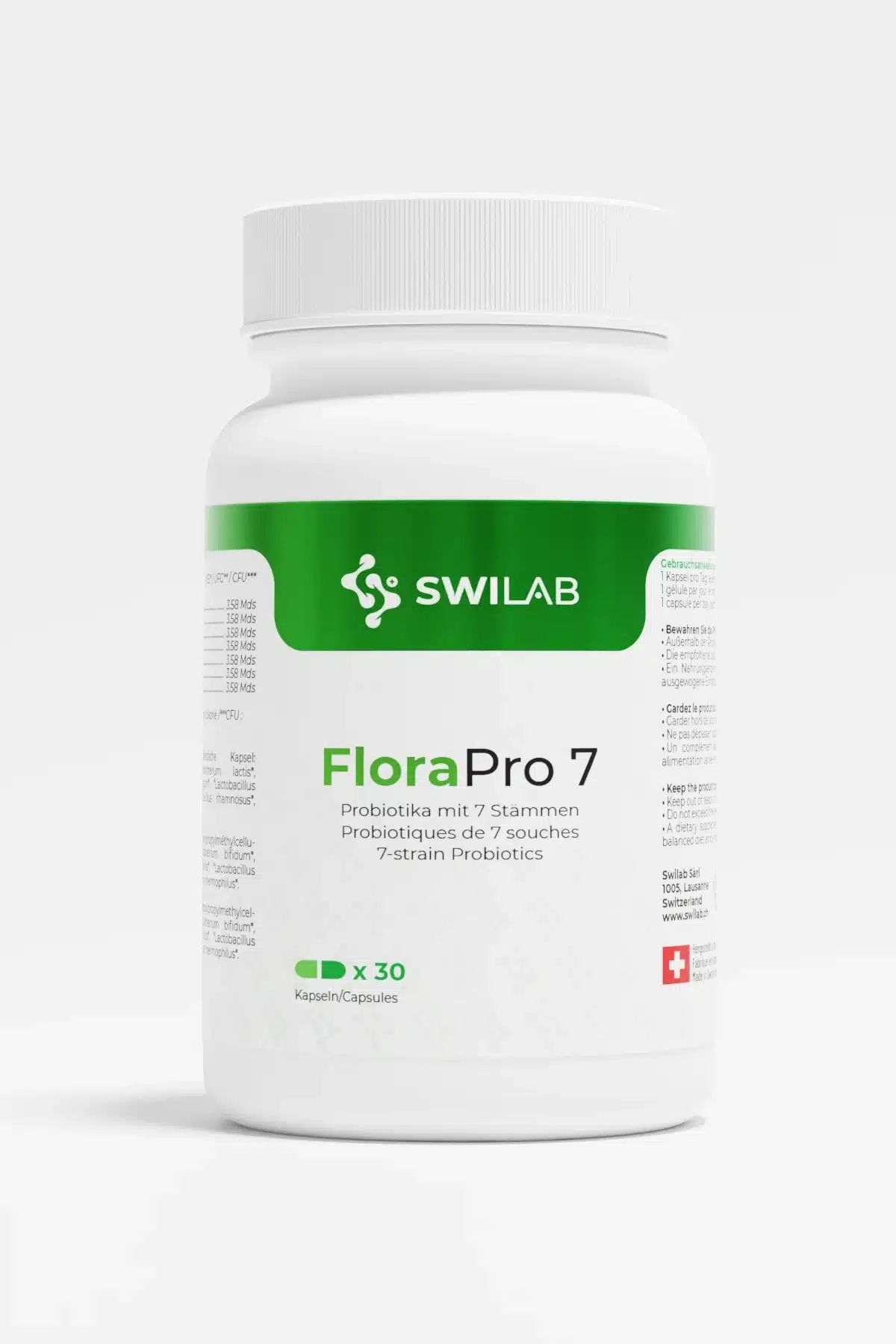
FloraPro 7 — Multi-strain probiotic for the post-antibiotic phase
Our formula combines 7 documented strains with 25 billion CFU per enteric-coated capsule, including L. rhamnosus and B. longum — among the best-documented strains in meta-analyses on antibiotic-associated diarrhoea.
- L. rhamnosus — reference genus against AAD (RR 0.71)
- B. longum — best bacterial efficacy (RR 0.46)
- B. lactis, L. acidophilus — gut barrier support
- HPMC enteric-coated capsules, 25 bn CFU
Food supplement. Does not replace your antibiotic treatment or a varied diet. Consult your doctor if in doubt.
Probiotics and antibiotics in children, the elderly and women
Children on antibiotics: stronger evidence than in adults
A Cochrane review (Guo et al., 2019) covering 33 trials and 6,352 children shows a 55% reduction in AAD risk (RR 0.45) — a clearer result than in adults. At high dose (≥ 5 billion CFU/day), the NNT drops to 6: only 6 children on antibiotics need to be treated with probiotics to protect 1 from diarrhoea.
The strains recommended by ESPGHAN are L. rhamnosus GG and S. boulardii. Dosage must be adapted to age and weight — never use adult-dosed capsules for a child. It is advisable to consult a healthcare professional (paediatrician or pharmacist) to prevent any adverse effects.
Elderly (65+) on antibiotics: timing is everything
The elderly are the population at highest risk of AAD and Clostridioides difficile diarrhoea, due to a naturally weakened immune system and frequent antibiotic exposure for treating bacterial infections. The meta-analysis by Zhang et al. (2022, 8 RCTs, 4,691 patients) reveals a striking finding: probiotics protect elderly patients only if started within the first 48 hours of antibiotic therapy. Two large studies, in which probiotics were started after 48 hours, showed no benefit and were excluded from the main analysis. In elderly patients, every hour counts.
Women on antibiotics: protecting the vaginal flora too
Antibiotics destroy the lactobacilli of the vaginal flora, encouraging the proliferation of Candida albicans (vulvovaginal thrush) and Gardnerella vaginalis (bacterial vaginosis). A meta-analysis of 35 trials and 3,751 patients (Abavisani et al., 2024) shows that adding probiotics as a complement to treatment increases the cure rate for candidiasis by 3.4 times (OR 3.42) and reduces recurrence by 67% (OR 0.33). For bacterial vaginosis, the cure rate is also significantly improved (OR 5.97). The best-documented strains for intimate flora are L. rhamnosus and L. reuteri.
When to seek urgent medical attention
See a doctor immediately if you experience severe or bloody diarrhoea, high fever, signs of dehydration or intense abdominal pain during or following antibiotic treatment. These symptoms may indicate Clostridioides difficile colitis requiring immediate medical treatment. In Switzerland: University Hospital Zurich (Zürich), CHUV (Lausanne), HUG (Geneva).
FAQ — Probiotics and antibiotics
Can you take probiotics at the same time as antibiotics?
Yes, it is recommended from day one. For S. boulardii (yeast), simultaneous intake is possible as antibiotics do not target yeasts. For bacterial probiotics (L. rhamnosus GG, B. longum), space them at least 2 hours apart. Starting within the first 48 hours is essential — beyond that, efficacy drops significantly.
What is the best probiotic to take with an antibiotic?
During the antibiotic: S. boulardii (resistant yeast, RR 0.63). As a complement, 2 hours later: L. rhamnosus GG (RR 0.71) or B. longum (RR 0.46). After the antibiotic: a multi-strain formula such as FloraPro 7 to support diversity. For guidance on choosing, see our guide to probiotics.
How long should you take probiotics after antibiotics?
Throughout the entire treatment, then 2 to 4 weeks after stopping. The gut flora takes 3 to 6 months to recover after a short course, and up to 12 months after a prolonged one. After fluoroquinolones, some species may never return to their original state.
Do antibiotics destroy all probiotics?
Yes for bacteria (Lactobacillus, Bifidobacterium) — they are partially destroyed, hence the 2-hour spacing. No for Saccharomyces boulardii: it is a yeast, unaffected by antibiotics. This is why S. boulardii is the probiotic of choice during treatment.
Do probiotics truly restore gut flora after antibiotics?
The picture is more nuanced than often claimed. Probiotics can help reduce digestive side effects (diarrhoea, bloating), but recent studies do not prove they restore the bacterial diversity of the gut microbiome (Szajewska et al., Nature Reviews, 2024). A study in Cell (Suez et al., 2018) even suggests that certain probiotics could slow the reconstitution of the intestinal mucosa. It is a fibre-rich diet, fermented foods and time that truly restore the gut flora. See our article on the microbiome for restoration protocols.
Should a child take probiotics with antibiotics?
Yes. The paediatric data are robust: a Cochrane systematic review (33 trials, 6,352 children) shows a 55% reduction in diarrhoea risk. At high dose (≥ 5 billion CFU/day), the NNT is 6. The strains recommended by ESPGHAN are L. rhamnosus GG and S. boulardii. It is advisable to consult a healthcare professional (paediatrician or pharmacist) for age-appropriate dosage.
Scientific sources & references (PubMed)
Goodman C. et al. — Probiotics for the prevention of antibiotic-associated diarrhoea: a systematic review and meta-analysis
BMJ Open, 2021, 11(8), e043054. 42 RCTs, 11,305 adults. GRADE: moderate.
DOIGuo Q. et al. — Probiotics for the prevention of pediatric antibiotic-associated diarrhea
Cochrane Database Syst Rev, 2019. 33 RCTs, 6,352 children.
DOIGoldenberg J.Z. et al. — Probiotics for the prevention of C. difficile-associated diarrhea in adults and children
Cochrane Database Syst Rev, 2017. 31 RCTs, 8,672 patients.
DOISzajewska H. et al. — Antibiotic-perturbed microbiota and the role of probiotics
Nat Rev Gastroenterol Hepatol, 2024, 22(3), 155-172.
DOISuez J. et al. — Post-antibiotic gut mucosal microbiome reconstitution is impaired by probiotics
Cell, 2018, 174(6), 1406-1423.
DOIÉliás A.J. et al. — Probiotic supplementation during antibiotic treatment is unjustified in maintaining the gut microbiome diversity
BMC Medicine, 2023, 21, 262. 15 RCTs.
DOIZhang L. et al. — Early use of probiotics might prevent AAD in elderly (>65 years)
BMC Geriatrics, 2022, 22, 562. 8 RCTs, 4,691 elderly patients.
DOIDethlefsen L. & Relman D.A. — Incomplete recovery and individualized responses of the human distal gut microbiota
PNAS, 2010, 108(Suppl 1), 4554-61.
DOISchwartz D.J. et al. — Understanding the impact of antibiotic perturbation on the human microbiome
Genome Medicine, 2020, 12, 82.
DOICusumano G. et al. — The impact of antibiotic therapy on intestinal microbiota: dysbiosis, resistance, and restoration
Antibiotics, 2025, 14(4), 371.
DOIAbavisani M. et al. — Probiotics as adjunct treatment in gynecological infections
Taiwan J Obstet Gynecol, 2024, 63(3), 357-368. 35 RCTs, 3,751 patients.
DOIGuarner F. et al. — World Gastroenterology Organisation Global Guidelines: Probiotics and Prebiotics
J Clin Gastroenterol, 2024, 58(6), 533-553.
DOIThis content is provided for informational purposes only and does not constitute medical advice. Never modify your antibiotic treatment without medical guidance. If you experience side effects or have concerns, consult a healthcare professional (doctor or pharmacist). Food supplements in Switzerland are regulated by the FDHA (Federal Department of Home Affairs) and supervised by the FSVO; probiotic medicines are regulated by Swissmedic. Swilab · Developed and produced in Switzerland