Probiotics Switzerland:
choose well, use well
From definition to proper use — everything you need to know about probiotics. With interactive quiz and comparison table.
What are probiotics?
According to the World Health Organisation (WHO, 2001), probiotics are "live microorganisms which, when administered in adequate amounts, confer a health benefit on the host."¹ The term encompasses not only lactic acid bacteria but also yeasts such as Saccharomyces boulardii.²
Our digestive tract harbours over 100 trillion microorganisms³ — bacteria, yeasts and fungi. This complex ecosystem, the microbiome, plays a key role in digestion, immunity, vitamin synthesis and protection against pathogens.⁴ A healthy microbiome is characterised above all by its diversity: the more varied the bacterial community, the more resilient the organism.⁵
Probiotics are found naturally in fermented foods — yoghurt, kefir, sauerkraut, kimchi or miso. They are also available as dietary supplements when targeted, dosed use is desired.
From laboratory to gut — the journey of a probiotic
Selection & Cultivation
Clinically tested strains are cultivated in controlled bioreactors — strain purity and identity are genetically verified.
Freeze-drying (Lyophilisation)
The bacteria are gently freeze-dried — they enter a dormant state and survive at room temperature until the expiry date.
Gastric-resistant encapsulation
The freeze-dried strains are placed in a gastric-resistant capsule that withstands stomach acid and releases the bacteria only in the small intestine.
Gut colonisation
In the small intestine, the bacteria reactivate, compete with pathogens and support local immunity — the process begins within hours.
The main probiotic families
| Family | Key strains | Characteristics | Documented indications |
|---|---|---|---|
| Lactobacillus | L. acidophilusL. rhamnosus GGL. reuteriL. casei | Lactic acid bacteria naturally present in the digestive system. Produce lactic acid against harmful bacteria. | Antibiotic-associated diarrhoea⁶ (L. rhamnosus GG), urinary tract infections⁷ (L. reuteri), lactose intolerance⁸ (L. acidophilus) |
| Bifidobacterium | B. longumB. bifidumB. breveB. infantis | Dominant bacteria in the infant microbiome. Ferment prebiotic fibres and produce short-chain fatty acids. | Irritable bowel syndrome⁹ (B. infantis), inflammatory bowel disease — supportive¹⁰ (B. bifidum) |
| Streptococcus | S. thermophilus | Used in yoghurt production. Improves lactose digestion. | Lactose digestion¹¹, immune stimulation |
| Saccharomyces | S. boulardii | Unique probiotic yeast. Remains active even during antibiotic use, as antibiotics do not affect yeasts. | Antibiotic-associated diarrhoea¹², traveller's diarrhoea¹³, C. difficile¹⁴ |
What disrupts the balance of the gut microbiome?
💊 Antibiotics
Eliminate not only pathogens but also beneficial bacteria — often long-term.¹⁵
😰 Chronic stress
Increases intestinal mucosal permeability and promotes pathogenic bacteria.¹⁶
🍔 Unbalanced diet
Low in fibre and high in sugar — reduces bacterial diversity.¹⁷
👴 Ageing
Bacterial diversity naturally declines from age 65.¹⁹
What buying criteria matter?
Taking antibiotics? → See the "Which are the best" section — L. rhamnosus GG and S. boulardii are particularly well documented here.
Digestive issues? → In the "Which are the best" section, you will find the clinically tested Bifidobacterium strains.
Boost immunity preventively? → In the "How do they help" section, you will find the strains with the strongest immunomodulatory evidence.
For a child or infant? → The "Which are the best" section covers paediatric Bifidobacterium strains.
🇨🇭 Probiotics in Switzerland — what you need to know
FSVO regulation: stricter than the EU
In Switzerland, probiotics are regulated as food supplements under food legislation (FLIA / NEM Ordinance) — not as medicines. The Federal Food Safety and Veterinary Office (FSVO) applies EFSA guidelines for health claims and prohibits any unauthorised therapeutic claims. In practice: a Swiss manufacturer cannot write "cures irritable bowel syndrome" — only documented and approved formulations may be used. A product marked "FSVO-compliant" guarantees that all label claims are scientifically substantiated and verified by the authorities.
KVG: no reimbursement
Probiotics are not covered by mandatory health insurance (KVG/LAMal) in Switzerland — they are entirely at the patient's expense. Some supplementary insurance plans (VVG/LCA) may partially reimburse dietary supplements: check your individual policy or contact your health insurer. Exception: in rare cases, a doctor may prescribe a probiotic as a magistral preparation, which may allow partial coverage.
Where to buy probiotics in Switzerland?
Switzerland has one of the highest pharmacy densities in Europe — 1,830 pharmacies for 8.9 million inhabitants (pharmaSuisse, 2024). This ensures easy access to qualified advice. Comparison of the three purchase channels:
How do probiotics
support health?
Probiotics work through a combination of biological processes at three levels: microbiome regulation, intestinal barrier strengthening and immune system modulation.²¹ The following overview presents the key benefits — with evidence level indicated.
Digestive support
Probiotics support nutrient absorption and help prevent digestive issues such as constipation, diarrhoea and bloating.²²
Immune system support
Certain strains stimulate antibody production and activate immune cells — a large part of the immune system resides in the gut.²³
Irritable bowel syndrome
B. infantis and L. rhamnosus show significant reduction in abdominal pain and bloating after 6 to 8 weeks in controlled studies.²⁴
Psychological wellbeing
Via the gut-brain axis, certain strains can influence serotonin production. Early studies show a reduction in stress and anxiety symptoms.²⁵
Weight management
L. rhamnosus and B. lactis have been associated with moderate visceral fat reduction in controlled studies — not a substitute for a balanced diet.²⁶
Nutrient absorption and energy
Probiotics optimise the absorption of vitamins (B12, K2) and produce short-chain fatty acids to nourish intestinal cells.²⁷
Skin health
Via the gut-skin axis, probiotic strains can alleviate inflammatory conditions such as eczema and acne.²⁸
Inflammatory bowel disease
In Crohn's disease and ulcerative colitis, certain strains show a supportive effect. Probiotics do not replace medical treatment.²⁹
Limitations of current research
Many RCTs include fewer than 200 participants — transferability to large population groups remains limited.
Most clinical studies last 4 to 12 weeks. Long-term effects beyond one year are poorly studied.
There is no scientific consensus that doses above 50 billion CFU provide a measurable additional benefit.
Studies with positive results are published more frequently — negative results remain underrepresented.
Which probiotics
are the best?
There is no universally "best" solution — efficacy depends on strain selection, dosage and the individual situation.³² The first step to making the right choice is understanding the quality criteria.
The 5 quality criteria
CFU count
At least 10 billion CFU per daily dose. For specific indications (antibiotic diarrhoea), studies recommend 25 billion+.³³
Strain diversity
Multiple documented strains — provided they do not inhibit each other.³⁴
Gastric resistance
Gastric-resistant encapsulation is essential — without protection, up to 90% of bacteria do not survive stomach passage.³⁵
Clinical documentation
Each strain should have been tested in at least one RCT (randomised controlled trial).³⁶
Stability until expiry
The product must guarantee the declared CFU count until the expiry date — not just at the time of manufacture. Freeze-dried strains offer the best stability at room temperature.³⁷
The right probiotic for your profile
| Your profile | Recommended strains | CFU / day | Duration | Note |
|---|---|---|---|---|
| 💊 After antibiotics | L. rhamnosus GGS. boulardii | 25 billion+ | 4–8 weeks | Start simultaneously³⁸ |
| 🤢 Irritable bowel syndrome | B. infantisB. longumL. rhamnosus | 10–25 billion | 8–12 weeks | Longer course needed³⁹ |
| 🛡️ Immune prevention | L. acidophilusB. bifidumL. reuteri | 10–25 billion | 4–12 weeks | Multi-strain preferred⁴⁰ |
| ✈️ Traveller's diarrhoea | S. boulardii | 25 billion | 5 days before + travel duration | 5 days before departure⁴¹ |
| 👶 Infant / Child | B. infantisB. breveL. reuteri | Age-appropriate | As per doctor | ⚠ Consult paediatrician⁴² |
| 👴 Seniors (65+) | B. longumL. acidophilusB. bifidum | 10–25 billion | Regular courses | 2–3× per year⁴³ |
Find your probiotic in 3 steps
Personal recommendation
3 questions · about 1 minute
Product comparison
| Criterion | Florapro-7 🇨🇭 Swilab | Pharmacy standard | Basic product |
|---|---|---|---|
| CFU per daily dose | 25 billion | 10–15 billion | 1–5 billion |
| Number of strains | 7 documented strains | 3–5 strains | 1–2 strains |
| Gastric protection | ✓ Included | Variable | ✗ Often not |
| Clinically doc. strains | ✓ All strains | Partially | ✗ Rarely |
| Freeze-dried strains | ✓ Yes | Partially | ✗ Rarely |
| Stability until expiry | ✓ Guaranteed | Not always | ✗ Often not guaranteed |
| Made in Switzerland | 🇨🇭 Yes — Swiss quality | ✗ Generally not | ✗ Generally not |
| FSVO-compliant (Switzerland) | ✓ Yes | EFSA / variable | Not always verifiable |
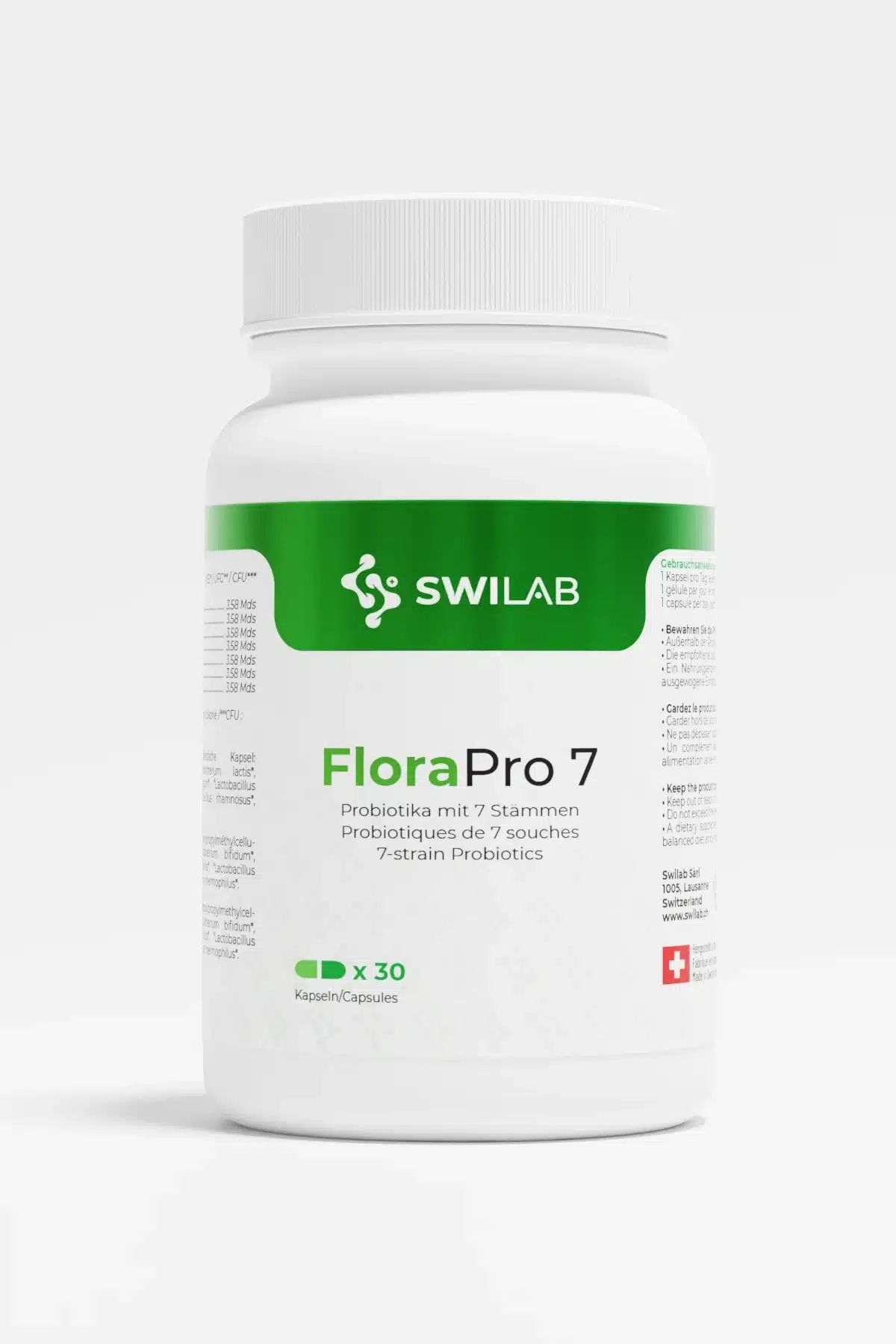
Florapro-7 — The Swiss probiotic by Swilab
Florapro-7 combines 7 carefully selected strains from the Lactobacillus, Bifidobacterium and Streptococcus families. With 25 billion CFU per gastric-resistant capsule and freeze-dried strains, developed and produced in Switzerland to FSVO standards.
- Synergy of 7 clinically documented strains
- 25 billion CFU per gastric-resistant capsule
- Freeze-dried strains — stable until expiry date
- Development and production in Switzerland
- FSVO-compliant — no unsubstantiated health claims
⚠️ For specific medical indications such as Crohn's disease or ulcerative colitis, we recommend consulting a doctor before starting a probiotic course.
How to
take probiotics?
Efficacy does not depend solely on strain selection — the timing and method of intake directly influence the number of live bacteria that actually reach the gut. Incorrect intake can reduce the effect by up to 90%.⁴⁴
1. The right time
Studies show that probiotics are most effective when taken just before or during a meal — particularly with a moderate fat content.⁴⁵ Dietary fats also protect the bacteria against stomach acid.
2. Dosage by indication
| Situation | CFU / day | Intake duration |
|---|---|---|
| General prevention | 10–15 billion | 4–8 weeks |
| After antibiotics | 25 billion+ | 4–8 weeks after end of course |
| Irritable bowel syndrome | 10–25 billion | 8–12 weeks |
| Traveller's diarrhoea (prevention) | 25 billion | 5 days before + travel duration |
| Acute diarrhoea | 25–50 billion | 5–7 days |
⁴⁷ A higher dose is not automatically more effective — what matters is that the bacteria reach the gut alive.
3. Regularity
Probiotic strains do not generally colonise the gut permanently — they disappear within days to weeks after stopping.⁴⁸ Daily intake at a fixed time optimises colonisation density. Stopping and restarting when symptoms arise is a valid strategy.
4. Course duration
The minimum duration for a measurable effect is 4 weeks.⁴⁹
First changes
First measurable changes in the composition of the gut microbiome.
Significant effect
Significant reduction of irritable bowel symptoms in clinical studies.
Optimal effect
Optimal effect for chronic digestive issues after 12 weeks.
No immediate effect
Do not expect effects in the first 5 to 7 days — the process is gradual.
5. Prebiotic support
Probiotics are measurably more effective in combination with prebiotic foods — non-digestible fibres that serve as food for probiotic bacteria.⁵⁰
| Food | Active compound | Main effect |
|---|---|---|
| Chicory, Jerusalem artichoke | Inulin | Strongest prebiotic effect⁵¹ |
| Garlic, onions, leeks | Fructooligosaccharides (FOS) | Bifidobacterium growth |
| Artichokes | Inulin + FOS | Combined effect |
| Oats, barley | Beta-glucan | Immunomodulation + digestion |
| Green bananas | Resistant starch | Short-chain fatty acids |
6. Storage
Room temperature
Dry, away from light — no refrigeration needed. Best option for daily use and travel.⁵³
Refrigerator 2–8°C
Short shelf life after opening. More sensitive to temperature variations.
Cool and dry
Consume immediately after opening. Never store near heat sources.
Heat and humidity
Never store on windowsills, near the bathroom or in the car.
Taking antibiotics? → Start simultaneously. Choose S. boulardii — as a yeast, it is unaffected by antibiotics.
Irritable bowel syndrome? → Allow a minimum of 8 to 12 weeks. Shorter courses do not show measurable efficacy in studies.
Travelling to a high-risk region? → Start 5 days before departure and take daily throughout the trip.
Senior (65+)? → 2 to 3 courses per year of 4 to 8 weeks each. Regular courses are better supported by evidence than continuous intake.
Summary
What science knows with certainty today — and what remains open.
✅ Scientifically well established
- Probiotics significantly reduce antibiotic-associated diarrhoea⁶
- B. infantis alleviates irritable bowel symptoms after 6 to 8 weeks⁹
- A diverse microbiome correlates with better immunity⁵
- The combination of probiotics + prebiotics is more effective than probiotics alone⁵⁰
- Gastric protection is decisive for efficacy³⁵
⚠️ Promising, not yet conclusive
- Gut-brain axis and psychological wellbeing²⁵
- Role in weight management²⁶
- Effect on inflammatory skin conditions²⁸
- Support in Crohn's disease and ulcerative colitis²⁹
📌 What always applies
- The effect is strain-specific — no result is transferable to other strains³¹
- Dosage, intake form and course duration are just as important as strain selection⁴⁴
- Probiotics do not replace medical treatment for diagnosed conditions
- ⚠️ Severely immunocompromised individuals (transplant recipients, HIV stage C, haematological diseases): probiotics only on medical advice — increased risk of bacterial translocation
- In Switzerland, probiotics are regulated by the FSVO — prefer FSVO-compliant products
Frequently
asked questions
Probiotics are live microorganisms which, in adequate amounts, confer a health benefit (WHO, 2001). They include bacterial strains such as Lactobacillus and Bifidobacterium as well as yeasts such as Saccharomyces boulardii. Read the full Section 1.
At least 10 billion CFU per daily dose for general prevention. For antibiotic-associated diarrhoea or irritable bowel syndrome, studies recommend 25 billion CFU or more. A higher dose is not automatically more effective — what matters is that the bacteria reach the gut alive.
Intake is most effective just before or during a meal — food buffers stomach acidity and increases the survival rate of the bacteria. Never take with hot drinks above 40°C. More details in Section 4.
The minimum duration for a measurable effect is 4 weeks. For irritable bowel syndrome, studies recommend 8 to 12 weeks. Probiotic strains do not permanently colonise the gut — the positive effect only persists with regular intake.
Certain strains such as B. infantis, B. breve and L. reuteri are suitable for infants and children. A paediatric consultation is mandatory before any intake. Do not use adult preparations — dosage and strains must be age-appropriate.
For antibiotics: start simultaneously — S. boulardii, as a yeast, remains active even during antibiotic use. For immunosuppressants, chemotherapy agents or other prescription medications, consult your doctor or pharmacist before intake.
Complete list
of sources
Section 1 — What are probiotics?
Section 2 — How do probiotics support health?
Section 3 — Which probiotics are best?
Section 4 — How to take probiotics?
This content is provided for informational purposes only and does not constitute medical advice. For any personal health questions, consult a doctor or pharmacist. Swilab · Developed and produced in Switzerland 🇨🇭