
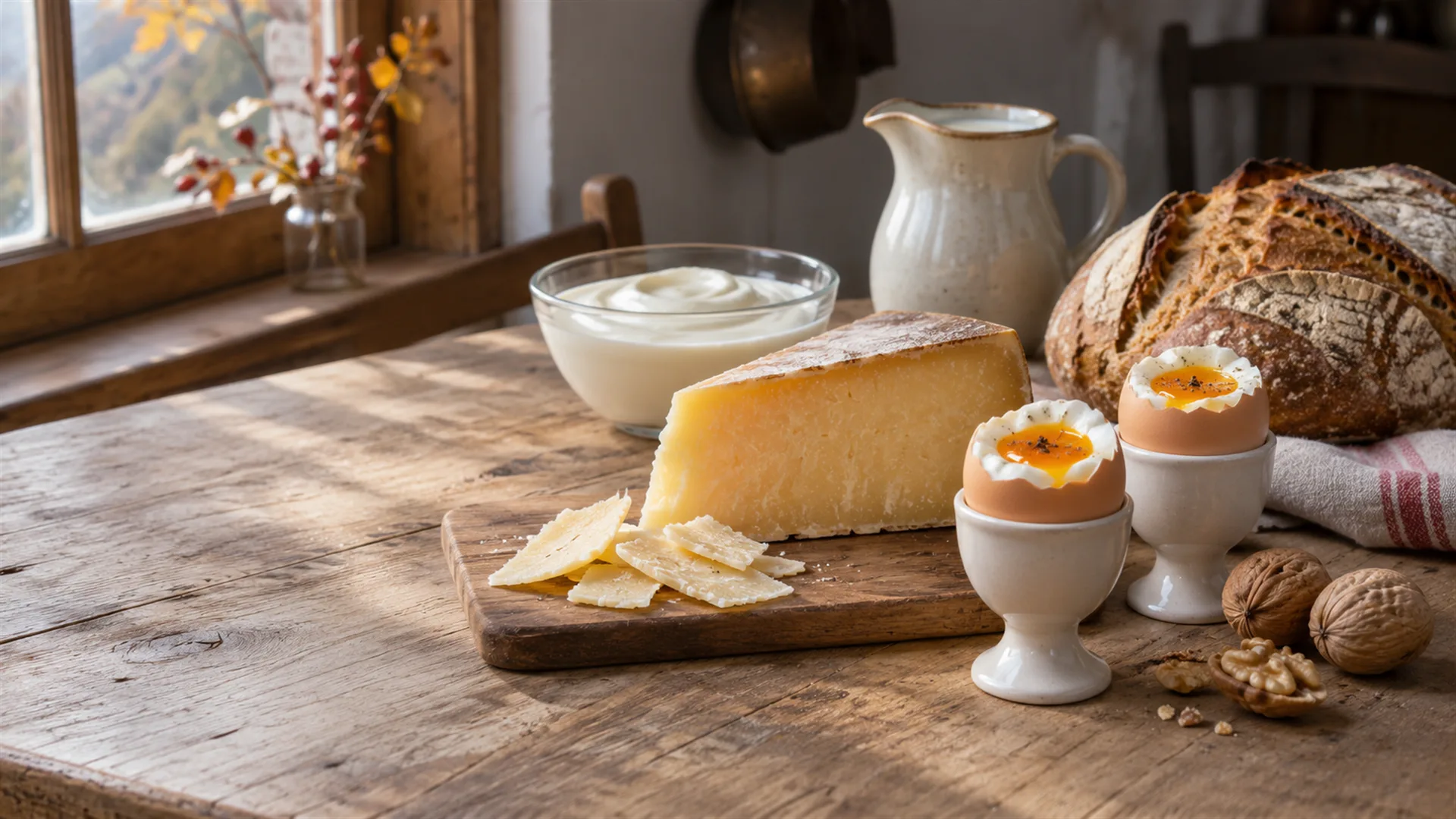
 AI-generated image
General Health · 2 min read
Stopped eating meat? This Swiss cheese has the most vitamin B12, and it isn't raclette
Without meat or fish, vitamin B12 needs a little attention. Among Swiss cheeses, one stands out, and it isn't raclette.

You've taken meat off the menu, or almost. Then a question comes up: where do you get vitamin B12? It is found, in principle, in foods of animal origin, the Swiss Society for Nutrition (SSN) points out1. Without meat or fish, meeting the recommended intake becomes harder1.
The good news for anyone still eating eggs and dairy: they are good sources of vitamin B121. And Swiss cheese has a surprise in store.
Seaweed won't do the job
A little can be found in sauerkraut, nori seaweed and shiitake mushrooms, the SSN notes. But it doesn't consider them reliable sources: the amounts are very low or vary widely1. Plain tofu contains none at all, according to the federal Swiss Food Composition Database2.
Raclette isn't on top
Here is how much vitamin B12 some Swiss cheeses provide, in micrograms (µg) per 100 g2:
- Appenzeller: 1.06 µg.
- Gruyère: 1.45 µg.
- Raclette cheese: 1.55 µg.
- Tête de Moine: 1.6 µg.
- Vacherin fribourgeois: 1.62 µg.
- Tilsiter, pasteurised milk: 1.64 µg.
- Emmentaler: 1.67 µg.
All of them are rich in vitamin B12. Yet two Swiss cheeses top the 2 µg mark.
Sbrinz beats them all
The winner is Sbrinz, with 2.07 µg per 100 g2. It edges out Vacherin Mont-d'Or, at 2.06 µg. The surprise: Vacherin is the only soft cheese in the ranking2.
For the law to call a food "rich" in this vitamin, it needs at least 0.75 µg per 100 g3. Sbrinz has almost three times that. Vitamin B12 contributes to normal functioning of the nervous system. A varied and balanced diet and a healthy lifestyle remain the basis.
Eggs and dairy count too
Cheese isn't alone. A raw whole egg provides 1.31 µg per 100 g2. Hard-boiled, it gives 1.16 µg2. Cottage cheese has 0.52 µg, plain yogurt 0.3 µg2.
The SSN and the Federal Food Safety and Veterinary Office (FSVO) recommend two to three portions of dairy a day4. A portion of hard cheese is 30 g. For Sbrinz, that makes 0.62 µg2.
The SSN is clear, though: at the usual amounts, dairy and eggs don't cover the desired intake1. In its view, it can therefore make sense to add fortified foods or, if needed, a vitamin B12 supplement after seeking a professional's advice1.
The small catch
These figures are averages from the federal database, in its July 2026 version2. They don't measure the cheese you buy today. And across the whole database, a foreign cheese, Limburger, even beats Sbrinz with 2.18 µg2.
For anyone who has said goodbye to steak, the Swiss cheese board still deserves a place of honour. And Sbrinz deserves the top spot.
Sources
5 sources- Swiss Society for Nutrition (SSN). Fact sheet « Alimentation ovo-lacto-végétarienne », 2022, French original (no English version), supported by the FSVO. Feuille d'information de la société savante, copie locale dans sources/. lien
- Federal Food Safety and Veterinary Office (FSVO). Swiss Food Composition Database, generic foods, version 7.1 of 1 July 2026. Base de données officielle. lien
- FDHA Ordinance of 16 December 2016 on Food Information (OIDAl, SR 817.022.16), annexes 10, 13 and 14, status as of 1 July 2025. Texte légal. lien
- Swiss Society for Nutrition (SSN) and FSVO. Swiss dietary recommendations for adults, long version, 2024. Recommandations officielles. lien
- Federal Food Safety and Veterinary Office (FSVO). Swiss nutrient reference values, June 2022 version. Valeurs de référence officielles. lien