
Vitamin E: role, sources and deficiency
In brief
Vitamin E is a fat-soluble antioxidant: its only recognised role is to contribute to the protection of cells from oxidative stress. It is easily found in vegetable oils, seeds and nuts, and green vegetables, and for most people a varied diet is enough. A true deficiency is rare. Conversely, high-dose supplements bring no proven benefit and can carry risks.
Key facts
Key points
- Vitamin E is a fat-soluble antioxidant; the only thing that can be stated is that it contributes to the protection of cells from oxidative stress.
- Its best sources are vegetable oils (wheat germ, sunflower), seeds and nuts (almonds, hazelnuts, sunflower seeds), avocado and spinach.
- A varied diet covers the requirement (about 15 mg a day in adults); a true deficiency is rare.
- Deficiency mainly concerns fat-absorption disorders (cystic fibrosis, liver or intestinal disease) and very premature babies.
- High doses prevent no disease and have been linked to risks: higher mortality, haemorrhagic stroke, prostate cancer.
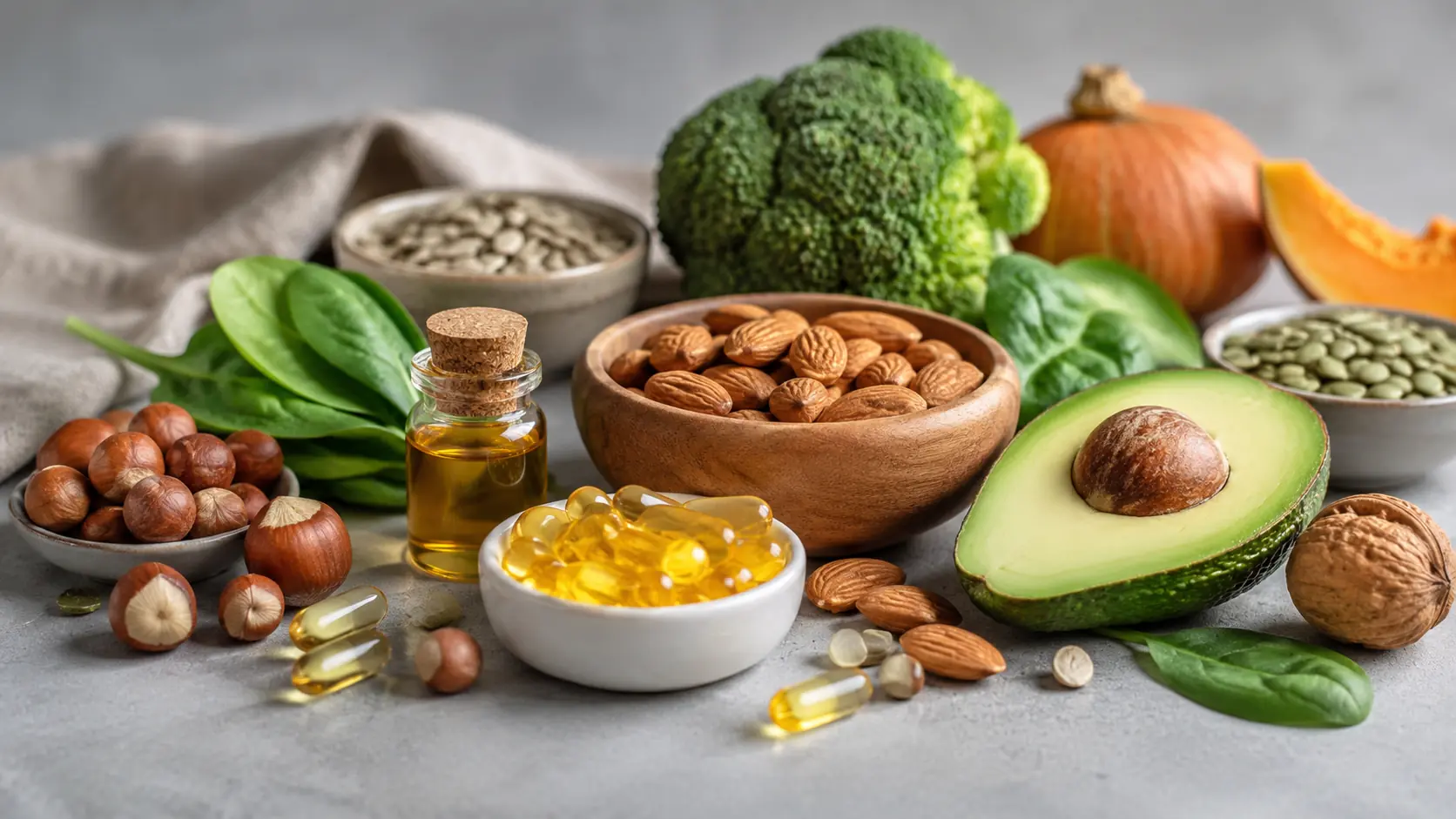
Vitamin E is a fat-soluble antioxidant: it dissolves in fats, and its recognised role is to contribute to the protection of cells from oxidative stress: the wear that unstable molecules, free radicals, inflict on the components of the cell[1]. It is found easily in vegetable oils, seeds and nuts, and green vegetables, and that is in fact the only property a label is allowed to attribute to it[8].
Three simple ideas sum up the topic. For most people, a varied diet covers the requirement (about 15 mg a day in adults)[3]. A true deficiency is rare and mainly concerns people who digest fats poorly[2]. And contrary to a widespread idea, a high dose does not protect better: several large studies have even linked it to risks[4][6].
What is vitamin E for, and what can really be said?
An antioxidant that protects cells
Vitamin E is not a single molecule but a family of eight compounds: four tocopherols and four tocotrienols. It is an essential nutrient: the body cannot make it, so it has to come from food. The form the body keeps and uses first is called alpha-tocopherol[1]. Being fat-soluble, it sits in the cell membrane, those thin envelopes made of fat, where its antioxidant properties protect those fats: it neutralises free radicals and slows the oxidation of fatty acids, a chain reaction known as lipid peroxidation, that would otherwise damage the cell[2]. Once it has acted, other antioxidants such as vitamin C or coenzyme Q10 help regenerate it.
A little history: vitamin E was discovered in 1922 by two American researchers, Herbert Evans and Katharine Bishop, as a factor essential to reproduction. Its scientific name, “tocopherol”, actually comes from the Greek and roughly means “to carry a pregnancy”. It was a Swiss chemist, Paul Karrer, a Nobel laureate in chemistry, who achieved the first synthesis in the late 1930s.
What vitamin E does not do (the promises to forget)
Everywhere you read that vitamin E “rejuvenates the skin”, “boosts immunity” or “protects the heart”. Be careful: these promises go beyond what the law allows and what science has shown. Oxidative stress is indeed involved in cell ageing and cardiovascular disease, and vitamin E was once expected to shield the “bad” LDL cholesterol from oxidation, but taking more of it does not prevent these diseases. A large research synthesis, covering hundreds of thousands of participants, found no benefit of antioxidant supplements, including vitamin E, in reducing mortality; vitamin E even slightly increased the risk[5]. In other words, covering your requirement is useful; adding more in capsule form does not make someone who lacks nothing any healthier.
Where to find vitamin E in food?
Foods high in vitamin E: the best sources
Vitamin E is abundant in the plant kingdom, especially where there is fat: oils, seeds and nuts (almonds, hazelnuts, walnuts). The table below gives benchmarks for vitamin E content, per usual serving. To put it in perspective: the recommended requirement in adults is around 15 mg a day[3], and a single handful of seeds or almonds already provides a good part of it.
| Food | Vitamin E (usual serving) | Good to know |
|---|---|---|
| Wheat germ oil | ≈ 20 mg per tablespoon | The most concentrated source. Use raw, as a dressing. |
| Sunflower seeds | ≈ 7 mg per handful (30 g) | About half the daily requirement in a snack. |
| Almonds | ≈ 7 mg per handful (30 g) | Easy to carry; also provide “good fats”. |
| Sunflower oil | ≈ 6 mg per tablespoon | Common and inexpensive, ideal as a cold dressing. |
| Hazelnuts | ≈ 4 mg per handful (30 g) | Good plant source, to alternate with other nuts. |
| Avocado | ≈ 2 mg per half avocado | A more modest source, but easy to include daily. |
| Spinach (cooked) | ≈ 2 mg per serving | Among the best green leafy vegetables for vitamin E. |
Food first
A natural, varied diet covers the bulk of vitamin E needs, without having to think about it. A few habits help: prefer raw vegetable oils as a dressing (heat and refining reduce the content), snack on seeds and nuts rather than sweets, and give a place to green vegetables and avocado. Eating well remains the foundation; capsules are at best a complement: not a substitute.
Vitamin E deficiency: who’s concerned, and what signs?
A rare deficiency, almost always linked to absorption
A vitamin E deficiency is very rare in a healthy person who eats normally[3]. It almost always occurs when the body absorbs fats poorly: and therefore the fat-soluble vitamins too: cystic fibrosis, liver diseases that block bile (cholestasis), intestinal diseases such as Crohn’s disease or short bowel syndrome, or rare genetic diseases of fat transport[2]. Very premature babies are also exposed, as they are born with low stores[3].
The symptoms of a true deficiency
When the deficiency sets in, it mainly affects the nervous system, which is particularly sensitive to oxidation: balance and coordination problems, tingling, reduced sensation, muscle weakness, sometimes damage to the eyes and vision[2]. In infants it can weaken the red blood cells and cause anaemia[2]. These signs are not specific: only a doctor can make the connection, if needed with a blood test that measures vitamin E levels (alpha-tocopherol).
- 1Eat varied food: raw vegetable oils, seeds and nuts, green vegetables and avocado cover most people’s needs.
- 2In case of a known digestive disease with poor fat absorption, or in a very premature baby, monitoring vitamin E is the doctor’s job.
- 3Faced with unexplained balance problems, tingling or weakness, see a professional: without self-diagnosing a deficiency or supplementing blindly.
The right move
Before thinking “supplement”, think “plate”. A few raw vegetable oils, a handful of seeds and nuts a day and some green vegetables are enough for most people. And don’t confuse a slightly low intake, common and harmless, with a deficiency with symptoms, which is rare and warrants medical advice.
Vitamin E supplements: useful or risky?
At high doses, the risk-benefit balance reverses
Since vitamin E is a powerful antioxidant, it was long hoped that high doses would protect the heart or prevent cancer. The large clinical trials disappointed: and even raised concern. An analysis of dozens of trials and more than 135’000 people linked high doses, from about 400 international units a day, to a rise in all-cause mortality[4]. A very large American trial observed, in healthy men taking 400 units a day, an increase in prostate cancer cases[6]. And a large analysis linked vitamin E to a higher risk of haemorrhagic stroke: a bleed in the brain[7].
What the law allows (and what it forbids)
On a supplement, only one thing can be written about vitamin E: that it “contributes to the protection of cells from oxidative stress”[8]. Promises such as “anti-ageing”, “good for skin and hair”, “boosts immunity” or “protects the heart” are, for this vitamin, neither authorised nor proven[5]. The underlying rule is simple: no food or supplement prevents, treats or cures a disease.
A word on the forms. On the label, natural vitamin E (of plant origin) differs from the synthetic version: at an equal dose, the body retains the natural form a little better[3]. The essentials, though, stay the same: it is a nutrient, not a medicine, and no form, natural or not, “cures” anything.
- “Anti-ageing” or “repairs the skin” through ingested vitamin E: not authorised and not proven.
- “Protects the heart” or “prevents cancer”: not authorised, and the trials show no benefit.
- Mega-doses “to top up on antioxidants”: with no proven benefit and potentially risky.
More is not better
Two concrete precautions about side effects and interactions. At high doses, vitamin E can impair blood clotting: caution is needed with anticoagulant (“blood-thinning”) treatment and before surgery[3][7]. And the authorities set a safety limit that some high-dose supplements exceed: there’s no point, and it’s not advisable, to stack up units to “load up” on antioxidants: that’s where the risk of overdose and toxicity lies. At a dietary dose, by contrast, vitamin E poses no such problem.
Frequently asked questions
What is the role of vitamin E in the body?
Vitamin E is a fat-soluble antioxidant: it contributes to the protection of cells from oxidative stress: the wear caused by unstable molecules. This is the only health claim authorised in Europe and Switzerland for this vitamin. It also protects the fats that make up our cell membranes. On the other hand, no benefit has so far been shown for preventing heart disease or cancer in someone who is already well nourished.
What are the signs of a vitamin E deficiency?
A true deficiency is rare and mainly affects people who digest fats poorly (cystic fibrosis, liver or intestinal disease) and very premature babies. When it sets in, it shows up mainly in the nerves: balance and coordination problems, tingling, muscle weakness, sometimes vision problems. These signs are not specific: only a doctor can make the connection, if needed with a blood test. You don’t diagnose a vitamin E deficiency on your own.
Which foods are richest in vitamin E?
The champions are vegetable oils, led by wheat germ oil, then sunflower oil. Next come seeds and nuts, sunflower seeds, almonds, hazelnuts, then avocado and green leafy vegetables such as spinach. A small handful of almonds or sunflower seeds already covers a good part of the daily requirement. For most people, a varied diet easily covers vitamin E needs.
Which oil is richest in vitamin E?
It’s wheat germ oil: one of the most concentrated food sources of vitamin E. Sunflower oil comes next, followed by safflower, soybean and olive oils. Used raw, as a dressing, these oils provide vitamin E without you having to think about it. One tablespoon of sunflower oil already provides an appreciable share of an adult’s daily requirement.
Should you take a vitamin E supplement?
For most people who eat varied food, no: diet covers the requirement, and a true deficiency is rare. Supplementation is mainly of medical interest in cases of poor fat absorption, under a professional’s supervision. Conversely, high-dose supplements have not shown any benefit for preventing disease, and several large studies have even flagged risks. Before supplementing, it’s better to talk to a doctor or pharmacist.
Is vitamin E dangerous at high doses?
In the amounts provided by food, no. The risk concerns high-dose supplements. From 400 international units a day, large analyses have linked vitamin E to a rise in all-cause mortality, a higher risk of haemorrhagic stroke (a bleed in the brain) and, in men, of prostate cancer. At high doses it can also impair blood clotting: caution with anticoagulant treatment or before surgery. Better not to exceed the recommended doses.
Sources and references (verified on PubMed)
8 sources- Traber M.G. (2014). Vitamin E inadequacy in humans: causes and consequences.
- Lobo L.M.C. & Hadler M.C.C.M. (2022). Vitamin E deficiency in childhood: a narrative review.
- National Institutes of Health, Office of Dietary Supplements. Vitamin E — Fact Sheet for Health Professionals.
- Miller E.R. et al. (2005). Meta-analysis: high-dosage vitamin E supplementation may increase all-cause mortality.
- Bjelakovic G. et al. (2012). Antioxidant supplements for prevention of mortality in healthy participants and patients with various diseases.
- Klein E.A. et al. (2011). Vitamin E and the risk of prostate cancer (SELECT trial).
- Schürks M. et al. (2010). Effects of vitamin E on stroke subtypes: meta-analysis of randomised controlled trials.
- European Commission. Register of nutrition and health claims (Regulation (EU) No 432/2012).