
Collagen: two different products under the same name
In brief
The word collagen actually covers two unrelated products, sold side by side. For the skin, these are hydrolysed peptides taken by the spoonful, and a meta-analysis of 19 randomised trials shows a clear improvement in hydration and radiance, with a more modest effect on wrinkles. For the joints, it is native type II collagen at 40 milligrams, hundreds of times less: a 24-week trial reports a gain in knee mobility, but three of its authors work for the manufacturer of the ingredient tested. Buying the wrong one of the two means paying for a goal the product is not aiming at.
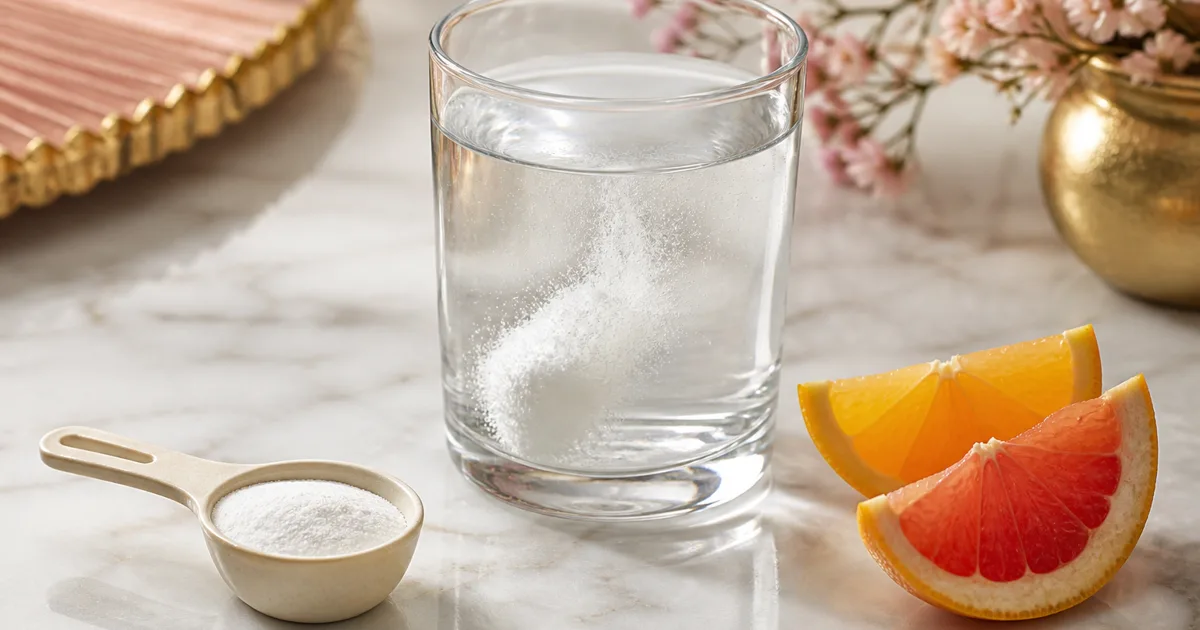
The collagen shelf is one of the most confusing on the market. Two neighbouring boxes display the same word in large type, one containing ten grams of powder per serving, the other forty milligrams in a small capsule. A factor of two hundred and fifty, under the same name, with nothing explaining why.
This is not an anomaly: they are two different products, with two mechanisms and two goals. This article separates them, examines what each has demonstrated, and flags who funded the studies. It is for information and does not replace the advice of a health professional.
Two products behind a single word
Hydrolysed collagen peptides
Collagen of animal origin is cut here into short fragments by hydrolysis, which makes it soluble and easy to swallow. The doses used are counted in grams, typically 2.5 to 10 g per day, and the target is the skin, sometimes nails and hair.
Native type II collagen
Here the molecule is not cut up: it is kept in its native form, in a very small quantity. The reference dose is 40 milligrams per day, and the target is the joint. The presumed mechanism is not to supply raw material but to act on the immune response at gut level.
Why the confusion is costly
Someone thinking of their knees who buys hydrolysed peptides is taking a product studied for the skin. Conversely, someone wanting to improve their skin who buys 40 mg of native collagen is taking a dose that has never been tested for that goal. In both cases the product is not bad: it simply does not match the expectation.
| Hydrolysed peptides | Native type II collagen | |
|---|---|---|
| Usual dose | 2.5 to 10 g per day | 40 mg per day |
| Target studied | Skin, hydration, radiance | Joint mobility |
| Proposed mechanism | Absorbed fragments, signal to skin cells | Action on the gut immune response |
| Format | Powder to dissolve, sachets | Small capsule |
The skin side: what 19 trials show
The synthesis available
A systematic review with meta-analysis brought together 19 randomised trials and 1,341 participants, covering peptides taken orally or applied to the skin[1]. That is a solid basis for a judgement, all the more so as the methodological quality of the trials was assessed.
The results
The peptides, particularly in oral form, significantly improved skin hydration and radiance. The effect on wrinkles exists but remains modest, and it is essentially driven by orally taken polypeptides[1]. On elasticity and density, results are inconsistent from one trial to the next.
The authors’ conclusion
They consider these peptides to be safe, non-invasive anti-ageing agents, well tolerated, while calling for larger trials with standardised criteria and histological assessment[1]. In practical terms: the effect is real on hydration, more discreet on wrinkles, and you should not expect a powder to do what a dermatological treatment does.
The joint side: one trial, and an important detail
The protocol
Ninety-six healthy people, aged 20 to 55 and experiencing knee discomfort during a standardised exercise test, were randomly given either a placebo or 40 mg of native type II collagen per day for 24 weeks, double-blind and multicentre[2]. None had osteoarthritis or any known joint disease.
The results
Knee flexion range increased by 3.2 degrees in the treated group, against 0.2 degrees on placebo. Among participants over 35, the gap was wider: 6.8 degrees against 0.3[2]. The effect therefore concerns measured joint flexibility, not a disease.
The detail worth knowing
Three of this trial’s authors belong to the research and development department of the company that produces the ingredient tested[2]. The methodology remains sound, with placebo and double blinding, but this information is part of the picture. In this market, a large share of trials is funded by the manufacturers of patented ingredients, and readers deserve to know it.
The mechanism, without myth or caricature
The classic objection
“Swallowed collagen is digested like any other protein, it cannot reach the skin.” The objection is right in principle: proteins are indeed broken down into amino acids and small fragments by digestion. It misses, however, what the research actually examines.
What is being studied
The hypothesis under test is not that ingested collagen goes and sticks to the skin, but that certain specific fragments pass into the bloodstream and act as a signal to the cells that build the skin matrix. That is what the authors’ wording conveys when they describe peptide therapies strengthening collagen synthesis and the integrity of the extracellular matrix[1].
For type II
The reasoning is different again, and that is what explains the tiny dose: the effect sought would work through an interaction with the gut’s immune tissue, not through a supply of material. A dose of 40 mg would make no sense as a supply of raw material; it makes sense as a signal.
Reading a label in thirty seconds
The three pieces of information to find
First the dose per serving: a few grams or a few tens of milligrams, which immediately tells you which family you are dealing with. Then the wording hydrolysed or native, which confirms it. Finally the type: I and III point to the skin, II to the joint.
The signals that should raise a flag
A label promising skin, joints, hair, nails and gut all at once with a single dose, without specifying which was studied for what, is simply casting a wide net. Likewise, a type II capsule sold for skin beauty, or hydrolysed peptides sold for the knees, indicate that the seller is banking on confusion.
The origin
Collagen is of animal origin, most often marine or bovine, which rules out vegan diets. The label “plant collagen” in fact refers to formulas meant to support its production, not to collagen: they do not contain the molecule.
What counts at least as much
The cofactors
Making collagen requires vitamin C, sufficient protein intake and zinc. This is rarely highlighted by powder sellers, even though it conditions synthesis. Vitamin C does, moreover, carry an authorised claim to that effect.
What breaks down existing collagen
Unprotected sun exposure and smoking are the two best-documented factors in the breakdown of skin collagen. Daily sunscreen weighs more on the look of your skin in ten years than any course of supplements, and it costs less.
For the joints
Suitable physical activity, keeping a sensible weight and building muscle around the joint remain the best-documented levers. A capsule can accompany that approach; it does not replace it.
Collagen is neither a miracle nor a scam. It is a badly labelled shelf, where two very different products carry the same name. Hydrolysed peptides have shown a real effect on hydration and radiance, a more modest one on wrinkles; native type II has shown a gain in joint mobility, in a trial partly signed by the ingredient’s manufacturer.
To go further, two articles approach skin and joints from another angle: our file on vitamins and hair, which deals with similar expectations, and the one devoted to coenzyme Q10.
Frequently asked questions
Is collagen powder effective for the skin?
A meta-analysis of 19 randomised trials covering 1,341 participants shows that peptides, especially taken orally, significantly improve skin hydration and radiance. The effect on wrinkles exists but remains modest, and results on elasticity and density are inconsistent. The authors describe them as safe and well tolerated, while calling for larger trials with standardised criteria.
Why do some capsules contain 40 mg and others 10 g?
Because these are two different products. Hydrolysed peptides, dosed in grams, target the skin and provide fragments that act as a signal to skin cells. Native type II collagen, dosed at 40 mg, targets the joint through a presumed immune mechanism at gut level, and not through a supply of raw material. At that dose, supplying material would make no sense.
Does collagen help the joints?
A randomised double-blind trial in 96 people without osteoarthritis showed that after 24 weeks at 40 mg of native type II collagen, knee flexion range increased by 3.2 degrees against 0.2 on placebo, with a wider gap after 35. Two caveats: this concerns joint flexibility in people without disease, and three authors work for the manufacturer of the ingredient tested.
Isn’t collagen simply digested?
Like any protein, it is indeed broken down by digestion, and the idea that it travels to the skin and settles there is false. What research examines is different: certain fragments pass into the bloodstream and could act as a signal to the cells that produce the skin matrix. It is that hypothesis, not one of a direct supply of material, which is tested in the trials.
Which type of collagen should you choose?
Look for three pieces of information on the label: the dose per serving, a few grams or a few tens of milligrams; the wording hydrolysed or native; and the type, with I and III pointing to the skin, II to the joint. A label promising skin, joints, hair, nails and gut with the same dose, without specifying what was studied for what, is mainly banking on confusion.
Does plant collagen exist?
No. Collagen is an animal protein, most often of marine or bovine origin, which rules it out of vegan diets. Products presented as plant collagen are in fact formulas meant to support the body’s own production, usually based on vitamin C and amino acids: they do not contain the molecule itself, and the name is misleading.
How long before you see an effect?
Skin trials generally run over several weeks to a few months, and the joint trial cited lasted 24 weeks. It is therefore a long undertaking, which makes it all the more useful to know from the outset which product matches which goal. Expecting a visible effect within a few days is the surest way to give up before the duration actually studied.
What else can you do for your collagen?
Two levers weigh heavily and cost little. On the production side, vitamin C contributes to normal collagen formation, alongside sufficient protein intake. On the breakdown side, daily sun protection and stopping smoking are the best-documented factors for preserving existing skin collagen. For the joints, suitable physical activity and strength training remain the most solid measures.
Sources and references (verified on PubMed)
2 sources- Nukaly H.Y., Halawani I.R., Irtaza H.M. et al. (2026). Oral and topical peptides for skin aging: systematic review and meta-analysis of randomized controlled trials.
- Schön C., Knaub K., Alt W., Durkee S., Saiyed Z., Juturu V. (2022). UC-II Undenatured Type II Collagen for Knee Joint Flexibility: A Multicenter, Randomized, Double-Blind, Placebo-Controlled Clinical Study.