
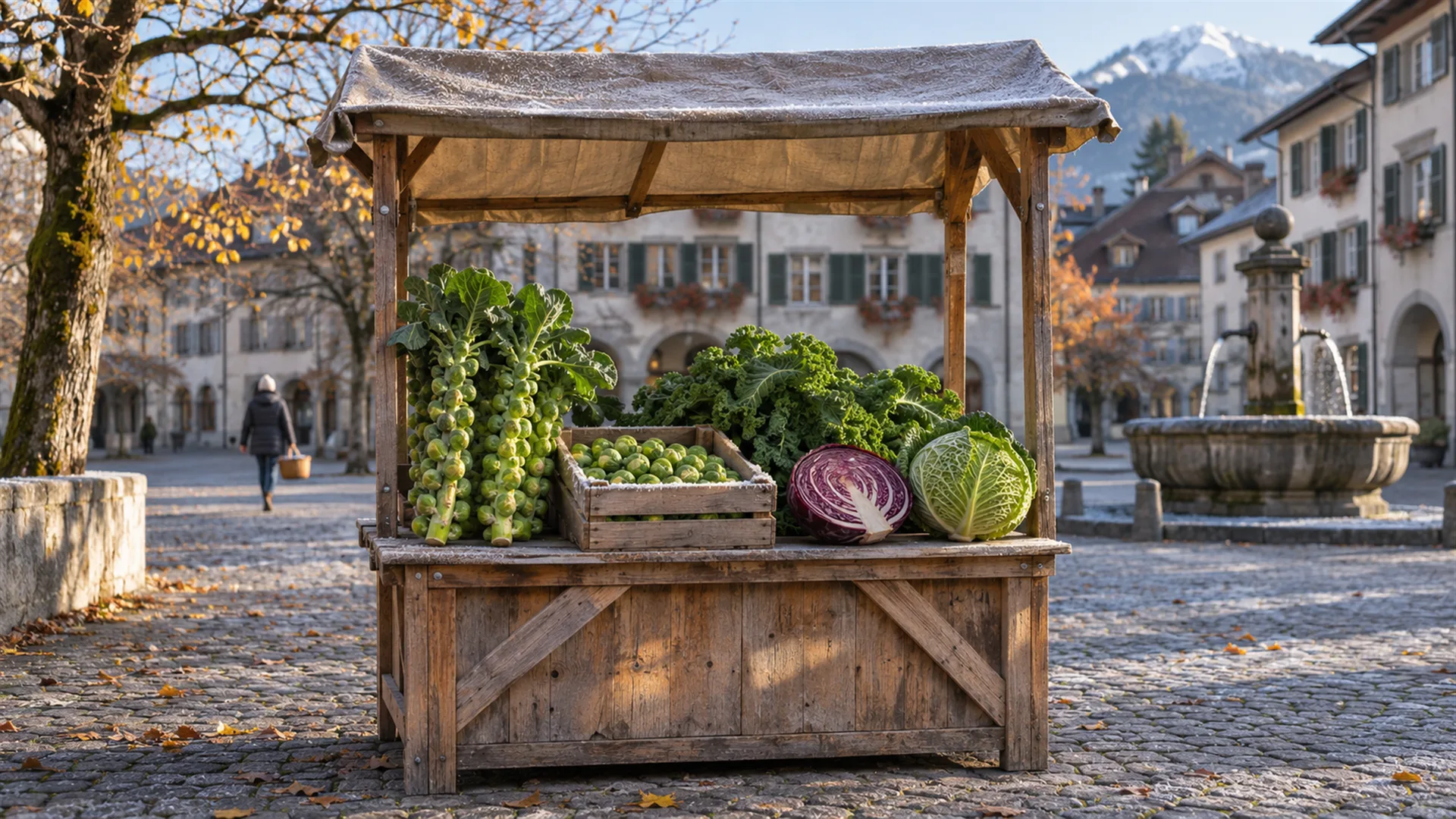
 AI-generated image
General Health · 3 min read
Vitamin C: this Swiss winter vegetable has nearly three times as much as an orange, and it is in season now
One vegetable in season in Switzerland this November contains nearly three times as much vitamin C per 100 g as a fresh orange. The figure comes from the federal Swiss Food Composition Database, alongside nine other seasonal vegetables.
A fresh orange gives you 50.9 mg of vitamin C per 100 g. A kiwi fruit, 75.3 mg. Raw Brussels sprouts (Rosenkohl, choux de Bruxelles) reach 145.6 mg.
These numbers come from the Swiss Food Composition Database, kept by the Federal Food Safety and Veterinary Office (FSVO, known as BLV in German and OSAV in French). The office publishes the data free of charge, in English as well as German, French and Italian. In November, the vegetable stall holds plenty of vitamin C too.
Vitamin C contributes to the reduction of tiredness and fatigue. Eaten raw, all ten vegetables below count as a source of vitamin C: Swiss food law sets that threshold at 12 mg per 100 g. A varied and balanced diet and a healthy lifestyle remain the foundation.
Five cabbages ahead of the orange
All five appear for November in the seasonal calendar of the Swiss vegetable growers' association, which lists 54 vegetables and salads this month. It exists only in German, French and Italian, so the German names used in Swiss shops are given in brackets. Per 100 g, raw:
- Brussels sprouts (Rosenkohl, in season from September to January): 145.6 mg.
- Kale (Federkohl): 74 mg.
- Savoy cabbage (Wirz): 66.3 mg.
- White cabbage (Weisskabis): 56.3 mg.
- Red cabbage (Rotkabis): 52.7 mg.
Five more sources in season
Also in season in November, they contain less, but each clears the legal threshold of 12 mg when raw.
- Lamb's lettuce (Nüsslisalat, or rampon in Swiss French): 24.5 mg.
- Chinese cabbage (Chinakohl): 22.1 mg.
- Parsnip (Pastinake): 19.7 mg.
- Pumpkin (Kürbis): 14.9 mg.
- Leek (Lauch): 14.5 mg.
For fibre, a dark winter root takes the lead instead: raw black salsify has 18.5 g per 100 g, more than any other fresh vegetable in the database. The full ranking is in our article on fibre in Swiss winter vegetables.
Steamed sprouts keep a good share
Vitamin C does not take well to cooking, and the federal database puts figures on the loss. Steamed without salt, Brussels sprouts drop to 105 mg per 100 g. That is still about twice the fresh orange.
The other cabbages lose a larger share. Steamed, Savoy cabbage falls to 36.9 mg and white cabbage to 31 mg. Stewed without salt or fat, kale comes down to 43.3 mg and red cabbage to 25.4 mg.
What the Swiss dietary recommendations say
The Swiss Society for Nutrition (SGE) and the FSVO published dietary recommendations for adults in 2024, in English too. They advise five portions of fruit and vegetables a day, three of them vegetables. One portion is 120 grams, “in other words, a handful”.
- Raw vegetables: ideally on the menu every day.
- Local and seasonal: check what your region has in season.
- Fresh, not stored long: to retain nutrients.
- Frozen counts too: frozen produce, processed straight after picking, largely keeps its vitamins and minerals.
The FSVO also publishes a reference value for vitamin C. For adults aged 18 to 65, it is 95 mg a day for women and 110 mg for men. It is a benchmark for a whole day's diet, not an individual target.
Fruit is still a good source
Raw kiwi fruit has 75.3 mg per 100 g. Lemon follows with 54.7 mg, orange with 50.9 mg. Mandarin has 39.4 mg and raw grapefruit 36 mg: all clear the legal threshold. Cabbages can join them in the basket, not replace them.
Typical values, not today's harvest
These are generic values from the federal database, version 7.1, dated 1 July 2026. They do not measure the vegetables on sale today, nor where they were grown. The database is free to search online, in English.
At a Swiss market in November, the orange has serious competition from the cabbages.
Sources
5 sources- Federal Food Safety and Veterinary Office (FSVO). Swiss Food Composition Database, generic foods, version 7.1 of 1 July 2026. Official database, English version. lien
- Verband Schweizer Gemüseproduzenten (Swiss vegetable growers' association). Saisonkalender Schweizer Gemüse (seasonal calendar of Swiss vegetables), page read on 15 November 2026. Industry organisation. No English version: German page cited, quotations translated by SwiLab. lien
- Federal Food Safety and Veterinary Office (FSVO). Dietary Reference Values for Switzerland, version of June 2022. Official reference values. The data file is in English; the FSVO page exists only in German, French and Italian (blv.admin.ch/en/nutrients, read 15.11.2026: “This page is only available in German, French and Italian.”). lien
- Swiss Society for Nutrition (SGE) and FSVO. Swiss dietary recommendations for adults, long version, 2024. Official recommendations, English version. lien
- FDHA Ordinance of 16 December 2016 on Food Information (OIDAl / LIV, SR 817.022.16), annexes 10, 13 and 14, status as of 1 July 2025. Legal text. No official English version: German text cited (French copy in the file). lien