
How to choose the form of a supplement according to your health goal?
Quick summary
The dosage form is chosen according to three criteria: the desired speed of action (liquid for fast, capsule for daily use), digestive tolerance (bisglycinate, liposomal) and the stability of the nutrient (soft capsule for oils).
Key facts
Key takeaways
- Liquids, ampoules and sublingual forms offer the fastest absorption, useful for one-off intakes such as energy before exertion or vitamin C at the onset of an infection.
- Magnesium bisglycinate and iron bisglycinate generate fewer digestive disturbances (nausea, loose stools) than classic inorganic salts at an equivalent dose.
- Vitamin D3 (cholecalciferol) raises 25-hydroxyvitamin D in the blood by about 40% more than D2 (ergocalciferol) at an equal dose.
- Probiotics require a gastro-resistant shell to reach the intestine alive: without this protection, stomach acidity destroys the majority of the bacteria.
- Gummies remain the least reliable forms in terms of dosage: a 2026 PLoS One study recorded an average 42.5% gap between the labelled and the actual manganese content.
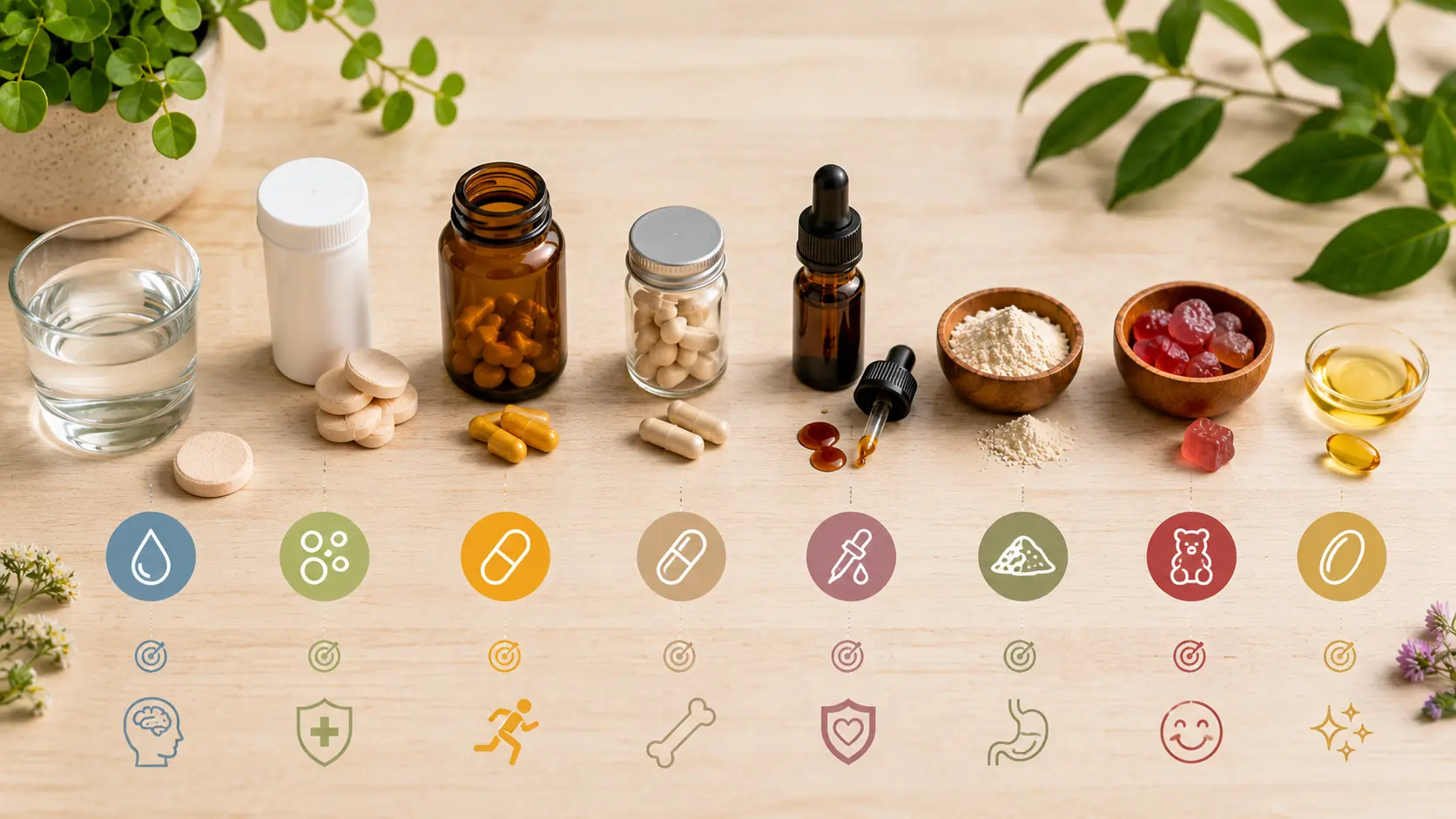
Nearly a third of the Swiss population consumes at least one food supplement according to an FSVO survey conducted in 2022 among 1,282 adults. Yet the choice of a food supplement does not come down to the targeted nutrient alone: the dosage form, capsule, liquid, powder, liposome or gummy, directly determines bioavailability, digestive tolerance and speed of action. Before arbitrating between molecules, you need to understand how to choose a supplement according to your needs. This article details the matches between dosage form and health goal, with scientific sources to back it up.
Which form should you favour for a rapid effect or maximum assimilation?
Liquids, ampoules and sublinguals: rapid action for energy and immunity
Liquid forms, drinkable ampoules and sublingual tablets deliver their active ingredient within a few minutes, without going through a disintegration stage in the stomach. The FSVO indeed lists capsules, tablets, powder sachets, ampoules and dropper bottles among the forms accepted for foodstuffs supplementing the diet in Switzerland[1]. This diversity of presentation makes it possible to adapt the intake of the product to the mode of use and to each person.
These formats are best suited when a rapid felt effect is sought: energy production before physical activity, support of the immune system at the onset of an infection, or a targeted intake in case of marked fatigue. A prospective study published in 2024 in the American Journal of Clinical Nutrition (Lacombe et al.) thus showed that cyanocobalamin (vitamin B12) taken orally at 1,000 µg per day corrected the deficiency in 88.5% of patients with pernicious anaemia within one month[2]. The useful daily dose varies according to the goal and the profile of the person, and the composition of the product depends on the targeted needs.
Liposomal and chelated forms: maximum absorption when needs run high
Liposomal forms encapsulate the active substance in a lipid membrane that protects it from gastric acidity and eases its passage through the intestinal wall, all the way to the target cell. A systematic review published in Nutrients in 2025 (Calder et al.) confirms that alternative forms of vitamin C, including liposomal ones, raise vitamin C concentration in leukocytes more than standard ascorbic acid does, with better digestive tolerance[3]. This particular chemical structure plays a central role in the bioavailability of the ingredient.
Chelated minerals (magnesium, iron or zinc bisglycinate) follow a similar principle: the mineral is bound to an amino acid that serves as a transporter, which improves its absorption and limits digestive irritation. A clinical trial published in 2026 in Wiadomosci Lekarskie (Kondratiuk et al.) on 120 women of childbearing age recorded 8.3% nausea with iron bisglycinate versus 24.1% with ferrous sulphate at an equivalent dose, with fewer treatment discontinuations[4]. These chelated forms are often chosen in case of marked fatigue, with iron contributing in particular to normal energy metabolism and to the normal formation of red blood cells.
Which forms should you choose for daily use?
Capsules and tablets: practicality, stability, sustained release
For long-term supplementation, capsules and tablets remain the most suitable formats. They are stable, easy to carry, tasteless, and protect the active ingredients from oxidative stress and humidity, which favours good preservation over time. Two-piece capsules also allow a slightly faster release than compressed tablets, without reaching the speed of a liquid: a useful benchmark for anyone who wants to choose a food supplement for daily use.
The choice of the shell matters: capsules made of animal gelatine suit most uses, while HPMC capsules (hydroxypropyl methylcellulose, derived from plant cellulose), a composition of plant origin, meet vegetarian and vegan diets. Gastro-resistant coated tablets, for their part, protect actives that are sensitive to acidity, which helps preserve their nutritional or physiological effect. A 2024 Heliyon study (Fredua-Agyeman) shows that an Eudragit L100-55 coating does not disintegrate in simulated gastric medium while preserving about 95% bacterial viability during the coating process[5].
Powders and sticks: dosing flexibility and high quantities
Powders make it possible to ingest high doses without swallowing dozens of capsules. They prevail for high-dose supplements: protein powders (20 to 30 g per serving) for muscle mass, creatine (3 to 5 g), collagen (10 g) for the skin, or electrolytes for physical activity. The single-serving stick format adds the practicality of a pre-measured dose, an essential element for the regularity of a course.
Powders also have a drawback: they oxidise faster than capsules once the container is opened, and demand precise measurement to respect the daily dose. For nutrients very sensitive to oxygen and light (omega-3 from fish oil, vitamin A, polyphenols), soft capsules or microencapsulated powders remain preferable, since they help protect the ingredient over time.
How to check the quality of the chemical form?
Vitamin D3 rather than D2, magnesium bisglycinate rather than oxide
Within the same category of nutrients, several molecules may exist: and not all are equal. For vitamin D, the D3 form (cholecalciferol, of animal or lichen origin) raises blood 25-hydroxyvitamin D more than D2 (ergocalciferol, from a fungus) does: a meta-analysis published in 2024 in Advances in Nutrition (van den Heuvel et al., 20 comparative trials) puts the gap at about 40% in favour of D3, at an equal dose and frequency[6]. This information helps the person looking to supplement their diet to support the normal functioning of the immune system and the normal formation of bones.
For magnesium, absorption varies markedly with the salt used: the absorption parameters differ from one substance to another. An in vitro study published in Physiological Research (Kyselovic et al., 2021) on a Caco-2 model shows marked absorption gaps between the various salts, citrate, lactate, oxide, pidolate, sulphate, carbonate, at an equivalent concentration, sometimes counter-intuitively[7]. In practice, bisglycinate is widely chosen for its digestive tolerance and its role in reducing fatigue; citrate offers a common price-tolerance compromise; oxide remains very cheap but can cause loose stools above 200 mg.
Practical benchmark
When purchasing, read first the full name of the salt or chemical form on the label: “magnesium bisglycinate” and not “magnesium” alone, “cholecalciferol” and not “vitamin D”, “zinc citrate” and not “zinc”. This precision conditions both the effect and the displayed dosage.
Point of vigilance
Gummies, despite their success, remain the most variable forms. The 2026 PLoS One study on 52 children’s multivitamins notes that 88.5% of the products containing manganese contain more than the label states, with overshoots sometimes higher than the maximum limits recommended by the Institute of Medicine[8]. For precisely dosed nutrients, tablets and capsules remain more predictable.
Gastro-resistant probiotics and omega-3 in soft capsules
Some nutrients impose their form. Probiotics must cross a very acidic medium (pH 1.5 to 3.5 in the stomach) to reach the intestine, where they colonise the intestinal flora: the basis of a balanced gut microbiota. Without a gastro-resistant capsule or enteric coating, the majority of sensitive strains are destroyed before even arriving at their destination. A 2024 Heliyon study confirms that an Eudragit L100-55 coating, which only dissolves above pH 5.5, does not disintegrate in simulated gastric medium and properly releases its content in intestinal medium[5].
Omega-3 (EPA, DHA) raise another issue: these fatty acids are very sensitive to oxygen, light and heat. Once oxidised, they lose their properties and their lipid peroxides can even become harmful, with a health risk in case of prolonged use. Opaque soft capsules sealed under nitrogen remain the reference formats; spray-drying microencapsulation, studied in 2025 in the Brazilian Journal of Medical and Biological Research (Pinto et al.), also makes it possible to significantly reduce the oxidation of fish oil compared with unencapsulated oil[9]. It is advisable to take into account the precautions of use indicated on the label and, if necessary, to consult a healthcare professional.
Frequently asked questions
Is the liposomal form really more effective than the classic form?
Yes, for some nutrients, but not all. The lipid membrane shields the active ingredient from gastric acidity and eases its passage into the intestine, which increases the quantity actually absorbed. A 2025 systematic review published in Nutrients (Calder et al.) shows that alternative forms of vitamin C, including liposomal ones, raise the intra-leukocyte concentration more than standard ascorbic acid does. The advantage is more marked for vitamin C, glutathione or curcumin than for nutrients already well absorbed in their classic form.
Should you favour magnesium bisglycinate over magnesium oxide for daily use?
Yes for most people on a daily basis. Bisglycinate, bound to an amino acid, is better tolerated digestively than oxide, which can cause loose stools at an equivalent dose. An in vitro model published in Physiological Research (Kyselovic et al., 2021) confirms that absorption varies markedly with the salt used. Oxide remains useful at very low cost for modest intakes or when a laxative effect is desired.
Are gummies as effective as capsules?
Not reliably. Gummies remain pleasant to take but suffer from significant dosage variability, with an actual content often far from what the label states. A PLoS One study published in 2026 (Frisbie et al.) on 52 children’s multivitamins measured an average 42.5% gap between the declared manganese content and the measured content. For precisely dosed nutrients, tablets and capsules remain more predictable.
Which form should you favour in case of sensitive digestion?
Chelated salts (bisglycinate) and liposomal forms. For iron, a clinical trial published in 2026 (Kondratiuk et al., Wiad Lek) on 120 women showed 8.3% nausea with iron bisglycinate versus 24.1% with ferrous sulphate at an equivalent dose, with fewer treatment discontinuations. Liposomal forms also protect against gastric irritation by encapsulating the active ingredient in a lipid membrane. Avoid magnesium oxide if you are prone to loose stools.
Is the liquid form quicker to act than the capsule?
Yes, as a general rule. Liquids, ampoules and sublingual forms do not need to be disintegrated by the stomach: the active ingredient is immediately available, sometimes absorbed directly through the buccal mucosa. This makes them a format suited to one-off intakes (energy before exertion, vitamin C at the onset of an infection). In exchange, liquids are less stable to light and oxygen than capsules, and their shelf life after opening is shorter.
Sources and references
9 sources