
Which supplements to strengthen winter immunity?
Quick summary
In Switzerland, vitamin D is the supplement best justified in winter: about 60% of the population is not adequately supplied between December and March according to the FSVO, at 600-800 IU per day depending on age.
Key facts
Key takeaways
- Vitamin D remains the only supplement solidly justified in winter in Switzerland, with about 60% of the population not adequately supplied between December and March according to the FSVO.
- The updated Jolliffe meta-analysis in the Lancet Diabetes & Endocrinology no longer shows a statistically significant protective effect of vitamin D on the overall risk of acute respiratory infections: including in the subgroups defined by initial status.
- Zinc lozenges to be dissolved shorten the duration of the cold once it has set in, without preventing it, according to the Cochrane Nault meta-analysis: a modest reduction, about two days.
- The network meta-analysis by Zhu and colleagues (2025) identifies flavonoids (including catechins), probiotics and synbiotics among the oral supplements most useful in reducing the risk of respiratory infections in adults.
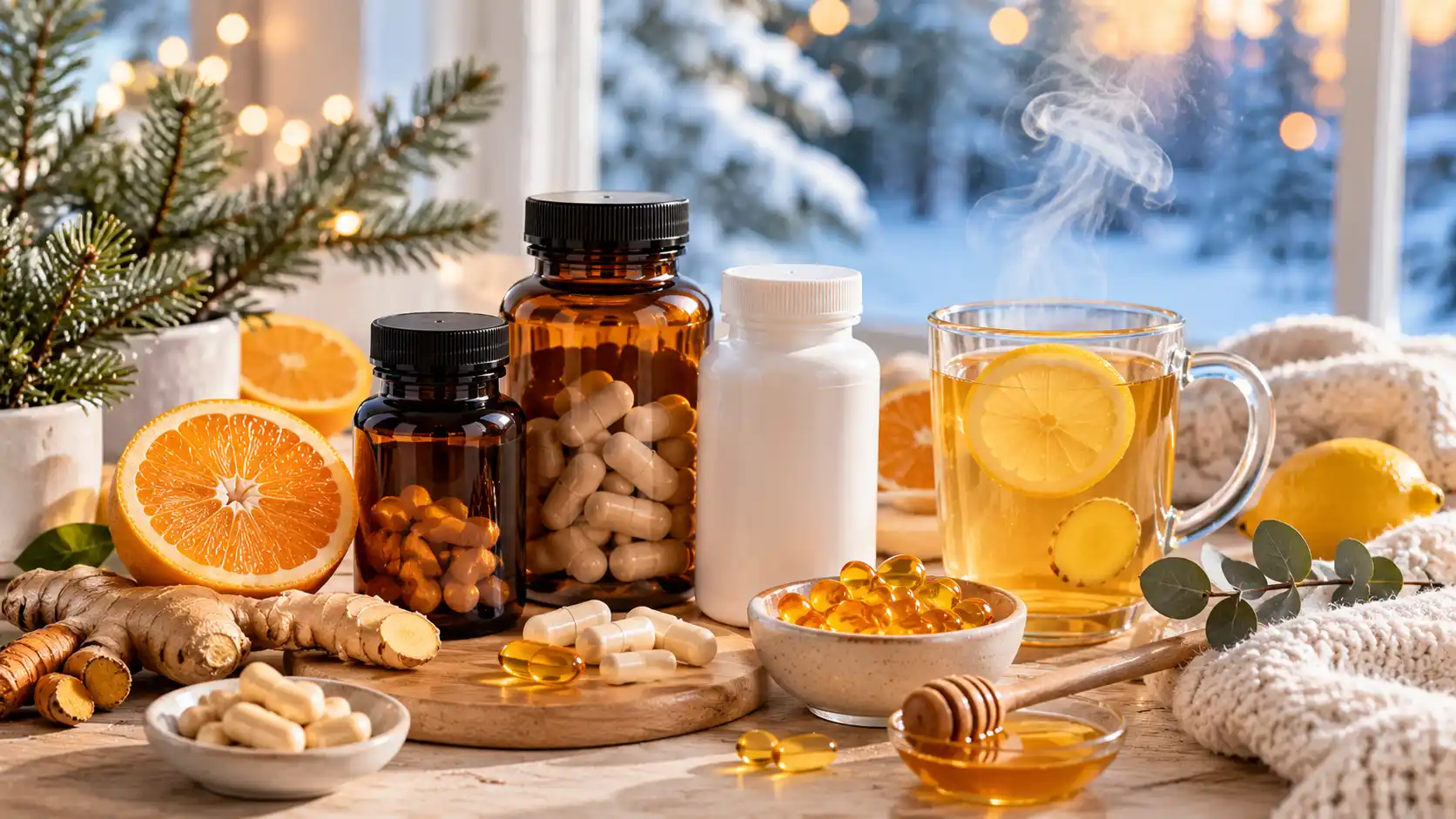
Between December and March, about 60% of the Swiss population shows an insufficient vitamin D status according to the data of the Federal Office of Public Health. In the world of the food supplement, winter concentrates the questions: should you take vitamin D, zinc, probiotics or a combined formula? Before targeting the cold season, it remains useful to revisit the principles to choose a supplement. This article gathers what recent meta-analyses and Swiss recommendations say, and explains how to build a truly justified winter course.
Why does immunity need specific support in winter?
What does Swiss winter change for the immune system?
Swiss winter reduces the natural production of vitamin D in the body and exposes you to a denser viral promiscuity, two factors that weigh on the body’s defences against pathogens. Between December and March, about 60% of the Swiss population is not adequately supplied according to the FSVO[1].
This winter drop is due to the lack of natural light at Swiss latitudes: under reduced daylight, the skin barely synthesises any vitamin D between October and March. The Federal Nutrition Commission sets the recommended daily intake at 600 IU for adults and 800 IU from age 60[2]. This molecule contributes to the normal functioning of the immune system[3]: this is the claim officially validated and reproduced by the FSVO in annex 14 of the Ordinance on Food Information. Add to this indoor confinement, heating that dries out respiratory mucous membranes, and dry air in enclosed spaces that favours the circulation of viruses during the winter months.
Who should pay particular attention to winter deficiencies?
Older people, young children, pregnant or breastfeeding women, and people with dark skin or little exposure to natural light are the most at risk according to the FSVO[1]. For these profiles, a sufficient intake is recommended all year round, not only in winter.
Skin synthesis decreases with age: in seniors, the FSVO recommends 800 IU per day on a continuous basis[1]. People who cover their skin for cultural or medical reasons, and those with obesity, are also among the groups to monitor. In an obese person, vitamin D is stored in fatty tissue and becomes less available in the bloodstream. Some treatments such as corticosteroids or antiepileptics also accelerate its degradation. Endurance athletes who train indoors in winter and night workers also accumulate deficiency factors: their lifestyle, sleep quality and lack of daylight weigh on the body’s balance.
Which supplements are really backed by recent studies?
Vitamin D: for whom and at what dose in Switzerland?
Vitamin D remains the supplement best justified in winter in Switzerland to strengthen immunity, but its impact on respiratory infections is more modest than the earlier literature suggested. The 2025 Jolliffe meta-analysis published in the Lancet Diabetes & Endocrinology, which gathers 46 randomised trials and more than 64,000 participants[4], no longer shows a statistically significant protective effect on the risk of acute respiratory infection.
This update incorporates a large recent trial of 15,804 people[4] that tipped the overall result. The subgroup analysis also reveals no different benefit by age, dose or starting status. The Swiss justification for supplementation therefore remains first and foremost the correction of the deficiency itself, which plays a key role for bone health and the immune function of cells. The recommended doses are 600 IU per day for adults and 800 IU from age 60[2]. The product is best taken with a meal rich in good fats, in the form of drops, capsules or tablets, to improve absorption; some preparations such as cod liver oil contain it naturally. For the specific prevention of flu or COVID, some work suggests that supplementation may reduce the risk[5]. That falls within a specific medical framework that goes beyond self-supplementation and free use of the product.
Zinc, probiotics and catechins: what do meta-analyses retain?
Zinc lozenges to be dissolved may shorten the duration of the cold by about two days according to the Cochrane Nault meta-analysis published in 2024[6], but do not prevent it: the authors stress that the evidence remains of low certainty. Probiotics, flavonoids (including catechins, antioxidants from green tea) and synbiotics are among the oral supplements most useful in reducing the risk of respiratory infections in adults, according to the network meta-analysis by Zhu and colleagues published in 2025[5].
The mineral acts locally, in direct contact with the mucous membrane of the throat, when the lozenge slowly dissolves in the mouth: intake in swallowed capsule form does not have this benefit. The Cochrane review also notes an increase in digestive adverse effects (nausea, bad taste) at high doses[6]. These minerals play a role in the functioning of the immune system but must remain on a reasoned intake basis. For probiotics, the documented effectiveness concerns multi-strain formulas of live bacteria taken for several weeks to rebalance the intestinal flora and support digestion, not commercial yoghurts. A balanced gut microbiota participates in the body’s immune response. Vitamin C at the usual dose (1 g per day or less) has not shown a robust preventive effect on the cold in the general population[10]; a marked benefit exists, on the other hand, in people very exposed to physical stress, such as marathon runners or soldiers in cold climates: the Cochrane Hemilä meta-analysis reports a relative risk of 0.48 in this subgroup[10]. Substances such as acerola (rich in vitamin C), royal jelly or some plants in essential oils are often used by preference or habit, but echinacea and elderberry do not have a validated European health claim for the immune system[3].
| Supplement | Documented effect | When to consider it |
|---|---|---|
| Vitamin D | Immune support in people with a deficiency; correction of the winter deficiency | From October to March for the whole Swiss population, continuously for seniors |
| Zinc lozenges | Reduces the duration of the cold by about two days once it has set in | Within the first 24 hours of symptoms, never as continuous prevention |
| Multi-strain probiotics | Slightly reduces the number of respiratory infections over the year | Course of 4 to 8 weeks, fragile or highly exposed people |
| Vitamin C | No robust preventive effect at the usual dose in the general population | Effect targeted on intense physical stress only |
| Echinacea, elderberry | No validated European health claim for immunity | Traditional use, without solid scientific evidence |
How to choose and use an immunity supplement well?
Which quality criteria should you look at first?
The form of the nutrient, the dosage in pure mineral, compliance with FSVO claims and the nature of the excipients are the four priority checkpoints before any purchase. In Switzerland, only the claims listed in annex 14 of the Ordinance on Food Information may appear on the packaging[3]; at the time of choice, the advice of a healthcare professional at a pharmacy remains the best counsel to validate the use of a targeted product.
Good reflex
For vitamin D, favour the D3 form (cholecalciferol) rather than D2: it is better assimilated. For zinc, bisglycinate or citrate are better tolerated than oxide on the stomach.
The displayed quantity must correspond to the quantity of pure mineral (elemental zinc, for example), not to the total salt. Check the absence of claims prohibited by the FSVO (“cures”, “prevents flu”): their presence signals a manufacturer who does not respect the Swiss framework[7]. On a website, also check the secure payment terms, the privacy policy, the displayed sale price and the delivery terms before ordering a product. These preparations are regulated by the Federal Act on Foodstuffs and Utility Articles and the FDHA Ordinance on Food Supplements[8].
- Form of the nutrient: D3 rather than D2 for vitamin D; bisglycinate or citrate for zinc.
- Dosage in pure mineral displayed clearly, not in total salt.
- Limited excipients: avoid unnecessary colourings and flavourings, especially in gummies.
- Claims compliant with annex 14 of the Ordinance on Food Information, with no promise of cure.
- Consistency with the diet: no overlap with a multivitamin already dosed in zinc and vitamin D.
Which common mistakes should you avoid during a winter course?
Stacking several immunity formulas, exceeding the recommended doses, or waiting for symptoms to appear before starting vitamin D are the three most frequent mistakes when facing winter. The FSVO reminds people that these products neither prevent nor treat diseases[9]: they correct a deficiency or provide a targeted micronutrient.
Stacking a multivitamin, an immunity complex and an added syrup often leads to exceeding the tolerable upper intake levels, in particular for vitamin A and zinc. For vitamin D, starting intake from October allows you to reach a sufficient status before the winter trough: full effectiveness requires several weeks of regular intake to durably strengthen the functioning of the immune system. A balanced diet rich in fresh fruit and vegetables, regular exercise, good sleep and the reduction of stress and alcohol remain the basics to strengthen the immune system over time. Lastly, the self-diagnosis of a “drop in immunity” often leads to mistargeting the need: chronic fatigue, repeated infections or digestive disorders justify medical advice, not a stack of products.
- Never exceed the doses indicated on the packaging, in particular for vitamin A, zinc and iron.
- A course does not replace a varied diet, sufficient sleep and regular physical activity.
- Ask the pharmacist or doctor for advice in case of chronic treatment, pregnancy or for a child.
Frequently asked questions about winter immunity supplements
At what dose should you take vitamin D in winter in Switzerland?
The FOPH recommends 600 IU per day for adults and 800 IU from age 60. Supplementation is best taken with a meal containing fats to favour absorption. The D3 form (cholecalciferol) is better assimilated than the D2 form. A course from October to March covers the period of lowest sun exposure; older people may maintain it all year round on their doctor’s advice.
Should you take zinc as prevention or only in case of a cold?
The 2024 Cochrane Nault meta-analysis does not support zinc as continuous prevention: no reduction in the number of colds is shown. By contrast, zinc lozenges dissolved in the mouth, taken within the first 24 hours of symptoms, shorten the duration of the cold by about two days. The dose studied is high, to be reserved for the acute phase and to be avoided long-term because of digestive adverse effects.
Does vitamin C really prevent the cold?
Not in the general population: at the usual dose (1 g per day or less), no reduction in the number of colds is shown. A marked preventive effect exists, however, in people exposed to intense physical stress, marathon runners, soldiers in cold climates, endurance skiers, according to the Cochrane Hemilä review. The authorised European claim states simply that vitamin C contributes to the normal functioning of the immune system, which does not mean that it prevents infections.
How long should a winter immunity course last?
For vitamin D, the course covers the period from October to March, with a daily or weekly intake depending on the chosen schedule. Multi-strain probiotics show an effect from 4 to 8 weeks of continuous intake in the trials included in the Zhu 2025 meta-analysis. For zinc lozenges, the duration is limited to the 5 to 7 days of the acute episode. A prolonged, unsupervised trace-element course exposes you to mineral imbalances.
Can you combine several immunity supplements at the same time?
Yes, provided you check the cumulative intakes. The main risk comes from multivitamins already dosed with zinc, vitamin D and vitamin A: stacking an immunity complex on top can exceed the tolerable upper intake levels. The simple rule consists of choosing either a targeted single nutrient (vitamin D alone) or a well-dosed combined formula, never both. In case of chronic treatment or pregnancy, the pharmacist’s or doctor’s advice is needed before any combination.
Sources and references
10 sources- FSVO. Recommendations concerning vitamin D for the Swiss population
- Federal Nutrition Commission (FNC). Vitamin D deficiency: scientific evidence, safety and recommendations for the Swiss population
- FSVO. FDHA Ordinance on Food Information (RS 817.022.16) — annex 14, authorised health claims
- Jolliffe DA, Camargo CA, Sluyter JD et al. Vitamin D supplementation to prevent acute respiratory infections: systematic review and meta-analysis of stratified aggregate data
- Zhu Z, Zhu X, Chu Y et al. Comparative effectiveness of oral nutritional supplements in preventing respiratory tract infections among adults: systematic review and network meta-analysis
- Nault D, Machingo TA, Shipper AG et al. Zinc for prevention and treatment of the common cold
- FSVO. Food supplements — legal aspects, labelling and claims
- Swiss Confederation. FDHA Ordinance on Food Supplements (RS 817.022.14)
- FSVO. Food supplements — a use reserved for certain situations
- Hemilä H, Chalker E. Vitamin C for preventing and treating the common cold