
How to read the label of a food supplement?
Quick summary
A reliable label shows the wording “food supplement”, the list of ingredients in decreasing order, the dosage per daily dose, clear warnings and the manufacturer’s name — article 3 of the Swiss Food Supplements Ordinance sets these obligations in Switzerland.
Key facts
Key takeaways
- Article 3 of the Swiss Food Supplements Ordinance requires six mandatory mentions on the label: wording, characteristic ingredients, content, daily dose, warning not to exceed the recommended intake, mention “keep out of reach of young children”.
- An analysis of 35 red rice yeast supplements bought online in the European Union found non-compliant labelling for 6 of the 17 samples from an e-commerce platform (about 35%) (Vanhee 2024).
- The molecular form of a nutrient — citrate, bisglycinate, oxide — changes its intestinal absorption; it must appear in the list of ingredients according to annex 2 of the Swiss Food Supplements Ordinance.
- A Spanish 2025 study on raspberry supplements (raspberry ketone) showed 60% gaps between the declared quantity and the quantity actually measured (Luque-Jurado 2025).
- The private labels USP, NSF Certified for Sport, Informed Sport or ConsumerLab verify in the laboratory the identity, purity and declared dosage to reduce the risk of gaps between the label and the actual content.
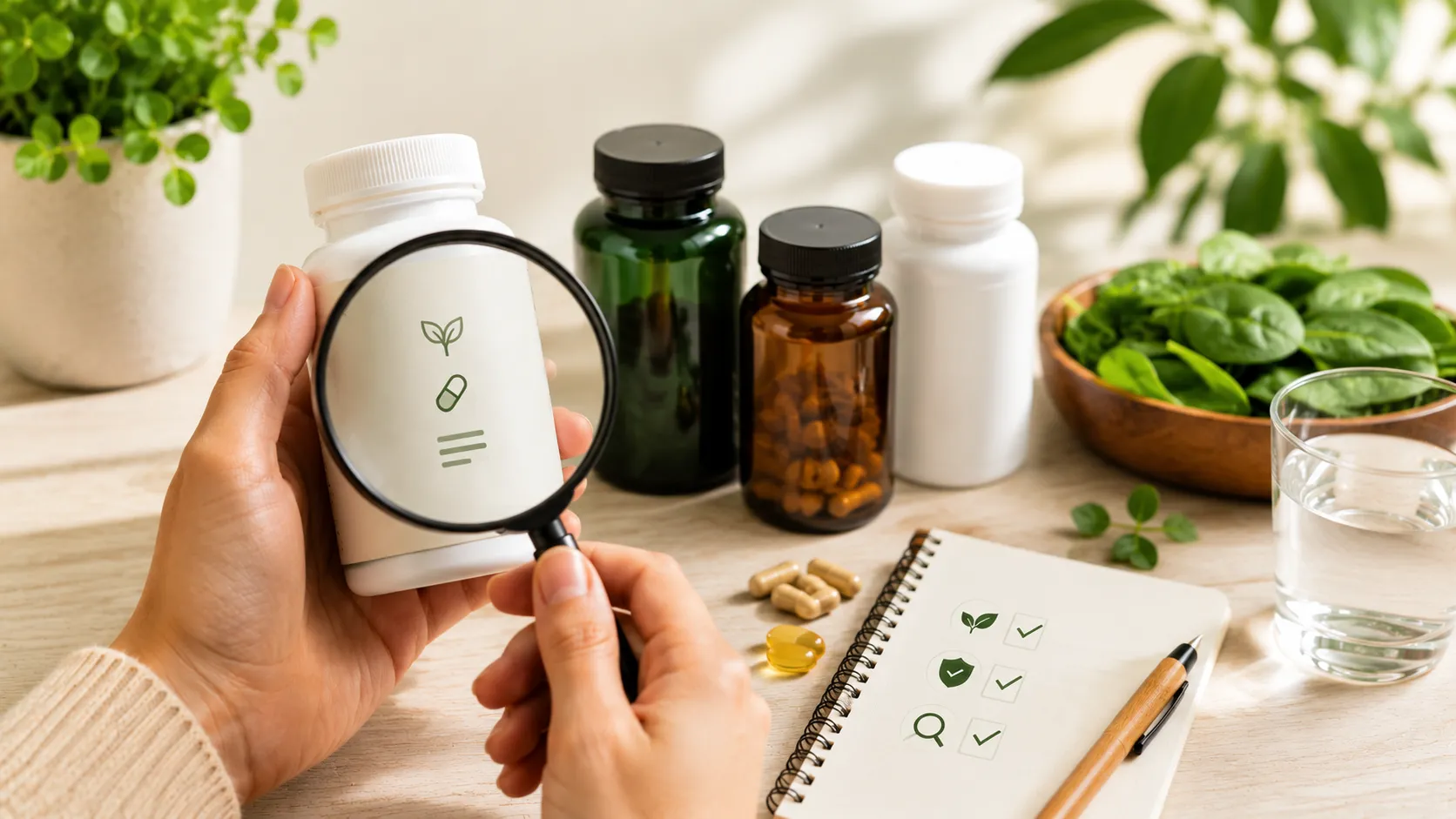
A Spanish study published in 2024 found that 45% of Coleus forskohlii supplements sold on the market contained no trace of the active molecule declared on the label (Jiménez-Amezcua 2024). On the food supplement market, the label is often the only link between the buyer and the actual composition of the product. Knowing how to decode it therefore becomes a practical skill before any purchase. This guide details the six mentions imposed by Swiss regulation, the technical clues of real quality, and the signals that should make you put the bottle back. To place these criteria in a wider approach, consult the guide to choosing the right supplement according to your needs.
Which mentions are mandatory on the label of a food supplement in Switzerland?
What must the wording and the nutritional declaration show?
The sales name of a food supplement must display the wording “food supplement” followed by the names of the characteristic vitamins, minerals or other substances, together with the precise content per daily dose. Article 3 of the Swiss Food Supplements Ordinance (RS 817.022.14)[1] requires a precise numerical declaration in the form of a legible nutritional table. The content of each vitamin, mineral salt or other active substance must appear on the label, accompanied by the percentage of the nutritional reference value according to annex 10 of the Ordinance on Food Information[1]. A label that simply mentions a “proprietary blend” without detailing the quantities of each ingredient therefore does not meet Swiss requirements, unlike packaging that clearly presents the composition of the product and the nutritional intake per capsule or tablet.
Which warnings and traceability indications are required?
Four further mentions are mandatory[1]: the recommended daily dose in portions and the warning “do not exceed the indicated dose”, which recalls the maximum amount for use. Added to this are the mention “keep out of reach of young children” and the contact details of an identifiable manufacturer, importer or distributor in Switzerland. The wording and all mentions must appear in at least one official Swiss language — German, French or Italian — in characters at least 1.2 mm high[3]. A label only in English or without a manufacturer’s address is a warning signal about the product’s compliance, in particular in the event of potential allergy or intake associated with medical treatment, where the traceability of the delivery and the ability to contact the manufacturer become essential for the consumer.
How to assess the real quality of a food supplement from its label?
Why the form of the nutrient and the dosage matter more than mere presence?
The exact chemical form of a nutrient determines its absorption by the intestine and therefore its real usefulness. Annex 2 of the Swiss Food Supplements Ordinance[1] lists the forms allowed for each vitamin and mineral authorised in this product category. For magnesium, oxide, citrate, bisglycinate, malate or gluconate are among the authorised salts. Not all these forms offer the same bioavailability. An experimental study in rats compared two forms — picolinate and oxide — and concluded that the absorption and retention of picolinate are better (Er 2024)[7]. Comparing the declared form — and not only the mention “magnesium” — allows you to genuinely compare two products in the same range. This difference in form is also observed for essential fatty acids, cod liver oil or marine omegas, where the concentration of the actually active acid varies from one pack to another.
What does the list of excipients and additives reveal?
The ingredients of a food supplement are listed in decreasing order of quantity, as for any food product in Switzerland[3]. A list that starts with manufacturing excipients before the declared active ingredients indicates that the ingredient highlighted represents only a small fraction of the content of the capsule or tablet. Common excipients are microcrystalline cellulose (bulking agent), magnesium stearate (lubricant) and silicon dioxide (anti-caking agent). Some authorised additives such as maltodextrin or talc — sometimes combined with technical sugars — have no nutritional effect and weigh down the formula unnecessarily without any benefit for digestive comfort. Article 5 of the Swiss Food Supplements Ordinance[1] imposes purity criteria for the ingredients listed in annex 2; a serious manufacturer often mentions its purity standards, its manufacturing conditions or a verifiable batch number on the packaging.
Which warning signals should make you reject a product?
How to spot non-compliant health claims?
Any mention suggesting that a food supplement cures, relieves or prevents a disease is forbidden in Switzerland[2]; it then falls within medical communication reserved for medicines. The FSVO recalls that only the health claims listed in annex 14 of the Ordinance on Food Information or authorised individually by the office are permitted on the label or in the advertising of a supplement[2]. A wording such as “vitamin D contributes to the maintenance of normal bones” is compliant; a wording such as “strengthens fragile bones” or “prevents osteoporosis” is not. Spectacular promises — “burns fat”, “stimulates immunity”, “repairs the liver”, or claims about hair loss, skin or personal-care — are both prohibited and generally not scientifically documented, even when they appear in a “health beauty sport” family of products.
Warning signals to know
Several signals justify rejecting a supplement: a label only in English, the absence of a manufacturer’s address identifiable in Switzerland, or the mention of a “proprietary blend” without individual dosage. Added to this are therapeutic claims (“cures”, “treats”), unverifiable numerical promises (“loss of 5 kg in 7 days”) and a sales site without legal notices.
What are independent labels worth (USP, NSF, ConsumerLab)?
A third-party label such as USP Verified, NSF Certified for Sport, Informed Sport or ConsumerLab verifies in the laboratory that the product does contain the declared ingredients, in the announced quantity, without major contaminants. A review published in Archives of Dermatological Research in 2024 set out the criteria of each label and recommended them as a quality benchmark for over-the-counter supplements (Mokhtari 2024)[8]. A recent analysis published by the US Pharmacopeia recalls that third-party certification is one of the main tools used by industry to reduce the risk of adulteration (Ma 2025)[9]. These labels do not appear as medical advice and do not guarantee the clinical effectiveness of a product; they at least rule out the risk of a gap between the label and the content. For the consumer, a search of the label’s database lets you check the batch number and the certification date, in addition to a varied and balanced diet and, if needed, the advice of a healthcare professional.
| Label | Verifies | Distinctive feature |
|---|---|---|
| USP Verified | Identity, purity, dosage, manufacture | American pharmaceutical standard recognised worldwide |
| NSF Certified for Sport | Identity, purity, absence of doping substances | Reference for professional athletes |
| Informed Sport | Purity, absence of more than 250 banned substances | Test on each batch before market release |
Frequently asked questions about reading the label of a food supplement
How can you tell whether a food supplement complies with Swiss legislation?
Compliance rests on six mentions required by article 3 of the Swiss Food Supplements Ordinance: the wording “food supplement”, the characteristic ingredients, the content per daily dose, the warning not to exceed the recommended intake, the mention “keep out of reach of young children” and the contact details of the manufacturer or importer. The label must appear in at least one official Swiss language in characters at least 1.2 mm high. A product only in English or without a manufacturer’s address does not meet the FSVO requirements.
What is the difference between the mention “contains” and “may contain” on a label?
“Contains” signals an ingredient actually present and required to be declared, in particular for the allergens listed in annex 6 of the Ordinance on Food Information (gluten, lactose, soya, nuts, etc.). “May contain” indicates possible cross-contamination during manufacture, with no intentional presence. This precautionary statement is useful for allergic consumers but is not strictly regulated in Switzerland — its presence or absence does not reflect the quality level of the product, unlike the mention “contains”, which is mandatory as soon as an allergen is used.
Should you be wary of the mention “proprietary blend” on a food supplement?
Yes, this mention masks individual dosages and does not comply with Swiss regulation. Article 3 of the Swiss Food Supplements Ordinance requires the precise content of each vitamin, mineral or substance per daily dose. A “proprietary blend” or “exclusive mix” that only gives the cumulative total of several ingredients prevents the consumer from checking that the quantities match the scientific studies. This practice comes from the American market where it is tolerated; on the Swiss market, it should lead you to abandon the purchase.
Which expiry date should you choose for a food supplement?
Favour a product with at least 12 months before the use-by date. Water-soluble vitamins, such as vitamin C or the B-group vitamins, lose activity over time even under correct storage conditions. For supplements based on live bacterial cultures, the Swiss Food Supplements Ordinance requires that the declared content be guaranteed until the date of delivery to the consumer. Keep away from heat, humidity and direct light. A bottle opened for more than six months generally loses stability, even before its expiry date.
How to check that the dosage per daily dose matches the scientific studies?
Compare the content shown per daily dose with the nutritional reference value (NRV) listed in annex 10 of the Ordinance on Food Information, as well as with the dosages of clinical studies on the molecule concerned. A vitamin D at 1,000 IU (international units) per day corresponds to 500% of the NRV but remains within the zone of common use; a vitamin C at only 50 mg represents 62% of the NRV. The label must show this percentage to make comparison easier. For substances without a set NRV — curcumin, marine omega-3, probiotics — refer to the dosages used in the scientific literature.
Sources and references
9 sources- FDHA Ordinance on Food Supplements (Swiss Food Supplements Ordinance), RS 817.022.14
- Food supplements — official page
- Labelling of food supplements — official guide
- Vanhee et al. (2024). Quality Control and Safety Assessment of Online-Purchased Food Supplements Containing Red Yeast Rice
- Luque-Jurado et al. (2025). Evaluation of quality and authenticity of raspberry ketone supplements
- Jiménez-Amezcua et al. (2024). Flow Injection Analysis-Mass Spectrometry for fraud detection in Coleus forskohlii supplements
- Er, B. (2024). Effects of Magnesium Forms on the Magnesium Balance and Jejunal Transporters in Healthy Rats
- Mokhtari et al. (2024). Over-the-counter dermatology supplements — a practical guide to authenticity labels
- Ma et al. (2025). Dietary Supplement Adulteration: Laboratory Approaches to Risk Mitigation