
Should you choose a single nutrient or a combined formula?
Quick summary
The single nutrient targets a deficiency confirmed by blood test (iron, vitamin D, B12) with a therapeutic dosage; the combined formula covers moderate nutritional intakes across several micronutrients in daily prevention.
Key facts
Key takeaways
- A single nutrient is justified in the presence of a documented biological deficiency: iron, vitamin D, vitamin B12, folic acid in pregnant women, iodine in the athlete subject to intense perspiration.
- The combined formula is aimed at a preventive audience without a confirmed deficiency, with dosages capped at 100% of the recommended daily intakes to limit the risk of cumulative overdose.
- According to the FSVO, about 30% of Swiss adults consumed a food supplement during the last seven days, mainly vitamins, vitamin-mineral combinations and mineral salts.
- Three different supplements taken simultaneously is a reasonable ceiling of caution: beyond that, the risk of duplications and of nutrient-nutrient interactions increases significantly.
- At the nutritional doses of a standard multivitamin, zinc-iron or calcium-magnesium interactions remain limited; at the therapeutic doses of a single nutrient, a two-hour spacing becomes relevant.
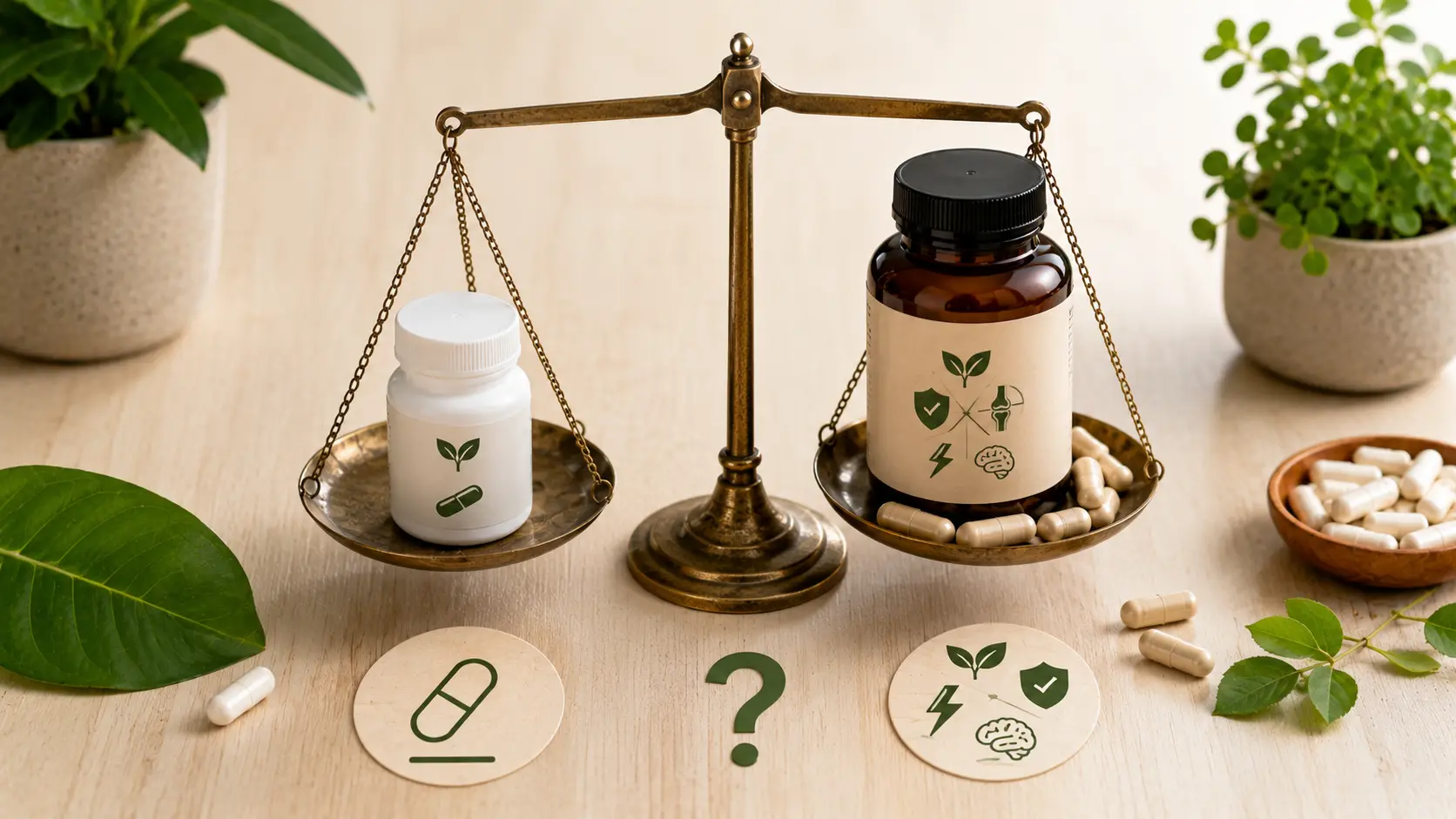
According to a Federal Food Safety and Veterinary Office (FSVO) survey published in 2023, about 30% of Swiss adults consumed at least one food supplement during the last seven days. Faced with a shelf that offers both single-substance therapeutic dosages and combined multivitamin formulas, the “as complete as possible” reflex is not always the most relevant. To choose a suitable supplement, it is better to understand the distinct logic of the two approaches: one corrects a precise biological deficiency, the other fills moderate nutritional gaps across several micronutrients at once.
Single nutrient or combined formula: which approach for which need?
When is a single-nutrient supplement relevant?
The single-nutrient supplement is justified in the presence of a biological deficiency documented by blood test, or for a precise physiological need identified by a healthcare professional. This is the therapeutic approach: one nutrient strongly dosed, over a defined duration, with a measurable correction goal. Choosing a food supplement of this type therefore presupposes prior clinical information, and not a decision taken on the basis of a simple feeling.
Classic indications include iron deficiency (iron in case of iron-deficiency anaemia), vitamin D insufficiency documented by blood test (level below 50 nmol/L)[2], the intake of folic acid before and during the first trimester of pregnancy, or vitamin B12 in people following a strict vegan diet, where the vitamin plays an essential role in the normal production of red blood cells and the functioning of the nervous system. The Federal Office of Public Health recommends consulting a professional to discuss any intake of vitamin D for at-risk groups[2] (older people, dark skin, limited sun exposure): advice that also applies before purchasing a product at a pharmacy or on a specialist website.
In which cases should you favour a combined formula?
The combined formula is aimed at an audience without a diagnosed deficiency, looking to compensate for a poorly varied diet or to support particular life stages, as part of a healthy lifestyle. It provides several selected vitamins and minerals at moderate doses, generally capped around the recommended daily values, to meet daily nutritional needs without excess.
Typical profiles include seniors with a natural decline in appetite and absorption, very busy people who often eat out, restrictive diets (vegetarian, vegan, gluten-free) at risk of deficits in vitamin B12, iron, zinc, iodine or omega-3 fatty acids (a concentrated source of essential dietary fats), and periods of temporary fatigue or prolonged stress. The FSVO survey conducted among 1,282 Swiss adults[1] shows that 66.7% of the supplements consumed contain vitamins and/or mineral salts, a sign of a clear preference for combined formats in common practice[3].
| Criterion | Single nutrient | Combined formula |
|---|---|---|
| Goal | Correct a deficiency confirmed by blood test | Global preventive support, fill moderate gaps |
| Dosage | High (therapeutic), often above daily intakes | Moderate (nutritional), close to recommended daily intakes |
| Typical profile | Person with a deficiency, pregnant woman, athlete under protocol | Adult without deficiency, senior, restrictive diet, temporary fatigue |
| Risk of overdose | Higher without medical follow-up (fat-soluble vitamins, iron) | Low at standard doses, watch out when combining several supplements |
What do recent studies say about effectiveness?
Multivitamins: what landmark clinical trials show
Multivitamins at moderate nutritional doses improve memory in seniors, but do not reduce mortality or cardiovascular risk in the general population. This is the conclusion of recent large studies, which distinguish a specific cognitive effect from a global prevention effect. This data invites you to choose a food supplement according to a precise goal rather than on the basis of a supposed general advantage.
The randomised COSMOS-Web trial, published in 2023 in the American Journal of Clinical Nutrition, followed 3,562 adults over 60 for three years[5]. Participants taking a standard multivitamin supplement in tablet form obtained better results on memory tests: an effect equivalent to about three years less on the cognitive clock[5]. A meta-analysis of three COSMOS sub-studies published in 2024 confirms this benefit, with an overall gain equivalent to two years of cognitive ageing avoided[6].
Conversely, the analysis of three American cohorts totalling 390,124 adults (Loftfield et al., JAMA Network Open, 2024) showed no reduction in mortality among regular users of multivitamins[7]. The 2022 recommendation of the US Preventive Services Task Force concludes that the evidence remains insufficient to recommend a multivitamin in cardiovascular or cancer prevention in the general population[4].
Targeted single nutrients: evidence by deficiency
For an isolated nutrient, effectiveness depends on the starting status: intake is useful in case of deficiency, little or not at all in the absence of a shortfall. This is the most solid finding of the recent literature on vitamin D, iron or vitamin B12. This logic also applies to targeted forms of magnesium (bisglycinate, magnesium glycinate, magnesium citrate, magnesium oxide), where use is justified above all in case of documented magnesium deficiency.
In the UK Biobank cohort (445,601 adults, median follow-up 11.8 years)[8], Sha and collaborators observed that a vitamin D deficiency (blood level < 30 nmol/L) or insufficiency (30-50 nmol/L) were strongly associated with excess mortality from all causes[8]. However, the FOPH reminds that at the Swiss scale, more than 60% of the population shows a vitamin D insufficiency during winter, compared with 20% in summer[2]: an argument for a targeted seasonal intake rather than a systematic year-round one[2].
Synergies, interactions and safety rules
Which nutrients work together, which get in each other’s way?
Some combinations are synergistic, others competitive at the level of absorption. Vitamin D, magnesium and calcium play a joint role in bone metabolism and contribute to the normal functioning of bones; zinc and iron, conversely, compete for the same intestinal transporters at high doses. Combining these trace elements therefore demands particular attention to the timing of intake.
A 2024 review published in Food Science & Nutrition (Shukla et al.) describes the cofactor role of magnesium in the enzymatic activation of vitamin D[9], as well as its synergies with calcium, potassium, zinc, iron and vitamin B6: all engaged in energy metabolism and the immune system. Conversely, a 2024 review published in the Journal of Trace Elements in Medicine and Biology (Einhorn et al.) documents the competition between zinc (in the form of zinc bisglycinate, for example), iron, copper and manganese at the level of the intestinal mucus layer[10]: a phenomenon relevant above all at the therapeutic doses of a single-nutrient supplement.
Good practice
At therapeutic doses, space iron and zinc by at least two hours, and the same rule applies between calcium and magnesium or between iron and tea/coffee. At the standard nutritional doses of a well-formulated multivitamin, this separation is not necessary.
How to avoid cumulative overdose?
The simplest rule consists of limiting cumulation to three different supplements, reading each label by adding up the vitamins and minerals present, and comparing the total with the tolerable upper intake level defined by EFSA. The main risk is not a well-dosed isolated product, but the unchecked stacking of several sources of the same active, sometimes taken at the same time. As a precaution, it is better to consult a professional before combining several magnesium supplements or several supplements based on the same vitamin. The FSVO survey published in 2023 shows that 25.4% of magnesium consumers and 6.2% of vitamin D consumers exceed the tolerable upper intake level[3]: a result directly linked to the cumulation of several products.
Tox Info Suisse, the official toxicology service, recorded about 1,200 enquiries linked to food supplements, slimming products and sports foods between 2014 and 2019[11]. Nearly two-thirds concerned accidental ingestions in young children. In adults, caffeine is documented as the main substance ingested intentionally in large quantities, with reported hospitalisations[11]. Fat-soluble vitamins (A, D, E, K) and iron remain the substances most at risk in case of chronic overdose due to their accumulation in the body: an additional risk of interaction exists, moreover, between some supplements and a prescription medicine, which justifies a prior exchange with the pharmacist or the family doctor.
Caution
Fat-soluble vitamins (A, D, E, K) and iron accumulate in the body. A prolonged overdose can lead to serious adverse effects: hypercalcaemia, liver damage, iron overload. Never exceed the doses indicated without medical advice, and avoid combining a multivitamin with a single nutrient covering the same nutrient.
- Always check the cumulative composition if several supplements are taken in parallel (vitamin D present in a multivitamin and a targeted supplement, for example).
- Have a blood test before a strongly dosed single nutrient (iron, high-dose vitamin D, injectable vitamin B12) to confirm the deficiency and calibrate the duration.
- Report any supplementation to your doctor in case of drug treatment: vitamin K interferes with anticoagulants, calcium with some antibiotics, St John’s wort with many medicines.
Frequently asked questions
Can you take magnesium and vitamin D at the same time?
Yes, and it is even recommended. Magnesium is an enzymatic cofactor needed to activate vitamin D in the liver and the kidneys; a magnesium deficit reduces the effectiveness of vitamin D supplementation. A 2024 review (Shukla et al.) confirms this synergy in calcium and bone metabolism. Taking them with a meal rich in lipids improves the absorption of both nutrients, with no particular timing constraint between them.
Should you separate zinc and iron during the day?
Yes, space them by at least two hours at a high dose. Zinc and iron compete for the same transporters at the level of the intestinal mucus layer; their simultaneous intake at a high dose lowers the absorption of the minority nutrient. A 2024 review (Einhorn et al.) documents this competition for zinc, iron, copper and manganese. At the moderate nutritional doses of a well-formulated multivitamin, the interaction remains limited and does not justify systematic separation.
Does a multivitamin replace a balanced diet?
No, never. Food supplements are designed to fill gaps, not to replace a varied diet; they cover neither fibre, nor polyphenols, nor the diversity of micronutrients from food. The FSVO reminds people that the Swiss food pyramid remains the reference and that supplements come in as an add-on. Insufficient diet therefore remains the main issue: a supplement is only useful in the presence of a real shortfall or a documented specific need.
How many different supplements can you combine without risk?
Three simultaneous supplements at the most, in common practice. Beyond that, the risk of duplications (vitamin D present in several products) and of interactions increases, and the cumulative reading of the labels becomes unreliable for the consumer. Tox Info Suisse recorded about 1,200 enquiries linked to supplements between 2014 and 2019, including accidental overdoses in children. To stay safe, check that the sum of the intakes does not exceed the tolerable upper intake level (UL) set by EFSA.
Should you have a blood test before choosing a supplement?
Yes for a strongly dosed single nutrient, recommended but not compulsory for a standard multivitamin. A therapeutic single nutrient such as iron or high-dose vitamin D can lead to excess if the deficiency is not confirmed; a combined formula at moderate nutritional doses has a lower risk of overdose. The FOPH recommends discussing vitamin D supplementation with a doctor for at-risk groups. In practice, a blood assessment remains the best basis before any targeted supplementation.
Sources and references
11 sources- FSVO — Survey on the consumption of food supplements in Switzerland
- FOPH / FNC — Vitamin D deficiency: evidence and recommendations for Switzerland
- Solliard C., Benzi Schmid C., König S.L.B. (2023). Food supplement consumption in Switzerland
- Mangione C.M. et al. (2022). Vitamin, Mineral, and Multivitamin Supplementation to Prevent Cardiovascular Disease and Cancer
- Yeung L.-K. et al. (2023). Multivitamin Supplementation Improves Memory in Older Adults: A Randomized Clinical Trial
- Vyas C.M. et al. (2024). Effect of multivitamin-mineral supplementation versus placebo on cognitive function — Meta-analysis of 3 cognitive studies within COSMOS
- Loftfield E. et al. (2024). Multivitamin Use and Mortality Risk in 3 Prospective US Cohorts
- Sha S. et al. (2022). Real-world evidence for the effectiveness of vitamin D supplementation in reduction of total and cause-specific mortality
- Shukla V. et al. (2024). Micronutrient interactions: Magnesium and its synergies in maternal-fetal health
- Einhorn V., Haase H., Maares M. (2024). Interaction and competition for intestinal absorption by zinc, iron, copper, and manganese at the intestinal mucus layer
- Tox Info Suisse / FSVO — Enquiries addressed to Tox Info Suisse concerning intoxications linked to food supplements