
Which supplements to choose if you are vegan or vegetarian?
Quick summary
Vitamin B12 is the only supplement truly essential for vegans, but six other nutrients (iron, vitamin D, EPA/DHA omega-3, iodine, calcium, zinc) deserve attention according to the profile.
Key facts
Key takeaways
- The FSVO considers vitamin B12 supplementation essential for any person following a strict vegan diet, without exception.
- An international meta-analysis published in 2025 covering 59 studies and 48,626 children notes that lacto-ovo-vegetarian children consume less vitamin B12, vitamin D and zinc, and that vegan children additionally show particularly low calcium intakes.
- The usual dose of vitamin B12 for an adult vegan is between 25 and 100 µg per day or 2,000 µg as a single weekly intake.
- Intakes of vitamin D, EPA/DHA omega-3, iodine, iron, zinc and calcium deserve an individual assessment, ideally supported by a blood test.
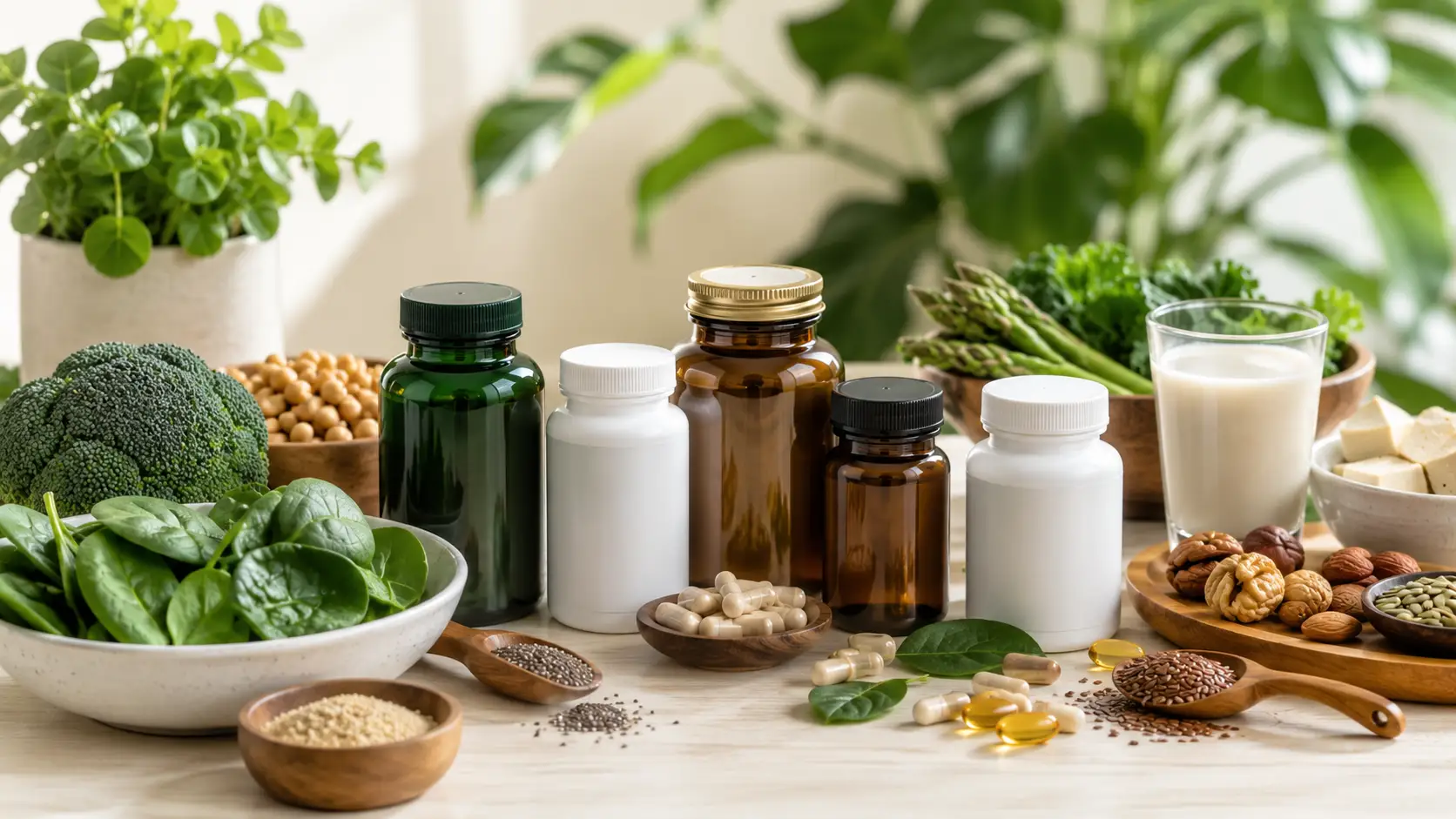
A study published in 2025 on Swedish teenage girls found 69% of iron deficiency in vegetarians and vegans, compared with 30% in omnivores. In the world of the food supplement, diets that exclude animal products call for particular vigilance over vitamin B12 and several other nutrients. Choosing your supplement starts by identifying the deficits specific to the diet adopted. This guide brings together the at-risk nutrients, the doses recommended by the FSVO and the forms best suited to vegetarian and vegan profiles.
Which nutrients should you monitor on a vegetarian or vegan diet?
Why is vitamin B12 essential for vegans?
Vitamin B12 is the only nutrient whose deficiency is almost inevitable without a supplement in vegans. This cobalamin is synthesised by bacteria and is found almost exclusively in animal products[2]: meat, fish, eggs and dairy products. The FSVO considers its supplementation essential for any person excluding animal foods[8], and the Swiss Society of Nutrition (SSN) takes up this recommendation in its info sheet dedicated to the vegan diet. Of all the nutrients essential to the body’s functioning, B12 is the only one for which a balanced plant-based diet is not enough. Ovo-lacto vegetarians are less exposed but still monitored: the amount of B12 needed to cover requirements solely through dairy products and eggs is equivalent to several daily portions. A prolonged deficiency affects the nervous system, may cause macrocytic anaemia and impair cognitive function[4]; some damage is poorly reversible, which makes this supplementation as important as follow-up by a healthcare professional in case of doubt.
Which other nutrients are at risk in vegetarians and vegans?
Six other nutrients deserve vigilance: iron, vitamin D, long-chain omega-3, iodine, calcium and zinc. These vitamins and minerals condition the balance of metabolism and the prevention of deficiencies. Non-haem iron from plant sources is less well absorbed than haem iron from red meat[2]; iron absorption drops further in the presence of phytates or tannins. A 2025 Swedish study observed a deficiency in 69% of vegetarian or vegan teenage girls, compared with 30% in omnivores[5]. Vitamin D, whose skin synthesis depends on sun exposure and remains limited during Swiss winter, is supplied in very small amounts by plant foods: a 2025 Italian study measured an average daily intake of about 84 IU in vegans[11], significantly less than the 600 IU/day recommended for the adult[8]. Omega-3 fatty acids EPA and DHA, naturally present in oily fish, are produced in small quantities by the body from the alpha-linolenic acid of seeds[3]. Iodine, calcium and zinc — each mineral taken in isolation — often show insufficient intakes in vegans[6], particularly in the absence of dairy products or fortified foods, which makes calcium intake and sufficient zinc intake particularly difficult to reach.
Which food supplements to choose and at what doses?
Which form and which dose of vitamin B12 should you favour?
For a healthy adult vegan, 25 to 100 µg per day of cyanocobalamin or 2,000 µg once a week are the regimens validated by international recommendations[3]. Cyanocobalamin is the best-studied, most stable and least expensive form; methylcobalamin is a directly active form but less documented in the long term. This ingredient exists in capsule or tablet form, and each brand offers a more or less pure formulation: choosing a vegan food supplement rests first on the actual dosage per intake, then on the dosage form and traceability. As no plant-based food provides active B12, a vegan food supplement remains the most reliable natural solution. The adequate intake set by EFSA for vitamin B12 in adults is 4 µg/day[12], but supplementation uses much higher doses: active intestinal absorption depends on intrinsic factor and tops out at around 1.5 to 2.5 µg per intake[12]. A high weekly dose compensates for this ceiling by passive diffusion and improves compliance. Vegetarians consuming few dairy products and eggs are also invited to supplement, as the FSVO recalls[10] in its position on the use of food supplements; an annual blood test allows the relevance of the course to be assessed.
| Nutrient | Reliable vegan form | Indicative adult dose |
|---|---|---|
| Vitamin B12 | Cyanocobalamin or methylcobalamin | 25–100 µg/day or 2,000 µg/week |
| Vitamin D3 | Cholecalciferol from lichen | 600 IU/day (15 µg); 800 IU from age 60 |
| EPA/DHA omega-3 | Marine microalgae oil | 250–500 mg/day combined |
| Iodine | Iodised salt or potassium iodide tablet | 150 µg/day |
| Iron | Bisglycinate or citrate (depending on ferritin) | To be assessed after a blood test |
| Calcium | Fortified foods or supplement if intake < 500 mg/day | 1,000 mg/day |
| Zinc | Bisglycinate or gluconate | 9–16 mg/day (men); 7–13 mg/day (women) depending on phytates |
Is a multivitamin formula better, or targeted supplements?
A vegan-specialised multivitamin formula covers the most at-risk nutrients, but it does not remove the need for separate B12 supplementation if the dose is insufficient. This multi-nutrient approach aims to balance the diet and act as a barrier against deficiencies, but the actual effect depends on the dosage of each essential nutrient. Many vegan multivitamins cap at 5 or 10 µg of B12 per tablet, below the 25 to 100 µg advised for this population. A 2025 German study showed that the nutritional quality of vegan diets depends heavily on supplementation: without it, intakes of B12, iodine and calcium fall below the recommended thresholds[6]. Conversely, excessive supplementation in zinc or selenium carries a risk of overdose[9]. The best supplements for this profile are therefore not always the broadest formulas: the targeted solution — separate B12, vitamin D and algae-derived omega-3 — allows each dose to be adjusted and remains relevant for most profiles.
How to adapt your supplementation to your profile?
Should you have a blood test before supplementing?
Yes for iron, B12 status and vitamin D; no for preventive B12 supplementation in a strict vegan. A blood test allows the real needs to be targeted before heavy supplementation and provides the medical information needed to adjust doses. For iron, measuring ferritin avoids unnecessary, even counter-productive, supplementation: a 2024 Portuguese study observed a correlation between iron intake and a rise in C-reactive protein, a marker of inflammation[7]. For B12, the measurement of the serum vitamin and of holotranscobalamin — its active form — informs about the stores[10]. By contrast, waiting for a blood test before starting B12 in a strict vegan is not justified: preventive supplementation is consensual and without risk of overdose at the recommended doses. In the event of persistent fatigue or immune problems, consulting a professional remains the safest approach to assess the real benefit of a targeted course.
To avoid
Considering spirulina or algae as a reliable source of vitamin B12. Spirulina mainly contains pseudo-cobalamins biologically inactive in humans, and their consumption can even distort blood B12 measurements by overestimating intakes.
Practical tip
For beginner vegans, start vitamin B12 supplementation from the first month without waiting for a blood test. The liver stores of a former omnivore may last 3 to 5 years, but once exhausted the deficiency sets in rapidly and may cause poorly reversible neurological damage.
Which specifics for pregnant women, children and athletes?
Pregnancy, childhood and intensive training increase the gap between dietary intakes and needs, and call for more structured supplementation. The vegan diet and lifestyle must then be adapted at each stage, from pregnancy to baby and child. During vegan pregnancy, 2025 Danish clinical recommendations insist on early B12 screening, monitored iron intake and maintained vitamin D supplementation[13]. In vegan infants and young children, a 2024 review sets a minimum threshold of 5 µg/day of B12, 10 µg/day of vitamin D and up to 110 µg/day of iodine when breastfeeding declines[9] — a critical nutritional care for the normal functioning of the developing immune system. For vegan athletes, a review published in 2025 underlines the value of a personalised protocol combining complete plant-based proteins (pea, soya, rice) — covering all the amino acids essential to the body —, creatine, algae-derived omega-3 and monitored iron[3]. In all these profiles, whether intensive sport or childhood, follow-up by a healthcare professional remains preferable to self-supplementation.
Frequently asked questions
Which food supplement is the most essential for a vegan?
Vitamin B12 without hesitation. It is the only nutrient that is virtually absent from plants, made by bacteria and stored in animal products. The FSVO and the Swiss Society of Nutrition recommend systematic supplementation for any adult vegan, at 25 to 100 µg per day or 2,000 µg as a single weekly dose. Without a supplement, the liver stores run out in 3 to 5 years and the deficiency may cause anaemia and neurological disorders.
Do ovo-lacto vegetarians really need vitamin B12 supplementation?
Yes, in most cases. The amount of B12 needed to cover the requirements solely through dairy products and eggs is equivalent to 3 to 6 daily portions, which exceeds the usual recommendations. The main French-speaking scientific societies — including the Academy of Nutrition and Dietetics and the National Observatory of Plant-Based Nutrition — invite vegetarians to supplement or to favour fortified foods. An annual blood test allows the usefulness of supplementation to be assessed on a case-by-case basis.
Is spirulina a reliable source of vitamin B12 for vegans?
No, despite the high content shown on labels. Spirulina mainly contains B12 analogues — known as pseudo-cobalamins — which are not biologically active in humans. Their presence can even falsely raise blood B12 measurements and mask a real deficiency. No raw plant food, be it spirulina, chlorella or non-fortified yeast, is recognised by health authorities as a sufficient source of B12.
How long does it take to correct a vitamin B12 deficiency?
Several weeks to several months depending on the severity of the deficiency and the route of supplementation. Haematological signs — anaemia, fatigue — usually subside in 4 to 8 weeks of well-dosed oral or injectable supplementation. Neurological symptoms, when present, can take several months to fade and some damage may remain partially irreversible. High-dose supplementation (1,000 to 2,000 µg per day during the correction phase, then a maintenance dose) is often prescribed, ideally under medical follow-up.
Can you meet all your needs without a supplement by eating only fortified foods?
This is theoretically possible but difficult in practice. Foods fortified with B12, iodine and calcium — plant milks, fortified yeasts, cereals — cover intakes if consumption is regular and calculated. A 2025 German study nonetheless observed that actual intakes of B12, iodine and calcium fall below the recommended thresholds in most non-supplemented vegans. Ultra-processed plant-based foods, often perceived as a healthy alternative, have a lower nutritional density than the animal products they replace.
Sources and references
13 sources- Lotti S. et al. (2025). Lacto-ovo-vegetarian and vegan diets in children and adolescents: a systematic review and meta-analysis.
- Malhotra A. & Lakade A. (2025). Analytical Review on Nutritional Deficiencies in Vegan Diets: Risks, Prevention, and Optimal Strategies.
- Vergara Nieto A. et al. (2025). Are there Effective Vegan-Friendly Supplements for Optimizing Health and Sports Performance? A Narrative Review.
- Clemente-Suárez V.J. et al. (2025). Impact of Vegan and Vegetarian Diets on Neurological Health: A Critical Review.
- Stubbendorff A. et al. (2025). Iron insight: exploring dietary patterns and iron deficiency among teenage girls in Sweden.
- Storz M.A. et al. (2025). Analyzing dietary exposure to critical nutrients on a plant-based diet using the food- and total nutrient index.
- Pinheiro C. et al. (2024). The Relevance of Plant-Based Diets and Micronutrient Supplementation for Body Composition: VeggieNutri Study.
- Federal Food Safety and Veterinary Office (FSVO) and Swiss Society of Nutrition (SSN). Swiss nutritional recommendations.
- Koeder C. (2024). Toward Supplementation Guidelines for Vegan Complementary Feeding.
- Federal Food Safety and Veterinary Office (FSVO). Food supplements: a use reserved for certain situations.
- Nuti R. et al. (2025). Vitamin D intake in Italian healthy subjects and patients with different pathological disorders.
- EFSA NDA Panel (2015). Scientific Opinion on Dietary Reference Values for cobalamin (vitamin B12).
- Skoven F.H. et al. (2025). Vegetarian and vegan diets among pregnant and breastfeeding women.