What is the role of the FSVO in supplement oversight?
Quick summary
The FSVO sets the legal framework for food supplements through the FSUAO, fixes the maximum quantities for vitamins and minerals and assesses health risks, but on-the-ground controls fall to the cantonal chemists.
Key facts
Key takeaways
- The FSVO drafts the FSUAO (SR 817.022.14), which defines the authorised substances, the maximum quantities per recommended daily dose and the labelling requirements.
- Food supplements require no prior authorisation in Switzerland, except for novel foods, GMOs and health claims not listed in Annex 14 of the FIO.
- The cantonal chemists control products in the field: 113 of 127 online samples were banned from sale during the 2024 national campaign.
- The FSVO assesses the risks of excessive micronutrient intake through the 2023 Swiss Nutrition Bulletin, which shows that 30% of Swiss residents consume at least one supplement.
- The FSVO is not Swissmedic: supplements are foodstuffs, not medicines, and must have no pharmacological effect.
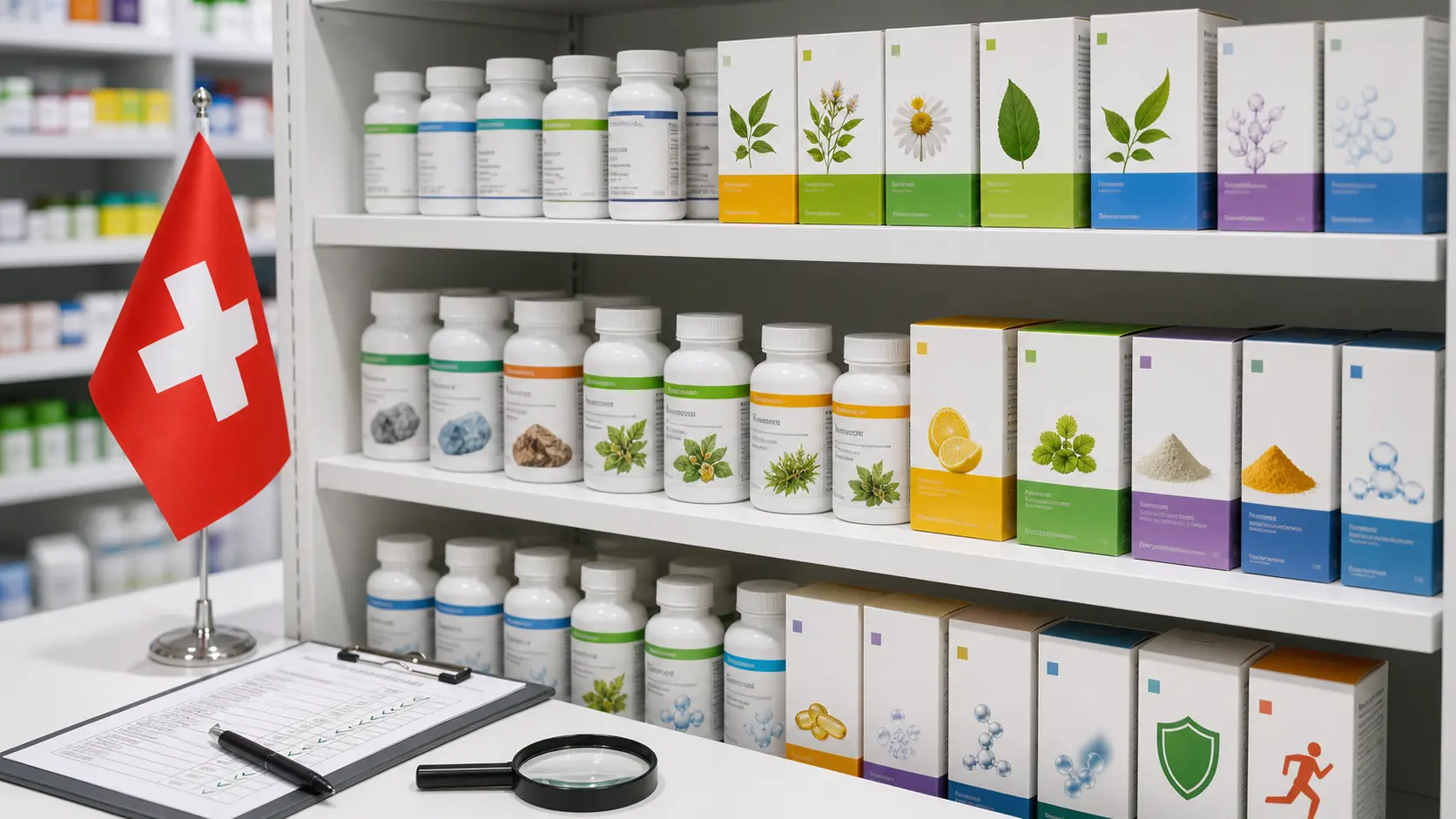
Close to one Swiss resident in three consumes at least one food supplement according to the 2023 Swiss Nutrition Bulletin, on a sample of 1,282 adults. These products concentrate vitamins, mineral salts or other substances, amino acids, plants, extracts, designed to supplement a balanced diet through a nutritional or physiological effect. In the world of the Swiss food supplement, the FSVO occupies a structuring position: it is the federal authority that defines the framework, sets the authorised substances and assesses the risks linked to excessive doses. Understanding its role is essential to grasp the Swiss regulation on food supplements as a whole: including the division of responsibilities with the cantonal chemists and Swissmedic.
What is the FSVO and what are its missions on food supplements?
The FSVO, federal authority for food safety in Switzerland
The FSVO is the Federal Food Safety and Veterinary Office, a federal authority attached to the Federal Department of Home Affairs (FDHA)[1]. Known by its German acronym BLV, it has the mission of ensuring the safety of foodstuffs and utility articles, of overseeing animal health and of protecting consumers against deception. The FSVO acts upstream of the market, for example by preparing the legal foundations, by assessing the risks linked to human consumption and by publishing the Swiss nutritional recommendations, all information intended for the general public as well as for professionals.
On food supplements, the FSVO’s role is that of a regulator and not of a field controller. The federal office is based in Liebefeld (Schwarzenburgstrasse 155)[1], with the official postal address for contact being 3003 Bern[2]. Its Foodstuffs and Nutrition division as well as its Scientific Foundations division handle the technical dossiers relating to supplements and publish the reference documents, implementing regulations, reports and practical fact sheets, accessible on its website.
The four missions of the FSVO on food supplements
The FSVO carries out four structuring missions: drafting the legal framework, fixing the maximum quantities, assessing health risks and authorising novel foods. The first is the most visible: the FSVO is the author of the FSUAO[3] (FDHA Ordinance on Food Supplements, SR 817.022.14), which defines the authorised substances and the labelling requirements. This regulatory work sets the measures applicable to all operators.
On maximum quantities, Annex 1 of the FSUAO[3] fixes the maximum quantities, ceiling values, of vitamins, mineral salts and other substances that must not be exceeded per recommended daily dose, with precise requirements on labelling of intakes. The assessment of health risks is carried out through national surveys such as the 2023 Swiss Nutrition Bulletin[4], which showed on 1,282 adults[4] that 30% had consumed at least one supplement in the last seven days. Finally, for novel foods[5], including ingredients of plant, animal or microbial origin (plants, fungi, micro-organisms) without a significant history of consumption in Switzerland before 1997, prior FSVO authorisation rests on research work and also conditions the importation of these new foods, the office taking on a role equivalent to EFSA’s in the European Union.
How does the FSVO actually control food supplements?
The FSVO does not carry out field controls: the role of the cantonal chemists
The FSVO does not take products from the shelves and does not analyse samples. The control of foodstuffs and utility articles is carried out by the cantons[6], under the direction of the cantonal chemists. They are the ones who inspect establishments, sample suspect supplements, commission laboratory analyses and provide the operational response: sales ban issued depending on the result of the tests.
This division is set out in the Federal Act on Foodstuffs and Utility Articles (FSA, SR 817.0). The FSVO sets the national framework, the cantons enforce it. The organisation is built around the cantonal services of the 26 Swiss cantons, coordinated by the Association of Cantonal Chemists of Switzerland, which inspects more than 40,000 businesses and produces annual statistics from around 100,000 samples analysed each year[7].
How does the FSVO assess the risks linked to micronutrient intakes?
The risk assessment rests on representative surveys and toxicovigilance data. The menuCH survey[8], Switzerland’s first national nutrition survey, provides representative data on the diet of residents in Switzerland and on intakes of vitamins and mineral salts. From these data, the FSVO estimates the share of the population that exceeds the Tolerable Upper Intake Level for each nutrient.
The FSVO also commissions Tox Info Suisse[9] to analyse poisoning notifications. The 2014-2019 report listed about 1,200 enquiries[9] linked to food supplements, slimming products and sports foods; among intentional ingestions in adults, caffeine appears in 17 of the 22 moderately serious to serious cases[9]: a signal that calls for particular attention. These data feed decisions to adapt the FSUAO and targeted campaigns.
FSVO, Swissmedic, cantonal chemists: who does what in Switzerland?
The FSVO / Swissmedic difference on food supplements
The FSVO regulates food supplements as foodstuffs, Swissmedic regulates medicines: these are two distinct legal regimes framed by Swiss legislation. Article 1 of the FSUAO[3] sets out the definition of supplements as foodstuffs intended to supplement a varied diet through a nutritional or physiological effect; their use must have no pharmacological effect nor be presented as curing or preventing disease. The banned or restricted substances appear in the annexes of the FDHA ordinances (Annex 4 of the OAVMS, Annex 1 of the OPFA) updated by the FSVO.
The boundary is fluid. Certain products may switch into the medicines regime depending on the composition and claims used: red yeast rice at high dosage, melatonin or certain plant extracts[10] may be reclassified as therapeutic products, which makes their importation subject to Swissmedic provisions and increases the administrative risk for the operator. The distinction is made on the objective composition and the subjective presentation of the product.
The division of roles between the FSVO, the cantons and economic operators
The primary responsibility for compliance lies with the economic operator, not with the public authority. The self-monitoring principle[2], central in the FSA, means that anyone who manufactures, imports or distributes a food supplement is responsible for its safety: prior legal advice is often useful before launching a market-placing project. The establishment must notify its activity to the competent cantonal authority, but no product notification is required in Switzerland.
During the 2024 cantonal chemists’ campaign, 13 establishments (18%) among the online shops tested[7] had not notified their activity to the control services, which already constitutes an infringement independent of the products’ compliance. The table below summarises the division of responsibilities between the actors.
| Actor | Main competence | Power of action |
|---|---|---|
| FSVO | National legal framework, FSUAO, novel food authorisation | Drafts the ordinances, assesses the risks, authorises novel foods |
| Swissmedic | Medicines and therapeutic products | Reclassifies a supplement as a medicine if pharmacological effect |
| Cantonal chemists | Field control, sampling, analyses | Sales ban, recall, cantonal sanctions |
| Economic operator | Self-monitoring of product compliance | Legal responsibility for safety and labelling |
Frequently asked questions on the role of the FSVO
How can I report a suspect or non-compliant food supplement to the FSVO?
Reporting is addressed to the cantonal chemist, not directly to the FSVO. The cantonal chemists enforce the legislation in the field: they are the ones who can sample, analyse and ban a product. Each canton has a cantonal chemist service reachable by phone or online form. The FSVO acts in the background through the FSUAO and national coordination, but does not handle individual consumer reports.
Can the FSVO withdraw a food supplement from the Swiss market?
No, withdrawal is ordered by the cantonal enforcement authorities. During the 2024 national campaign on supplements sold online, 113 products out of 127 tested were banned from sale and 48 recalls were ordered. The FSVO can trigger a risk-based investigation, as in 2024, and coordinate bans at national level, but the act of banning falls to the canton.
Is there an official list of food supplements authorised in Switzerland by the FSVO?
No, no official list of authorised products exists. Food supplements are not subject to prior authorisation in Switzerland, except for exceptions (novel foods, GMOs, unlisted health claims). This is the self-monitoring principle enshrined in the FSA: every manufacturer, importer or distributor is responsible for the compliance of their products. The FSVO does, however, publish the annexes of the FSUAO with the authorised substances, their maximum quantities and the list of permitted health claims.
What happens if the FSVO detects an infringement involving a food supplement?
Sanctions range from a sales ban to a public recall. The 2024 campaign triggered 48 mandatory recalls and 3 notifications to the European RASFF system for foreign products. The cantonal chemists can also sanction operators who have not notified their activity: 18% of the online shops tested were in breach on this point. Fines and criminal proceedings then fall to cantonal justice, in accordance with the FSA.
Is the FSVO responsible for the safety of all food supplements sold in Switzerland, including online?
The FSVO sets the legal framework but the primary responsibility lies with the economic operator. Swiss food law is based on self-monitoring: importing or selling a supplement engages the distributor’s responsibility, whether they operate in a shop or online. Online trade remains a partial blind spot: private imports fall outside the FSA, and the Federal Council is considering strengthening the control of foreign shops with a .ch domain. The FSVO recommends buying on Swiss or European platforms.
Sources and references
10 sources- FSVO, Mandate and missions
- FSVO, Food supplements: legal aspects
- FSUAO, FDHA Ordinance on Food Supplements (SR 817.022.14)
- Solliard C, Benzi Schmid C, König SLB, Food supplement consumption in Switzerland
- FSVO, Authorisation for new kinds of foodstuffs (novel foods)
- FSVO, Importation of foodstuffs: cantonal competence
- Association of Cantonal Chemists of Switzerland, Mission and key figures of official control
- FSVO, menuCH, Switzerland’s first national nutrition survey
- Tox Info Suisse, Enquiries linked to food supplements 2014-2019
- FSVO, Buying foodstuffs online and reclassification as a medicine