What differences between Swiss and EU rules?
Quick summary
Switzerland applies its own FSUAO Ordinance (SR 817.022.14) alongside Directive 2002/46/EC. Melatonin and red yeast rice remain banned as supplements, the maximum dosages are set in Annex 1 of the FSUAO, and any non-compliant EU product requires a decision of general scope from the FSVO (Art. 16c FATTB).
Key facts
Key takeaways
- Switzerland governs supplements through the FSUAO (SR 817.022.14) and the OAVMS, the EU through Directive 2002/46/EC transposed into each national legislation.
- The FSUAO sets, in its Annex 1, maximum quantities per daily dose; the EU directive leaves the thresholds to the Member States, with marked differences between countries.
- Melatonin is banned as a supplement in Switzerland (Annex 4 of the OAVMS, Swissmedic medicine) whereas it is sold over the counter up to 1 mg in Germany.
- The Cassis-de-Dijon principle, codified in Art. 16a-16e of the FATTB, excludes foodstuffs from automatic free movement between the EU and Switzerland.
- An EU supplement that does not comply with the FSUAO can only be placed on the Swiss market after a decision of general scope from the FSVO (Art. 16c FATTB, OPTFMR).
- Private importation falls outside Swiss food law (Art. 2 para. 4 let. b FSA), but transfers the entire responsibility to the consumer.
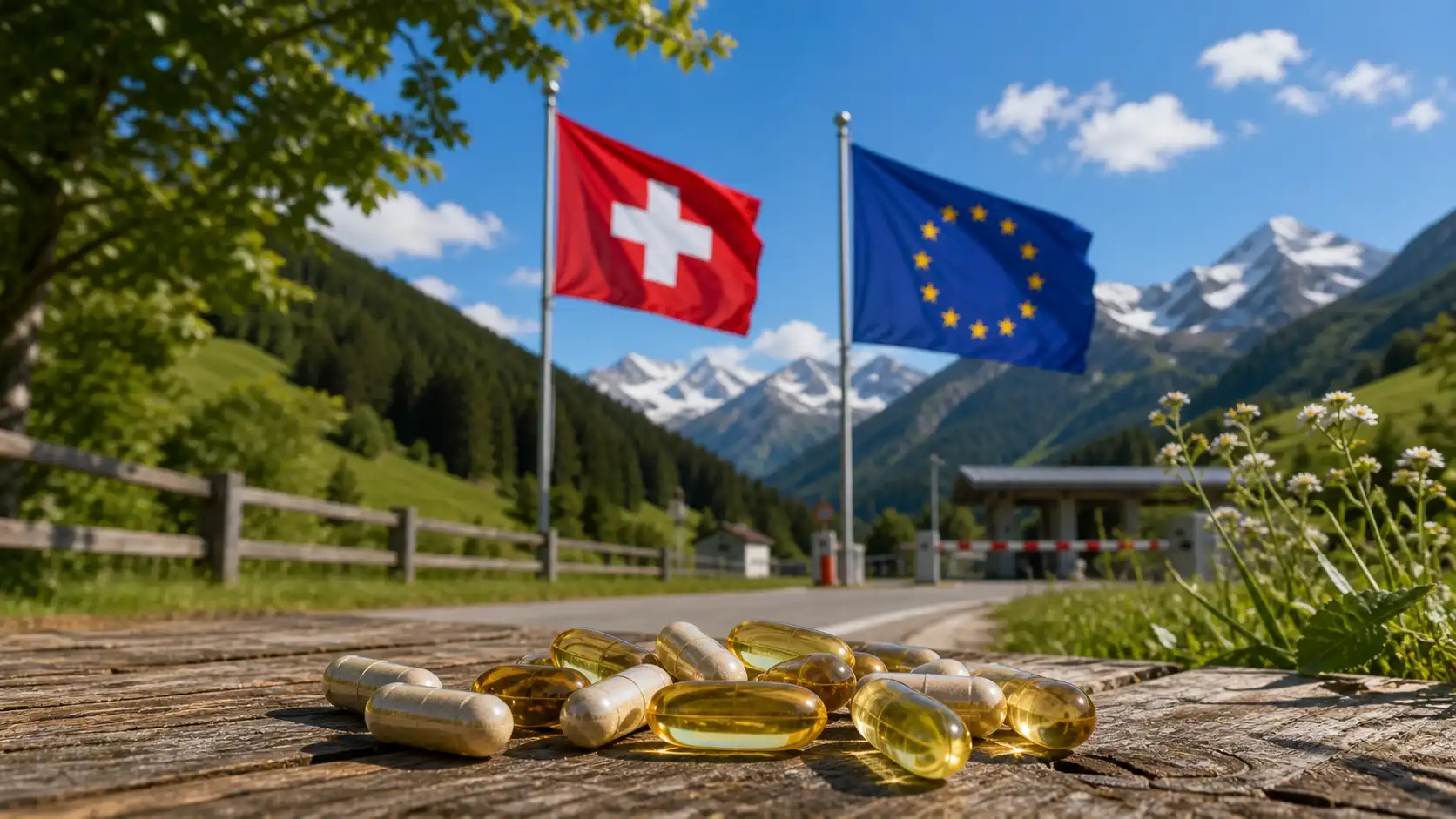
The FSVO has notified the entry into force, on 1 January 2026, of several ordinance adaptations that partially align Swiss law with European developments while preserving specific national rules. This tension between alignment and autonomy structures the entire framework of the food supplement marketed in Switzerland. Understanding the Swiss regulation on supplements therefore means situating it against European Directive 2002/46/EC. The practical divergences concern the governing texts, the authorised substances, the maximum dosages, the status of melatonin and the Cassis-de-Dijon mechanism.
Which texts govern supplements in Switzerland and the EU?
The Swiss framework: FSA, FSUAO and OAVMS
Three texts structure Swiss legislation applicable to food supplements. The Federal Act on Foodstuffs and Utility Articles (FSA, SR 817.0)[1] and its implementing ordinance, the Foodstuffs Ordinance, form the base of general food legislation. The text specific to supplements is the FSUAO (SR 817.022.14)[2], enacted by the Federal Department of Home Affairs on 16 December 2016[2]. The FSUAO sets, in its Article 2, the legal definition of supplements[2]: concentrated sources of nutrients or other substances with a nutritional or physiological effect, packaged in doses, intended to supplement the normal diet and not to replace it. Its Annex 1 lists the admitted ingredients, vitamins, mineral salts and other active substances, with their maximum daily quantities[2]. The OAVMS (SR 817.022.32) completes this framework by listing in its Annex 4 the substances banned in supplements (lactulose, melatonin, Monascus purpureus)[2], which are subject to a separate therapeutic regime.
The European framework: Directive 2002/46/EC
The EU harmonised the definition and labelling of supplements through Directive 2002/46/EC of 10 June 2002[3], transposed into each national legislation. The directive sets a harmonised positive list of admitted vitamins and mineral salts (Annex I) and the usable formulations (Annex II)[3], with a mandatory nutrition declaration. By contrast, it does not set harmonised maximum quantities[3]: each Member State applies its own thresholds, which explains the marked divergences in dosages and admitted ingredients. EFSA evaluates the risks, but the final authorisation rests with the European Commission. The directive does not cover plant-based substances: their framework remains partially national, and a phytomedicine may fall under a different therapeutic regime depending on the Member State.
On which substances and dosages do the rules diverge?
Substances banned in Switzerland but admitted in certain EU countries
Several substances authorised in certain EU countries as supplements are classified as medicines in Switzerland and inaccessible without a prescription. Melatonin is the most telling example: in Germany, it is sold freely in chemist shops up to 1 mg per tablet[4]; in France, preparations under 2 mg per dose are available without prescription. In Switzerland, it appears in Annex 4 of the OAVMS as a substance banned in supplements[2]: only Circadin® 2 mg and Melatonin-Mepha 2 mg, authorised by Swissmedic[4] for primary insomnia from age 55, are available, on prescription. Red yeast rice (monacolin K) follows the same logic: strictly regulated in Switzerland[2], it remains sold in the EU under certain dosage limits. The boundary between foodstuff and medicine accounts for most of the practical divergences between the two systems.
Maximum dosages: Swiss ceilings, European heterogeneity
The FSUAO sets, in its Annex 1, maximum quantities per recommended daily dose for each admitted vitamin and mineral salt[2]. The maximum-quantity model revised in July 2020[5] rests on the tolerable upper intake level (UL) defined by EFSA, reduced by the estimated baseline nutritional intake from the usual diet[5]. Switzerland sets, for example, the vitamin D ceiling at 70 µg per daily dose[2], whereas the EFSA UL for adults reaches 100 µg per day[5]. The EU had planned to harmonise the maximum contents under Directive 2002/46/EC[3], but this exercise never came to fruition. Consequence: a vitamin supplement compliant in a Member State may exceed the Swiss thresholds, which creates practical import and export gaps. For substances classified as novel foods (negligible consumption before 15 May 1997), prior authorisation is required in both systems, by the European Commission for the EU, by the FSVO for Switzerland, and a novel food authorised by the EU is not automatically admitted in Switzerland[12].
| Dimension | Switzerland | European Union |
|---|---|---|
| Central text | FSUAO SR 817.022.14 | Directive 2002/46/EC |
| Assessment authority | FSVO (federal) | EFSA + European Commission |
| Maximum quantities | Set in Annex 1 of the FSUAO | Not harmonised between States |
| Melatonin | Prescription medicine | Supplement (up to 1 mg in Germany) |
| Product notification | No centralised procedure | Notification required in most States |
| Titanium dioxide (E171) | Banned since 15 March 2022 | Banned since January 2022 |
How do Cassis-de-Dijon and the FSVO procedure work?
An explicit exception for foodstuffs
The Cassis-de-Dijon principle, transposed into Swiss law in Art. 16a-16e of the Federal Act on Technical Barriers to Trade (FATTB, SR 946.51)[6], in principle allows products originating in the EU or EEA and legally marketed there to access the Swiss market without prior control. A specific exception targets foodstuffs: under Art. 16c FATTB, a food product that does not meet Swiss technical requirements requires prior authorisation from the FSVO before its first placing on the market[7]. Supplements are part of foodstuffs under Art. 1 of the FSUAO[2]; they therefore fall within this exception[8]. The Confederation has justified this legal regime by the particular sensitivity of the food sector in matters of public health and protection against deception[7].
The FSVO decision of general scope
The FSVO issues the authorisation in the form of a decision of general scope, valid for all comparable products[7]. Once published, the decision automatically applies to all foodstuffs of the same nature marketed on Swiss territory, and not only to the applicant’s product[8]. The importing business must prove two elements: that the supplement is legally sold in an EU or EEA Member State, and that it meets the technical requirements of that State (Art. 4 to 11 of the OPTFMR[9]). The office then assesses health safety and compliance with consumer information rules[8]. Only two grounds justify a refusal: risk to health or risk of deception (Art. 16d para. 1 FATTB[6]). According to the Fédération romande des consommateurs, the FSVO has published 41 decisions of general scope concerning foodstuffs since 2010[10]. The official list is available at cassis.admin.ch.
Private importation: a separate regime
Art. 2 para. 4 let. b of the FSA exempts foodstuffs intended for private domestic use[1]. A private individual may order online from a European site or bring back from France, Germany or Italy a supplement that does not comply with the FSUAO for personal consumption, under their own responsibility. The exception does not cover resale, free distribution to third parties or commercial importation by a professional, which remain subject to the FSVO regime[8]. This private regime also does not cover products reclassified as medicines by Swissmedic: melatonin, DHEA and growth hormones imported privately are seized by the Federal Office for Customs and Border Security (FOCBS)[4], as are certain phytomedicines subject to prescription. The SECO negative list of products excluded from Cassis-de-Dijon is regularly updated[11].
Which grounds block an authorisation and what mistakes should be avoided?
Three EU-Switzerland gaps most often cause a refusal
Exceeding the thresholds, novel-food status and non-compliant labelling dominate the grounds for rejection. The Swiss thresholds for vitamins and mineral salts (Annex 1 of the FSUAO[2]) are often lower than those applied in Member States such as Germany or the Netherlands. A European supplement dosed at 100 µg of vitamin D cannot be distributed as is in Switzerland[2], even when authorised in France. Ingredients qualified as novel foods by the FSVO require a separate procedure, independent of Cassis-de-Dijon[12]. The labelling must meet the conditions of Art. 36 of the Foodstuffs Ordinance before the dossier is filed, including nutritional information and the mention of authorised claims (Annex 14 of the FIO). Health protection takes precedence: no Cassis-de-Dijon derogation can justify exceeding a national health threshold[7].
| Ground for rejection | Legal basis | Outcome |
|---|---|---|
| Exceeding vitamin/mineral thresholds | Annex 1 FSUAO + Art. 16d para. 1 FATTB | Rejection for health risk |
| Ingredient classed as novel food in Switzerland | Art. 15 Foodstuffs Ordinance + novel food ordinance | Separate novel food procedure required |
| Labelling not in official languages | Art. 36 Foodstuffs Ordinance + Art. 3 FSUAO | Request inadmissible |
The most frequent importer mistakes
Confusing EU compliance with access to the Swiss market remains the most costly mistake. A product compliant with Directive 2002/46/EC[3] and legally sold throughout the EEA is not automatically authorised in Switzerland: commercial resale requires an FSVO decision[8]. Second common mistake: translating the label after the dossier is filed, whereas Art. 36 of the Foodstuffs Ordinance requires labelling in German, French or Italian as soon as the product is placed on the market. Third mistake: ignoring the Swissmedic dimension. A plant-based supplement may be reclassified as a medicine if its pharmacological effect is established, which shifts the authorisation outside the FSVO’s scope[4]. The cantonal enforcement authorities order the compliance measures (Art. 34 FSA[1]); the product may be confiscated, rendered harmless or disposed of at the business’s expense. Infringements are forwarded to the criminal prosecution authority (Art. 64 FSA[1]). The FOCBS controls compliance at the border, and the importer remains responsible even when buying the product already labelled from a European supplier.
Frequent mistake
Believing that a product bought in a French pharmacy and compliant with Directive 2002/46/EC can be freely resold on the Swiss market. Commercial resale requires an FSVO decision, even for a supplement legally sold throughout the EEA.
Frequently asked questions
Is Switzerland part of the EFSA system?
No, Switzerland is not a member of EFSA. The risk assessment of food supplements in Switzerland falls to the FSVO (Federal Food Safety and Veterinary Office), which often relies on EFSA opinions without being bound by them. Novel-food authorisations are issued by the FSVO for Switzerland and by the European Commission for the EU. A product authorised by EFSA and the Commission may therefore be refused in Switzerland if the FSVO considers that the conditions are not met.
Why is melatonin banned as a food supplement in Switzerland?
Because it is classified as a medicine by Swissmedic. It is only available in Switzerland on prescription (Circadin® 2 mg, Melatonin-Mepha 2 mg), authorised for primary insomnia from age 55. In Germany, it is sold up to 1 mg in chemist shops; in the United States, as a food supplement. Importing melatonin without a prescription into Switzerland exposes the consumer to seizure at customs, with no quantitative allowance.
Can an EU food supplement enter Switzerland via Cassis-de-Dijon?
Not automatically: an FSVO decision is still required. Art. 16c of the FATTB establishes a specific regime for foodstuffs, of which supplements form part under Art. 1 of the FSUAO. The importer must obtain a decision of general scope from the FSVO, which verifies the product’s safety and protection against deception (Art. 16d para. 1 FATTB). Once issued, it applies to all products of the same nature and is listed on cassis.admin.ch.
Are EFSA health claims valid in Switzerland?
Not automatically: the FSVO maintains its own list in Annex 14 of the FIO. The FDHA Ordinance on Food Information (FIO, SR 817.022.16) lists in its Annex 14 the health claims authorised in Switzerland. This list draws largely on European Regulation (EC) 1924/2006 and EFSA opinions, but does not adopt everything. A wording valid in the EU must therefore be checked against Annex 14 of the FIO before use on the Swiss market.
Does the label of an EU food supplement have to be translated for Switzerland?
Yes, in at least one Swiss official language. Art. 36 of the Foodstuffs Ordinance requires labelling in German, French or Italian depending on the sales area. The specific designation ‘food supplement’ must appear on the packaging (Art. 3 para. 1 of the FSUAO), with the vitamin and mineral content per recommended daily dose. A label only in English or Spanish makes the product non-compliant, even if it otherwise meets the Swiss thresholds in Annex 1 of the FSUAO.
Sources and references
12 sources- Federal Act on Foodstuffs and Utility Articles (FSA), SR 817.0
- FDHA Ordinance on Food Supplements (FSUAO), SR 817.022.14
- Directive 2002/46/EC on food supplements
- Warning on imports of melatonin and DHEA
- Maximum-quantity model for vitamins and mineral salts in food supplements
- Federal Act on Technical Barriers to Trade (FATTB), SR 946.51
- Cassis-de-Dijon principle, regulation for foodstuffs
- Cassis-de-Dijon principle: questions and answers
- Ordinance on the Placing on the Market of Products Manufactured according to Foreign Technical Regulations (OPTFMR), SR 946.513.8
- Cassis-de-Dijon, review and decisions of general scope
- Cassis-de-Dijon principle, negative list
- Authorisation for novel foods