What about online purchase of food supplements in Switzerland?
Quick summary
Buying a food supplement online in Switzerland is legal, but the .ch extension guarantees nothing: 89% of the suspect products tested in 2024 by the cantonal chemists were banned, and 18% of the e-shops checked were not declared.
Key facts
Key takeaways
- Online purchase is legal in Switzerland, but responsibility for product safety lies with the manufacturer or distributor: not with the buyer, who nevertheless bears the health risks.
- The cantonal chemists banned the sale of 113 out of 127 products checked in 2024 (89%), because of unsafe ingredients or ingredients whose health risks had not yet been sufficiently assessed.
- 18% of the Swiss e-shops checked were not declared with the cantonal chemist: something the FSA nevertheless requires of every seller of foodstuffs.
- Melatonin, CBD, red yeast rice and St John’s wort are among the substances most frequently flagged in supplements sold online.
- Seven concrete criteria allow you to filter an e-shop before buying: verifiable Swiss registered office, complete legal notice, labelling in an official language, claims compliant with the FIO, daily dose indicated, no therapeutic promise, traceability of the manufacturer.
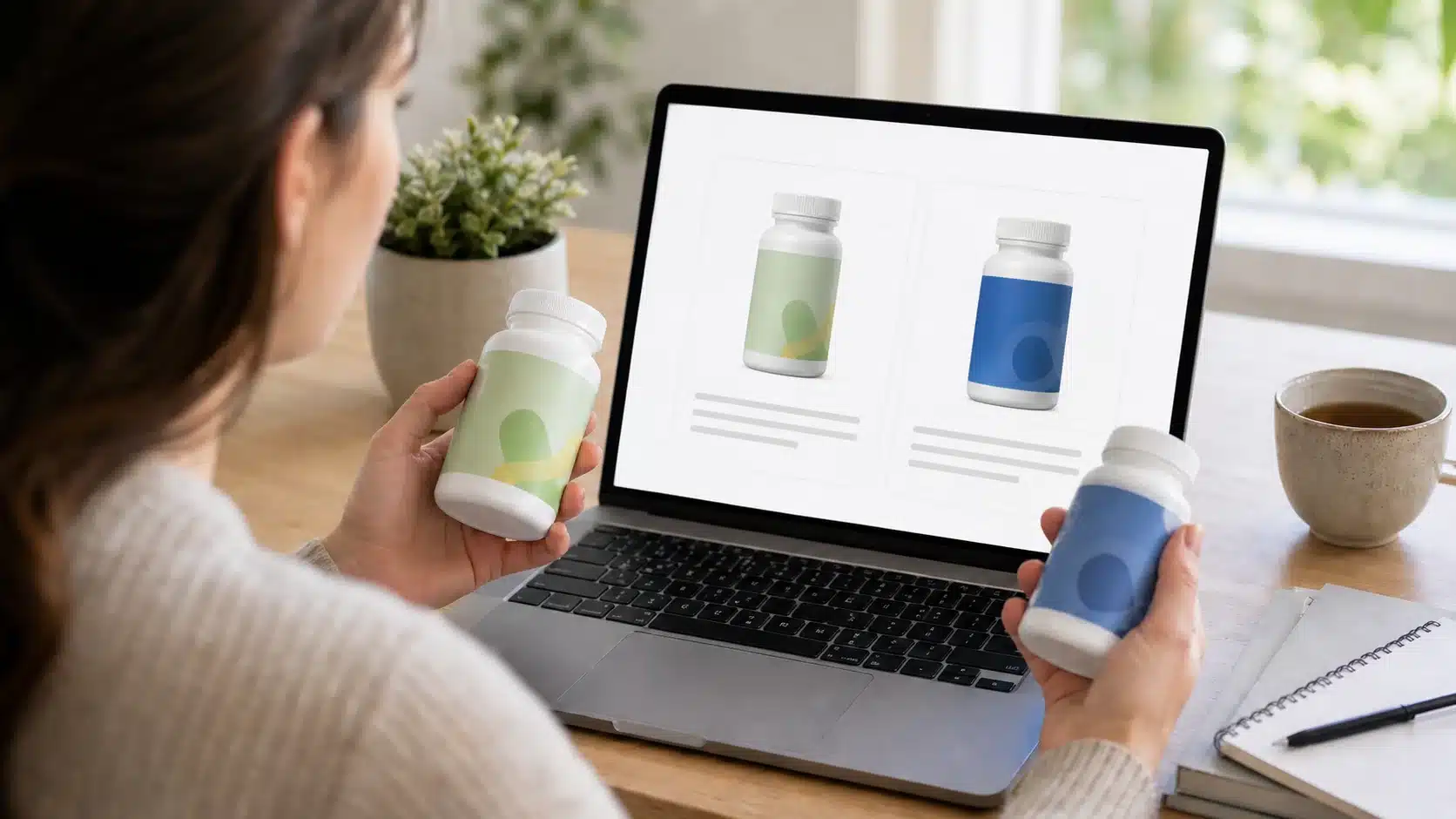
In 2024, the cantonal chemists checked 127 food supplements sold on Swiss and Liechtenstein e-shops: 113 had to be banned from sale, that is 89% of the sample. In the world of the Swiss dietary supplement, online purchase is legal in Switzerland but remains a risky ground where the Swiss regulation on food supplements rests on seller self-monitoring, controlled only on a sample basis. Understanding what distinguishes a reliable e-shop from an undeclared shop becomes the only safety net for the consumer.
Is it safe to buy a food supplement online in Switzerland?
What does Swiss law say about the online sale of supplements?
Yes, the online sale of food supplements is legal in Switzerland, but the framework applies identically to physical and digital commerce. The FSVO points out that the legal provisions also apply to supplements offered on the internet, and that the consumer must receive, before purchase, the same information as in a physical shop: with the exception of the durability date[1].
In concrete terms, no prior authorisation is required to place a food supplement on the Swiss market. The safety of the product falls under the self-monitoring of the manufacturer or distributor, who must notify their activity to the cantonal enforcement authority before sale[2]. The control by cantonal authorities is carried out after the product is placed on the market and is done by sampling: a mechanism that is structurally lax for the consumer buying online.
Why is a .ch site not a safety guarantee?
The .ch domain certifies neither the seller’s physical establishment in Switzerland, nor their declaration with the cantonal chemist. Registering a .ch domain name is subject to no prior compliance check with food law: any seller, Swiss or not, can hold one.
In spring 2024, the FSVO led a targeted control campaign on Swiss and Liechtenstein e-shops, focused mainly on plant-based food supplements: of 127 suspect products analysed from 72 businesses, 113 were banned from sale (89%), and 18% of the e-shops checked were not declared with the food-control service[3].
The sample targeted suspect products, so the rate is not representative of the market as a whole. Patrick Edder, cantonal chemist of Geneva and French-speaking spokesperson for the campaign, qualifies this in the specialist press: the majority of products withdrawn are not all dangerous, but they are not safe[4]. The distinction is legal: a banned product does not comply with the FSUAO or contains a substance that has not been assessed, which falls under the precautionary principle ahead of any health conclusion.
How can you check that a Swiss e-shop is reliable?
The 7 concrete criteria to check before buying
Seven checks in under five minutes filter out most at-risk e-shops. This checklist cross-references the requirements of the FSA, the FSUAO and the FIO with the reliability criteria used by the cantonal chemists in the 2024 campaign[3]. No single criterion taken in isolation is enough; reliability rests on their combination.
- Verifiable Swiss registered office: full physical address + active UID (business identification number) number on the commercial register.
- Cantonal declaration: the e-shop must be registered as a food-sector establishment with the cantonal chemist of the canton of its registered office (FSA + FSUAO).
- Labelling in an official language: the product page displays the full composition, daily dose and warnings in German, French or Italian before purchase.
- Compliant claims: only the claims in Annex 14 of the FIO or pre-approved by the FSVO are lawful: any promise of cure or relief is prohibited.
- Maximum quantities respected: the daily dose indicated does not exceed the thresholds of the FSVO maximum-quantities model for vitamins and minerals.
- No suspect substances: no melatonin (a medicine in Switzerland, on prescription only), no red yeast rice / Monascus purpureus (Annex 4 of the OAVMS), no St John’s wort or other plants from Annex 1 of the OPFA, no SARMs: substances frequently flagged in recalls[5].
- Traceability of the manufacturer: name and address of the manufacturer or importer legible on the label (legal liability in case of problem).
Which warning signals should make you flee?
Four signals concentrate almost all the problematic products identified by the cantonal authorities. Their simultaneous presence on a product page or on a site flags an e-shop to avoid, regardless of the domain or visual appearance. An earlier 2021 ACCS study on 323 online shops had already found that 78% of them displayed incomplete or missing information on ingredients and allergens[6].
- Therapeutic claims: ‘cures’, ‘relieves’, ‘treats’, ‘prevents a disease’: these terms are reserved for medicines authorised by Swissmedic and their use is prohibited on a supplement.
- ‘Miracle’ promises: drastic weight loss, maximum energy, sexual performance: the FSVO identifies these wordings as a recurring marker of non-compliant products.
- Labelling only in English or in a foreign language: the designation ‘food supplement’ and the mandatory mentions must appear in German, French or Italian on the packaging intended for the Swiss market.
- No physical address or legal notice: an e-shop without a UID number, without verifiable contact details or without a self-monitoring page does not meet its legal obligations.
And if you buy on a foreign site?
Foreign site: 3 concrete traps for the online buyer
Buying on a site based outside Switzerland exposes you to three practical risks that the buyer alone bears. Foreign online shops are not subject to Swiss law, and the control of their compliance falls to the authorities of the country of establishment[7]. In concrete terms, neither the FSVO nor the cantonal chemist can intervene before the parcel crosses the border.
First trap: the product may contain substances allowed elsewhere but prohibited in Switzerland: DNP, DMAA, 5-HTP, DHEA, or certain doses of melatonin are regularly intercepted by the Federal Office for Customs and Border Security (FOCBS) and forwarded to Swiss Sport Integrity or Swissmedic. Second trap: a supplement bought abroad may be reclassified as a medicine in Switzerland according to its pharmacological effect: its importation then falls under the Therapeutic Products Act and comes under Swissmedic, with strong restrictions or even a total ban[8]. Third trap: in case of a health problem, no recourse is possible with the Swiss authorities, who can only confiscate a non-compliant product without acting against the foreign supplier.
Importation for private use: your responsibility
Importation for personal use does not fall within the scope of Swiss food law (Art. 2 para. 4 let. b FSA): importation and consumption take place under your sole responsibility. Before any purchase on a foreign site, check the list of substances banned in Annex 4 of the OAVMS and Annex 1 of the OPFA to confirm the product’s compliance in Switzerland.
Frequently asked questions
How can I check that a Swiss online shop is officially declared with the cantonal authorities?
You need to contact the cantonal chemist service of the canton where the e-shop has its registered office. Any business in the food sector must notify its activity to the competent cantonal authority before placing food supplements on the market (FSUAO, SR 817.022.14). During the 2024 national cantonal chemists’ campaign, 18% of the Swiss e-shops checked were not declared. A ‘legal notice’ page with a complete Swiss physical address and an active UID number is a first filter, but it does not replace direct verification with the canton.
What should you do if you discover after purchase that a supplement contains a banned substance?
Stop consuming it and report the product to the cantonal chemist of your canton. Substances that are not admitted appear in Annex 1 of the OPFA (prohibited plants) and Annex 4 of the OAVMS (red yeast rice / Monascus purpureus, ostarine and other SARMs). Melatonin is not strictly speaking banned but is classified as a medicine in Switzerland, therefore available only on prescription and not admitted in a food supplement. Keep the packaging, the invoice and the purchase URL: these elements allow the cantonal authority to open a recall procedure. In 2024, of 113 banned products, 48 were subject to a recall for health risk and 3 triggered a national public recall.
Do marketplaces such as Amazon or multi-vendor platforms apply Swiss law to the food supplements they sell?
No, it depends on the seller and their place of establishment. A marketplace hosts third-party sellers whose compliance depends on the place of establishment of each one. A product sold via a marketplace by a foreign seller is not subject to Swiss cantonal controls, even if delivery starts from a warehouse located in Switzerland. Always check the ‘Sold by’ or ‘Shipped by’ label before purchase: a third-party seller not established in Switzerland escapes the control of the FSVO and the cantonal chemists, regardless of the site’s domain. A marketplace whose operating company is based in Switzerland remains subject to Swiss food law for its own sales made on its .ch site, but not necessarily for the sales of the third-party sellers it hosts.
Must a supplement product page online display labelling in an official Swiss language before purchase?
Yes, the labelling must be in German, French or Italian before purchase. The FSVO specifies in its Consumer FAQ that the online consumer must receive the same information as in a physical shop before purchase (composition, daily dose, warnings, allergens), except for the durability date. A product page that only shows the packaging visual without a legible list of ingredients in an official language is non-compliant. This is one of the most reliable indicators to disqualify an e-shop.
How can I report a suspect food supplement bought online to the Swiss authorities?
Contact the cantonal chemist of your canton of residence. The contact details are available on the website of the Association of Cantonal Chemists of Switzerland (ACCS). If you suspect an adverse effect, you can also contact Tox Info Suisse (145, 24/7). If the product is suspected of being in reality an unauthorised medicine (healing claim, therapeutic dosage), Swissmedic is the competent authority. Attach a photo of the label, the receipt or a screenshot of the order, and the exact URL of the seller: these items speed up the opening of an investigation.
Sources and references
8 sources- FSVO, FAQ Food supplements consumers (PDF)
- FSVO, Food supplements: legal framework and self-monitoring
- Canton of Fribourg, Supplements sold online: 2024 national campaign
- FRC, ‘Legally, food supplements are foodstuffs’
- 20 minutes, Food supplements: alert on online shops
- SWI swissinfo.ch, Foods online: reliable information too often missing
- FSVO, Buying food, toys and cosmetics online
- Swissmedic, Delimitation criteria between medicines and foodstuffs (PDF)