
Hypothyroidism: symptoms, causes, diagnosis and treatment
In brief
Hypothyroidism is a condition in which the thyroid gland no longer produces enough hormones, which slows the whole metabolism. The symptoms, fatigue, weight gain, cold intolerance, are slow and non-specific. The diagnosis rests on a blood test (TSH, T4 and T3).
Key facts
Key points
- Hypothyroidism affects up to one person in twenty; it is more common in women and increases with age.
- The symptoms (fatigue, weight gain, cold intolerance, constipation, dry skin) are slow and misleading: only a blood test confirms.
- The leading cause here is Hashimoto’s thyroiditis; worldwide it is iodine deficiency.
- Well treated, it allows a normal life; untreated, it carries a long-term cardiovascular risk (heart disease, raised cholesterol).
- Treatment is medical and often lifelong. No food supplement prevents, treats or cures hypothyroidism.
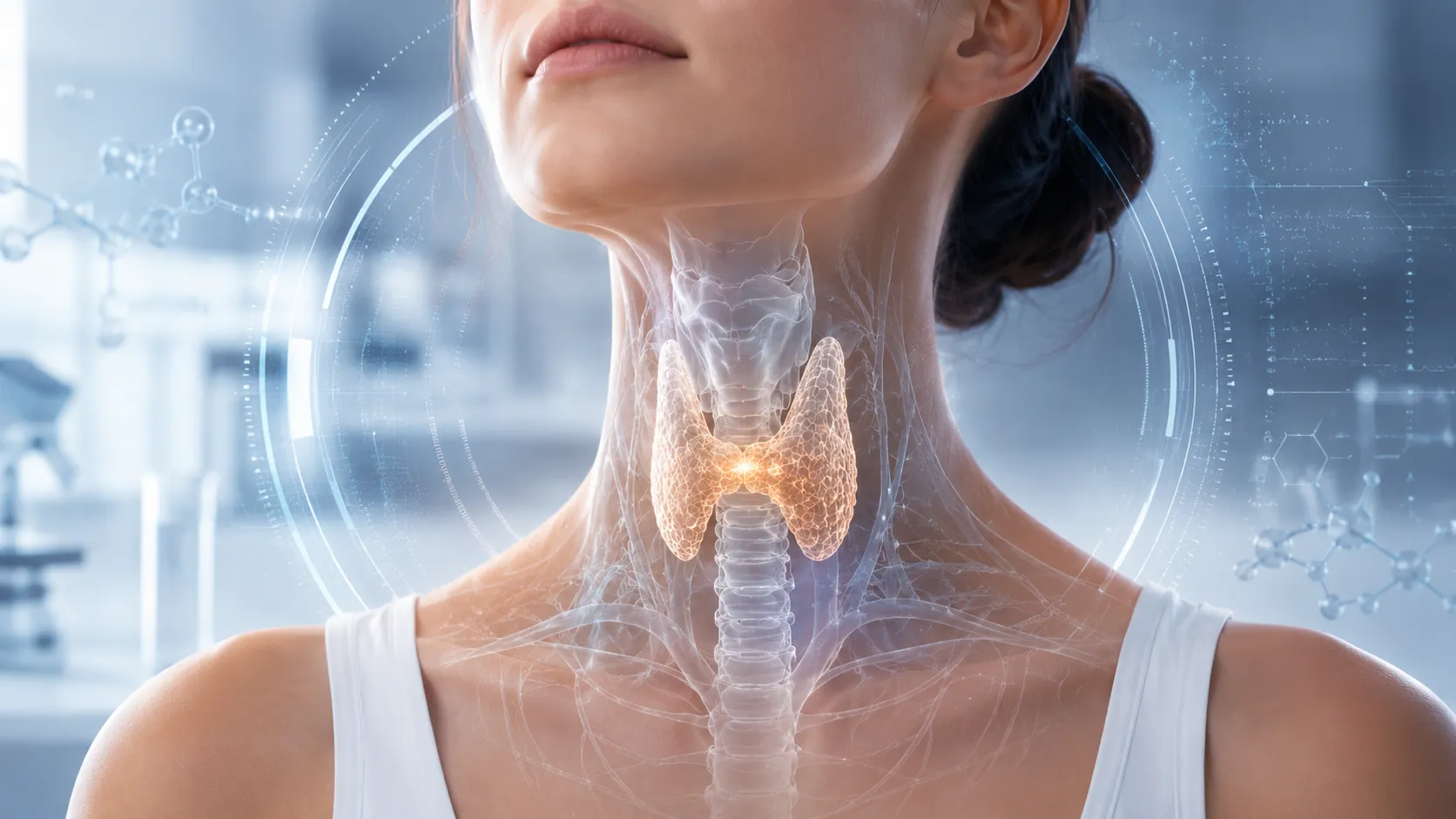
“I’m tired all the time, I’ve put on weight without changing anything, I’m always cold.” Behind these very common sentences sometimes lies hypothyroidism: a thyroid running in slow motion. It is one of the most widespread hormonal disorders, and one of the easiest to confirm: a blood test is enough[2].
This article takes a full tour of the topic, in plain language and backed by scientific sources: what hypothyroidism is, its symptoms, its causes, how the diagnosis is made and what the treatment involves. Let us say it at once, to avoid any misunderstanding: hypothyroidism is a disease that is treated medically. No food, plant or food supplement cures it. Nutrition plays a supporting role: not a cure.
What is hypothyroidism?
A simple definition
The thyroid is a small butterfly-shaped gland at the base of the neck. Its job: to make the thyroid hormones, T4 (or thyroxine) and T3, the true conductors of the metabolism, but also of growth and development. We speak of hypothyroidism when this gland no longer produces enough of them[1]. The result is a slow metabolism: the whole body runs in slow motion, with lower energy levels and changes in transit, heart rate and body temperature. It is this general slowing that explains most of the symptoms.
How many people are affected?
Hypothyroidism is common: it affects up to 5% of the population, about one person in twenty, and a further share is unaware of it[2]. It is markedly more common in women and its risk rises with age[2]. It can affect any age, from children to older people. In the vast majority of cases the problem lies in the thyroid itself: this is primary hypothyroidism; more rarely it stems from the pituitary gland or the hypothalamus (secondary or central hypothyroidism)[2]. A further distinction separates congenital hypothyroidism, present from birth, from the acquired form that develops during life: by far the commonest. Whatever the level, the underlying issue is the gradual failure of the thyroid to produce enough thyroid hormone.
What is “subclinical” (or latent) hypothyroidism?
It is an early, quiet form. On the blood test the TSH is slightly raised, but the thyroid hormones (free T4) are still within range[1]. Often it causes no clear symptoms. Not all cases progress to overt hypothyroidism: a moderately raised TSH may even return to normal on its own: this is the case for a good share of results, which are therefore rechecked before any decision[8]. What to do is discussed case by case with the doctor.

What are the symptoms of hypothyroidism?
The most common signs
The trap of hypothyroidism is that its symptoms set in slowly and resemble many other things[1]. The most typical are persistent fatigue, moderate weight gain, unusual cold intolerance (increased sensitivity to cold), constipation, dry skin, dull and brittle hair up to hair loss, menstrual-cycle disturbances and sometimes low mood[2]. Taken on their own, none of these signs proves anything; it is their combination and, above all, the blood test that point the way.
Over time, more telling signs may be added. Skin, nails and hair: dry, thickened skin that flakes or cracks on the hands and feet, reduced sweating, brittle nails and thinning hair: sometimes with loss of the outer eyebrows. Face and neck: a slightly puffy face and eyelids, a hoarser voice, sometimes a goitre (a swelling at the base of the neck). Heart and muscles: a slowed pulse and heart rate, cramps, muscle weakness or aches. In women, periods may become heavier or irregular[1][2].
Why such deep fatigue?
Because thyroid hormones set the pace of the metabolism. When they are lacking, the “tempo” drops: you feel slowed down, drained, you recover poorly. It is one of the most characteristic symptoms. Good news: this fatigue usually eases once treatment is well balanced. If it persists despite a normalised TSH, another cause should be sought (low iron, poor-quality sleep, another illness) rather than blaming the thyroid alone[1].
Hypothyroidism, mood and the brain
The thyroid also influences mood and cognitive function. Depression is the mental disorder most often associated with hypothyroidism. The link exists even for the subclinical form: after the age of 50 in particular, people whose TSH is slightly raised show an increased risk of depressive symptoms[7]. On the neurological side, poor memory and difficulty concentrating are described, “brain fog”, slowed thinking, low energy, tingling in the hands (carpal tunnel syndrome) and slowed reflexes. These signs are usually reversible once the thyroid is rebalanced.
| Common symptom | Why it appears |
|---|---|
| Fatigue, sluggishness | The metabolism slows for lack of hormones to set the pace. |
| Moderate weight gain | Lower energy expenditure at rest; water retention. |
| Cold intolerance | Less heat produced by the body. |
| Constipation | Bowel transit slows down too. |
| Dry skin, brittle hair | Slowed cell renewal. |
| Low mood, “brain fog” | Thyroid hormones act on the brain and mood as well. |
| Hoarse voice, puffy face and eyelids | A tissue infiltration (“myxoedema”) accompanies the slowing. |
| Slowed pulse, muscle cramps | The heart and muscles work in slow motion too. |
| Goitre (swelling at the base of the neck) | The thyroid may enlarge in an attempt to compensate for its reduced activity. |
Symptoms alone are not enough to conclude
Fatigue, extra kilos or cold intolerance are so common that they do not “make” the diagnosis. Many tired people have a perfectly normal thyroid. Only a blood test can settle it: if you suspect you have hypothyroidism, consult a healthcare professional rather than drawing conclusions yourself.
Causes: what triggers hypothyroidism?
Hashimoto’s thyroiditis, the leading cause here
In countries where salt is iodised, such as Switzerland, the commonest cause is Hashimoto’s thyroiditis (or Hashimoto’s disease)[1]. It is an autoimmune disease: the immune system, meant to defend the body, begins to attack the thyroid by mistake, sustaining a chronic inflammation of the gland that slowly exhausts it. This disease affects women 7 to 10 times more often than men[3]. It develops on a background of genetic susceptibility and can be accompanied by other autoimmune conditions, such as type 1 diabetes: among the known risk factors[3]. In the lab it is spotted thanks to antibodies directed against the thyroid (anti-TPO, or thyroid peroxidase antibodies)[3].
Iodine deficiency, the leading cause worldwide
Iodine is the building block of thyroid hormones: without it, the gland cannot make them[6]. Worldwide, iodine deficiency therefore remains the leading cause of thyroid disorders[5]. An estimated 2 billion people have an inadequate intake[4]. The simple, effective remedy is iodised salt, widespread in many countries: including Switzerland, a pioneer in the field. Note: even in Europe, part of the population remains mildly deficient[4].
The other causes
Hypothyroidism can also follow a thyroid treatment: surgical removal, radioactive iodine (used against an overactive thyroid, hyperthyroidism, for example in Graves’ disease, or thyroid cancer), or radiotherapy of the neck. Certain medicines (medication) can also bring it on, notably some antithyroid drugs, lithium or amiodarone. There are also temporary forms, especially after childbirth (postpartum thyroiditis) or a viral inflammation of the gland (subacute thyroiditis), which sometimes resolve. Finally, rare forms are present from birth (congenital hypothyroidism): in newborns and infants they are picked up by newborn screening.
How is hypothyroidism diagnosed?
A simple blood test
This is one of the great advantages of the disease: the diagnosis rests on the clinical examination and simple, low-cost blood tests (thyroid function tests), prescribed by a doctor: GP or specialist (endocrinologist)[1]. The first marker measured is TSH (thyroid-stimulating hormone, or thyrotropin), a hormone produced by the pituitary gland (a gland in the brain) to “command” the thyroid. When the thyroid weakens, the pituitary pushes harder: the TSH level rises. A raised serum (blood) level of TSH is therefore the first sign of an underactive thyroid: the TSH measurement is the key test of the diagnosis[1].
TSH, free T4, antibodies: what is measured?
If the TSH is abnormal, the doctor usually adds free T4 (the circulating thyroid hormone) to gauge severity, and a search for anti-TPO antibodies to tell whether the origin is autoimmune (Hashimoto’s)[1]. The combination of these results helps distinguish overt hypothyroidism from a mere subclinical form, and look for the cause.
| Test | What it measures | What an abnormal result may indicate |
|---|---|---|
| TSH | The “command” sent by the pituitary to the thyroid | Raised: the thyroid is underactive. This is the first signal. |
| Free T4 | The thyroid hormone actually available | Low: overt hypothyroidism. Normal with high TSH: subclinical form. |
| Anti-TPO antibodies | An autoimmune attack on the thyroid | Present: points to Hashimoto’s thyroiditis. |
Values are interpreted in context
TSH levels and thresholds vary with age, pregnancy and the laboratory. A single figure does not tell the whole story: it is for the doctor to interpret the results, recheck them if needed and decide what comes next. Do not self-diagnose from a single result.
Beyond TSH: the conversion of the hormones
To understand certain situations, you need to know how thyroid hormones act. The thyroid mainly makes T4, a barely active storage form. This T4 is then converted, largely in the liver, into T3, the truly active form, the one that acts inside cells. A small part goes the other way, towards an inactive “reverse T3” (rT3)[6]. It is this balance between production, conversion and action that the diagram below sums up.

This mechanism underpins an approach advocated by some practitioners: among them Dr Benoît Claeys in his book En finir avec l’hypothyroïdie. It holds that the TSH blood test alone may “miss” people hampered by poor conversion of T4 into T3, an excess of reverse T3 or insufficient cellular action. To explore these avenues, it relies on clinical signs and proposes 24-hour urine measurements (TSH, T3 and T4), said to reflect hormone activity over a whole day rather than at a single moment.
A complementary approach, not the reference test
Let us be clear: in mainstream medicine, the diagnosis rests on the TSH blood test (supplemented by free T4 and antibodies), and it is this that holds authority in the guidelines[1]. The 24-hour urine measurements and the “conversion / reverse T3 / cellular resistance” reading belong to a functional-medicine approach: they are neither standardised nor validated as a routine test, and remain debated. They may inform a line of thought, but replace neither the reference tests nor a doctor’s advice. Draw no conclusions on your own.
Treatment: can hypothyroidism be cured?
Levothyroxine, the replacement hormone
The management of overt hypothyroidism rests on thyroid hormone replacement therapy: the missing hormone is replaced. The reference medicine is levothyroxine, a synthetic T4 identical to the natural hormone. It is, in fact, one of the most prescribed medicines in the world[1]. The dose, calculated from body weight, is then adjusted to bring the TSH into the target range; getting the dose right sometimes takes several attempts[2]. Important: levothyroxine is a prescription medicine whose dose is fine-tuned with the doctor: it is not a food supplement.
How and when to take it?
Levothyroxine is absorbed best on an empty stomach: it is usually taken with a glass of water, 30 to 60 minutes before breakfast (taking it at bedtime is an equally effective alternative)[10]. Several things reduce its absorption if swallowed at the same time: coffee, soya, very high-fibre foods and, above all, calcium or iron supplements[10][11]. The practical rule: space these out by several hours. This explains most of the “forbidden breakfasts” you read about online: it is really a matter of timing, not dangerous foods.
How long to stabilise?
It takes patience: after starting treatment or changing the dose, the doctor usually rechecks the TSH after 6 to 8 weeks, because the hormonal balance takes time to settle. Several adjustments are sometimes needed before the right dose is found. Once the situation is stable, an annual check is usually enough. At the right dose, levothyroxine is well tolerated; too high a dose can instead cause side effects such as palpitations or restlessness: another reason for regular monitoring.
Can it be cured?
It depends on the cause. Hashimoto’s thyroiditis, the commonest, is lasting: treatment is generally taken for life, but it merely replaces the missing hormone, allowing a perfectly normal life[3]. Conversely, some forms of hypothyroidism are temporary (after childbirth, viral thyroiditis, a medicine) and may disappear. And very mild subclinical hypothyroidism sometimes normalises on its own[8]. Only the doctor can say, in your case, whether treatment is temporary or permanent.
Never stop your treatment on your own
Once levothyroxine is prescribed, do not stop it or change the dose without speaking to your doctor, even if you feel well: it is precisely the treatment that keeps you in balance. During pregnancy, needs change and close monitoring is required. And never replace this medicine with a food supplement.
Nutrition, micronutrients and lifestyle
This is the part most prone to received ideas. Let us set the frame straight away: if hypothyroidism is established, it is treated medically. Diet helps you feel well and cover the thyroid’s needs, but no food or supplement replaces levothyroxine or “cures” the disease. Here is what the research actually says, nutrient by nutrient.
Iodine: neither too little nor too much
Iodine contributes to the normal production of thyroid hormones and to normal thyroid function: this is an authorised health claim, because the thyroid genuinely needs it to make its hormones[6]. It is found mainly in seafood (fish, shellfish) and, in very high doses, in seaweed. In Switzerland, most of the intake comes from iodised table salt: the country was a world pioneer of this public-health measure as early as 1922, and the iodine content of salt has been raised in stages over the decades.
But here, more is not better. An excess of iodine (seaweed, kelp, high-dose supplements) can, on the contrary, unbalance a fragile thyroid, trigger temporary hypothyroidism or feed an autoimmune disease[17]. The goal is therefore to cover the needs, ensured here by iodised salt and a varied diet, not to overload. If you have Hashimoto’s thyroiditis, do not take iodine (or concentrated seaweed) without medical advice.
Selenium
Selenium contributes to normal thyroid function (authorised claim): it is a trace element essential to the metabolism of thyroid hormones[6]. In people with Hashimoto’s thyroiditis, analyses pooling several trials have observed that selenium supplementation lowers the level of anti-thyroid antibodies[12][13]. This is an interesting signal, but to be read with caution: these studies have not shown a clear improvement in thyroid function or in patients’ well-being, and the clinical benefit remains to be confirmed[13]. Selenium is therefore not a treatment for hypothyroidism; at most it may be considered as a complement, under medical supervision.
Vitamin D
People with autoimmune thyroid disease more often have a vitamin D deficiency than others[15]. But correlation is not causation: it is not known whether this deficiency promotes the disease, results from it, or both. Overall, vitamin D seems to play a secondary role, among many other factors[15]. Correcting a proven deficiency is useful for general health, but does not constitute a treatment for hypothyroidism.
“Forbidden” foods: the truth and the myth
This is one of the most asked, and most misunderstood, questions. No food is truly forbidden. Only two nuances deserve attention. First, the timing of levothyroxine: coffee, soya, calcium and iron hinder its absorption if taken at the same time[10]. Second, the famous goitrogens of cabbage-family vegetables (broccoli, cauliflower, turnip): a systematic review concludes that these vegetables, eaten normally and with a sufficient iodine intake, do not impair thyroid function[14]. So there is no need to banish them. The right reflex is not a list of bans, but a varied diet and a correct iodine intake.
Tobacco, water, pollutants: the iodine disruptors
Beyond the plate, certain environmental contaminants hinder the uptake of iodine by the thyroid. Three are well documented: perchlorates (chlorine derivatives, present in some waters), nitrates and thiocyanates (notably in cigarette smoke). All compete with iodine at the gland’s “doorway”[16]. Their effect remains modest in the general population, however, and counts mainly in people already deficient in iodine[16].
The case of tobacco is instructive: and counter-intuitive. Its smoke delivers thiocyanate, which blocks iodine; yet smoking is associated with fewer anti-thyroid antibodies and a lower risk of autoimmune hypothyroidism, an effect that appears to reverse in the years after quitting[18]. The tobacco-thyroid relationship is therefore more complex than a simple “tobacco harms the thyroid”: which, of course, does not make tobacco an ally: quitting smoking remains a major benefit for health. Other environmental factors are under study, from radiation to various chemical pollutants[17].
Hypothyroidism and weight: can you lose weight?
Hypothyroidism slows the metabolism and often causes some weight gain, but this gain stays moderate: it is rarely the sole explanation for significant excess weight[9]. And it is worth knowing that, when treatment rebalances the thyroid, the weight lost is mostly water, not fat[9]. In other words: levothyroxine is not a slimming product. Once the thyroid is stable, losing weight remains possible: through the same levers as for everyone: a balanced diet and regular physical activity.
| Nutrient | Role for the thyroid | What to keep in mind |
|---|---|---|
| Iodine | Building block of the hormones; contributes to their normal production | Cover the needs, do not overload. Caution with seaweed. |
| Selenium | Contributes to normal thyroid function | Lowers antibodies in Hashimoto’s, but clinical benefit unproven. |
| Vitamin D | Immune role; often low in autoimmune diseases | Link not causal. Correct a proven deficiency, without expecting a cure. |
| Iron | Involved in thyroid metabolism; test it if fatigue persists | Apart from levothyroxine (it reduces its absorption). |
Frequently asked questions
What are the signs of hypothyroidism?
The most common signs are persistent fatigue, moderate weight gain, unusual cold intolerance, constipation, dry skin, brittle hair and sometimes low mood. They set in slowly and are non-specific: many other causes explain them too. Only a blood test measuring TSH confirms the diagnosis. If in doubt, see a doctor.
What triggers hypothyroidism?
In countries with iodised salt such as Switzerland, the commonest cause is Hashimoto’s thyroiditis, an autoimmune disease in which the immune system attacks the thyroid. Worldwide, the leading cause remains iodine deficiency. Other triggers include thyroid surgery, radioactive-iodine treatment, certain medicines, or the period after childbirth.
Is hypothyroidism dangerous?
Well treated, hypothyroidism is usually not dangerous: treatment replaces the missing hormone and allows a normal life. It is untreated or poorly balanced hypothyroidism that causes problems, as it is linked, over the long term, to an increased cardiovascular risk. In severe, long-neglected cases, serious complications can rarely occur, up to myxoedema coma. That is why regular medical follow-up and the control blood test matter.
Can hypothyroidism be cured?
It depends on the cause. The commonest form, Hashimoto’s thyroiditis, is lasting: treatment is generally taken for life, but it simply replaces the missing hormone. Some forms of hypothyroidism are temporary (after childbirth, viral thyroiditis or a medicine) and can resolve. Very mild subclinical hypothyroidism may also normalise on its own. Only a doctor can determine this.
Hypothyroidism: how long to stabilise?
It usually takes several weeks. After starting or changing the levothyroxine dose, the doctor typically rechecks TSH after 6 to 8 weeks, because the hormonal balance takes time to settle. Several adjustments are sometimes needed before the right dose is found. Once stable, an annual check is usually enough.
What foods are forbidden with hypothyroidism?
No food is truly forbidden. The real issue is timing: coffee, soya, calcium or iron supplements and very high-fibre foods reduce levothyroxine absorption if taken at the same time, hence the value of spacing them out. It is also wise to avoid excess iodine (seaweed, kelp). Vegetables such as cabbage, eaten normally and cooked, are no problem.
How can you lower hypothyroidism naturally?
Established hypothyroidism cannot be corrected with home remedies: it is treated medically, because a hormone is missing that only treatment can replace. Diet and lifestyle help you feel better and cover the thyroid’s needs (iodine, selenium), but do not replace levothyroxine. No supplement cures hypothyroidism. Never change your treatment without medical advice.
Can you lose weight with hypothyroidism?
Yes. Hypothyroidism slows the metabolism and often causes some weight gain, but this gain stays moderate: and is rarely the sole explanation for significant excess weight. Once the thyroid is rebalanced by treatment, the weight lost is mostly water anyway, not fat. Losing weight remains possible, through the same levers as for everyone: diet and physical activity.
What breakfast for hypothyroidism?
There is no special thyroid breakfast. The most useful practical point concerns levothyroxine: it is absorbed best on an empty stomach, with a glass of water 30 to 60 minutes before eating. Morning coffee in particular reduces its absorption, so it is best to wait. Otherwise, a balanced breakfast is fine, just as for everyone.
Why am I so tired with my hypothyroidism?
Because thyroid hormones set the pace of the metabolism: when they are lacking, everything slows down, hence deep fatigue, sluggishness and low energy. It is one of the most typical symptoms. If fatigue persists despite a well-balanced TSH, other causes should be sought (iron deficiency, sleep, another illness). Talk to your doctor.
What mental illness is associated with hypothyroidism?
Depression is the disorder most often associated with hypothyroidism. The link also exists for the subclinical form, especially after the age of 50, where the risk of depressive symptoms is higher. More rarely, mood or concentration disturbances are described. This is why, faced with unexplained or treatment-resistant depression, the thyroid is sometimes checked. This does not replace a specialist assessment.
What are the neurological signs of hypothyroidism?
Hypothyroidism can be accompanied by difficulty concentrating and memory problems (the famous brain fog), slowed thinking, tingling in the hands (carpal tunnel syndrome) and slowed reflexes. These signs usually reverse once treatment is well balanced. Any new neurological symptom warrants medical advice.
Sources and references (verified on PubMed)
18 sources- Chaker L. et al. (2022). Hypothyroidism.
- Chiovato L. et al. (2019). Hypothyroidism in Context: Where We’ve Been and Where We’re Going.
- Klubo-Gwiezdzinska J., Wartofsky L. (2022). Hashimoto thyroiditis: an evidence-based guide to etiology, diagnosis and treatment.
- Zimmermann M.B. (2009). Iodine deficiency.
- Zimmermann M.B. et al. (2008). Iodine-deficiency disorders.
- Köhrle J. (2023). Selenium, Iodine and Iron: Essential Trace Elements for Thyroid Hormone Synthesis and Metabolism.
- Tang R. et al. (2019). Subclinical Hypothyroidism and Depression: A Systematic Review and Meta-Analysis.
- Ross D.S. (2021). Treating hypothyroidism is not always easy.
- Jonklaas J. (2025). The Influence of Thyroid Dysfunction on Body Composition and Weight Trajectory.
- Wiesner A. et al. (2021). Levothyroxine Interactions with Food and Dietary Supplements: A Systematic Review.
- Skelin M. et al. (2017). Factors Affecting Gastrointestinal Absorption of Levothyroxine: A Review.
- Huwiler V.V. et al. (2024). Selenium Supplementation in Patients with Hashimoto Thyroiditis: A Systematic Review and Meta-Analysis of Randomized Clinical Trials.
- Wichman J. et al. (2016). Selenium Supplementation Significantly Reduces Thyroid Autoantibody Levels in Patients with Chronic Autoimmune Thyroiditis.
- Galanty A. et al. (2024). Do Brassica Vegetables Affect Thyroid Function?: A Comprehensive Systematic Review.
- Vieira I.H. et al. (2020). Vitamin D and Autoimmune Thyroid Disease: Cause, Consequence, or a Vicious Cycle?
- Serrano-Nascimento C., Nunes M.T. (2022). Perchlorate, nitrate, and thiocyanate: environmentally relevant NIS-inhibitor pollutants and their impact on thyroid function.
- Ferrari S.M. et al. (2017). Environmental Issues in Thyroid Diseases.
- Wiersinga W.M. (2013). Smoking and thyroid.