
Iron deficiency: why your blood test looks normal
In brief
Many women are told their blood test is normal while they are exhausted. The explanation usually comes down to two points. First, you can be short of iron without being anaemic: a randomised trial in active women who were iron-deficient but not anaemic showed improved fatigue scores after four weeks of correction, while haemoglobin had not moved. Second, haemoglobin and the stores do not follow the same calendar: the first corrects within weeks, the second takes months. One last pitfall is worth knowing: with inflammation, ferritin rises and can mask a genuine deficiency.
“Your results are fine.” Thousands of women hear this sentence every year as they leave the consulting room, with no explanation for the fatigue that brought them there. The misunderstanding rarely comes from carelessness: it comes from the fact that iron is told through two distinct measures, which do not say the same thing and do not move at the same pace.
This article untangles that: what haemoglobin and ferritin actually measure, why you can be short of iron without being anaemic, how long a recovery really takes, and when a reassuring number can mislead. It is for information and does not replace your doctor’s assessment.
Haemoglobin and ferritin: two measures, two questions
Haemoglobin measures the present
Haemoglobin is the protein in red blood cells that carries oxygen. When it falls below a threshold, this is called anaemia. It is an indicator of consequence: it says the shortage of iron has become large enough to affect the production of red blood cells. As long as it is normal, the body is still managing that job.
Ferritin measures the stores
Ferritin is the protein that stores iron. Measuring it reflects the state of the reserve, and it is the one that falls first, often well before haemoglobin. That is why someone can have a perfectly normal blood count and near-empty stores.
The practical consequence
If only haemoglobin was measured, a “normal” result answers only one question out of two. This is precisely the point worth raising in consultation, especially with heavy periods, closely spaced pregnancies, a vegetarian diet or regular sport.
Being short of iron without being anaemic
A common and real situation
Iron deficiency without anaemia is described as very widespread among women who are physically active[1]. It long stayed in a blind spot: since haemoglobin is normal, the picture fits no classic box, and the fatigue is put down to a busy life.
The trial that tested the question
Twenty-six active women, iron-deficient but not anaemic, were randomly allocated to intravenous iron or a placebo, double-blind. Performance, fatigue, mood and quality of life were assessed before the intervention, then four days and four weeks afterwards[1].
The results
Iron status improved, with a highly variable individual response. No difference appeared in maximal oxygen uptake, lactate threshold or haemoglobin mass. Running economy did improve, however, and above all fatigue scores improved in the iron group but not on placebo, after four weeks[1]. Mood and quality of life did not change.
The two clocks: why the fatigue persists
What corrects quickly
Once treatment starts, red blood cell production picks up quickly and haemoglobin rises within a few weeks. This is the value checked first, and it is the one that comes back “normal” at the follow-up visit.
What takes months
Refilling the stores is another matter entirely. The reserve rebuilds slowly, which is why treatment is usually continued for several months after haemoglobin has normalised. Stopping as soon as the blood count looks good is the most common mistake: it leaves the stores empty and sets up the next relapse.
The gap as it is lived
This gap explains the sentence “my results are normal but I am still tired”. Two different questions then arise with the doctor: was ferritin measured, and was treatment continued long enough to rebuild the reserve? The exact duration depends on how deep the deficiency is and on how well the treatment is tolerated.
| Measure | What it measures | Pace of change |
|---|---|---|
| Haemoglobin | The effect of the shortage on red blood cells | Corrects within a few weeks |
| Ferritin | The state of the iron stores | Rebuilds over several months |
| C-reactive protein | The presence of inflammation | Essential for interpreting ferritin |
The pitfall: a falsely reassuring ferritin
Why it can mislead
Ferritin is not only a marker of the stores: it is also an acute-phase protein, whose level rises with inflammation, infection or chronic disease. Someone who genuinely lacks iron can therefore show a ferritin within the reference range, or even a raised one, if an inflammatory process is under way.
What this implies
This is why a ferritin result is interpreted in context, often alongside an inflammatory marker such as C-reactive protein. A normal ferritin together with inflammation does not rule out a deficiency, and further iron studies may then be needed.
The right question to ask
Rather than “is my ferritin normal”, the useful question becomes: “is my ferritin interpretable in my situation?” This nuance is rarely explained in consultation for lack of time, and yet it accounts for a share of the cases where symptoms persist despite results judged satisfactory.
Absorbing iron better day to day
Two forms, two rates of absorption
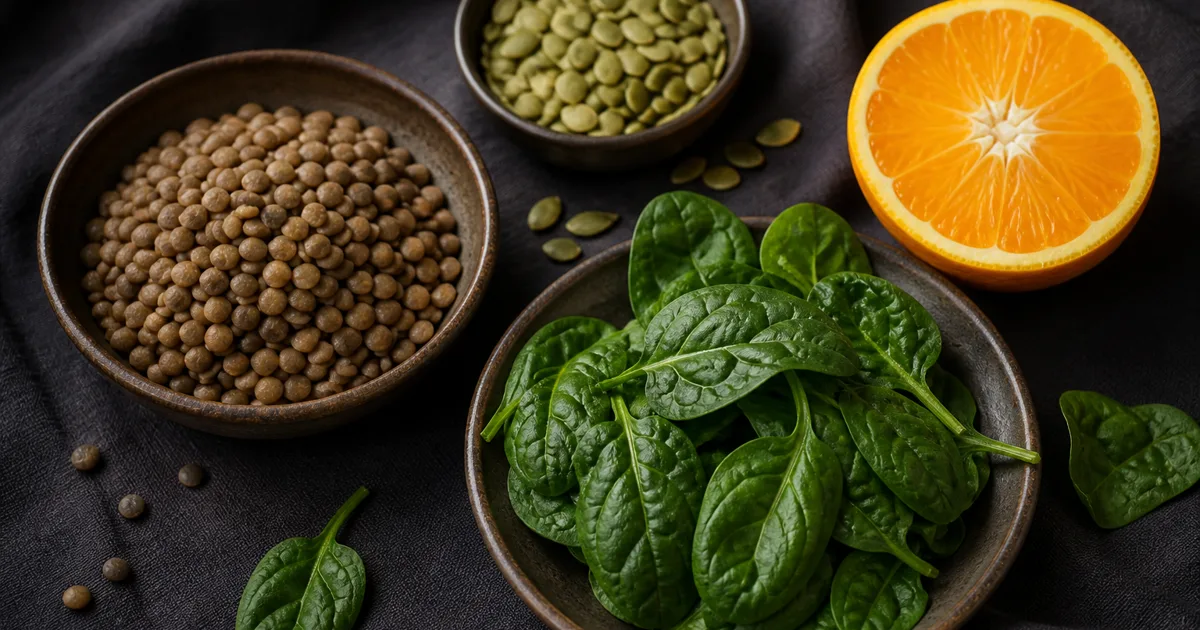
Iron from animal products, known as haem iron, is better absorbed than iron from plants. The latter is not negligible for all that: lentils, chickpeas, tofu, pumpkin seeds and green vegetables all provide iron, as long as the conditions for absorption are looked after.
What helps and what hinders
Vitamin C clearly improves the absorption of plant iron: citrus, peppers or parsley in the same meal is enough. Conversely, tea and coffee taken during the meal reduce it sharply, as does calcium in high doses. Shifting the hot drink by an hour is a simple and often overlooked step.
The dosing rhythm: what Zurich showed
Here is a finding that upsets habit, and it comes from Switzerland. Two randomised trials at the Swiss Federal Institute of Technology in Zurich, in women aged 18 to 40 with low stores, compared dosing schedules. The result: giving iron every other day allowed more of it to be absorbed than a daily dose, with cumulative absorption of around 22 % versus 16 %, and 175 mg of iron actually absorbed versus 131 mg[2].
Why less often absorbs better
The explanation lies with a hormone, hepcidin, which blocks iron absorption and rises after each dose. Spacing the doses gives it time to come back down. The same work also compared a single morning dose with two half-doses spread through the day: splitting did not improve absorption and raised hepcidin[2]. In other words, the classic advice to spread doses through the day is not the best option.
These findings concerned women who were deficient but not anaemic, and the authors called for confirmation in anaemic patients. So it is a question to put to your doctor rather than to apply on your own, all the more so as the schedule also depends on digestive tolerance.
What diet does not do
It maintains iron status; it does not correct an established deficiency. When the stores are low, no dietary rebalancing replaces the treatment decided by a doctor. Confusing the two costs months, often at the price of fatigue that settles in.
Look for the cause, not just the number
A deficiency always has an origin
Correcting without understanding is like filling a leaking bucket. The most common causes in women of childbearing age are heavy periods, closely spaced pregnancies and breastfeeding. Then come digestive losses, absorption disorders including coeliac disease, and insufficient intake.
When finding the cause becomes a priority
In a man, in a woman after the menopause, or where deficiency returns despite well-conducted treatment, the origin must be actively sought. This is not a formality: sometimes that is exactly where the real diagnosis lies, and it is entirely a matter for the doctor.
Two things to take away. You can be short of iron with a normal blood count, and correction then improves fatigue within a few weeks, as a randomised trial in active women showed. And bringing the stores back up takes months, far longer than haemoglobin, which explains most treatments stopped too early.
On fatigue and micronutrients, two articles take this one further: our piece on vitamin B12 and how quickly it acts, which answers the same question of timing, and the one on hypothyroidism, another common cause of lasting fatigue in women.
Frequently asked questions
Can you be short of iron with a normal blood test?
Yes, if only haemoglobin was measured. Ferritin, which reflects the stores, falls well before haemoglobin drops. This situation, known as deficiency without anaemia, is described as very common among physically active women. A randomised trial in affected women did in fact show improved fatigue scores after four weeks of correction, while haemoglobin mass had not changed.
How long does it take to bring ferritin back up?
Much longer than haemoglobin. Haemoglobin corrects within a few weeks, whereas rebuilding the stores takes several months, which is why treatment is usually continued after the blood count has normalised. Stopping as soon as haemoglobin looks good leaves the stores empty and sets up the relapse. The exact duration depends on how deep the deficiency is and is decided with your doctor.
Why am I still tired despite treatment?
Three explanations come up often. Treatment may have been stopped as soon as haemoglobin normalised, without the stores being refilled. Ferritin may have been distorted by inflammation. Or the fatigue has another cause, alongside the deficiency. These three possibilities are teased apart in consultation, in particular by looking at ferritin and an inflammatory marker together.
Does a normal ferritin rule out a deficiency?
Not always. Ferritin is also an acute-phase protein: its level rises with inflammation, infection or chronic disease. A genuine deficiency can therefore hide behind a ferritin within the reference range. That is why this test is interpreted alongside the clinical context, often together with an inflammatory marker, and why further iron studies are sometimes needed.
How can I absorb more iron from food?
By pairing a source of vitamin C with the same meal: citrus, peppers or parsley clearly improve the absorption of plant iron. Conversely, tea and coffee taken during the meal reduce it sharply, as does calcium in high doses. Shifting the hot drink by an hour is a simple and effective step. This maintains iron status, but it does not correct an established deficiency.
Should you take iron on your own initiative?
No. Excess iron is harmful, and some people store it abnormally without knowing. Supplementation is decided on the basis of testing, with a suitable dose and duration, and is then monitored. The trial cited in this article involved intravenous administration in a medical setting, in women whose deficiency had been documented, which bears no relation to taking iron on your own.
Which foods are rich in iron?
Iron from animal products, known as haem iron, is the best absorbed. On the plant side, lentils, chickpeas, tofu, pumpkin seeds and green vegetables all provide iron, with lower absorption that good food pairings can offset. A varied diet maintains iron status over time, but it does not replace treatment when the stores are already low.
Should the cause of the deficiency be investigated?
Always, because correcting without understanding is like filling a leaking bucket. In women of childbearing age, heavy periods, closely spaced pregnancies and breastfeeding dominate. Otherwise the search turns to digestive losses, an absorption disorder such as coeliac disease, or insufficient intake. In a man, after the menopause, or in the event of a relapse, this search becomes a priority and is a matter for the doctor.
Sources and references (verified on PubMed)
2 sources- Dugan C., Peeling P., Buissink P. et al. (2025). Effect of intravenous iron therapy on exercise performance, fatigue scores and mood states in iron-deficient recreationally active females of reproductive age (IRONWOMAN Trial).
- Stoffel N.U., Cercamondi C.I., Brittenham G. et al. (2017). Iron absorption from oral iron supplements given on consecutive versus alternate days and as single morning doses versus twice-daily split dosing in iron-depleted women: two open-label, randomised controlled trials.