
Berberine: banned in the EU, on sale in Switzerland
In brief
Here is a situation few people know about: berberine is banned as a food supplement in the European Union, while it remains available in Switzerland as bark or root. On the evidence side, a meta-analysis of 46 randomised trials in people with diabetes reports real effects on blood sugar and lipids, often alongside a treatment. Two major caveats come with that finding: most of these trials come from a single publication area, and health authorities flag risks of low blood sugar, low blood pressure and numerous drug interactions.
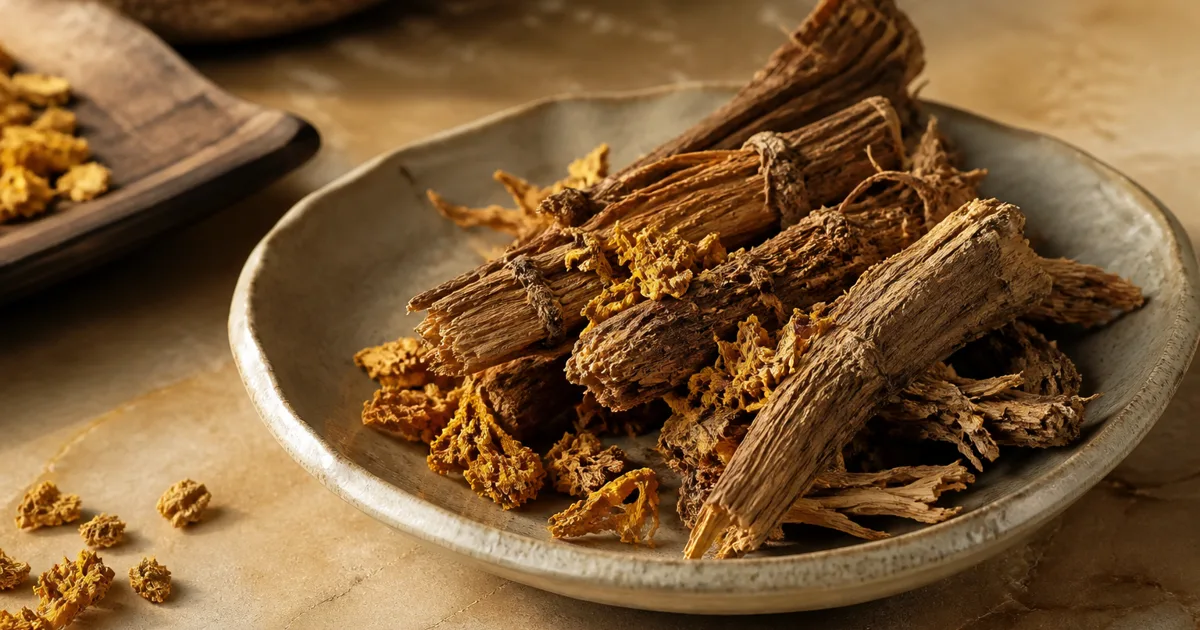
For two years berberine has been everywhere on social media, presented as “natural Ozempic”. The molecule is old, long used in traditional Chinese medicine, but its regulatory status has created a curious situation: what you cannot legally buy as a supplement in Paris or Munich remains available in Geneva or Zurich.
This article starts from that anomaly, then looks at the evidence. What it shows, what it does not, where it comes from, and what health authorities say about it. A useful clarification: SwiLab does not sell berberine. This content is purely informational and does not replace the advice of a doctor or pharmacist.
The Swiss paradox: allowed here, banned next door
The European situation
In the European Union, berberine as such cannot be used in food supplements. Preparations containing it have therefore been withdrawn from the market there. That is why French or German consumers try to obtain it elsewhere, often online.
The Swiss situation
In Switzerland, berberine remains permitted in food supplements as plant bark or root, with usual amounts of the order of 500 mg, one to three times a day. So this is not a vague tolerance: it is a difference of framework between two neighbouring sets of rules, producing different shelves on either side of the border.
What that means in practice
Two things. First, the availability of a product says nothing about how ordinary it is: a substance can be on sale here and judged too active elsewhere. Second, the reverse is also true: some substances sold freely in the European Union are banned in Switzerland, which raises the question of online purchases in both directions.
What 46 randomised trials show
The reference meta-analysis
A systematic review brought together 46 randomised controlled trials of berberine in people with type 2 diabetes, alone or in addition to usual treatments[1]. It is the largest body of evidence available on this molecule, and it concerns objectively measured parameters, not impressions.
The results on blood sugar
Compared with control groups, berberine was associated with a fall in HbA1c of around 0.7 points, in fasting blood sugar of around 0.9 mmol/l and in blood sugar two hours after a meal of around 1.3 mmol/l[1]. Markers of insulin resistance also improved.
The results on lipids and weight
In the same analysis, triglycerides, total cholesterol and LDL fell, while HDL rose slightly. Body mass index decreased by around one point[1]. The authors conclude there is solid evidence of efficacy, particularly when berberine is used as an add-on to a treatment rather than in its place.
The caveat that changes the reading
Where these trials come from
This is the point enthusiastic articles systematically leave out. To build this body of evidence, the authors searched eight databases, four of them Chinese: CNKI, SinoMed, Wanfang and VIP[1]. A significant share of the included trials therefore comes from a single publication area, where berberine is part of the traditional pharmacopoeia.
Why that matters
This is not an argument for dismissing the work, and the authors took the quality of publications into account. But when a body of evidence is concentrated on one region and one therapeutic tradition, the question of publication bias arises: positive results are statistically more likely to be published there than neutral ones. Confirmation by large independent trials conducted elsewhere is still awaited.
The right way to conclude
Neither “it does not work” nor “it is proven”. The honest wording is this: a substantial body of evidence suggests a real metabolic effect, in a medically supervised setting, with a need for independent replication. That is very different from what the pages selling it promise.
The risks the authorities flag
An active profile means a risk profile
The French food safety agency issued an alert on supplements containing berberine. It recommends that children, adolescents, pregnant and breastfeeding women, and certain at-risk groups avoid it, including people with diabetes and those with liver or heart conditions.
The effects reported
The risks mentioned are gastrointestinal upset, low blood sugar, low blood pressure, and numerous drug interactions. This last point is the most underestimated: a substance that acts on the metabolism of medicines can change the effect of treatments taken for other reasons, including those with nothing to do with blood sugar.
What laboratory work shows about the mechanism
Preclinical work sheds light on the origin of these interactions. In cell culture and on rat liver microsomes, berberine strongly induces a liver enzyme, cytochrome P450 1A2, which takes part in breaking down many medicines: its activity was multiplied fivefold in cells[2]. Changing that enzyme means changing the speed at which the body clears other treatments.
These results come from the laboratory and from animals, not from trials in humans, and should therefore be read as a plausible mechanism rather than a clinical demonstration. The same authors note a point that qualifies things in both directions: taken orally, berberine has extremely low bioavailability, so much so that the induction did not appear by that route in animals[2]. That poor absorption tempers the promises as much as the fears.
The practical consequence
If you take any long-term treatment, the question of berberine arises with your doctor or pharmacist, not alone in front of a screen. The logic is simple: the more measurable effects a substance has, the more reasons it has to interact with something else.
| Claim | Level of evidence |
|---|---|
| Effect on blood sugar in type 2 diabetes | 46 randomised trials, clear effects, geographically concentrated evidence |
| Effect on blood lipids | Shown in the same analysis |
| Notable weight loss in someone without diabetes | Not demonstrated to date |
| Comparison with GLP-1 type medicines | No data justifying it |
| Drug interactions | Flagged by health authorities |
“Natural Ozempic”: where the nickname comes from
A shortcut with no basis
The nickname comes from an association of ideas: berberine acts on sugar metabolism, the GLP-1 family of medicines does too, so one would replace the other. The reasoning does not hold. The mechanisms are different, and no direct comparison allows berberine to be placed in the same category of effect, particularly on weight.
What the observed BMI fall says
The meta-analysis reports a fall of around one point of body mass index in people with diabetes[1]. That is measurable, but very far from what the treatments it is compared with produce, and it concerns a specific population under medical follow-up. For someone without diabetes, no data support a slimming promise.
The Swiss authorities’ warning
The Confederation has also warned about fake slimming products presenting themselves as natural alternatives to injectable treatments. Berberine has become a convenient selling point in that context, which partly explains the state of the online offering.
Spotting what is wrong in the online offering
The warning signals
Search for “berberine” and you will land first on slimming patches, fake comparison sites and articles written to sell. Three signals should raise a flag: a “test” site that tests nothing and points to a single product, a numerical weight-loss promise, and the complete absence of any mention of drug interactions.
What common sense looks like
A seriously presented product states its exact composition, the plant part used, the content per dose, the groups who should avoid it and the known interactions. The absence of that information is not an oversight, it is a commercial choice. In Switzerland, a supplement must also meet the requirements of the ordinance that applies to food supplements.
Berberine occupies an unusual place: too active to be an ordinary supplement in the European Union’s view, still available in Switzerland, supported by a real but geographically concentrated body of trials, and appropriated by marketing that compares it to injectable medicines without the slightest basis.
If your interest is metabolism and weight, two articles address the subject without promises: the one on belly fat and the one on protein on GLP-1 treatment, which explains what these medicines actually do.
Frequently asked questions
Is berberine allowed in Switzerland?
Yes, as plant bark or root in food supplements, with usual amounts of the order of 500 mg one to three times a day. That is a notable difference from the European Union, where berberine as such cannot be used in supplements. This availability does not mean it is harmless: health authorities flag its risks and interactions.
Does berberine make you lose weight?
No data support a weight-loss promise in someone without diabetes. The available meta-analysis reports a fall of around one point of body mass index, but in people with diabetes under medical follow-up, often alongside a treatment. That is measurable and very far from what the advertising promises. The Swiss Confederation has also warned against fake slimming products.
Is it really a natural Ozempic?
No, and that nickname is misleading. It comes from an association of ideas: both act on sugar metabolism. But the mechanisms differ and no direct comparison allows them to be placed in the same category of effect, particularly on weight. The medicines concerned are prescribed and medically monitored; a food supplement cannot legally claim to replace them.
What do the studies actually show?
A systematic review of 46 randomised trials in people with type 2 diabetes reports a fall of around 0.7 points in HbA1c, around 0.9 mmol/l in fasting blood sugar, as well as an improvement in markers of insulin resistance and in the lipid profile. The authors conclude there is efficacy above all as an add-on treatment. The important caveat is that the body of evidence comes largely from a single publication area.
What are the risks?
Gastrointestinal upset, low blood sugar, low blood pressure and numerous drug interactions are among the risks flagged by health authorities. Children, adolescents, pregnant and breastfeeding women, as well as people with diabetes or with liver or heart conditions, are advised to avoid it. If you are on any long-term treatment, the question arises with your doctor or pharmacist.
Why is it banned in the European Union?
Because its activity profile puts it closer to a pharmacological substance than to a nutrient. The same logic leads Switzerland to prohibit other active substances in foodstuffs: once an effect becomes comparable to that of a medicine, the applicable framework changes. Switzerland made a different choice for berberine as bark and root, which explains the divergence.
Can you take it with metformin or a statin?
This question is not settled online. Drug interactions are among the risks explicitly flagged, and people with diabetes are among those advised to be cautious. A treatment under way is never changed on your own initiative, and adding an active substance alongside a medicine is exactly the kind of decision that belongs to the doctor or pharmacist.
How do you spot a dubious offer?
Three reliable signals: a comparison site that tests nothing and always points to the same product, a numerical weight-loss promise, and the absence of any mention of drug interactions. Conversely, a serious presentation states the plant part used, the content per dose, the groups who should avoid it and the known interactions. The absence of that information is a commercial choice, not an oversight.
Sources and references (verified on PubMed)
2 scientific sources + institutional source- Guo J., Chen H., Zhang X. et al. (2021). The Effect of Berberine on Metabolic Profiles in Type 2 Diabetic Patients: A Systematic Review and Meta-Analysis of Randomized Controlled Trials.
- Jiang B., Meng L., Zhang F., Jin X., Zhang G. (2017). Enzyme-inducing effects of berberine on cytochrome P450 1A2 in vitro and in vivo.
- Federal Food Safety and Veterinary Office (FSVO) | Food supplements: basics and legal aspects.