
Vitamin K2: the dose at which it works, depending on the goal
In brief
Vitamin K2 has one field where its data are most convincing, and it is not the one marketing puts forward. A randomised double-blind trial in 244 postmenopausal women showed that with 180 micrograms of MK-7 a day, exactly the order of magnitude of the supplements sold here, arterial stiffness improved after three years, particularly in those whose arteries were stiffest to begin with. On the bone side, by contrast, the reference trials used another form at 45 milligrams, a dose unrelated to the usual capsules. Choosing your K2 therefore comes down to choosing your goal, and your duration.
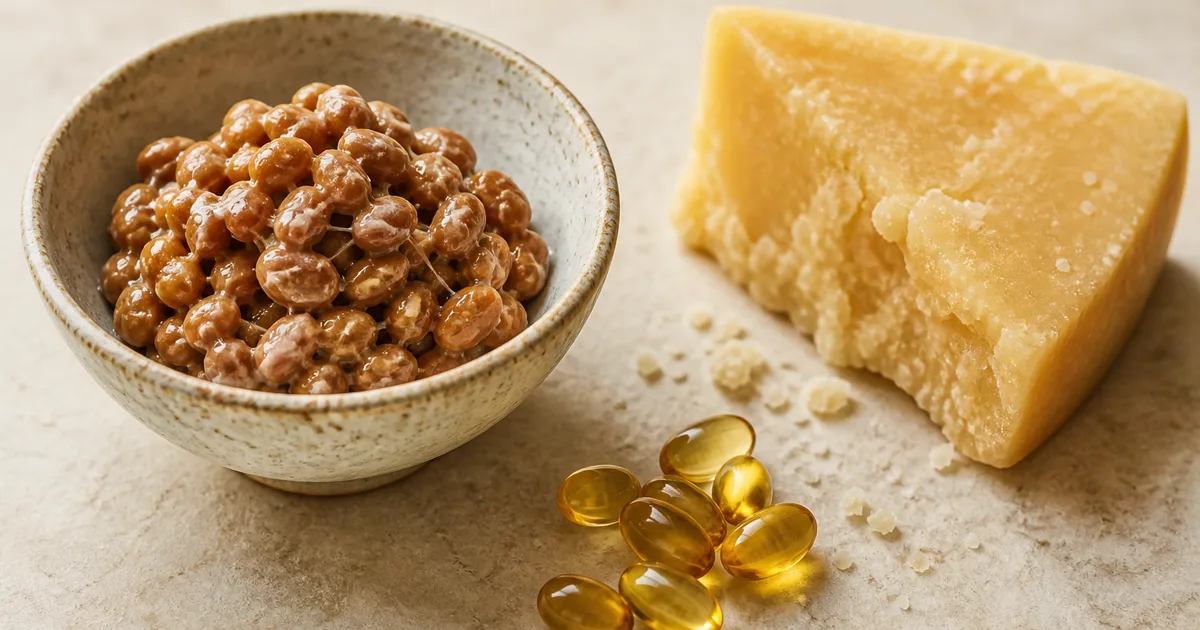
Vitamin K2 made a spectacular entrance onto the shelves, almost always paired with vitamin D3, on a simple argument: D3 lets calcium in, K2 directs it towards bone rather than towards the arteries. The story is a fine one, and it has sold well.
It rests, however, on work whose doses nobody quotes. This article puts them on the table, looks at what each form has actually demonstrated, and flags conflicts of interest where there are any. It is informational and does not replace your doctor’s advice, particularly if you are taking an anticoagulant.
K1, K2, MK-4, MK-7: the minimum vocabulary
Two families
Vitamin K1 comes from green plants and plays the main role in blood clotting. Vitamin K2, or menaquinone, comes mostly from fermented foods and some animal products. It is the one that interests bone and vascular research.
Two forms that matter
K2 comes notably as MK-4, with a short lifespan in the body, and as MK-7, obtained by fermentation and markedly more persistent. This difference is no commercial detail: the two forms have been studied at doses and over durations that bear no comparison, and confusing their results is the main source of error on this subject.
The dose gap nobody mentions
What the bone trials used
K2’s bone reputation comes from Japan, where menatetrenone (MK-4) is used in osteoporosis. In a randomised trial in 109 postmenopausal women with osteoporosis, the treated group received 45 mg of menatetrenone a day for six months[1]. That is not a typo: 45 milligrams, or 45,000 micrograms.
What your capsule contains
The supplements sold here generally provide between 90 and 200 micrograms of K2. The gap with the dose used in the bone trials is therefore counted in hundreds of times. Nobody puts these two figures side by side, and yet it is the most useful information for deciding what to do with your money.
And what that trial concluded
Even at 45 mg, caution remains in order. The trial showed changes in bone turnover markers, notably better carboxylation of osteocalcin. But its authors explicitly conclude that further investigation is needed to determine whether these effects on turnover are associated with fracture prevention[1]. Changing a marker is not avoiding a fracture.
| Context | Form and dose | Duration |
|---|---|---|
| Japanese bone trial | MK-4, 45 mg a day | 6 months |
| Arterial stiffness trial | MK-7, 180 µg a day | 3 years |
| Usual capsule on the market | K2, 90 to 200 µg | Variable |
The arterial lead: closer to the doses on sale
The reference trial
It is on the vascular side that the data come closest to commercial products. Two hundred and forty-four healthy postmenopausal women received, double-blind, either a placebo or 180 micrograms of MK-7 a day for three years[2].
The results
Pulse wave velocity between the carotid and the femoral artery, a recognised indicator of arterial stiffness, fell significantly in the treated group, as did the stiffness index. The improvement was most marked in the women whose baseline stiffness was highest. A biological marker linked to K2 also halved[2].
The two caveats worth knowing
First the duration: three years. That is very far from a three-month course, and nothing indicates that short use produces the same effect. Second, one of the authors of this trial is attached to the structure linked to the MK-7 product used[2]. This does not invalidate the results, obtained double-blind against placebo, but it is information the reader deserves to have.
Should K2 and D3 really be combined?
The sales argument
It is mechanistically appealing: vitamin D promotes calcium absorption, K2 takes part in activating proteins involved in fixing it into bone and in the arterial wall. From there to concluding that vitamin D supplementation without K would be risky is a single step, one that many labels take.
What is missing
That step is not documented. There is no trial showing that vitamin D supplementation at usual doses would cause a problem that K2 then comes to fix. Swiss reference sources on micronutrition write as much without hedging: in a healthy person, nothing requires adding K2 for the sole reason that vitamin D is being taken.
The reasonable reading
The combination is neither absurd nor essential. It makes sense in specific situations, discussed with a doctor, and much less as a blanket reflex. In practice, the most useful question remains that of dietary intake, covered further down.
Anticoagulants: the non-negotiable point
Why this is serious
Vitamin K is involved in blood clotting. Anticoagulants of the vitamin K antagonist family work precisely by opposing its action. Adding vitamin K, including as K2 in a supplement, can therefore interfere with the balance of the treatment.
The other situations to report
Pregnancy, breastfeeding, advanced kidney disease or long-term treatment likewise warrant a conversation before starting. That is the general principle in micronutrition: the more active the molecule, the more valuable professional advice becomes.
What the plate actually provides
K2 sources
The undisputed champion is natto, that Japanese fermented soya preparation, very rich in MK-7 but barely present in our habits. Next come aged cheeses, in particular some hard and blue varieties, along with egg yolk, liver and butter. Our usual K2 intakes remain modest compared with those of K1.
K1 sources
They are far simpler: spinach, kale, broccoli, lettuce, fresh herbs. A daily serving of green vegetables easily covers K1 needs, and K1 remains the foundation of vitamin K intake.
The practical conclusion
Before buying a capsule dosed hundreds of times below the bone trials, increasing green vegetables and regularly including aged cheeses is a modest, inexpensive approach with no problematic interaction, except on anticoagulant treatment.
Let us sum up usefully. Vitamin K2 does have real data, and the best of it concerns arterial stiffness, at an MK-7 dose that commercial supplements actually reach. The condition is duration: the trial ran for three years, not for a spring course. On the bone side, more caution is called for, since the reference trials used another form at a dose unrelated to the usual capsules.
To read on about micronutrients and bone, two articles complement this one: our file on the multivitamin and ageing, and the one devoted to vitamin E, another nutrient whose promises research has scaled back.
Frequently asked questions
Should K2 be taken with vitamin D3?
Nothing requires it in a healthy person. The sales argument rests on mechanistic reasoning, but no trial shows that vitamin D supplementation at usual doses would create a problem that K2 then comes to fix. Swiss reference sources in micronutrition state this explicitly. The combination can make sense in specific situations, to be discussed with a doctor, not as a blanket reflex.
Does vitamin K2 strengthen bones?
The trials that built this reputation used 45 mg of MK-4 a day, several hundred times the dose of the capsules sold here. And even at that dose, a randomised trial in 109 postmenopausal women with osteoporosis showed changes in bone turnover markers while concluding that further work is still needed to know whether this prevents fractures. Changing a marker is not avoiding a fracture.
What dose of K2 is useful?
It all depends on the goal, and that is where the confusion lies. For bone, the trials used 45 mg of MK-4 a day. For arterial stiffness, 180 micrograms of MK-7 a day, but over three years. A 100-microgram capsule taken for three months matches neither of those protocols. This question deserves to be put to a professional rather than to a label.
MK-4 or MK-7, what is the difference?
MK-4 has a short lifespan in the body; MK-7, obtained by fermentation, is markedly more persistent. Above all, they have not been studied in the same way: MK-4 in bone trials at very high doses, MK-7 in vascular trials at a low dose but over several years. Attributing to one the results obtained with the other is the most frequent error on this subject.
Can it be taken on an anticoagulant?
Not without prior medical advice. Vitamin K is involved in blood clotting and vitamin K antagonist anticoagulants work precisely by opposing its action: adding vitamin K can therefore disturb the balance of the treatment. This also applies to multivitamins that contain it without highlighting the fact. Do report any supplement already being taken before an anticoagulant treatment is started.
Which foods contain K2?
Natto, a Japanese fermented soya preparation, is by far the richest source of MK-7, but it is barely present in our eating habits. Next come aged cheeses, notably some hard and blue varieties, along with egg yolk, liver and butter. Usual K2 intakes remain modest compared with those of vitamin K1, which comes from green vegetables.
Are K1 and K2 the same thing?
No. K1 comes from green plants and plays the main role in blood clotting; K2, or menaquinone, comes mostly from fermented foods and some animal products, and it is the one that interests bone and vascular research. Both belong to the same family and share the same precaution regarding vitamin K antagonist anticoagulants.
Should manufacturer-funded studies be distrusted?
They should be read with that in mind, without being dismissed on principle. The arterial stiffness trial cited here was run double-blind against placebo for three years, which is methodologically solid, and one of its authors is attached to the structure linked to the product tested. Both pieces of information coexist. The useful reflex is to check who funded and who signed, for any study used as a sales argument.
Sources and references (verified on PubMed)
2 sources- Shiraki M., Itabashi A. (2009). Short-term menatetrenone therapy increases gamma-carboxylation of osteocalcin with a moderate increase of bone turnover in postmenopausal osteoporosis: a randomized prospective study.
- Knapen M.H.J., Braam L.A.J.L.M., Drummen N.E., Bekers O., Hoeks A.P.G., Vermeer C. (2015). Menaquinone-7 supplementation improves arterial stiffness in healthy postmenopausal women. A double-blind randomised clinical trial.