
Can a Multivitamin Slow Down Brain Ageing?
In brief
The question hides a vocabulary trap. “Ageing”, for a brain, does not mean the same thing depending on whether you are talking about memory declining or the brain shrinking. On memory, a large recent US trial called COSMOS showed that a daily multivitamin slightly curbs the decline in older adults – the equivalent of about two years of cognitive ageing. But that trial measured tests, not the brain: to date, no trial has shown that a multivitamin slows the physical shrinkage of the brain. That result only exists for high doses of B vitamins, in very specific people. The multivitamin mainly acts as a corrector of deficiencies, not as a youth pill.
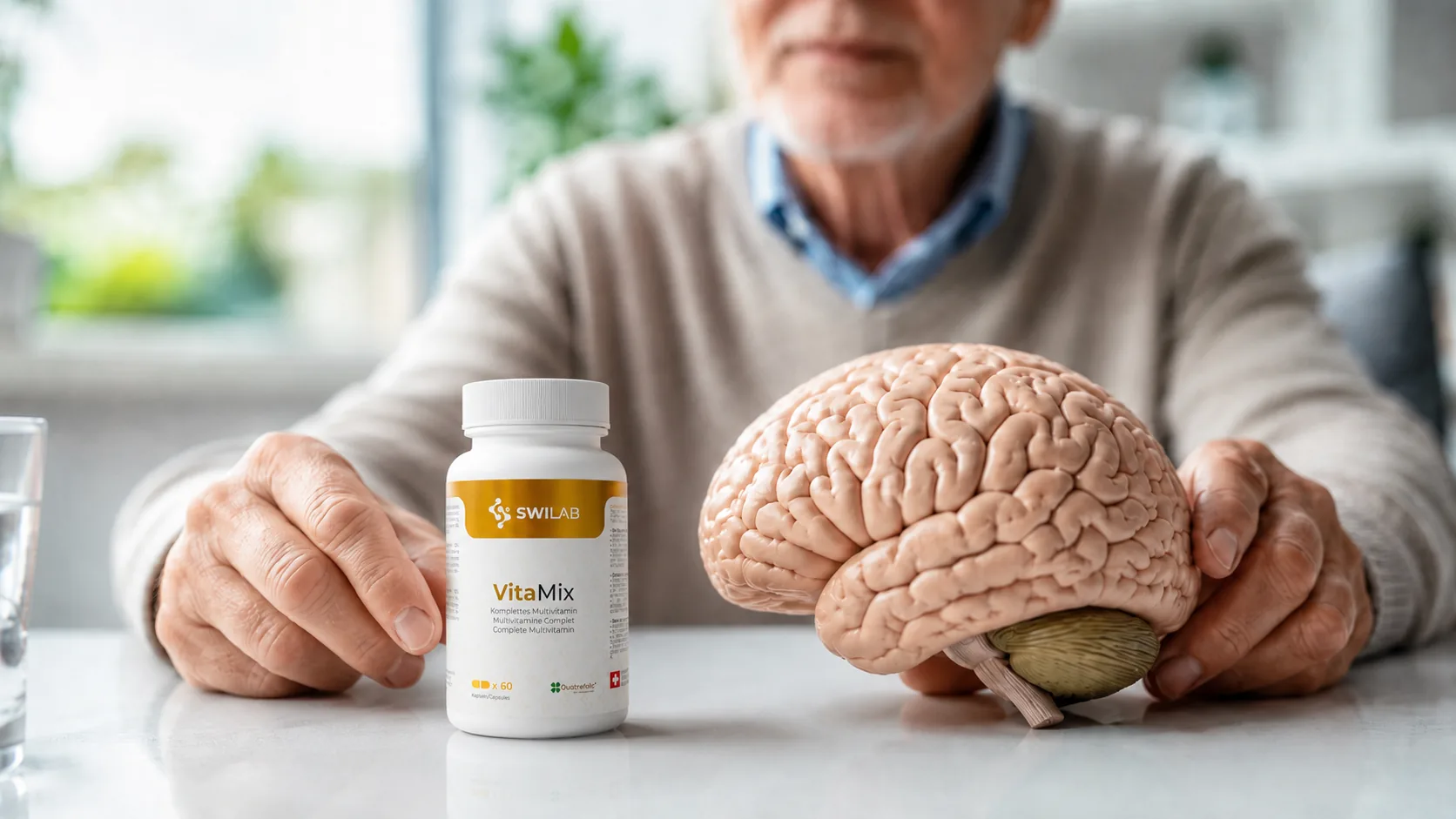
It is one of the most tempting promises on the supplement shelf: a simple daily capsule that keeps the brain young. Since a large US trial published between 2022 and 2024, the line has been everywhere – “a multivitamin protects memory”, “two years off your brain”. The science behind it is real. But it is also narrower than the headlines suggest.
The heart of the matter lies in a distinction almost no one makes: ageing, for a brain, can mean two very different things. This article separates those two meanings, looks at what the trials actually measured, and above all what they did not measure. Everything is grounded in studies verified on PubMed, and nothing is promised that a multivitamin cannot deliver – Swiss law forbids it, and caution demands it.
Memory or brain: two kinds of “ageing” not to confuse
What does “the brain ages” mean?
Two things, really, that must be separated to answer honestly. On one side, cognitive ageing: the performance of memory, attention, focus and thinking that slowly declines with age – what many simply call memory loss. It is measured with tests – recalling a list of words, chaining together numbers. On the other side, the biological ageing of the brain: the brain tissue that slowly shrinks, year after year. That one is not inferred from a test; you see it, by measuring brain volume on repeated MRI scans over time.
Why does this distinction change everything?
Because a treatment can act on one without touching the other. You can improve a score on a memory test without the brain shrinking any more slowly – and conversely, slow the loss of brain tissue without a spectacular immediate effect on tests. These are two distinct targets. Now, the question “does a multivitamin slow down brain ageing?” blends the two. The honest answer therefore treats each target separately: first memory, where the multivitamin has results; then the brain itself, where the story is very different.
The reading key for the whole article
When a headline announces that a supplement “slows down brain ageing”, ask a simple question: was a test measured, or was the brain measured? That is not the same evidence. Most articles about the multivitamin talk about memory tests – and present that as if the brain itself had grown younger.
What the COSMOS trial actually showed
What exactly was discovered?
That a daily multivitamin slightly curbs memory decline in older adults. That is the result of the large US research programme COSMOS, run in more than 21’000 adults aged 60 and over. In its online arm, participants taking a multivitamin (the widely sold Centrum Silver) did better on a word-recall test than those on placebo, as early as the first year, with the gain held over three years[1]. Another arm, run by telephone, found a benefit on global cognition and memory[2]. By pooling its sub-studies, the team estimated the effect at the equivalent of about two years of cognitive ageing[3].
Is it an effect you actually feel?
No, and this is a crucial nuance. “Two years of cognitive ageing” is a statistical translation of a weak effect, observed across thousands of people. At an individual level there is nothing spectacular to feel: no one “senses” their memory improving by swallowing a capsule. It is an average signal, useful at population level, not a personal transformation. The authors themselves stay cautious and speak of a “promising” lead, still to be confirmed.
Is the benefit the same for everyone?
Not that either. In the telephone arm, the effect was more pronounced in people with a cardiovascular history[2] – a group often more exposed to nutritional imbalances. Experts convened in 2025 for a summary on cognitive ageing reached the same idea: the multivitamin is mainly of interest for filling insufficient intakes, common in older adults, rather than as a universal cognitive booster[10]. We will come back to this below: the starting profile changes everything.
And what about dark chocolate?
Good question, because the COSMOS programme did not test only the multivitamin. Originally, this large clinical trial aimed at the prevention of cardiovascular disease and cancer – among the main chronic diseases – in older adults, and it compared in parallel a cocoa flavanol extract (a cocoa supplement) – the compounds of dark chocolate, studied notably for blood circulation. The verdict: cocoa showed no benefit on cognition[2]. So it was the pairing of vitamins and minerals, and not the chocolate, that carried the small effect observed on memory.
Through what mechanism does it act? We don’t know yet
This is one of the most honest points to raise: the COSMOS researchers acknowledge that the mechanism remains unknown. The simplest hypothesis is the correction of insufficient intakes of micronutrients. Another lead often put forward involves antioxidants: certain vitamins and minerals, through their antioxidant properties, help neutralise free radicals, those molecules arising from oxidative stress that can cause oxidative damage to brain cells, neurons included. Appealing as it is, this explanation remains unproven for a multivitamin: at this stage we observe an effect without having proven its cause.
The missing link: what about the brain itself?
Does a multivitamin slow the shrinkage of the brain?
To date, no trial has shown it. This is the point most often left unsaid. The multivitamin studies, including COSMOS, measured cognitive tests – not brain volume. They simply never scanned a brain. Saying that a multivitamin “slows down brain ageing” in the biological sense therefore means going beyond the available evidence. The result exists for memory; for brain tissue, it does not.
So what does slow the shrinkage of the brain?
There are indeed trials that managed it – but with a very different product. Researchers in Oxford gave older adults with early memory problems high doses of three B vitamins (folic acid, B6 and B12). Result: in the treated group, the brain shrank markedly more slowly over two years than on placebo[5]. A follow-up analysis showed that the protection targeted precisely the brain regions most vulnerable to ageing, with a considerable slowing of atrophy[6]. That is what evidence about the brain itself looks like.
Why these B vitamins, and not a multivitamin?
Because the mechanism is targeted. These B vitamins lower homocysteine, an amino acid in the blood which, in excess, goes hand in hand with faster brain atrophy. And the effect appeared only in people whose homocysteine was high to begin with. A detail that complicates the picture further: the benefit for the brain was clear only if the omega-3 level was also adequate[7]. This is a long way from a multivitamin “for everyone”: this is a high-dose treatment, for a specific profile, under specific conditions.
| What you want to slow | How it is measured | What worked in the trials |
|---|---|---|
| Memory decline | Cognitive tests (word recall, etc.) | Multivitamin: modest benefit in older adults (COSMOS) |
| Brain shrinkage | Brain volume on MRI | High doses of B vitamins, if homocysteine is high (not a multivitamin) |
Beware the shortcut
The results on B vitamins and the brain concern high, pharmacological doses, in people with elevated homocysteine and under supervision. That is not the dose of an over-the-counter multivitamin, and it is not a protocol to reproduce on your own. This work shows a promising mechanism, not a recommendation to dose yourself with B vitamins blindly.
Why it works for some and not others
Why does one trial find an effect and another not?
Because everything depends on what was missing to begin with. Long before COSMOS, a large US trial had followed nearly 6’000 physicians aged 65 and over for years: a daily multivitamin brought no cognitive benefit there compared with placebo[4]. The authors offered a simple explanation: this population was perhaps too well nourished to benefit from a supplement. A multivitamin only “recharges” what is low; where nothing is missing, it adds nothing.
Nutritional status, the real hidden variable
This is the thread running through all the research. The multivitamin mainly helps when an intake is genuinely insufficient – a situation that becomes common with age, as absorption falls and appetite drops. Conversely, in a person who eats a varied diet and has no deficiency, the expected gain is close to zero. This is not a contradiction between the studies: it is the same rule expressing itself according to the audience. The multivitamin acts as a corrector of deficiency, not as a youth pill.
| Profile | Intake often worth watching | Value of a targeted supplement |
|---|---|---|
| Older adult, reduced absorption | Vitamin B12, vitamin D | High: intakes hard to cover with age |
| Poorly varied / processed diet | Several micronutrients | Real: the multivitamin acts as a safety net |
| Elevated homocysteine | Folate, B6, B12 | To assess with a doctor, not by self-dosing |
| Well-nourished adult, no deficiency | None in particular | Low: expected benefit close to zero |
And the other “brain vitamins”?
The same principle comes back everywhere. A large summary of trials concluded that B vitamins can help maintain cognition in older adults, in connection with the lowering of homocysteine – but with variable results[8]. On the vitamin D side, a large trial found no effect on cognitive decline in the general population, with a possible benefit limited to certain subgroups[9]. Other nutrients are under study – choline, or the lutein in green vegetables – but without solid evidence to date. No vitamin behaves like a treatment for the brain: their value lies in filling a gap, when one exists.
Multivitamin and dementia: what the trials don’t say
Does a multivitamin prevent Alzheimer’s disease?
Nothing allows us to claim so, and this is a boundary to respect. The multivitamin studies measured performance on tests, not the occurrence of dementia or Alzheimer’s disease. Slightly slowing the decline of a memory score is not the same as preventing a neurodegenerative disease – two very different levels of ambition. No study has shown that a multivitamin reduces the risk of developing dementia.
Why is this caution not just a formality?
Because it is also a legal requirement, and a matter of honesty. In Switzerland as in the European Union, a dietary supplement is a food, not a medicine: it can neither prevent, nor treat, nor cure a disease, and no advertising may suggest it. The slide from “improves a memory test” to “protects against Alzheimer’s disease” is exactly the shortcut that the regulation forbids – and that the science does not support. The good news remains solid: preserving a little of your everyday functions is already useful, without needing to promise the impossible.
Should you take one? The practical and legal frame
Who is a multivitamin really useful for?
For specific profiles, above all after 60. Older adults, whose absorption of B12 and synthesis of vitamin D decline, people with a poorly varied diet, or those whose intake is low: there, a multivitamin plays its role as a safety net on micronutrients, and that fits the modest benefit seen in COSMOS. For a young, healthy person who eats a varied diet, the value is much lower: better to look after the plate first.
What can you honestly expect?
A top-up, not a guarantee. A multivitamin can help fill small nutritional gaps, and several of its nutrients carry authorised health claims – for example “zinc, iron and iodine contribute to normal cognitive function” or “B vitamins contribute to the normal functioning of the nervous system”. These wordings say exactly what they say: support for normal functions, not a treatment, and certainly not a rejuvenation of the brain.
How to choose and use it well?
A few simple markers. Check the actual dose against the nutrient reference values, the form of the nutrients (some, like B12 as methylcobalamin, are well absorbed), the clarity of the labelling and the origin. In Switzerland, supplements are foods under the oversight of the FSVO. Avoid stacking overlapping products and mega-doses: more is not better, and some fat-soluble vitamins can accumulate. If you are on treatment, pregnant or unwell, seek advice from a healthcare professional.
What matters most for a well-ageing brain
Before any capsule, it is habits that matter most for cognitive health – and the research is far more solid on that side. A healthy, balanced diet rich in fruits and vegetables and whole grains, lightly processed (approaches like the MIND diet, designed for brain health, draw on the Mediterranean diet), regular physical exercise, sufficient sleep, mental stimulation, stress management and social connection form the real foundation of a brain that ages gently. A multivitamin replaces none of these pillars: it comes, at best, as support when an intake is missing.
The golden rule
Start with the foundations: a varied diet, sleep, physical activity, social connection – these weigh the most for a well-ageing brain. Add a multivitamin where an intake is genuinely missing, at a sensible dose, as a safety net. And keep in mind the nuance running through this whole article: supporting memory, yes, a little; “rejuvenating the brain”, no.
Frequently asked questions
Does a multivitamin slow down brain ageing?
Partly, and only in a specific sense. In older adults, a large US trial showed that a daily multivitamin slightly slows the decline in memory performance, the equivalent of about two years of cognitive ageing. But that trial measured memory tests, not the brain itself: no trial has shown that a multivitamin slows the physical shrinkage of the brain seen on MRI. The benefit is real but modest, and mainly useful when the diet does not cover requirements.
What is the difference between brain ageing and memory decline?
They are two related but distinct things. Biological brain ageing is the progressive shrinkage of brain tissue, measured with MRI scans. Cognitive decline, on the other hand, is measured with memory and reasoning tests. A treatment can act on one without affecting the other. The multivitamin trials measured cognitive tests; the only trials that slowed brain shrinkage involved high doses of B vitamins in people with elevated homocysteine.
Do multivitamins slow cognitive decline?
Several large recent trials suggest so, with a modest effect. In the COSMOS research programme, run in more than 21’000 older US adults, a daily multivitamin improved global cognition and memory compared with a placebo, the equivalent of about two years of cognitive ageing. The effect was more pronounced in people with a cardiovascular history. By contrast, an older trial in well-nourished physicians found no benefit: the baseline nutritional status matters a great deal.
What is the best vitamin for the brain?
There is no single miracle vitamin for the brain. The vitamins most studied in brain ageing are the B group (B6, B9/folate, B12), because they lower homocysteine, a risk factor for brain atrophy. Vitamin D and omega-3 are also involved. But none works like a treatment: their value lies in filling an insufficient intake. The best strategy remains a varied diet, supplemented in a targeted way where a need exists.
Is it good to take multivitamins every day?
For a healthy person who eats a varied diet, a daily multivitamin is not essential: it mainly acts as a safety net against small intake gaps. At recommended doses, it is generally safe. Risks arise mainly from overdosing or from stacking several overlapping products. A multivitamin should be seen as a top-up on micronutrients, not as a health guarantee nor a substitute for food.
Can a multivitamin prevent dementia or Alzheimer’s disease?
No, and no trial has shown it. Multivitamin studies measured performance on cognitive tests, not the occurrence of dementia or Alzheimer’s disease. Slightly slowing the decline of memory on tests is not the same as preventing a neurodegenerative disease. In Switzerland as in the European Union, a dietary supplement cannot legally claim to prevent, treat or cure a disease.
Which multivitamin to choose for a woman of 60 or an older adult?
Rather than a specific brand, a few markers: a dose matched to the nutrient reference values, well-absorbed forms, clear labelling and, in Switzerland, a product under FSVO oversight. With age, the absorption of vitamin B12 and the synthesis of vitamin D decline: these are the intakes to watch first. It is best to adjust the dose with a doctor or pharmacist, especially if you are on treatment, rather than guessing.
Why does a multivitamin help some people and not others?
Because a multivitamin only tops up what is missing. It mainly benefits people whose diet does not cover their needs: older adults, low intakes, reduced absorption, a cardiovascular history. In people who are already well nourished, the effect is close to zero, as a trial in physicians showed. A multivitamin therefore acts more as a corrector of deficiencies than as a universal youth pill.
How long do you need to take a multivitamin for an effect on memory?
In the trials that observed a benefit, intake was daily and prolonged, over one to three years. The improvement in memory appeared as early as the first year in one of the studies, then held. It is therefore not an immediate effect felt from day to day, but a statistical signal measured over the long term and across a large group. At an individual level, no one notices an effect overnight.
Sources and references (verified on PubMed)
10 sources- Yeung L.K. et al. (2023). Multivitamin Supplementation Improves Memory in Older Adults: A Randomized Clinical Trial (COSMOS-Web).
- Baker L.D. et al. (2022). Effects of cocoa extract and a multivitamin on cognitive function: a randomized clinical trial (COSMOS-Mind).
- Vyas C.M. et al. (2024). Effect of multivitamin-mineral supplementation on cognitive function (COSMOS-Clinic) and meta-analysis.
- Grodstein F. et al. (2013). Long-term multivitamin supplementation and cognitive function in men: a randomized trial (Physicians’ Health Study II).
- Smith A.D. et al. (2010). Homocysteine-lowering by B vitamins slows the rate of accelerated brain atrophy in mild cognitive impairment (VITACOG).
- Douaud G. et al. (2013). Preventing Alzheimer’s disease-related gray matter atrophy by B-vitamin treatment.
- Jerneren F. et al. (2015). Brain atrophy in cognitively impaired elderly: the importance of long-chain omega-3 fatty acids and B vitamin status.
- Li S. et al. (2021). The preventive efficacy of vitamin B supplements on the cognitive decline of elderly adults: a systematic review and meta-analysis.
- Kang J.H. et al. (2021). Effect of vitamin D on cognitive decline: results from two ancillary studies of the VITAL randomized trial.
- Nogueira-de-Almeida C.A. et al. (2025). Role of Micronutrient Supplementation in Promoting Cognitive Healthy Aging: Evidence-Based Consensus Statement.