
Should you take food supplements in the morning or evening?
Quick summary
The ideal time of intake depends on the supplement: water-soluble vitamins and iron are better absorbed in the morning on an empty stomach, magnesium in the evening before bed, and vitamin D during the meal richest in fatty matter.
Key facts
Key points
- Vitamins B and C, iron and zinc are better assimilated in the morning on an empty stomach or at breakfast, away from tea and coffee, which slow down their absorption.
- Magnesium taken about 1 hour before bedtime is associated with a modest but significant improvement of sleep quality in adults (Schuster 2025).
- Vitamin D and the other fat-soluble vitamins (A, E, K) must be taken during the meal richest in fatty matter to maximise intestinal absorption.
- Melatonin reaches its optimal effectiveness at 2-4 mg, taken about 3 hours before the intended bedtime, according to a meta-analysis of 26 clinical trials (Cruz-Sanabria 2024).
- In Switzerland, close to one third of the adult population consumes at least one food supplement (FSVO, 2023 Swiss Nutrition Bulletin), which makes the question of timing very concrete in daily life.
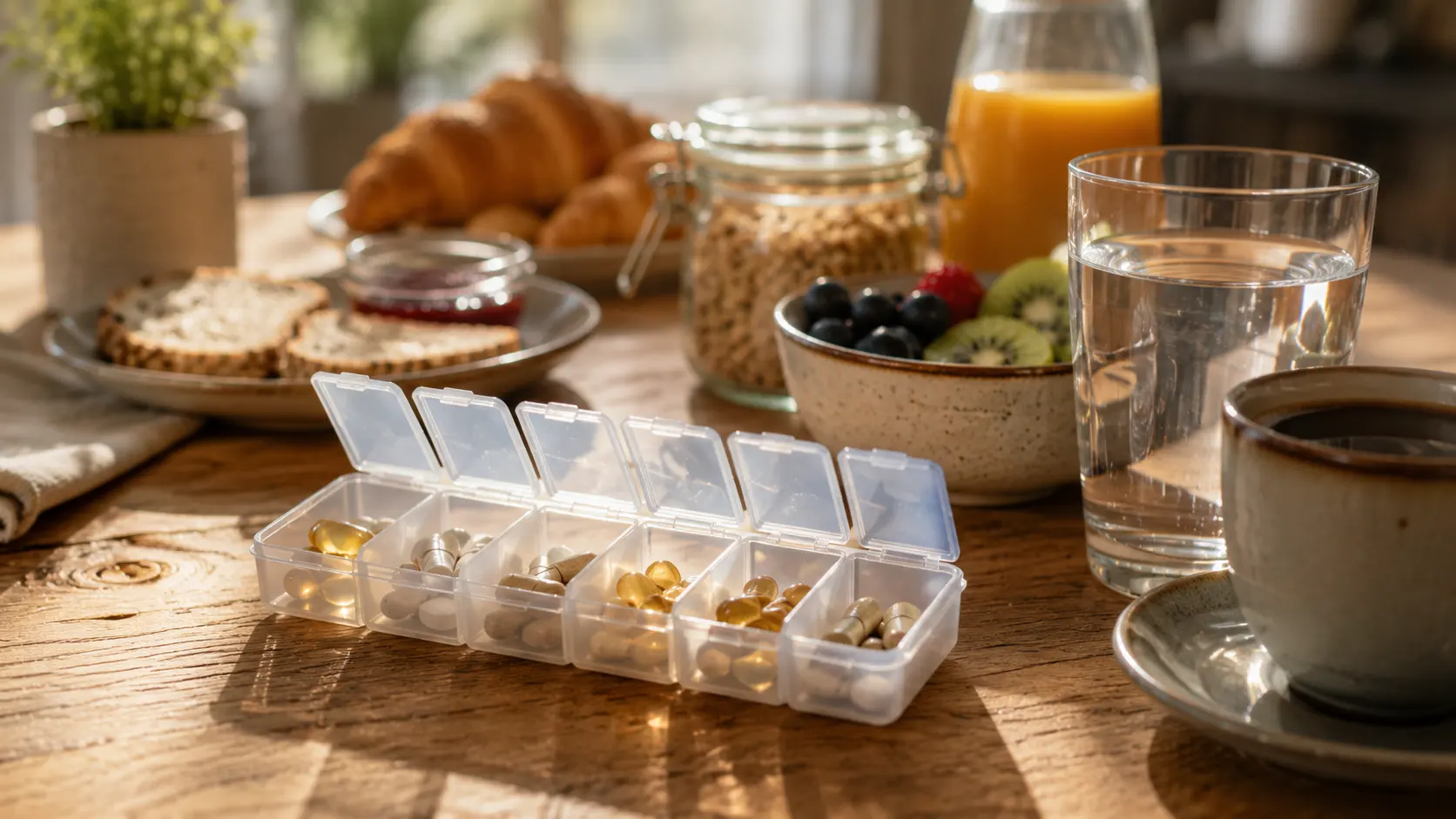
Close to one third of Swiss adults consumes at least one food supplement, according to the Swiss Nutrition Bulletin published by the FSVO in 2023. Yet many do not realise that the time of intake can lower the absorption of a nutrient by more than 50% depending on its chemical nature. In the world of food supplements, timing is among the most neglected levers: the optimal time of intake depends on the solubility of the nutrient, interactions with meals and the circadian rhythm. This article distinguishes the supplements to take in the morning from those that work better in the evening, drawing on clinical trials published since 2020.
Why does the time of intake change the effectiveness of a supplement?
Absorption depends on the solubility of the nutrient
A water-soluble vitamin of the B group or vitamin C quickly crosses the intestine with or without a meal. A fat-soluble one (A, D, E, K), by contrast, needs fatty matter in the food bolus to cross the digestive wall[1]. The time of intake therefore directly determines the absorbed quantity and the nutritional or physiological effect of the product on the body. The systematic review by Silva and Furlanetto published in Nutrition Reviews stresses that vitamin D is clearly better assimilated during a meal rich in lipids[1], a condition for optimal bioavailability at the intestinal cells. Without an associated fat, absorption can fall markedly, which degrades the ratio between the quantity ingested and the share actually useful to the body. This nuance applies to any fat-soluble ingredient, including the carotenoids and vitamin K found in a balanced diet but also in certain dedicated capsules.
The circadian rhythm also shapes the expected effects
The body produces melatonin at night and cortisol on waking. Taking a supplement against the cycle can therefore reduce its benefit, or even disturb sleep and night-time rest. A randomised controlled trial in 290 diabetic patients published in 2024 in Frontiers in Endocrinology compared four groups over two months. Magnesium and potassium supplementation increased serum melatonin and reduced cortisol[2], two effects that only make sense at the end of the day of activity and that contribute to a better night-time hormonal balance, particularly useful on terrains weighed down by stress. Conversely, iron and vitamin C take better advantage of the morning peak of digestive motility to support energy at the start of the day, while magnesium plays a role as a relay on relaxation, the nervous system and muscle recovery as night falls. Following a stable rhythm, day after day, remains the condition for maximum effectiveness.
Which food supplements to take in the morning?
Water-soluble vitamins, iron and zinc are taken in the morning on an empty stomach
Taking on an empty stomach remains the preferred slot for iron, zinc and the B and C group vitamins, vitamin B12 included. These water-soluble micronutrients are quickly absorbed and do not need fatty matter, which makes the intake effective from the start of the day to support energy, wakefulness and the immune system. Iron even benefits from an empty stomach, paired with a glass of water or citrus juice, a simple choice to fit into a stable daily routine, including during the cold season or a period of intense exercise. A practical guide published in 2025 in the Journal of Clinical Psychiatry recommends taking ferrous salts on waking with about 100 mg of vitamin C[3]. Attention should also be paid to avoiding milk, green tea, coffee, calcium and antacids[3], which strongly reduce the assimilation of the non-haem mineral and compromise the desired effect; in case of doubt, the advice of a healthcare professional helps adapt the programme to the profile.
Multivitamins and omega-3 are taken at breakfast
Multivitamins combine water-soluble and fat-soluble vitamins and minerals, a blend designed to cover a broad need throughout the day. Their best absorption occurs during a meal containing a little fatty matter, breakfast type with eggs, butter or avocado, a useful reference to spread your supplements without digestive overload. Omega-3s in the form of fish oil (EPA and DHA) follow the same rule: they are fatty acids absorbed through bile micelles, which play a crucial role in energy metabolism and the protection of cells. The review by Maki and Dicklin published in Current Opinion in Clinical Nutrition and Metabolic Care confirms that omega-3 concentrates in ethyl esters (magnesium omega 3 EPAX included) are poorly assimilated on an empty stomach[5]. Lipids are required to release the bile salts that emulsify these molecules. Intake at the start of the morning meal, with 10 to 15 g of fatty matter, remains the simplest moment to get the most out of a course, whether it targets sports nutrition or simple muscle recovery after effort.
Which food supplements to take in the evening?
Magnesium acts on sleep quality
Magnesium taken about 1 hour before bedtime is associated with an improvement in sleep quality and favours restorative sleep, with no overdose if the intake remains reasonable. A randomised placebo-controlled trial published in 2025 in Nature and Science of Sleep followed 155 adults over 4 weeks. The daily intake of 250 mg of bisglycinate reduced insomnia severity compared with placebo[6]. The benefit was more pronounced in people whose diet was poor in this mineral, a sign that a prior shortfall can amplify the effect of the course. A 2024 study on the L-threonate form observed in parallel an improvement of deep sleep measured by Oura ring[7]. A recent systematic review bringing together 15 clinical trials mostly finds favourable effects on sleep parameters[8], which places it among the useful levers to support a regular day-and-night cycle, including in people exposed to chronic stress or to a risk of prolonged fatigue.
Practical
To avoid disturbing the onset of sleep, take magnesium during dinner or 1 hour before bedtime, never in the middle of the day if the goal is sleep. Bisglycinate is generally better tolerated than oxide on the digestive level.
Vitamin D and fat-soluble: with the meal richest in fatty matter
The fat-soluble vitamins A, D, E and K are better absorbed during the meal that contains the most fatty matter[1], which in France as in Switzerland often corresponds to dinner. The season also weighs in: in winter, reduced sunshine limits skin synthesis at the level of the skin, and supplementation becomes a useful relay. A normal and varied diet does not always provide enough vitamin D, and the FSVO recommends supplementation for children up to 3 years, people aged 60 and above and pregnant or breastfeeding women[9], particularly in the event of menopause or increased bone needs. The recommended intakes are 600 IU per day before 60 years and 800 IU per day from 60 years[9]. The authority does not specify the hour, but the scientific literature suggests an intake of at least 10 to 15 g of lipids in the food bolus to maximise absorption[1]. The presence of pulses on the plate, by contrast, can reduce the bioavailability of fat-soluble vitamins, according to a study by Margier et al. published in Molecular Nutrition & Food Research[10]. The opinion of a nutritionist or an expert remains useful to adjust the intake and the specific ingredient according to each personal history.
Melatonin: 2 to 4 mg, about 3 hours before bedtime
Melatonin reaches its maximum effectiveness at a dose of 2 to 4 mg[11]. This quantity must be taken not 30 minutes but about 3 hours before the intended bedtime[11], a window worth following rigorously to optimise the effect on falling asleep and avoid disturbing sleep with a badly placed intake. This is the conclusion of a meta-analysis of 26 randomised controlled trials published in 2024 in the Journal of Pineal Research. A second paediatric meta-analysis published in 2025 in Sleep Medicine Reviews confirms this same window upstream of lights-out in children with neuropsychiatric disorders[12]. The usual scheme, 2 mg just before going to bed, therefore underexploits the molecule’s potential on falling asleep, a typical example where a poor intake degrades the benefit/cost ratio of the course and calls for a professional consultation to adjust form (capsule, tablet, powder) and quantity to age. On this subject, consulting a professional remains prudent, particularly in case of any concomitant treatment likely to interact with the molecule.
To avoid
Melatonin is not taken in the morning or in the middle of the day: it shifts the circadian rhythm in the wrong direction and may induce daytime sleepiness. In Switzerland, food supplements based on melatonin are capped at 1 mg per daily dose; beyond that, melatonin falls under the medicine category requiring a prescription (Circadin® and Slenyto® authorised by Swissmedic).
Frequently asked questions
What should you do if you miss your morning or evening intake?
Take the missed dose as soon as you think of it, unless the time of the next dose is approaching. Skipping entirely is preferable to doubling the dose: an excess of magnesium causes loose stools, and an excess of iron disturbs absorption for 24 hours through activation of hepcidin[4]. Regularity prevails over hourly precision: the biological effect of water-soluble vitamins is built over several weeks. Simply resume the usual rhythm the following day.
Can coffee block the absorption of my supplements?
Yes, especially for iron and calcium. The polyphenols of coffee and tea strongly reduce the absorption of non-haem iron from food supplements[3]. The practical guide by Andrade published in 2025 in the Journal of Clinical Psychiatry recommends spacing iron intake from coffee and tea by at least 1 hour[3]. For other supplements (fat-soluble vitamins, omega-3, magnesium), the effect of coffee is limited or nil. Drinking a coffee with your multivitamin is therefore generally not a problem, but with your iron, it is a serious one.
Can I take all my supplements at the same time?
Not for all. Calcium reduces the absorption of iron and zinc if taken together[3], and a high-dose magnesium can compete with a calcium taken at the same time. The simple rule: space the opposed minerals by at least 2 hours. Mixing a multivitamin with an omega-3 during breakfast poses no problem; mixing an iron with a calcium, by contrast, halves the absorption of iron[3]. If several supplements are part of the routine, planning their slots avoids these interactions.
Is regularity more important than the precise time?
Yes, in most cases. For nutrients whose blood concentration is regulated over several days (vitamin D, B12, magnesium on a long course), a regular intake at any hour matters more than an irregular intake at the theoretical ideal moment. For supplements with an acute effect such as melatonin or energy complexes, the precise time, on the contrary, makes all the difference. The practical rule: choose the most sustainable time in daily life and stick to it for the whole duration of the course.
Should you take supplements on an empty stomach or with the meal?
It depends on the supplement. Water-soluble ones (B group, vitamin C) and iron are better assimilated on an empty stomach[3]. Fat-soluble ones (A, D, E, K) and omega-3s need the fats of the meal to cross the digestive wall[1][5]. Multivitamins combine the two types: a breakfast with a little fat offers the best compromise. In the event of nausea on an empty stomach, taking the supplement with a little food is preferable to interrupting the course.
Sources and references
12 sources- Silva MC, Furlanetto TW. (2018). Intestinal absorption of vitamin D: a systematic review.
- Khalid et al. (2024). Effects of magnesium and potassium supplementation on insomnia and sleep hormones in patients with diabetes mellitus.
- Andrade C. (2025). Dosing Patients With Oral Iron Supplements: Practical Guidance.
- Moretti et al. (2015). Oral iron supplements increase hepcidin and decrease iron absorption from daily or twice-daily doses in iron-depleted young women.
- Maki KC, Dicklin MR. (2019). Strategies to improve bioavailability of omega-3 fatty acids from ethyl ester concentrates.
- Schuster et al. (2025). Magnesium Bisglycinate Supplementation in Healthy Adults Reporting Poor Sleep: A Randomized, Placebo-Controlled Trial.
- Hausenblas et al. (2024). Magnesium-L-threonate improves sleep quality and daytime functioning in adults with self-reported sleep problems: A randomized controlled trial.
- Rawji et al. (2024). Examining the Effects of Supplemental Magnesium on Self-Reported Anxiety and Sleep Quality: A Systematic Review.
- FSVO, Recommendations on vitamin D supplementation and 2023 Swiss Nutrition Bulletin.
- Margier et al. (2019). The Presence of Pulses within a Meal can Alter Fat-Soluble Vitamin Bioavailability.
- Cruz-Sanabria et al. (2024). Optimizing the Time and Dose of Melatonin as a Sleep-Promoting Drug: A Systematic Review and Dose-Response Meta-Analysis.
- Bruno et al. (2025). Optimizing timing and dose of exogenous melatonin administration in neuropsychiatric pediatric populations: a meta-analysis on sleep outcomes.