
When to take a supplement alongside a medical treatment?
Quick summary
A food supplement is never added to a medical treatment without advice from the doctor or the pharmacist: some plants and minerals change the effect of medicines, sometimes strongly.
Key facts
Key points
- Any supplement-medicine combination must be validated upstream by a doctor or a pharmacist: 23 to 82% of seniors combine the two without speaking to their healthcare professional about it (Cureus review, 2025).
- St John’s wort speeds up the elimination of many medicines by the liver via the CYP3A4 enzyme — which metabolises about half of common medicines — and causes a drop in the effectiveness of antidepressants, immunosuppressants, anticoagulants and oral contraceptives.
- Calcium, iron, magnesium and zinc block the absorption of many antibiotics, antithyroid drugs and bisphosphonates: at least 2 to 4 hours’ gap between the two intakes must be respected.
- Before a surgical operation, most plant-based supplements (ginkgo, garlic, ginseng, St John’s wort, vitamin E) must be stopped 1 to 2 weeks before the procedure to limit the risk of bleeding.
- In Switzerland, food supplements are foodstuffs supervised by the FSVO through the Food Supplements Ordinance: they cannot treat or cure a disease, and never replace a prescribed medicine.
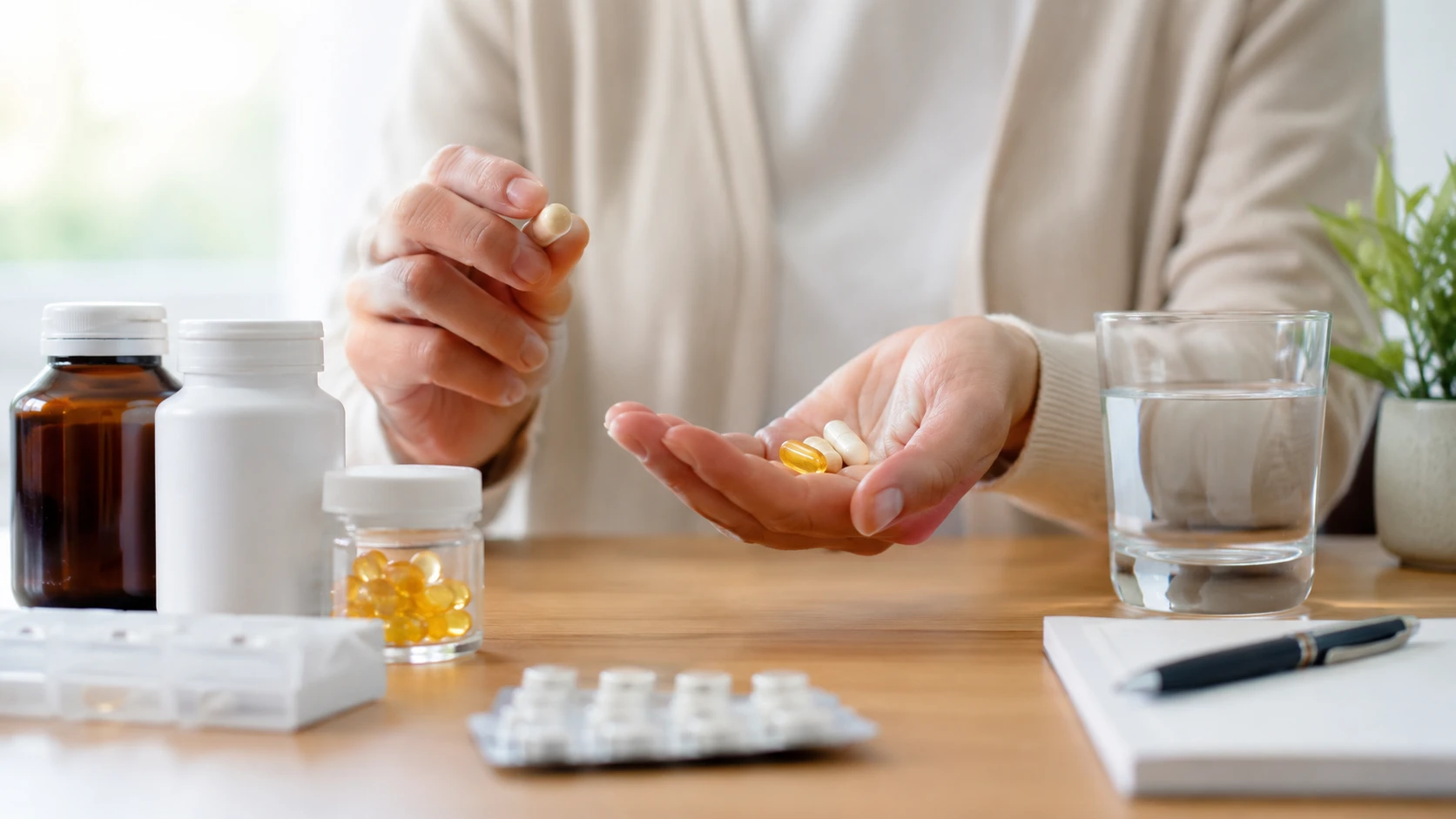
In Switzerland, about a third of the adult population takes at least one food supplement according to the 2022 FSVO survey, and the share climbs above 80% in people treated for a chronic disease (Cureus review, 2025). The world of food supplements therefore constantly crosses that of medicines, sometimes without the doctor being informed. This page specifically deals with the time of intake of a supplement when a medical treatment is already ongoing: under which conditions, under which monitoring, with what time gap and in which cases you must abstain completely.
Should you take a food supplement during a medical treatment?
Why talk to the doctor or the pharmacist beforehand
Before any intake, you must tell your doctor or your pharmacist — it is the first piece of advice of any healthcare professional, without exception. A recent scientific review published in Cureus in 2025 analysed sixteen international studies: between 23% and 82% of older people take supplements and medicines at the same time[1], but their healthcare professionals are almost never aware of it. This absence of accompanying information explains most avoidable accidents. The pharmacist is often the most accessible: they know the list of your treatments, have access to interaction databases and can flag in seconds if a combination is a problem. In Switzerland, supplements are foodstuffs supervised by the FSVO through the Food Supplements Ordinance[2]: they are not subject to a market authorisation procedure like a medicine authorised by Swissmedic, and their safety of use is not assessed upstream. This difference in framework makes medical verification all the more useful, especially with an ongoing drug treatment.
In which cases is a supplement useful during a treatment
A food supplement during a treatment only makes sense to fill a proven deficiency or to compensate an effect of the medicine on the body. Three situations dominate. First, deficiencies detected by blood test, for example vitamin B12 in patients on long-term metformin, or iron in case of objectified anaemia — a targeted intake then complements the diet. Second, deficits induced by some medicines: a review published in the American Journal of Health-System Pharmacy in 2026 documents how several antiepileptic and antipsychotic drugs lower the levels of B vitamins, vitamin D, zinc or selenium[3], and sometimes justify targeted supplementation to support nutritional balance. Third, pregnancy and breastfeeding, where folic acid and vitamin D remain recommended by learned societies including in the presence of a treatment, on the doctor’s advice. Outside these cases, adding a supplement “to feel better” mostly exposes to the risk of interaction[8] without proven benefit; a varied and balanced diet already covers most of the body’s needs in vitamins and minerals.
Which food supplements carry an interaction risk?
The plants: St John’s wort, ginkgo, garlic, ginseng
Plant-based preparations concentrate the most serious interactions with medicines. St John’s wort is the most documented case: its active principle speeds up the elimination of medicines by the liver[4] and causes a drop in the effectiveness of antidepressants, immunosuppressants after transplant, oral anticoagulants, the contraceptive pill and several antivirals[7]. A 2024 review in Seminars in Thrombosis and Hemostasis explicitly recommends that patients on anticoagulants avoid St John’s wort[5]. Ginkgo, high-dose garlic and ginseng — plant-based substances commonly sold over the counter — can interact with these treatments and increase the risk of bleeding in patients on anticoagulants or antiplatelets. A 2024 review in the Journal of Clinical Anesthesia reminds us that these plants top the list of products to disclose before any surgery[6]. The practical rule: no plant in capsules, medicalised herbal tea or therapeutic blend without prior validation by the healthcare professional.
The minerals that block medicine absorption
Calcium, iron, magnesium and zinc — four common mineral salts in food supplements — form complexes in the digestive system with several medicines and prevent their absorption[8]. Antibiotics of the tetracycline and fluoroquinolone families lose a large part of their effectiveness when taken at the same time as these minerals, because of a poorly timed simultaneous intake. Levothyroxine, the treatment of hypothyroidism, is very sensitive: taken with calcium or iron, its bioavailability can drop by 20 to 50% depending on the formulation[1], which destabilises the thyroid balance. Bisphosphonates against osteoporosis follow the same logic. The fix is simple and effective: space the intake by 2 to 4 hours depending on the medicine-mineral pairs concerned. The pharmacist, the leaflet or the packaging indicate the exact duration to respect; this accompanying information is part of the recommended dosage.
How to organise your supplements with a medical treatment?
Spacing medicine and supplement through the day
When the combination is validated, the general rule is to separate medicine and supplement by several hours to limit absorption interactions. For tetracycline or fluoroquinolone antibiotics, a delay of 2 to 4 hours with calcium, iron, magnesium or zinc is usually recommended[8]. For levothyroxine, intake is on an empty stomach in the morning and supplements containing calcium or iron are postponed by at least 4 hours[1]. For bisphosphonates against osteoporosis, the window is even stricter: no mineral supplement in the 30 minutes to 2 hours following intake, depending on the molecule. Keeping a small paper table or a note on the phone — medicine time, supplement time — is part of good usage hygiene: it avoids forgetting and makes follow-up exchanges with the doctor easier. In case of doubt about the exact delay for a personal situation, asking the pharmacist or consulting your doctor remains the safe reflex.
When to interrupt supplements before an operation
Before a surgical operation, most plant-based supplements and some vitamins must be stopped in advance to limit the risk of bleeding and the interactions with anaesthetics. The American anaesthesia societies recommend stopping 1 to 2 weeks before the procedure[6]; this washout period also concerns high-dose fatty acids. The plants concerned in priority are: ginkgo, high-dose garlic, ginseng, St John’s wort, high-dose vitamin E, high-dose omega-3s. A 2024 study in the Journal of Clinical Anesthesia underlines that 50 to 70% of patients do not disclose their plant intake to the surgeon[6], which complicates risk assessment. The instruction is therefore to inform your doctor and to bring to the pre-operative consultation the complete list of everything you take — including infusions and medicalised herbal teas — and to follow the doctor’s advice on the stops to plan. Beyond surgery, heavy treatments such as chemotherapy, radiotherapy or transplants impose equivalent vigilance, to be discussed with the oncologist or the referring specialist.
Frequently asked questions on supplements and medical treatment
Can a food supplement be taken at the same time as a medicine?
It depends on the supplement-medicine pair and must be validated by a healthcare professional. Some combinations are neutral, others cause a drop in the medicine’s effectiveness or amplify its effects. A 2025 Cureus review describes a supplement-medicine combination rate of 23 to 82% in older people, without the doctor being informed in most cases. The practical rule: write down everything you take, vitamins and plants included, and present it to the doctor or the pharmacist before any new combination.
Which supplements should be avoided when on anticoagulants?
St John’s wort, ginkgo, high-dose garlic, ginseng and high-dose vitamin E are the most problematic when on anticoagulants. St John’s wort causes a drop in the treatment’s effectiveness and increases the risk of clots; the others amplify the risk of bleeding. A 2024 review in Seminars in Thrombosis and Hemostasis explicitly recommends avoiding these plants on oral anticoagulants. Any intake must go through the referring doctor — cardiologist, haematologist or family doctor — who will adjust the biological monitoring.
How long should you wait between a medicine and a supplement?
The usual spacing is 2 to 4 hours, but the exact rule depends on the pair concerned. Calcium, iron, magnesium and zinc block the absorption of tetracyclines, fluoroquinolones and levothyroxine. Levothyroxine requires at least 4 hours’ gap with a calcium or iron supplement; bisphosphonates require 30 minutes to 2 hours without any mineral supplement depending on the molecule. The exact delay appears on the medicine’s leaflet or can be asked of the pharmacist — it is better to ask the question than to rely on a general rule.
Should supplements be stopped before an operation?
Yes, most plant-based supplements and some vitamins are stopped 1 to 2 weeks before the operation. The American anaesthesia societies particularly target ginkgo, garlic, ginseng, St John’s wort, high-dose vitamin E and high-dose omega-3s, because of the risk of bleeding and interactions with anaesthetics. Bringing the complete list of supplements to the pre-operative consultation — including infusions and medicalised herbal teas — lets the surgeon and the anaesthetist set the precise stop date.
Does St John’s wort really cause as many problems as we read?
Yes, St John’s wort is among the most at-risk supplements. It strongly activates the liver’s CYP3A4 enzyme that metabolises about half of common medicines, which reduces the effectiveness of antidepressants, immunosuppressants, some anticoagulants, antivirals and oral contraceptives. Several reviews, including PeerJ in 2023 and Molecules in 2022, classify these interactions among the best documented. An unwanted pregnancy on the pill plus St John’s wort has already been described. No intake without medical advice, especially in case of chronic treatment.
Sources and references
8 sources- Changaramkumarath G, et al. Pharmacological Interactions Between Nutritional Supplements and Prescription Medications in Older Adults
- FSVO — Federal Food Safety and Veterinary Office. Food supplements
- Cupp MA, Nelson LA. Identification and management of psychiatric medication-induced nutrient depletion
- Czigle S, et al. Pharmacokinetic and pharmacodynamic herb-drug interactions — central nervous system
- Talasaz AH, et al. Pharmacokinetic and Pharmacodynamic Interactions between Food or Herbal Products and Oral Anticoagulants
- Elvir Lazo OL, et al. Use of herbal medication in the perioperative period: Potential adverse drug interactions
- Kenda M, et al. Medicinal Plants Used for Anxiety, Depression, or Stress Treatment: An Update
- Bell V, et al. An Update on Drug-Nutrient Interactions and Dental Decay in Older Adults