
When is the ideal moment to optimise supplement absorption?
Quick summary
The optimal moment depends on the supplement: vitamins A, D, E, K and omega-3 with a fatty meal, iron on an empty stomach every other day to bypass the hepcidin peak, magnesium in the evening for digestive tolerance.
Key facts
Key points
- Vitamins A, D, E, K and omega-3 see their absorption rise by about 32% in the presence of fats in the meal (Dawson-Hughes 2014, single dose of vitamin D3), because the micelles formed during lipid digestion carry them across the intestinal wall.
- Iron taken on an empty stomach in the morning every other day is better assimilated than taken daily: in anaemic women, the share of iron effectively absorbed at each intake is 40 to 50% higher on alternate days (Stoffel et al. 2020), because daily intake maintains a high hepcidin level that blocks absorption.
- Calcium and iron compete in the digestive tract: taking both together reduces iron assimilation, so the two supplements should be spaced by at least 2 hours.
- Coffee, tea and certain drinks rich in polyphenols bind to iron and zinc and lower their absorption when consumed less than an hour before or after the supplement.
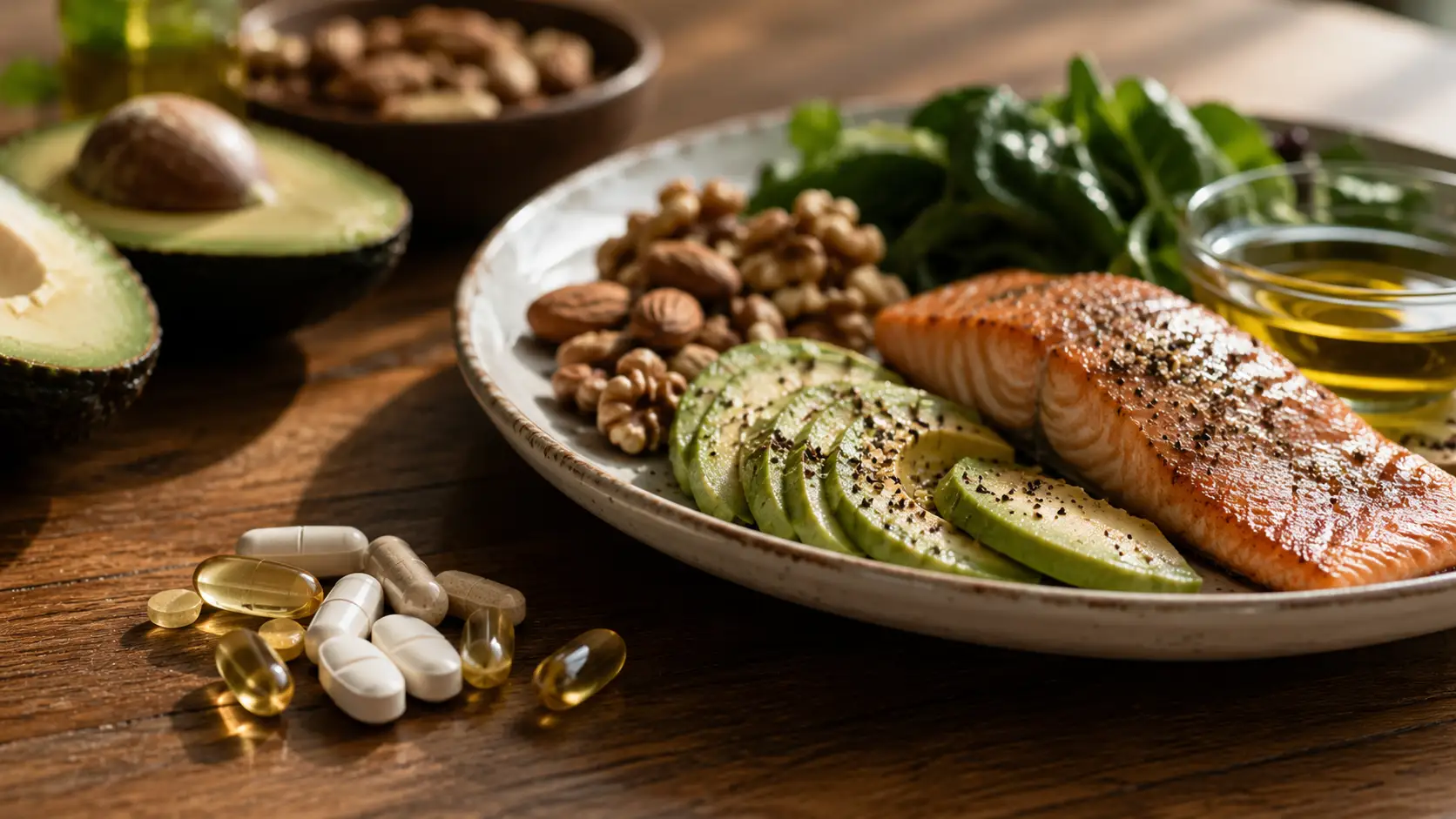
In Switzerland, about 30% of adults consume at least one food supplement every week, according to the 2023 Swiss Nutrition Bulletin published by the FSVO. Yet their effectiveness depends as much on the timing of intake as on the dosage. On this site dedicated to food supplements, we document the absorption rules drawn from clinical studies. The page devoted to the right time to take a food supplement covers the subject more broadly; this article zooms in on the optimal absorption window. Fatty meal, intake on an empty stomach, spacing between minerals: three concrete levers decide whether the molecule reaches the bloodstream or leaves the digestive tract without having acted.
Why does the meal change the absorption of a supplement?
Vitamins A, D, E, K and omega-3: why fats are indispensable
These molecules do not dissolve in water and need dietary lipids to cross the intestinal wall and reach the body. A randomised clinical study measured a 32% higher absorption[1] of a single dose of vitamin D3 taken with a meal containing fats, compared with the same menu without fats (Dawson-Hughes 2014).
The mechanism rests on micelles, small particles produced by lipid digestion that carry the fat-soluble vitamins towards the intestinal cells. Without this fat intake, these micelles do not form correctly and the vitamin leaves with the stools. The systematic review by Silva and Furlanetto (2018)[2] confirms this scheme for vitamin D and extends the principle to vitamins A, E and K. For omega-3 fatty acids in the form of ethyl esters, assimilation falls in the absence of lipids, unless the formulation is specifically emulsified[3]. These vitamins play an essential role in the immune system and bone health, provided they are absorbed correctly.
How much fat is enough to optimise absorption?
A menu containing fats, for example the equivalent of a full-fat yoghurt, half an avocado or a tablespoon of oil, triggers lipid digestion and the formation of the micelles needed to assimilate the fat-soluble vitamins[2]. This is one of the key levers for aiming at the ideal timing.
In the trial by Raimundo et al. (2011), participants who received a single dose of vitamin D3 with a breakfast containing 25 g of lipids showed at 14 days a blood level of 53.7 nmol/L against 33.7 nmol/L[4] in the group on a fat-poor menu (1.7 g). The type of fat matters less than the total amount: a mix of saturated and unsaturated lipids gives equivalent results to fats rich in omega-9[1] in the Dawson-Hughes trial. Conversely, a menu rich in pulses can reduce the availability of these vitamins: the fibres and saponins of peas, lentils and beans trap part of the micelles in the digestive tract[5] (Margier 2019). Within a varied and balanced diet, including a slightly fatty food at the meal remains the most effective move.
Which supplements to take on an empty stomach for better absorption?
Iron and the every-other-day rule
Iron is better assimilated when ingested alone, in the morning on an empty stomach, and ideally every other day rather than daily. The work conducted at ETH Zurich by Stoffel et al.[6] showed that a daily administration triggers a hepcidin peak, a liver hormone that blocks absorption for 24 hours, and ends up reducing the overall effectiveness of the course. This protocol is among the most studied empty-stomach supplements.
In their 2017 randomised trial on 40 women receiving 60 mg of iron, cumulative fractional absorption was 21.8% with the alternate schedule (28 days) against 16.3% with the consecutive schedule (14 days)[6], i.e. a higher total absorption (175.3 mg vs 131.0 mg). The 2020 follow-up study in anaemic women receiving 100 or 200 mg of iron confirmed a fractional absorption 40 to 50% higher on alternate days[7]. A 2023 systematic review nevertheless tempers this: over the duration of a full course, the rise in haemoglobin is similar between the two schedules, but the alternate formula reduces nausea and digestive disorders, which improves treatment adherence[8]. In the event of a vitamin shortfall or an established iron deficiency, it is preferable to consult a healthcare professional to adjust the dosage.
Vitamin C, B vitamins and amino acids
The water-soluble vitamins, vitamin C and B complex, do not need lipids to cross the intestinal wall, unlike the fat-soluble ones that depend on the micelles formed during the digestion of fats[2]. They can therefore be ingested on an empty stomach or away from a meal, with no notable loss of absorption, which leaves some flexibility throughout the day.
The drawback of intake on an empty stomach for these vitamins is the possible digestive discomfort: high-dose vitamin C sometimes irritates a sensitive stomach and niacin (vitamin B3) can cause transient flushes. For isolated amino acids (BCAA, leucine, glutamine) consumed in a sports-nutrition setting, an empty stomach favours a fast blood peak that more quickly stimulates protein metabolism and supports muscle recovery after intense physical activity. After a meal, the peak occurs later and less markedly. Vitamin B12, particularly useful in the case of a plant-based diet, follows the same logic as the other B group vitamins and can be consumed at any moment of the day.
How to avoid the interactions that slow assimilation?
Calcium and iron: a couple to keep apart
Calcium ingested at the same time as iron clearly reduces the assimilation of the latter. The two ions partly use the same intestinal transporters in the digestive system: an excess of one occupies the sites and blocks the passage of the other.
The practical rule is to space an iron supplement and a calcium supplement, or a meal rich in dairy products, by at least 2 hours. The same principle applies to multivitamins combining minerals: a tablet containing both 200 mg of calcium and 14 mg of iron loses part of its expected effectiveness. The FOPH[9] reminds users not to multiply the simultaneous sources of the same nutrient and to respect the indicated dosage, for the sake of food safety and to avoid any risk of overdose. In case of doubt about the choice of supplementation, it is advised to consult a healthcare professional, particularly in case of a fragile state of health or ongoing drug treatment.
Coffee, tea and fibres: discreet brakes
The polyphenols of coffee, black tea, green tea and red wine bind to iron and zinc, and lower their passage into the bloodstream when consumed less than an hour before or after the supplement.
This effect has been documented since the 1980s and remains a reference in recommendations on iron-deficiency anaemia: a cup of black tea consumed with a meal can significantly slow the assimilation of non-haem iron. Dietary fibres in large quantity (wheat bran, pulses) also slow the fat-soluble vitamins: the saponins of peas and lentils reduce the availability of β-carotene and cholecalciferol by up to about half[5] in in vitro models. For non gastro-resistant probiotics, the living bacteria that make up the intestinal flora survive gastric acidity better if ingestion takes place during or just before a meal containing a little fatty matter[10]. These discreet brakes play a non-negligible role in the final result of a course, and explain why a well-dosed food supplement can appear ineffective if it is paired with the wrong moment of consumption.
Frequently asked questions about the absorption of a food supplement
Should all food supplements be taken with a meal?
No, it depends on the nature of the supplement. The fat-soluble vitamins A, D, E, K and omega-3 require a meal containing lipids to be properly absorbed, whereas iron is better absorbed on an empty stomach. A clinical study in 50 adults measured an absorption 32% higher for vitamin D3 taken with a meal containing fats (Dawson-Hughes 2014). Conversely, taking an iron supplement with calcium or coffee reduces its assimilation: it is better to take it alone, away from other minerals.
How long before or after the meal to optimise absorption?
During the meal for fat-soluble supplements, and just before or during the meal for most non gastro-resistant probiotics. An in vitro study on the gastric transit of a multi-strain probiotic (Tompkins 2011) showed better bacterial survival when taken with or just before a meal containing a little fatty matter. For iron taken on an empty stomach, allow at least 1 hour before breakfast or 2 hours after. For water-soluble vitamins (C and B complex), the exact moment weighs little on absorption: daily regularity matters more.
Can you take several food supplements at the same time?
Yes for most, no for some known pairs. Calcium and iron compete in the digestive tract: taken together, they inhibit each other. Zinc and copper taken in high doses at the same time can also hinder one another. The practical rule is to space an iron supplement from a calcium supplement or a significant dairy product by at least 2 hours. Multivitamins combine these minerals at moderate doses, which limits interactions without removing them entirely.
Do coffee or tea really block absorption?
Yes, particularly for non-haem iron and zinc. The polyphenols of black tea, green tea and coffee bind to these minerals and prevent their passage into the bloodstream when consumed at the same time. This effect was quantified as early as the 1980s and remains a reference in recommendations on iron-deficiency anaemia. The workaround is simple: take the iron supplement at least 1 hour before or 2 hours after a drink containing polyphenols.
How long does it take to feel an effect from a food supplement?
Variable according to the molecule: between a few days and several months. Magnesium can reduce irritability or night-time cramps within a few days to a few weeks. A moderate vitamin D deficiency is corrected in 6 to 12 weeks with a suitable dose. Iron in an anaemic person generally requires about 3 months to restore the stores and even longer to normalise haemoglobin. Supplements meant to make up for a documented deficiency give faster results than those taken without a documented shortfall.
Sources and references
10 sources- Dawson-Hughes B, Harris SS, Lichtenstein AH et al. (2014). Dietary fat increases vitamin D-3 absorption.
- Silva MC, Furlanetto TW (2018). Intestinal absorption of vitamin D: a systematic review.
- Maki KC, Dicklin MR (2019). Strategies to improve bioavailability of omega-3 fatty acids from ethyl ester concentrates.
- Raimundo FV, Faulhaber GAM, Menegatti PK et al. (2011). Effect of High- versus Low-Fat Meal on Serum 25-Hydroxyvitamin D Levels after a Single Oral Dose of Vitamin D.
- Margier M, Antoine T, Siriaco A et al. (2019). The Presence of Pulses within a Meal can Alter Fat-Soluble Vitamin Bioavailability.
- Stoffel NU, Cercamondi CI, Brittenham G et al. (2017). Iron absorption from oral iron supplements given on consecutive versus alternate days.
- Stoffel NU, Zeder C, Brittenham GM et al. (2020). Iron absorption from supplements is greater with alternate day than with consecutive day dosing in iron-deficient anemic women.
- Kamath S, Parveen RS, Hegde S et al. (2023). Daily versus alternate day oral iron therapy in iron deficiency anemia: a systematic review.
- FOPH, Recommendations on vitamin D.
- Tompkins TA, Mainville I, Arcand Y (2011). The impact of meals on a probiotic during transit through a model of the human upper gastrointestinal tract.