Which substances are banned in Swiss supplements?
Quick summary
Nine substances are banned or restricted in food supplements in Switzerland, including DNP, DMAA, DHEA, melatonin, red yeast rice and E171, on the basis of the FSUAO, the OAVMS, the OPFA and the Therapeutic Products Act.
Key facts
Key takeaways
- DNP, DMAA, red yeast rice and senna appear on the FSVO list of substances banned in food supplements.
- DHEA and melatonin are not banned by Annex 4 of the OAVMS but are classified as prescription medicines by Swissmedic.
- Titanium dioxide (E171) has been banned in Switzerland since 15 March 2022, transposing the European decision based on the 2021 EFSA opinion.
- Swiss customs seized 7,841 consignments of medicines and doping products in 2025, compared with 6,755 in 2024 (Federal Office for Customs).
- A national campaign by the Association of Cantonal Chemists checked 127 supplements bought online in 2024: 89% had their sale banned.
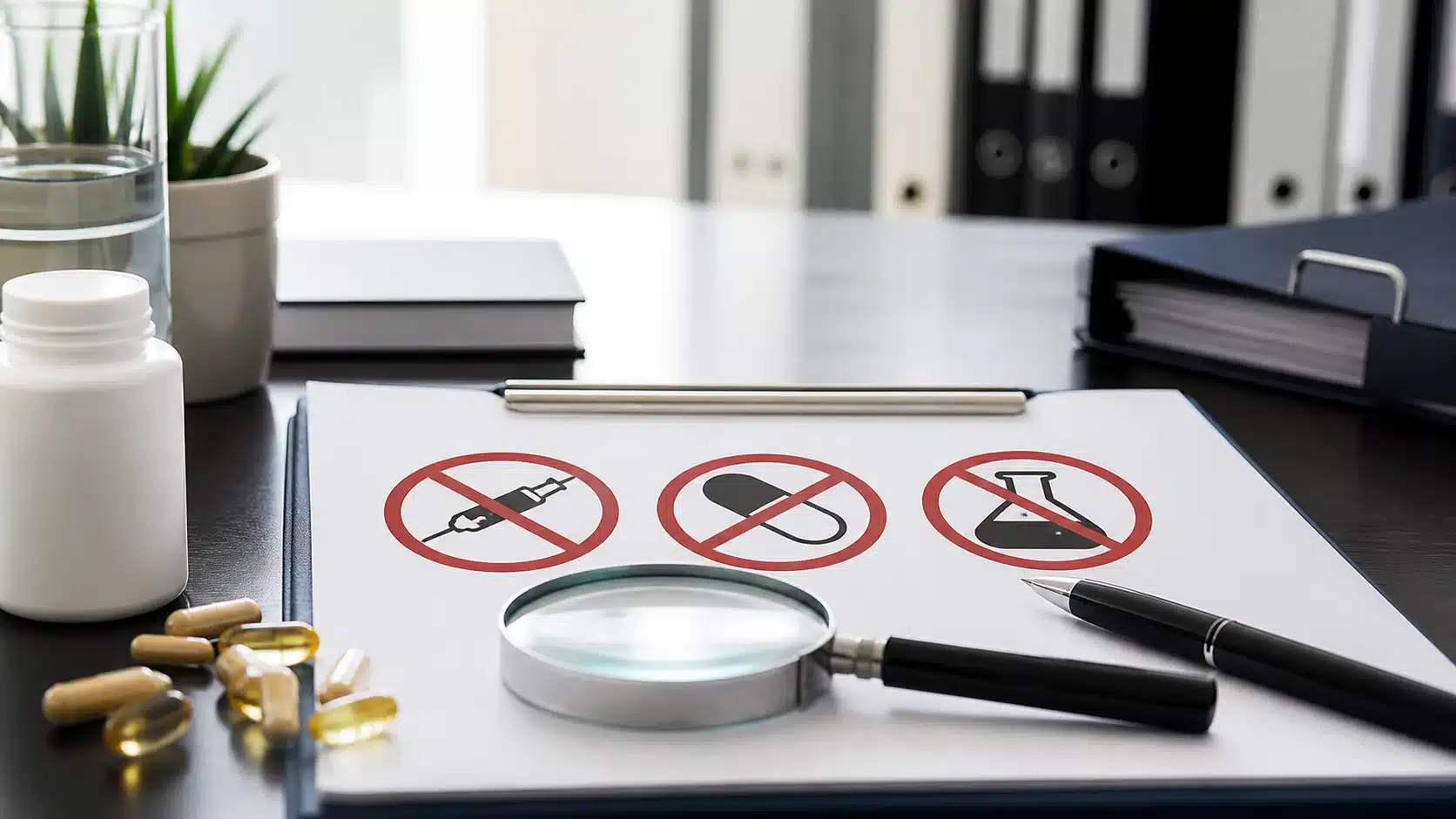
The Federal Food Safety and Veterinary Office lists at least nine substances specifically banned or restricted in food supplements sold in Switzerland. Within the universe of the Swiss food supplement, the Swiss regulation on food supplements distinguishes three separate legal regimes that overlap: substances banned by Annex 4 of the OAVMS, plants prohibited by the OPFA, and molecules classified as medicines by Swissmedic. This three-way split explains why a product that is legal in France or the United States may be seized at the Swiss border.
Which substances are concretely banned in food supplements?
Which synthetic chemical substances are prohibited?
Four synthetic chemical substances are strictly banned in Swiss food supplements: 2,4-dinitrophenol (DNP), dimethylhexanamine (DMAA), SARMs and ibutamoren (MK-677).[1] These compounds fall under the list of ingredients banned by Annex 4 of the OAVMS or the list of doping substances annexed to the Federal Sports Promotion Ordinance (SPO). DNP is an industrial chemical that causes severe, potentially fatal poisonings, with a toxicological profile that remains worrying; the FSVO advises against any consumption, in any form, and sets out this information in a dedicated information letter.[1] DMAA, a stimulant used for weight loss or to improve athletic performance, appears on the doping-products list because of its severe cardiovascular effects. SARMs (selective androgen receptor modulators) and MK-677, a growth-hormone secretagogue, are the new generation of molecules popular in certain amateur sporting circles: Swiss Sport Integrity has particularly flagged them in its 2025 report for their cardiac, hepatic and psychiatric risks.[2]
Which hormonal substances and plants are prohibited?
Four additional categories complete the list of bans: DHEA and melatonin fall under the medicine regime (prescription required),[4] red yeast rice and senna are banned as foodstuffs,[1] and aristolochic acid, of plant origin, appears on list A of prohibited plants in Annex 1 of the OPFA.[3] Melatonin is only authorised as a prescription medicine in Switzerland, in the form of extended-release tablets Circadin® and generics, available for patients aged 55 and over.[4] DHEA follows the same logic: only one medicine authorised by Swissmedic, as vaginal ovules. Red yeast rice (Monascus purpureus), a fermentation product of rice by a microscopic mould of the Monascus genus, was the subject of a joint Swissmedic/FSVO notice on 12 March 2014 declaring its marketing unlawful, before being formally entered in Annex 4 of the OAVMS when the revised food law came into force on 1 May 2017; its monacolin K acts like a statin and may lead to liver and muscle damage. Swissmedic confirmed in its factsheet of 15 January 2026 that its marketing remains unlawful, both as a foodstuff and as a medicine.[5] Titanium dioxide (E171), a white colouring additive sometimes containing nanoparticles, completes this inventory with a ban effective since 15 March 2022.[6]
On which legal basis do these bans rest?
What do the FSUAO, Annex 4 of the OAVMS and the OPFA say?
Three federal ordinances structure Swiss legislation governing substances in food supplements. Article 2 paragraph 4 of the FDHA Ordinance on Food Supplements (FSUAO, SR 817.022.14) refers to Annex 4 of the OAVMS and expressly declares the substances listed there banned.[7] Article 3 of the OPFA prohibits the food use of plants listed in Annex 1. Annex 4 of the OAVMS groups together pharmacologically active or toxicologically concerning substances: DNP, DMAA, red yeast rice and sennosides in particular.[8] Annex 1 of the OPFA lists two categories: list A groups plants banned because of their toxicity, list B those subject to strict restrictions, as opposed to ingredients authorised under precise conditions.[3] These lists are described as non-exhaustive by the FSVO: an unlisted substance, whether a vitamin, minerals, an alga or another extract, may still be challenged if it qualifies as a novel food or if it has a pharmacological effect under the legal criteria set by Swissmedic.
| Substance | Legal basis | Legal regime | Authority |
|---|---|---|---|
| 2,4-DNP | Annex 4 OAVMS (SR 817.022.32) | Banned substance | FSVO |
| DMAA | Annex 4 OAVMS + SPO | Banned and doping | FSVO + SSI |
| SARMs / MK-677 | TPA + SPO | Medicine and doping | Swissmedic + SSI |
| DHEA | SPO + TPA | Prescription medicine | Swissmedic + SSI |
| Melatonin | TPA: cat. B medicine | Prescription medicine | Swissmedic |
| Red yeast rice | Annex 4 OAVMS | Banned substance | FSVO |
| Senna (fruits, leaves) | Annex 1 OPFA list A | Banned plant | FSVO |
| Aristolochias | Annex 1 OPFA list A | Banned plant | FSVO |
| Titanium dioxide (E171) | Ordinance on additives | Additive withdrawn | FSVO |
How do the foodstuff and medicine regimes overlap?
The boundary between food supplement and medicine determines the competent authority at the placing-on-the-market stage. The FSVO (Federal Food Safety and Veterinary Office) handles foodstuffs, Swissmedic handles medicines and medical devices. A substance may shift from the second regime to the first as soon as it exerts a pharmacological or therapeutic effect under the definition of the Therapeutic Products Act (TPA, SR 812.21).[9] This duality explains the particular status of melatonin and DHEA: neither appears in Annex 4 of the OAVMS, yet neither can enter the composition of a food supplement sold on the Swiss market. Their status as medicines subject to marketing authorisation, via a separate Swissmedic authorisation procedure, and to prescription rules them out of the food sphere in practice.[4] Added to this, for DHEA and DMAA, is the Federal Sports Promotion Ordinance (SPO), which qualifies these substances as doping products: importation is then banned with no quantitative allowance, including for non-athletes, whether through an everyday online purchase or a shipment between private individuals.[2]
How many banned products are seized each year in Switzerland?
What do the 2024-2025 figures from the FOCBS, Swissmedic and Swiss Sport Integrity say?
The three authorities converge on the same finding: seizures are rising. Swissmedic received 6,647 consignment notifications in 2025, of which 12% concerned hormones (including melatonin), compared with 4% in 2024, a tripling in twelve months.[10] Swiss Sport Integrity reports 1,282 seizures of doping products in 2025, after an unprecedented drop in 2024.[2] In 2024, the Association of Cantonal Chemists of Switzerland conducted a national control survey targeting 127 food supplements bought from Swiss and Liechtenstein online shops; the sale was banned for 89% of the samples because of prohibited ingredients or ingredients subject to authorisation.[11] This proportion gives the measure of the risk for a consumer who buys without verifying the compliance of the supplier, and underlines the importance of consulting a healthcare professional before any purchase.
Criminal risk for the consumer
The importation of a banned doping product is seized by customs with no quantitative allowance. The recipient pays the destruction costs and is exposed to a criminal complaint under the Federal Sports Promotion Act, irrespective of any sporting practice.
Which emerging substances are the most seized?
Three families dominate the latest seizures: erection inducers (41% of Swissmedic consignments in 2025), hair-loss medicines (19%, compared with 4% in 2024) and hormones including melatonin (12%).[10] Close to 40% of the illegal consignments seized in 2025 came from Western Europe, mainly from France and Germany: the share originating from Eastern Europe and India has been falling sharply for four years.[10] SARMs and ibutamoren (MK-677) are spreading rapidly via social media, where they are promoted as anti-ageing alternatives or recovery stimulants.[2] The Federal Council plans to strengthen the control of online trade by requiring a Swiss contact point for shops operating in .ch, so that any e-commerce site can respond to a request from the authorities.[12]
Frequently asked questions
Is titanium dioxide (E171) banned in food supplements in Switzerland?
Yes, since 15 March 2022. The FSVO transposed the European ban after EFSA concluded in May 2021 that genotoxic damage could no longer be excluded. A transitional deadline ran until 15 September 2022 to use up stocks manufactured under the old law. The ban concerns foodstuffs and supplements, but not yet medicines to date.
Is 5-HTP authorised in Switzerland as a food supplement?
No, 5-hydroxytryptophan is not authorised as a food-supplement ingredient in Switzerland. A serotonin precursor extracted from Griffonia simplicifolia, it has a pharmacological effect which places it under the medicine regime according to Swissmedic. Only magistral preparations on medical prescription are accessible. Importation for personal use is limited to one month of treatment with a valid prescription.
Red yeast rice is banned in Switzerland but authorised in France: why the difference?
The joint Swissmedic/FSVO notice of 12 March 2014 declared the marketing of Monascus purpureus unlawful, before its formal entry in Annex 4 of the OAVMS when the revised food law came into force on 1 May 2017. Its monacolin K acts like a statin and may cause documented liver and muscle damage. France maintains an authorisation under European restriction, with a daily dose strictly below 3 mg of total monacolins (Regulation (EU) 2022/860). Swissmedic confirms in its version of 15 January 2026 that marketing remains unlawful on the Swiss side, both as a foodstuff and as a medicine.
How can I check whether a plant is on the FSVO list of prohibited plants?
Consult Annex 1 of the OPFA, which lists the plants and parts of plants whose use is not admitted in foodstuffs. List A groups plants banned because of their toxicity, list B those subject to restrictions. The FSVO also publishes updated information letters on at-risk botanicals. For substances not listed, the manufacturer assumes its own self-monitoring responsibility under FSVO information letter 2021/7.1.
Can DHEA be prescribed by a doctor in Switzerland?
Yes, but only as a prescription medicine and under a single dosage form. Swissmedic authorises one medicine containing DHEA, exclusively as vaginal ovules, therefore reserved for women. A Swiss pharmacy may also make up a magistral formula on medical prescription. Importation for personal use remains banned by the Federal Sports Promotion Act, with no quantitative allowance: including for non-athletes.
Sources and references
12 sources- FSVO, Banned substances (DNP, DMAA, red yeast rice, senna)
- Swiss Sport Integrity, Ban on the importation of DHEA and 2025 seizures report
- Geneva consumer protection service, Ingredients admitted or banned in food supplements
- Swissmedic, Warning on imports of melatonin and DHEA
- Swissmedic, Red yeast rice, marketing unlawful in Switzerland
- Swiss Confederation, Ban on titanium dioxide as a food additive
- FDHA Ordinance on Food Supplements (FSUAO), SR 817.022.14
- FDHA Ordinance on the Addition of Vitamins, Mineral Salts and Other Substances (OAVMS), SR 817.022.32
- Swissmedic and FSVO, Delimitation criteria between therapeutic products and foodstuffs
- FOCBS, Review of seizures of medicines and doping products 2025
- Swiss Sport Integrity, Food supplements and 2024 ACCS campaign
- FSVO, Buying food, toys and cosmetic products online