
On Ozempic or Wegovy: why protein becomes essential
In brief
Ozempic and Wegovy cause rapid weight loss, but part of the weight you lose is muscle, not fat: often around a quarter of the weight lost, sometimes more. Protein helps preserve that muscle. The trap: the treatment suppresses appetite at the very moment you should be eating more of it. The solution comes down to three ideas: aim for 1.2 to 1.6 g/kg of protein per day, eat it first (if needed in liquid form such as whey), and move: muscle is not kept without a minimum of strength training. Nothing here replaces the supervision of your doctor.
Ozempic and Wegovy, two names for the same molecule, semaglutide, have changed the game in weight loss. They belong to the family of GLP-1 medications (glucagon-like peptide-1 receptor agonists) and share the same active ingredient, semaglutide. These drugs were first designed to treat type 2 diabetes, where they help control blood sugar, and are now also used in weight management, alongside related medicines such as tirzepatide (Mounjaro) or liraglutide (Saxenda). Ozempic is approved for type 2 diabetes and Wegovy for weight management: both contain the same active ingredient, usually given once a week, but your doctor decides the difference in use and dose. In the large landmark trial (the STEP 1 study), people treated with semaglutide lost on average nearly 15% of their weight in a little over a year[1]. But behind this striking figure lies a question the scale never asks: where does this weight actually come from?
Part of it is not fat, but muscle. And it is precisely for this reason that protein, long confined to the domain of athletes, becomes a central topic for anyone on this kind of treatment. This article explains why, how much to aim for, and above all how to avoid muscle breakdown when the medicine suppresses your appetite. One clarification up front: Ozempic and Wegovy are medicines prescribed and supervised by a doctor, as part of overall care. Nothing that follows replaces that advice, and no food or supplement prevents, treats or cures a disease.
What the scale does not show: part of the weight is muscle
Losing weight is not just losing fat
When you lose weight, whatever the method, you never lose only fat. Some lean mass (muscle, but also water and other tissues) goes with it. With GLP-1 agonists, the loss is so rapid and so large that this muscle share becomes impossible to ignore. The studies that measure body composition, rather than weight alone, are clear on this point[2].
How much, exactly? The analyses converge on an order of magnitude: lean mass generally represents 15 to 40% of the weight lost on these treatments[3][6]. One review sums up the stakes with a striking phrase: the muscle loss observed can be equivalent to a decade or more of muscle ageing, condensed into a few months[4].
An honest nuance: not all of it is “muscle at risk”
It would be dishonest to dramatise. Part of this decline in lean mass is expected: a lighter body needs slightly less muscle to carry itself, and some imaging measurements suggest that the quality of the remaining muscle may even improve[5]. Experts speak of a partly “adaptive” response, and the debate about its real consequences is not entirely settled[3]. In other words: losing a little lean mass while slimming down is not abnormal.
The real risk mainly concerns people who are already frail: older adults, those who have little muscle to begin with, or who lose weight very quickly. In them, an overly marked loss of muscle can weaken the body and degrade strength and independence[6]. This is where the simple levers, eating enough protein, moving, make the difference. And since you cannot know in advance which category you are in, it is best to protect your muscle as a precaution.
Why this muscle matters more than you think
Muscle, the engine of metabolism
Muscle is not just a matter of appearance or strength. It is an energy-hungry tissue: at rest, it burns more calories than fat. So losing muscle means lowering your baseline energy expenditure, the number of calories you burn doing nothing. This detail has a direct and often overlooked consequence: less muscle today makes regaining weight easier tomorrow, a matter of long-term metabolic health, and a point we return to later.
Strength, independence, and bone health
Beyond metabolism, muscle carries function: getting up from a chair, climbing stairs, carrying the shopping. Preserving it means protecting your independence, especially as you age. Protein plays a recognised and regulated role here: it contributes to the maintenance of muscle mass and to the maintenance of normal bones: two health claims authorised in Switzerland and the European Union. Rapid weight loss also puts a strain on bone; an adequate protein intake is one of the supports.
The key idea
The goal of a treatment for obesity is not just to bring a number on the scale down: it is to lose fat while keeping as much muscle as possible. Protein and physical activity are the two tools that steer the loss in the right direction.
How much protein, and above all how to spread it out
The right amount: around 1.2 to 1.6 g per kilo
Weight-loss research gives a clear benchmark: a higher protein intake helps preserve lean mass during a diet, compared with a standard intake[7][14]. In older people in particular, it is better to aim for the top of the range to retain more muscle and lose more fat[8]. In practice, the usual target is around 1.2 to 1.6 grams of protein per kilogram of body weight per day[7].
Quality, not just quantity: the leucine story
Not all grams of protein are equal. To launch muscle building, the body needs a precise signal, carried by one of the essential amino acids: leucine. In older people, this signal dulls: muscles become less responsive, a phenomenon called “anabolic resistance”[9]. You then need a sufficient dose of leucine, around 2.5 to 3 grams per meal, to get the same response as a young adult.
This is where the source counts. Studies show that it is indeed the leucine content, more than the total amount of protein, that determines muscle protein synthesis[10]. Animal proteins, eggs, dairy, meat, fish, and especially whey (milk protein) are particularly rich in it. Plant proteins (lentils, chickpeas, tofu) contain less; they work, but require larger portions or well-thought-out combinations. Under appetite suppression, where volume is precisely the problem, this leucine density becomes a concrete asset.
Spread out rather than concentrate
One last useful reflex: spread out your protein. Three intakes of around 25 to 30 grams spread across the day stimulate muscle better than a single large intake in the evening[9]. This is good news on treatment: small protein portions, easier to swallow when appetite is reduced, fit naturally into this logic.
The satiety paradox: reaching your quota without hunger
The medicine that sabotages your protein
Here is the difficulty that lists of tips often pass over in silence. GLP-1 agonists work by slowing gastric emptying, the rate at which the stomach empties, and by suppressing appetite: that is the whole point for losing weight. But the logical side effect is that you eat much less: and therefore, spontaneously, much less protein, at the very moment when you would proportionally need more. A small stomach that fills quickly, nausea at the start of treatment, sometimes a sudden aversion to meat: everything pushes you to cut back on the most important food. This is the central paradox of these treatments.
Countermeasure no. 1: protein first
The most effective rule comes down to one sentence: eat the protein first. While hunger is there, often at the very start of the meal, you tackle the protein source (egg, fish, poultry, skyr) before the starches and vegetables. That way, if you stop halfway through your plate, what you have eaten is precisely what counts most. It is a simple change of order, with no extra effort, and it is probably the most rewarding piece of advice in this whole article.
Countermeasure no. 2: dense and liquid
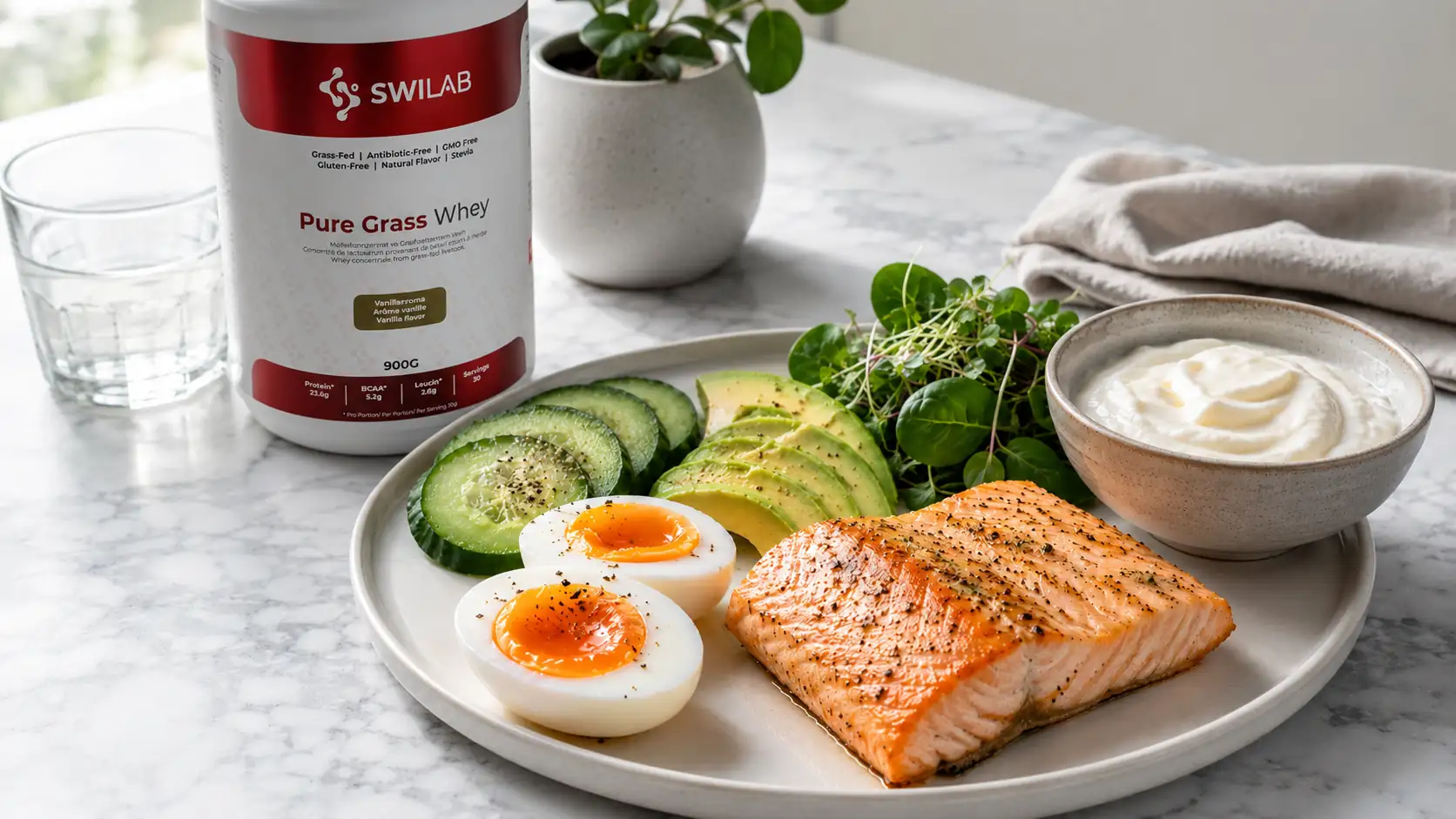
Then, two principles. First, favour foods that are protein-dense and low in volume: a skyr or a Greek yoghurt, cottage cheese, a whipped quark, two eggs, a slice of salmon, chicken breast provide plenty of protein in little space: high-protein dairy products are valuable allies here. Then, when solid food is hard to get down, think liquid: a glass of milk, a drinkable yoghurt, or a protein shake such as a serving of whey mixed with water provide a good dose of protein without the “full stomach” effect of a real meal. Protein, incidentally, also supports satiety: a virtuous circle rather than a fight[14].
A study in overweight women illustrates the logic well: on a very low-calorie diet, an intake combining whey and leucine helped preserve lean mass and improve strength[11]. It is not magic, and it does not remove the need to eat real meals, but it shows the value of quality protein when total quantities are reduced.
Nausea and aversions: do not force it
At the start of treatment, or after a dose increase, nausea, constipation and distaste for certain foods (often meat) are common and usually temporary. There is no point in forcing yourself against your will: it is better to rely on the best-tolerated proteins of the moment (dairy, eggs, white fish, liquid protein) and to report to your doctor any digestive symptoms that persist.
Protein alone is not enough: move to keep the muscle
The missing signal
Here is the other half of the equation, the one that is almost always forgotten. Protein provides the raw material for muscle, but it is not enough to make the body keep it. A mechanical signal is missing: use. Without demand, an organism in a calorie deficit tends to sacrifice the muscle it deems “useless”. It is physical activity, and especially strength training (weight training, resistance exercises), that tells the body to keep this tissue.
The specialists on this question are clear: combining weight loss on a GLP-1 agonist with resistance training is the best-known way to preserve muscle mass while losing fat[4][6]. Protein and exercise are not opposed: they complement each other, and one without the other gives a lopsided result.
Start simple
You do not need a gym or heavy loads to begin. Standing up and sitting down from a chair, climbing stairs, carrying bags, using resistance bands or your own body weight: all of it counts. The essential thing is to work the major muscle groups regularly (legs, back, chest). If you are unsure what is right for your condition, a doctor, a physiotherapist or a coach can suggest a safe starting point.
In practice: preparing for after and building your meals
The angle people forget: muscle, your insurance for later
One rarely discussed point deserves attention. These treatments are not always taken for life, and stopping has a known consequence: weight often climbs back. In the extension of the large trial on semaglutide, participants had regained about two thirds of the weight lost one year after stopping[12]. And what comes back is mainly fat, whereas the muscle that was lost does not rebuild spontaneously. Having preserved your muscle mass during treatment, protein plus activity, helps you get through this phase better and limit the regain.
This is not just a hypothesis: in one trial, the people who had maintained physical activity after stopping the treatment kept their weight loss far better than those who had relied on the medicine alone[13]. Muscle and the habit of moving are, in a way, your long-term metabolic insurance. Any decision to stop or change a treatment is made with the doctor who supervises it.
The “a protein source at every intake” reflex
Concretely, the strategy comes down to one habit: at every eating occasion, ask yourself “where is my protein?”. A breakfast without protein (pastry, juice) is a missed opportunity; replacing it with a skyr, eggs or a dairy product changes the day. Here are some high-protein sources, easy to build into your diet even with little appetite.
| Food | Common portion | Protein (approx.) | Why it is useful on treatment |
|---|---|---|---|
| Skyr / whipped quark | 150 g | 15-17 g | Dense, mild, easy to swallow; ideal at breakfast or as a snack. |
| Chicken breast | 100 g | 25-30 g | Very rich in protein; to be eaten first on the plate. |
| Fish (cod, salmon) | 100 g | 20-25 g | Often well tolerated when meat is off-putting; tender and easy to digest. |
| Eggs | 2 eggs | 12-13 g | A good base to top up; two eggs cover only half a meal. |
| Milk / drinkable yoghurt | 250 ml | 8-9 g | Liquid format: goes down when solid food is blocked. |
| Whey mixed with water | 1 serving (≈30 g) | 20-24 g | Liquid, quick, rich in leucine; a fallback when appetite is lacking. |
- 1Eat the protein first, while your appetite is there.
- 2Aim for a protein source at every intake, including breakfast.
- 3Choose dense and low in volume; switch to liquid (milk, drinkable yoghurt, whey) when solid food is blocked.
- 4Add 2 to 3 sessions of strength training per week, even light ones.
- 5Check in with your doctor, a dietitian or a nutritionist: this kind of healthcare provider offers personalised nutritional support, especially if you have a kidney problem or persistent digestive symptoms (nausea, constipation).
Frequently asked questions
Why do you need more protein on Ozempic or Wegovy?
Because these treatments make you lose weight quickly, and part of the weight lost is not fat but muscle: often around a quarter of the weight lost, sometimes more. A high protein intake helps preserve muscle mass during weight loss. As the treatment sharply reduces appetite, reaching that quota takes more attention than before: you eat less, so every mouthful has to count more. The quantity and quality of protein then take on an importance they did not have.
How much protein per day should you aim for on GLP-1?
The benchmarks from weight-loss research put the useful intake at around 1.2 to 1.6 grams of protein per kilogram of body weight per day, spread across the day. It is also worth aiming for at least 25 to 30 grams of good-quality protein per meal, as that is the dose that best stimulates muscle building, especially as you get older. These figures are orders of magnitude: your doctor or a dietitian can adjust them to your situation, in particular if you have a kidney problem.
How do you reach your protein target when you are no longer hungry?
The most effective rule: eat the protein first on your plate, before the starches and vegetables, while your appetite is still there. Then favour foods that are protein-dense and low in volume (skyr, eggs, fish, chicken breast, quark), split into small meals, and rely on liquid protein when solid food is hard to get down: a glass of milk, a drinkable yoghurt or a serving of whey mixed with water provide plenty of protein without filling the stomach. Nausea and aversions, common at the start of treatment, often ease over time.
Is whey useful on Ozempic or Wegovy?
It can help, as a practical way to reach your protein quota when your appetite is suppressed. Whey is liquid, digests quickly and is rich in leucine, the amino acid that best triggers muscle building. It contributes to the maintenance of muscle mass as part of a suitable diet. It is not a medicine or a treatment: it is a supplement that comes on top of meals, not in place of them, and it does not replace the medical supervision of your treatment.
Do you really lose muscle with Ozempic or Wegovy?
Yes, in part. Any rapid weight loss comes with a loss of lean mass, and body-composition studies show that the muscle share generally represents 15 to 40% of the weight lost on these treatments. An honest nuance: part of this decrease is expected as the body gets lighter, and the scientific debate is not entirely settled on its functional consequences. But in people who are already frail or older, preserving muscle is a real issue, hence the importance of protein and physical activity.
Do you need to exercise as well as eat protein?
Yes, it is the essential complement. Protein provides the raw material for muscle, but it is activity, especially resistance training, that gives the body the signal to keep that muscle rather than sacrifice it. The available work suggests that combining protein intake and resistance exercise helps preserve muscle mass during weight loss on GLP-1, far better than protein alone. Two to three sessions a week, even light ones, are enough to get started.
What happens to muscle if you stop the treatment?
When you stop, appetite returns and weight often climbs back: in the extension of the STEP 1 trial, participants had regained about two thirds of the weight lost one year after stopping semaglutide. The problem is that what comes back is mainly fat, whereas the muscle that was lost does not rebuild on its own. Having preserved your muscle mass during treatment, protein plus activity, helps you manage this phase better. Any decision to stop is made with the doctor who supervises the treatment.
Are two eggs enough to cover my protein needs?
No, not for a meal. Two eggs provide about 12 to 13 grams of protein, roughly half of the 25 to 30 gram per-meal target that best stimulates muscle. They are a good base, but you need to top up: a dairy product, cheese, a slice of ham, or more eggs. Under appetite suppression, this is exactly the kind of calculation that becomes useful: aiming for a sufficient protein source at every eating occasion rather than relying on a single food.
Sources and references (verified on PubMed)
14 sources- Wilding J.P.H. et al. (2021). Once-Weekly Semaglutide in Adults with Overweight or Obesity (STEP 1).
- Karakasis P. et al. (2024). Effect of GLP-1 receptor agonists and co-agonists on body composition: systematic review and network meta-analysis.
- Neeland I.J. et al. (2024). Changes in lean body mass with GLP-1-based therapies and mitigation strategies.
- Locatelli J.C. et al. (2024). Incretin-Based Weight Loss Pharmacotherapy: Can Resistance Exercise Optimize Changes in Body Composition?
- Linge J. et al. (2024). Muscle Mass and GLP-1 Receptor Agonists: Adaptive or Maladaptive Response to Weight Loss?
- Memel Z. et al. (2025). Impact of GLP-1 Receptor Agonist Therapy in Patients High Risk for Sarcopenia.
- Leidy H.J. et al. (2015). The role of protein in weight loss and maintenance.
- Kim J.E. et al. (2016). Effects of dietary protein intake on body composition changes after weight loss in older adults: systematic review and meta-analysis.
- Paddon-Jones D., Rasmussen B.B. (2009). Dietary protein recommendations and the prevention of sarcopenia.
- Devries M.C. et al. (2018). Leucine, Not Total Protein, Content of a Supplement Is the Primary Determinant of Muscle Protein Anabolic Responses in Healthy Older Women.
- Camajani E. et al. (2022). Whey Protein, L-Leucine and Vitamin D Supplementation for Preserving Lean Mass during a Low-Calorie Diet in Sarcopenic Obese Women.
- Wilding J.P.H. et al. (2022). Weight regain and cardiometabolic effects after withdrawal of semaglutide: the STEP 1 trial extension.
- Jensen S.B.K. et al. (2024). Healthy weight loss maintenance with exercise, GLP-1 receptor agonist, or both combined followed by one year without treatment.
- Leidy H.J. et al. (2007). Higher Protein Intake Preserves Lean Mass and Satiety with Weight Loss in Pre-obese and Obese Women.