
Prevention over correction: how supplements became a pillar of everyday health
In brief
For a long time, health care meant repairing: we waited for the symptom before acting. A different logic is taking hold: tending to your foundations every day rather than correcting after the fact. In this preventive approach, dietary supplements have a precise place: not a pillar that replaces lifestyle, but a targeted support when diet is not enough to cover a need: vitamin D in winter, B12 for vegans, folate before pregnancy. Neither a miracle cure nor a gimmick: a useful complement, provided it targets what is genuinely lacking.
Key facts
Key points
- Preventing means tending to your foundations every day; correcting means acting once the problem has set in.
- Supplements fill insufficient intakes, they do not replace a balanced diet.
- Vitamin D in winter is one of the best-justified preventive uses at our latitude.
- The benefit depends on the profile: targeted, a supplement helps; taken for everything, its usefulness drops.
- Quality first: suitable dose, well-absorbed form, clear labelling, FSVO oversight, no mega-doses.
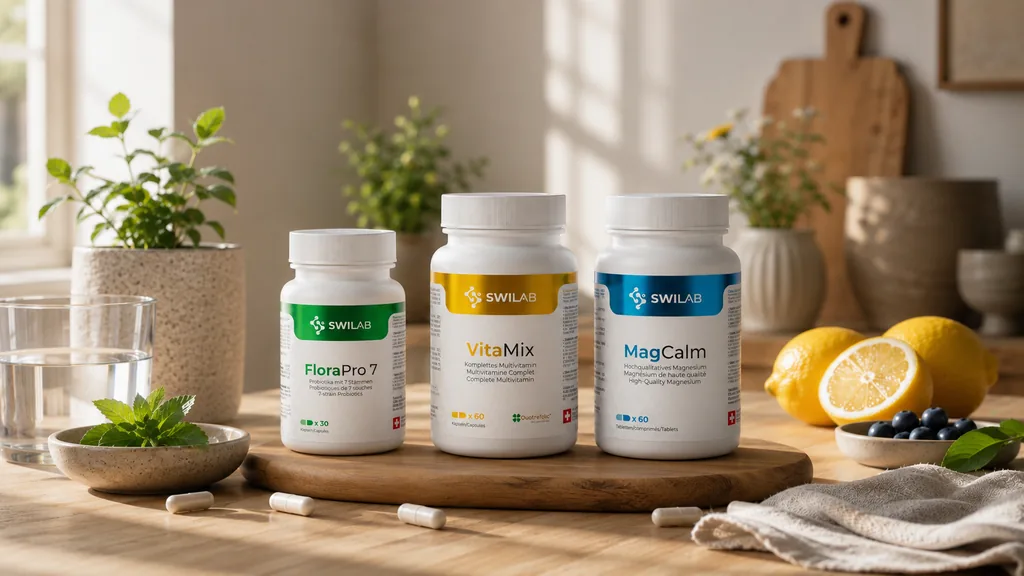
For decades, looking after your health mostly meant repairing: you consulted once the pain or illness had set in, and you corrected it. This correction logic remains essential, but it has a blind spot. It acts late, when the ground has already deteriorated.
Another approach is gaining ground: prevention. Not waiting for the problem, but tending every day to the foundations of health and wellness to reduce the risk of getting there. It is in this context that dietary supplements have found a place in many routines. But which place, exactly? Have they become a true “pillar” of daily life, or merely a marketing reflex? This article sorts it out, drawing on studies verified on PubMed and on Swiss regulations: without promising anything supplements cannot deliver.
From correction to prevention: a change of perspective
What is the difference, in practice?
Correcting means stepping in once the disorder has appeared: you treat what is already going wrong. Preventing means acting upstream, on the ground, so it stays solid as long as possible. Both are useful and complementary: curative medicine saves lives; prevention, for its part, seeks to reduce the frequency and severity of problems before they set in.
Why this shift now?
Because our lifestyles have changed. A sedentary routine, often processed food, chronic stress, reduced sun exposure: all of these slowly weigh on the body. Faced with this, many people are looking to take back control day to day, through simple, regular actions rather than late corrections. Dietary supplements have moved into this trend: sometimes rightly, sometimes beyond what science supports. Hence the value of setting a clear framework.
Prevention as a public-health priority
This shift goes beyond individual choice. Preventive healthcare has become a public health priority: bodies such as the World Health Organization frame primary prevention of chronic disease, cardiovascular disease, type 2 diabetes, cancers, around a handful of shared risk factors: poor diet, lack of exercise, tobacco and alcohol. Acting on those factors is what lowers disease risk across a whole population. In that picture, dietary supplements are only a small detail: the essentials are lifestyle and the support of a doctor or other healthcare professional.
The guiding idea
Prevention is not a pill. It is first and foremost a sum of habits: eating well, sleeping well, moving, managing stress, staying connected. The supplement is just one tool among others, useful when a specific intake is lacking: not a shortcut to skip the rest.
The pillars of health, and where supplements fit
What are the real pillars of health?
You often read lists of “4”, “5” or “6 pillars of health”. There is no single official list, but the same foundations always come up. They form the bedrock on which everything else rests: physical and mental health alike.
| Pillar | What it covers | Role of supplements |
|---|---|---|
| Diet | A varied plate, rich in plants, lightly processed | As a complement, if a nutrient is still lacking |
| Sleep | Sufficient duration and regularity | Marginal; sleep hygiene comes first |
| Physical activity | Moving regularly, limiting sedentary time | Possible support for higher needs (sport) |
| Stress management | Mental recovery, breathing, breaks | Limited; not a substitute for rest |
| Social connection | Relationships, support network, meaning | None |
Is the supplement a pillar in its own right?
Honestly, no: and it is important to say so. No supplement makes up for chronically insufficient sleep, a poor diet or constant stress. Seeing it as a “pillar” that lets you skip the rest would be a mistake. On the other hand, within the diet pillar, it plays a real and well-defined role: filling an intake that the plate does not cover, in identified situations. It is this supporting role, and this alone, that justifies its place in a preventive routine.
Why deficiencies despite abundance?
How can you lack nutrients while eating your fill?
This is the paradox of affluent societies: you can take in enough calories while lacking certain micronutrients: those vitamins and minerals needed in small amounts. A highly processed diet provides energy but little nutritional density. On top of this come lifestyle factors: little sun exposure, smoking, certain medicines, or higher needs at certain stages of life.
Which shortfalls do we see, even in Switzerland?
The most telling case is vitamin D. At Switzerland’s latitude, the winter sun is too weak for the skin to make enough: the available work estimates that a significant share of the population is short of it (vitamin D deficiency), especially between autumn and spring[2]. And this is not isolated: across Europe, vitamin D intake is largely insufficient in most countries[1]. Another Swiss example, folate (vitamin B9, taken as folic acid): one study found inadequate status in nearly one woman of childbearing age in five, a key point before and at the start of pregnancy[3].
These figures do not say that “everyone should supplement with everything”. They say something more precise: some intakes are hard to reach through diet alone, in certain seasons or for certain profiles. That is exactly where a measured, preventive approach makes sense.
Everyday nutrients: what the science says
What can, and cannot, be said about each one?
Here are the nutrients most often linked to a preventive approach, with what the studies genuinely support and the corresponding authorized health claim. The principle: cautious wording, calibrated to the level of evidence.
| Nutrient | What the research supports | Authorized claim (example) |
|---|---|---|
| Vitamin D | Intake often insufficient in winter at our latitude | Contributes to the normal function of the immune system |
| Magnesium | Involved in muscle, the nervous system and energy | Contributes to a reduction of tiredness and fatigue and to normal muscle function |
| Omega-3 (EPA/DHA) | Active cardiovascular research, still debated | EPA and DHA contribute to the normal function of the heart |
| Vitamin B12 | Low intake common on a vegan diet | Contributes to normal energy-yielding metabolism and to the reduction of tiredness and fatigue |
| Ferments / microbiota | Fermented foods studied for microbiota diversity | No “probiotic” health claim is authorized in the EU |
Vitamin D, the winter priority
This is the nutrient where the preventive case is strongest in our region. Since the winter sun does not allow enough to be produced, a regular intake from October to March is a reasonable measure. Vitamin D contributes to the normal function of the immune system and to the maintenance of normal bones. If in doubt, a blood test makes it possible to adjust the dose with a professional rather than aiming at random.
Magnesium, support for muscle and fatigue
Magnesium takes part in many of the body’s reactions. The authorized claims are telling: it contributes to a reduction of tiredness and fatigue, to normal muscle function, to the normal functioning of the nervous system and to normal psychological function. A note of honesty, however: it is not a remedy for cramps. Outside a genuine deficiency, a reference review concludes that a magnesium supplement probably provides no clinically useful benefit for cramps in adults[10]. Magnesium supports the ground; it does not “cure” a symptom.
Omega-3, between heart and brain
Long-chain omega-3 fatty acids (EPA and DHA), found mainly in oily fish (the basis of fish oil supplements), are the subject of intense research on cardiovascular disease. A large analysis pooling more than 130,000 people observed a slightly reduced risk of cardiac events with omega-3 supplementation[5]; a signal also found in people with type 2 diabetes in another analysis[6]. Bodies such as the American Heart Association still suggest eating fish rather than relying on pills. The field remains debated, and these results belong to research, not to a product promise. As for the authorized claim, EPA and DHA contribute to the normal function of the heart (with a sufficient daily intake).
Vitamin B12, essential for certain diets
Vitamin B12 is found almost only in animal-source products. People following a vegan diet therefore often have lower levels: a synthesis of studies in children and adolescents confirmed this, especially on a vegan diet[4]. In this case, a supplement is not a comfort, it is a recognized necessity. B12 contributes to normal energy-yielding metabolism, to the reduction of tiredness and fatigue and to the normal functioning of the nervous system: a background support, not to be confused with an instant “boost”.
The microbiota, the fermented-foods lead
Our gut is home to a microbiota, the set of micro-organisms that live in it, whose balance is of great interest to research. A landmark trial compared two diets: the one rich in fermented foods (yoghurt, kefir, lacto-fermented vegetables) increased microbiota diversity and lowered several inflammation markers[7]. A caveat, though: these were foods, not supplements, and in the European Union the term “probiotic” cannot be presented as a health claim. A ferment supplement can accompany this approach, but with no promise of medical benefit.
Who are supplements really useful for?
Why does usefulness depend on the profile?
Because a supplement only “tops up” what is lacking. For a healthy person who eats a varied diet and gets some sun, adding a nutrient that is already present in sufficient amounts usually does not bring much. Conversely, some profiles have needs that are harder to cover: that is where the benefit becomes tangible.
| Profile | Intake often worth watching | Why |
|---|---|---|
| Little sun exposure | Vitamin D | Insufficient skin production, especially in winter |
| Vegan diet | Vitamin B12 (sometimes iron, omega-3) | B12 almost absent from plants |
| Planning pregnancy / pregnancy | Folate (B9) | Higher need at the very start of pregnancy |
| Older people | Vitamin D, B12, protein | Absorption and synthesis decline with age |
| Intense sport | Magnesium, protein, iron | Higher needs and losses with exertion |
And for “everyone”, day to day?
Outside these profiles, the usefulness of broad supplementation is lower, but not zero either. A multivitamin can serve as a safety net against small insufficient intakes. You simply have to keep the right measure: it is a complement, not a guarantee. The bulk of the health benefit remains, by far, on the side of diet and lifestyle, which also underpin healthy longevity.
What a supplement can, and cannot, do
What does Swiss law say?
The answer is clear and shapes everything else. In Switzerland, a dietary supplement is a foodstuff, not a medicine: by definition, a concentrated source of nutrients, such as vitamins, minerals or amino acids, intended to supplement the normal diet. It is overseen by the Federal Food Safety and Veterinary Office (FSVO). Direct consequence: it can neither prevent, nor treat, nor cure a disease, and no advertising may suggest otherwise. The same logic applies in the European Union: and in the United States, where supplements fall under the Food and Drug Administration (FDA).
So what can it claim?
Only authorized health claims, drawn from an official list, and worded cautiously: “contributes to a normal function” of the body. For example “vitamin D contributes to the normal function of the immune system” or “magnesium contributes to a reduction of tiredness and fatigue”. The nuance is not cosmetic: it marks the line between informing honestly and promising the impossible.
Should you believe spectacular promises?
No. A product that claims to “boost immunity”, “detoxify”, “burn fat” or “prevent” a specific disease steps outside the legal framework and beyond what science can support. Even the most encouraging research stays measured: in a large randomized controlled trial in US seniors, a daily multivitamin slightly improved memory compared with a placebo: a real but modest effect, confirmed at an overall level by an analysis of several sub-studies[8][9]. Worth knowing, but far from a promise of eternal youth.
The warning sign
If a label or advert promises to cure, prevent or treat a disease, that is a red flag: neither Swiss nor European law allows it for a supplement. Honest communication is limited to the body’s normal functions and never erases the doctor’s role.
Choosing well and using safely
How do you recognize a quality supplement?
Whether vitamins, minerals or herbal supplements, a few simple markers make the difference. Check the actual dose relative to the nutrient reference values (NRV), the form of the nutrient (some, such as magnesium bisglycinate, are better absorbed), the clarity of the labelling and the origin. In Switzerland, supplements are foodstuffs subject to FSVO oversight: a manufacturer that is transparent about its composition and its controls inspires more confidence than a flashy promise.
Are more doses better?
No, it is even a common trap. Most benefits are obtained at reasonable doses, close to needs. Beyond that, you do not increase the benefit: and some fat-soluble vitamins (vitamin D, vitamin A) can accumulate at high doses. The risk comes mainly from overdosing, from stacking several overlapping products, or from an interaction with a medicine.
How do you fit it into a preventive routine?
In a targeted and regular way. You start from your real needs (season, diet, profile), you choose one or two relevant intakes rather than a pile-up, and you set them within a lifestyle that remains the foundation. A well-chosen supplement is a small repeated action in service of the ground: not a chore of ten capsules, nor insurance against the excesses of everything else.
The golden rule
Look after the foundations first: a varied plate, sleep, movement, stress management. Then add a supplement where an intake is genuinely lacking, at a reasonable dose, and ask a professional for advice in case of treatment, pregnancy or illness. That is how prevention becomes concrete, without tipping into excess.
Frequently asked questions
What are the pillars of health?
There is no single official list, but the same foundations come up again and again: a varied diet, enough sleep, regular physical activity, stress management and social connection. Some models add not smoking and moderate alcohol use. Dietary supplements are not a pillar in their own right: they support these foundations, to fill an insufficient intake, never to replace them.
Prevention or correction: what difference does it make to my everyday health?
Correcting means acting once the problem has set in. Preventing means tending to your foundations every day to reduce the risk of getting there. In practice, prevention starts with lifestyle: what you eat, how you sleep, move and manage stress. Dietary supplements can fit into this preventive logic, by covering intakes that are sometimes hard to reach through diet alone, such as vitamin D in winter.
Are dietary supplements really useful?
It depends on the person and the nutrient. They are most useful when an intake is genuinely insufficient: vitamin D in winter, vitamin B12 for vegans, folate before and during pregnancy. For a healthy person who eats a varied diet, many supplements offer only limited benefit. The idea is not to take them for everything, but to target what is genuinely lacking.
Can supplements replace a balanced diet?
No, and this is even written into Swiss law: a dietary supplement is a foodstuff intended to supplement the diet, not to replace it. A varied plate provides fibre, protein and thousands of compounds that no capsule reproduces. The supplement has a targeted, complementary role, when diet is not enough to cover a specific need.
Should you take vitamin D in winter in Switzerland?
This is one of the best-justified cases. At Switzerland’s latitude, the winter sun is not enough to make enough vitamin D, and studies estimate that a large share of the population is short of it, especially from October to March. Vitamin D contributes to the normal function of the immune system and to the maintenance of normal bones. Taking it in winter is a reasonable preventive measure; if in doubt, a blood test and professional advice help to adjust.
Who benefits most from supplements?
Specific profiles: people with little sun exposure for vitamin D, vegetarians or vegans for vitamin B12, women planning a pregnancy for folate, seniors whose absorption declines, and athletes with higher needs. For these situations, a targeted supplement makes sense. Otherwise, the usefulness is lower: better to look after your diet and lifestyle first.
Can a dietary supplement prevent a disease?
No. A dietary supplement legally cannot prevent, treat or cure a disease: these are foodstuffs, not medicines. They can only carry authorized health claims, worded as “contributes to a normal function” of the body. Any promise to cure or protect against a specific disease should raise a flag: it does not comply with Swiss and European regulations.
Is a daily multivitamin worth anything?
It can help fill small insufficient intakes, without being a health guarantee. In a large US trial in seniors, a daily multivitamin slightly improved memory compared with a placebo, with a modest effect. It is not a miracle cure, and it is no substitute for eating well. A multivitamin is best thought of as a safety net for micronutrients, not as a substitute for diet.
How do you choose a quality supplement?
Look at the actual dose relative to the nutrient reference values, the form of the nutrient (some are better absorbed), the clarity of the labelling and the origin. In Switzerland, supplements are foodstuffs subject to oversight by the FSVO: favour a product that is transparent about its composition and manufacturing. Avoid spectacular promises and unjustified “mega-doses”; more is not better.
Do dietary supplements carry risks?
Used properly, at recommended doses, they are generally safe. Risks appear mainly with overdosing, with stacking several overlapping products, or with interaction with a medical treatment. Some fat-soluble vitamins, such as vitamin D or vitamin A, can accumulate at high doses. The right reflex: respect the doses, avoid pointless stacking, and ask a doctor or pharmacist for advice if you are on treatment.
Sources and references (verified on PubMed)
10 sources- Cashman K.D. (2022). Global differences in vitamin D status and dietary intake: a review of the data.
- Christoph P. et al. (2020). High prevalence of severe vitamin D deficiency during the first trimester in pregnant women in Switzerland.
- Herter-Aeberli I. et al. (2020). Inadequate Status and Low Awareness of Folate in Switzerland.
- Jensen C.F. (2023). Vitamin B12 levels in children and adolescents on plant-based diets: a systematic review and meta-analysis.
- Dinu M. et al. (2024). Effects of omega-3 fatty acids on coronary revascularization and cardiovascular events: a meta-analysis.
- Huang L. et al. (2023). Effect of Omega-3 Polyunsaturated Fatty Acids on Cardiovascular Outcomes in Patients with Diabetes: A Meta-analysis.
- Wastyk H.C. et al. (2021). Gut-microbiota-targeted diets modulate human immune status.
- Yeung L.K. et al. (2023). Multivitamin Supplementation Improves Memory in Older Adults: A Randomized Clinical Trial.
- Vyas C.M. et al. (2024). Effect of multivitamin-mineral supplementation on cognitive function (COSMOS) and meta-analysis.
- Garrison S.R. et al. (2020). Magnesium for skeletal muscle cramps.