
Diverticula: what to eat during and after a flare-up
In brief
Two diets coexist in diverticular disease, and confusing them is the most widespread mistake. During a flare-up, food is kept light for a few days: a practice from the field, very thinly supported. Outside a flare, by contrast, the recommendation of a high-fibre diet rests on solid data. And not all fibre is equal: in two large Swedish cohorts, it was fibre from fruit and vegetables that went with fewer hospital admissions, not fibre from cereals. As for nuts, seeds and popcorn, long forbidden, following 47,228 men over 18 years found no increase in risk.
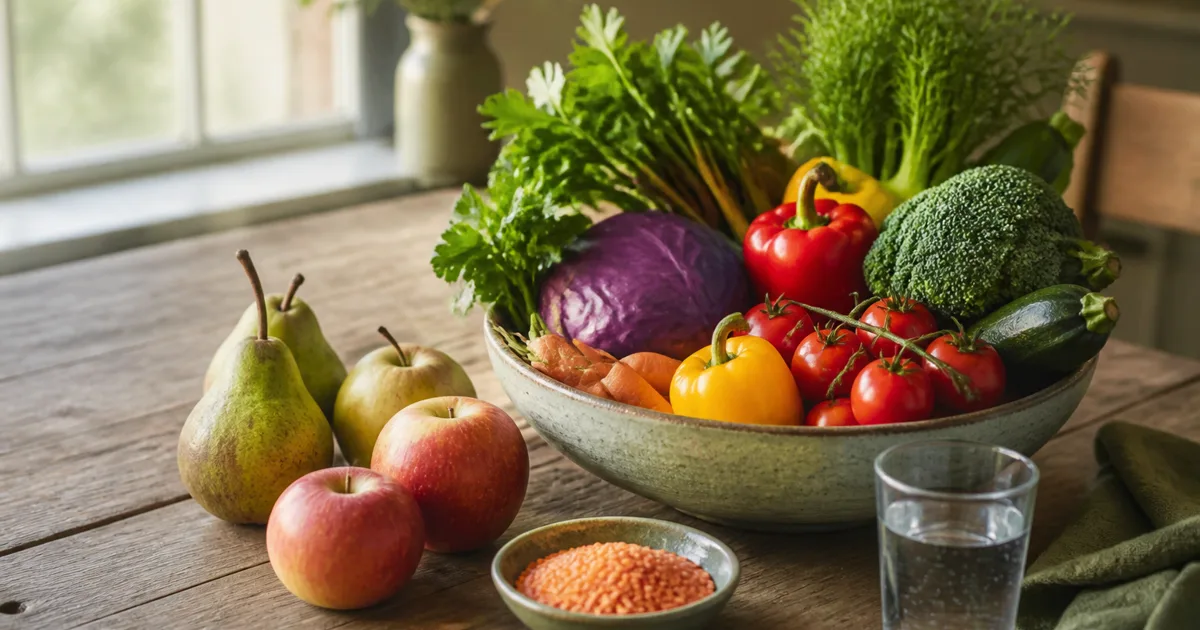
Thousands of people live with diverticula while following, year after year, a diet that was never designed to last. They had a flare-up, were told to avoid fibre for a few days, and the advice stuck. Others have banned nuts, tomatoes and kiwi seeds for twenty years, on the strength of a recommendation research abandoned back in 2008[1].
The problem is not that this advice is foolish. It is that it applies to two opposite moments of the condition, and that nobody clearly explains which belongs where. This article separates the two, stating each time how solid the data really are. It is for information and does not replace your doctor’s assessment, the only one able to judge your situation.
Diverticula, diverticulosis, diverticulitis: three words not to confuse
What is a diverticulum?
A diverticulum is a small hernia in the colon wall, a pouch a few millimetres across that bulges outward. It forms where the wall is naturally weaker, where the blood vessels cross it. These pouches appear mainly with age and most often sit in the left part of the colon, in the sigmoid segment.
Having diverticula is not being ill
Carrying diverticula is called diverticulosis. It is a state, not a disease, and it stays silent in the vast majority of people concerned. Many find out by chance, during a colonoscopy or a scan done for something else entirely. No particular diet is required at this stage.
When do we talk about diverticulitis?
Diverticulitis is inflammation of one or more of these diverticula. It typically shows up as a settled pain in the lower left abdomen, often with fever and disturbed bowel habit. It is an acute episode, diagnosed and treated medically. The distinction is crucial for what follows: the dietary advice below concerns neither the same people nor the same weeks.
Nuts, seeds, popcorn: the myth that will not die
Where does this ban come from?
The idea seemed logical: a small hard fragment, a tomato seed or a popcorn kernel, might lodge in a pouch and trigger inflammation. It was taught for decades and still appears on advice sheets handed out today. It never rested on data, only on that mechanical reasoning.
What following 47,228 men showed
An American team followed 47,228 men for 18 years, recording their diet at regular intervals. Over that period, 801 cases of diverticulitis and 383 bleeds occurred. Heavy eaters of nuts and popcorn, at least twice a week, had no more diverticulitis than those eating them less than once a month. The result even pointed the other way: they had slightly fewer, around a fifth less risk for nuts and a little over a quarter less for popcorn[1]. No link with corn either, nor with bleeding. As early as 2008, the authors concluded that the recommendation to avoid these foods should be reconsidered.
Does that mean you should force yourself to eat them?
No. This work consists of follow-up studies: they describe what goes with what in a population, without proving that a food protects. The useful message is simpler, and it is liberating: nothing justifies banning nuts, seeds, tomatoes or strawberries. If one specific food consistently troubles you, avoid it for that reason, not because of a general rule that was never demonstrated.
The two diets almost everyone confuses
During the flare-up: a habit, not a certainty
Keeping food light for a few days of a flare-up is common practice: fibre is reduced, sometimes with a brief switch to liquids, to rest the colon. That is reasonable and often brings relief. But a systematic review that examined the data concluded that this restriction is very thinly supported: it even cautiously recommends a liberalised rather than a restricted diet during the acute episode[2]. In other words, the flare-up diet belongs more to clinical tradition than to evidence.
After the flare-up: the only genuinely solid part
Here the data are clearest. The same review makes a strong recommendation in favour of a high-fibre diet, in line with usual nutritional guidance, once the episode has resolved[2]. The contrast is striking: the part patients follow the longest, the restriction, is the least proven; the one best established, the high-fibre diet, is often abandoned for fear of triggering another flare.
The mistake that costs dearly
Someone leaves a bout of diverticulitis with instructions to avoid fibre. Nobody tells them when those instructions end. They keep to it for months, sometimes years, and deprive themselves of exactly what the research supports outside a flare. That is the central confusion of this subject, and it is corrected in one sentence: the restriction is temporary, the high-fibre diet is the diet for the rest of the year. When to make the switch is decided with the doctor who managed the episode.
| Situation | Common practice | Strength of the data |
|---|---|---|
| Acute flare-up | Light diet, fibre reduced for a few days | Very low; a review even leans towards a liberalised diet |
| After resolution | High-fibre diet, within usual guidance | Strong recommendation from the systematic review |
| Silent diverticulosis | No restriction | No reason to avoid nuts, seeds or popcorn |
Not all fibre is equal
Fruit and vegetables on one side, cereals on the other
This is the point almost no consumer article mentions. Two large Swedish cohorts, one of women and one of men, compared the types of fibre consumed with hospital admissions for diverticular disease. People eating the most fibre from fruit and vegetables were hospitalised around 30 % less often than those eating the least, in women as in men[3].
The surprising result
In that same analysis, fibre from cereals had no effect at all on the risk of hospitalisation[3]. That contradicts the most widespread reflex, which is to add bran or flakes to “get your fibre”. These results remain observational and do not demonstrate causation, but they point clearly: in practice, the priority goes to fruit, vegetables and pulses.
How much, concretely?
In the Swedish study, the best-supplied quarter sat at around 12.6 g of fruit and vegetable fibre per day among women, against 4.1 g for the lowest quarter. The gap corresponds to an achievable order of magnitude: a few extra portions of vegetables and one more piece of fruit across the day. The increase is made gradually, over two to three weeks, with enough fluid, to avoid bloating and discomfort.
Why fibre also matters to the microbiota
The fibre we do not digest serves as a substrate for the bacteria of the colon. That is one of the explanations put forward for why fermentable fibre from fruit and vegetables behaves differently from cereal fibre in these studies. This line of thinking remains a hypothesis about mechanism, not a demonstration, but it explains the interest in the gut ecosystem in digestive disorders generally.
What weighs as much as fibre
The overall dietary pattern
A cohort of 46,295 men, followed over nearly 900,000 person-years, compared two dietary patterns. The so-called Western pattern, rich in red meat, refined grains and full-fat dairy, went with a risk of diverticulitis higher by about half. Conversely, a prudent pattern, rich in fruit, vegetables and wholegrains, was associated with a risk lower by about a quarter[4]. The authors attribute most of that difference to two elements: fibre and red meat.
The other factors that count
Diet is only one part of the picture. Age remains the main determinant of whether diverticula appear. Excess weight, smoking, inactivity and regular use of non-steroidal anti-inflammatory drugs are among the factors associated with a higher risk of complications in the literature. These points are discussed with a doctor, particularly the question of anti-inflammatories if you take them for another condition.
Antibiotics: what has changed in management
Why they are no longer routine
For a long time, every case of diverticulitis received antibiotics. Two randomised trials, one Swedish and one Dutch, compared that practice with simple observation in uncomplicated cases: observation did no worse, with no increase in complications or recurrences[5]. A later meta-analysis points the same way and even suggests that antibiotics might slightly increase complications, while stressing that the certainty of that conclusion remains low[6].
What that changes for you
Nothing you can decide alone. This shift concerns the doctor, not the patient: it simply explains why you may leave a consultation without an antibiotic prescription where someone close to you received one ten years ago. This is not negligence, it is a change of practice grounded in trials. A treatment under way is never stopped on your own initiative.
The thread running through this subject is a distinction of timing. A few days of light eating during a flare-up belong to a poorly documented clinical habit; the high-fibre diet, by contrast, is the everyday one, and it is above all fibre from fruit and vegetables that stands out in the large follow-up studies. Nuts and seeds, meanwhile, can come back to the plate.
These pouches form on a colon whose function also depends on its microbial ecosystem. If transit and digestive comfort are your ongoing concern, the question of the gut microbiota is the natural extension of this read, as is that of the links between probiotics and constipation, or that of SIBO, the small intestinal bacterial overgrowth whose symptoms are often confused with other digestive disorders.
Frequently asked questions
Can you eat nuts and seeds with diverticula?
Yes. The ban rested on mechanical reasoning, never on data. Following 47,228 men for 18 years found no increase in the risk of diverticulitis among regular eaters of nuts, popcorn or corn. The result even leaned slightly the other way. As early as 2008 the authors recommended reconsidering this instruction. If a particular food troubles you personally, that is another matter: avoid it for that reason, not in the name of a general rule.
Should you eat a fibre-free diet with diverticula?
No, except briefly during a flare-up and on medical advice. This is the most common confusion. A systematic review strongly recommends a high-fibre diet once the acute episode has resolved, and only very weakly supports restriction during the flare. Many people follow for years a diet designed for a few days. How long the light phase lasts is decided with the doctor managing the episode.
Which fibre should you favour?
Fibre from fruit and vegetables. In two large Swedish cohorts, people with the highest intake of fruit and vegetable fibre were hospitalised for diverticular disease around 30 % less often than those with the lowest. In the same analysis, fibre from cereals showed no effect at all. This work is observational and does not prove causation, but it points towards the plate rather than the bowl of bran.
How long does a diverticulitis flare-up last?
That depends on the form and the management, and this question is settled in consultation, not online. What has changed, however, is documented: in uncomplicated cases, two randomised trials showed that simple observation did no worse than antibiotic treatment, with no more complications or recurrences. That is why an antibiotic prescription is no longer automatic today.
Do diverticula go away?
No. Once formed, these pouches in the colon wall do not close up again. That is precisely why this is a matter of a long-term eating habit, not a course of treatment. The reasonable aim is not to make the diverticula disappear, but to live with them comfortably, which means eating regularly and with enough plant food, as discussed with your doctor.
Is diet alone enough to avoid a recurrence?
No, and that must be said plainly. The available studies describe associations in populations, not individual guarantees. The overall dietary pattern matters: in a cohort of 46,295 men, a Western-style pattern went with a risk higher by about half, a plant-rich pattern with a risk lower by about a quarter. But age, weight, smoking and certain medicines weigh in too, and no single food prevents a disease on its own.
Are probiotics of any use when you have diverticula?
Two questions need separating. On diverticulitis itself, the work is too sparse and too heterogeneous to conclude, and a food supplement neither treats nor prevents a disease. On day-to-day digestive comfort, by contrast, the real concern for many people affected is regularity: that is where a daily intake of ferments finds its place, alongside fibre and hydration, which remain the foundation. After an acute episode, ask your doctor before starting a course.
Should you avoid coffee, alcohol or spices?
No solid data justify banning them in diverticulosis. These prohibitions circulate out of habit, like the one about seeds. Individual tolerance, on the other hand, is real: if a drink or a dish consistently causes you discomfort, adjust your diet accordingly. That is a useful personal observation, to be distinguished from a rule that applies to everyone.
Sources and references (verified on PubMed)
6 sources- Strate L.L. et al. (2008). Nut, corn, and popcorn consumption and the incidence of diverticular disease.
- Dahl C. et al. (2018). Evidence for Dietary Fibre Modification in the Recovery and Prevention of Reoccurrence of Acute, Uncomplicated Diverticulitis: A Systematic Literature Review.
- Mahmood M.W. et al. (2018). High intake of dietary fibre from fruit and vegetables reduces the risk of hospitalisation for diverticular disease.
- Strate L.L. et al. (2017). Western Dietary Pattern Increases, and Prudent Dietary Pattern Decreases, Risk of Incident Diverticulitis in a Prospective Cohort Study.
- Mayl J., Marchenko M., Frierson E. (2017). Management of Acute Uncomplicated Diverticulitis May Exclude Antibiotic Therapy.
- Araya-Quezada C. et al. (2021). Antibiotics for acute uncomplicated diverticulitis in hospitalized patients.