Red yeast rice: a statin dressed up as a supplement
In brief
Red yeast rice is banned in Switzerland, neither as a foodstuff nor as an authorised medicine. The reason is rarely explained correctly: it is not because it fails to work, it is because it works. Its active principle, monacolin K, is chemically identical to lovastatin, a cholesterol-lowering medicine available on prescription. A meta-analysis of 14 double-blind trials reports a mean fall in LDL of about 36 mg/dl, the order of magnitude of a low-dose treatment. Taken without a prescription, it is therefore a statin with no leaflet, no liver monitoring and no guarantee of content.
Search this topic in Switzerland and you will find almost nothing: a few dozen results, an official factsheet and a press article. The emptiness is striking for a product that thousands of people bring back from France, Italy or Germany, convinced they are buying a gentle alternative to cholesterol medicines.
This article explains what the product really contains, what the trials show, and why the argument “it’s natural, so it’s safer” turns completely on its head here. SwiLab does not sell this product: this content is purely informational and does not replace your doctor’s advice.
Red yeast rice: what we are talking about
A fermented rice
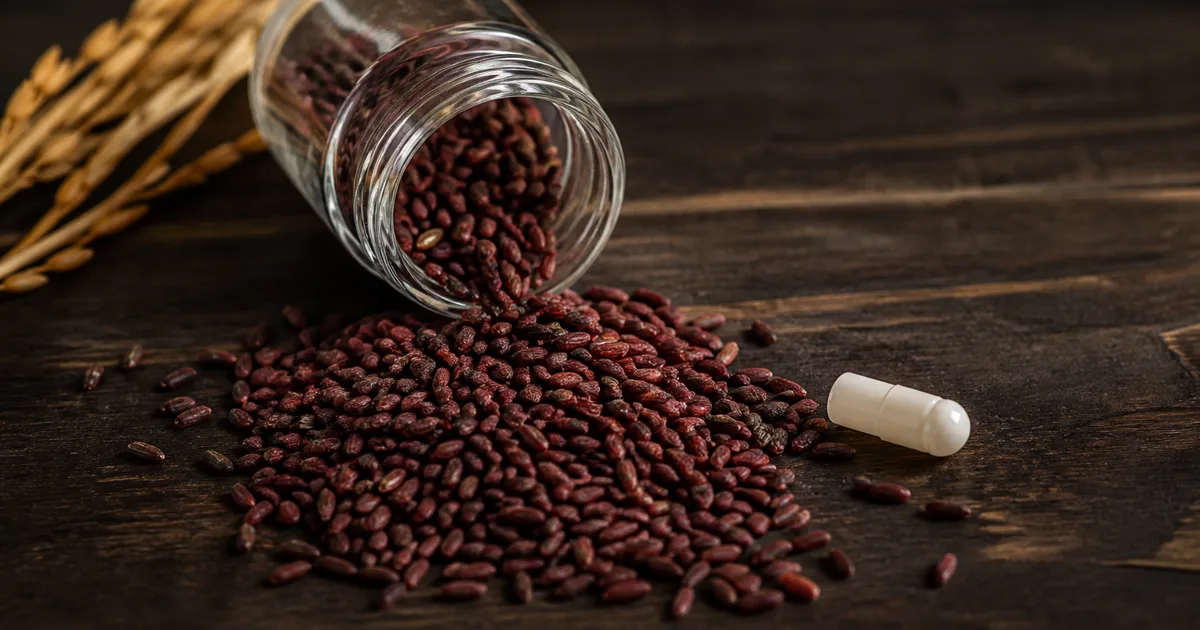
It is rice on which a mould, Monascus purpureus, is grown, giving it its characteristic red colour. The process is old and documented in Asia, both as a food colouring and in traditional pharmacopoeia. Fermentation produces compounds called monacolins.
The active principle
Among those compounds, one dominates: monacolin K. It carries the effect on cholesterol, and it raises the whole regulatory question. A product with a low monacolin K content will have little effect; a product with a high content will act, but will then become something other than a food.
The fact almost nobody states clearly
A chemical identity, not a resemblance
Monacolin K is not “comparable” to a medicine: it is chemically identical to lovastatin, a statin authorised as a medicine and available on prescription. This is not a teaching analogy, it is the same molecule. That is exactly the ground given by the Swiss authorities, who note that this product contains pharmacologically active substances.
The logical consequence
If you take a red yeast rice capsule containing monacolin K, you are taking a statin. The difference from a prescription is not the nature of the product, it is the absence of everything that normally accompanies a statin: an indication set by a doctor, an adapted dose, information on interactions, monitoring of liver enzymes and muscle pain.
What the trials actually show
The available meta-analysis
A systematic review gathered 14 double-blind clinical trials in people with high cholesterol, over durations of 4 to 24 weeks[1]. It is a methodologically sound body of work, since double blinding limits expectation effects.
The results
Consumption of red yeast rice extract came with a mean fall in LDL of about 36 mg/dl, that is nearly 0.9 mmol/l, and a fall in total cholesterol of about 37 mg/dl[1]. No significant effect was seen on HDL, triglycerides or apolipoproteins.
How to read that figure
This is where the reasoning becomes interesting. An LDL fall of that order matches what is expected from a low-dose lipid-lowering treatment. In other words, the efficacy observed is itself the proof of the product’s medicinal character. You cannot claim the effect of a statin and the status of a food.
| Parameter | Meta-analysis result |
|---|---|
| LDL cholesterol | Mean fall of about 36 mg/dl |
| Total cholesterol | Mean fall of about 37 mg/dl |
| HDL, triglycerides, apolipoproteins | No significant effect |
| Trial duration | 4 to 24 weeks |
| Status in Switzerland | Neither a foodstuff nor an authorised medicine |
Why Switzerland bans it
The two official grounds
The first is the one we have just seen: the presence of pharmacologically active substances, reserved by law to medicines. The second is toxicological: fermentation can produce citrinin, an undesirable substance whose presence depends on production conditions. In Switzerland this product is therefore authorised neither as a foodstuff nor as a medicine.
The problem of the real dose
One point makes the picture worse and concerns the buyer directly. Monacolin K content varies widely between batches and between manufacturers, since it depends on a biological process. Two boxes carrying the same label can therefore deliver different doses. No patient on a statin would accept a tablet whose strength varies without being told.
Consistency with the rest
This ban is not an isolated case. Switzerland applies the same logic to other substances whose effect falls within the medicinal field, and European regulation has likewise tightened the framework for monacolins. The reasoning is consistent: beyond a certain level of activity, a substance changes legal category.
The safety question, honestly
What the available data say
It would be dishonest to wave a danger the studies do not show. The meta-analysis concludes that the extract was considered a safe choice, with no frequent or threatening adverse effects in the trials analysed[1]. A surveillance system covering a widely distributed product reports, for its part, a very low rate of reported adverse effects, of the order of 0.04 % of exposed consumers[2].
The reservation that comes with that figure
This surveillance system was set up and run by the company that sells the product[2]. That is not disqualifying in itself, and such voluntary systems have their use, but it is worth knowing: the safety figure most often quoted about this product comes from its manufacturer, on the basis of spontaneous reports, which structurally underestimates adverse effects.
What remains true
The adverse effects of statins are known, in particular muscular and hepatic. There is no reason to think the same molecule taken without monitoring is free of them. The difference is not in the risk, it is in the detection: on prescription, someone is watching; over the counter, nobody is watching anything.
What remains possible and lawful here
The medical route
If your cholesterol is high, the subject belongs to your doctor. Depending on your overall cardiovascular risk, the approach can range from lifestyle change alone to a treatment with follow-up. That route has the advantage of being supervised, reimbursed in some cases, and based on molecules whose dose is known.
The recognised dietary levers
Some health claims are authorised and documented, such as the contribution of plant sterols and stanols to the maintenance of normal blood cholesterol levels, or that of soluble oat fibre. These effects are more modest than a medicine’s, but they are lawful, measured and unambiguous in status.
The red yeast rice case sums up on its own a very widespread confusion. “Natural” does not mean “weak”: here the product contains exactly the molecule of a prescription medicine, at a dose that varies without the buyer knowing. It is precisely because it works that it has no place on a shelf.
If the cardiovascular subject interests you, two articles complement this one: our file on homocysteine, a marker often misunderstood, and the one devoted to coenzyme Q10, frequently raised by people on statins.
Frequently asked questions
Is red yeast rice banned in Switzerland?
Yes. It is authorised neither as a foodstuff nor as a medicine. Two grounds are given: it contains pharmacologically active substances, in particular monacolin K, and its fermentation can produce citrinin, an undesirable substance. Selling and promoting it is therefore not lawful here, while products containing it remain available in some neighbouring countries.
Is it really the same thing as a statin?
As regards its active principle, yes. Monacolin K is chemically identical to lovastatin, a prescription statin. This is not a resemblance but a molecular identity. The difference from a medicine therefore lies not in the nature of the product, but in the absence of an indication set by a doctor, a controlled dose, information on interactions and monitoring of the liver and muscles.
Does it lower cholesterol?
Yes, and that is precisely the problem. A meta-analysis of 14 double-blind trials reports a mean fall in LDL of about 36 mg/dl and in total cholesterol of about 37 mg/dl, with no significant effect on HDL or triglycerides. That order of magnitude matches a low-dose lipid-lowering treatment, which confirms the pharmacological nature of the product rather than a food status.
Can I bring it back from France or Italy?
A product banned here does not become lawful because it was bought elsewhere, and private imports of unauthorised substances can be blocked. Beyond the regulatory aspect, the practical risk stays the same: you would be taking a statin at a variable dose, with no follow-up. If your aim is to lower your cholesterol, the medical route is safer and more effective.
Is it dangerous?
The trials analysed did not find frequent or threatening adverse effects, and a surveillance system reports a very low rate of reports. Two reservations apply: that system was set up by the company selling the product, and spontaneous reporting structurally underestimates adverse effects. Since this is the same molecule as a statin, there is no reason to believe it free of the effects statins are known for.
Can it be taken with a prescribed statin?
No, and that is the most worrying scenario. It amounts to adding the same class of molecule twice, often without the doctor’s knowledge, which increases the risk of muscular and liver effects. More broadly, every supplement should be mentioned at a consultation, just like a medicine. The omission is common because the word supplement wrongly suggests harmlessness.
Why does the dose vary from one box to another?
Because monacolin K is produced by fermentation, a biological process sensitive to culture conditions. The content therefore depends on the strain, the substrate and the process, and can vary between batches and between manufacturers. That is acceptable for a food colouring, much less so for a substance that acts like a medicine: no patient would accept a tablet of uncertain strength.
What to do instead if my cholesterol is high?
Talk to your doctor, who will assess your overall cardiovascular risk before proposing an approach, from lifestyle alone to a monitored treatment. On the dietary side, some claims are authorised and documented, such as the contribution of plant sterols and stanols to the maintenance of normal blood cholesterol levels, or that of soluble oat fibre. The effects are more modest than a medicine, but the status is clear.
Sources and references (verified on PubMed)
2 scientific sources + institutional source- Trogkanis E., Karalexi M.A., Sergentanis T.N., Kornarou E., Vassilakou T. (2024). Safety and Efficacy of the Consumption of the Nutraceutical “Red Yeast Rice Extract” for the Reduction of Hypercholesterolemia in Humans: A Systematic Review and Meta-Analysis.
- Banach M., Katsiki N., Latkovskis G. et al. (2021). Postmarketing nutrivigilance safety profile: a line of dietary food supplements containing red yeast rice for dyslipidemia.
- Federal Food Safety and Veterinary Office (FSVO) | Monascus purpureus (red yeast rice).