
Osteoporosis: what builds bone and what maintains it
In brief
Bone health rests on two complementary pillars, and one of them is largely under-used. Nutrients supply the material: calcium and vitamin D contribute to the maintenance of normal bones, and so do magnesium and protein. Mechanical loading, for its part, gives the signal to build. In a randomised trial in 101 postmenopausal women with low bone mass, two thirty-minute sessions a week of heavy lifting and impact exercise increased lumbar bone density by 2.9 % in eight months, while the control group lost 1.2 %. And contrary to the widespread fear, lifting heavy proved safe under supervision.
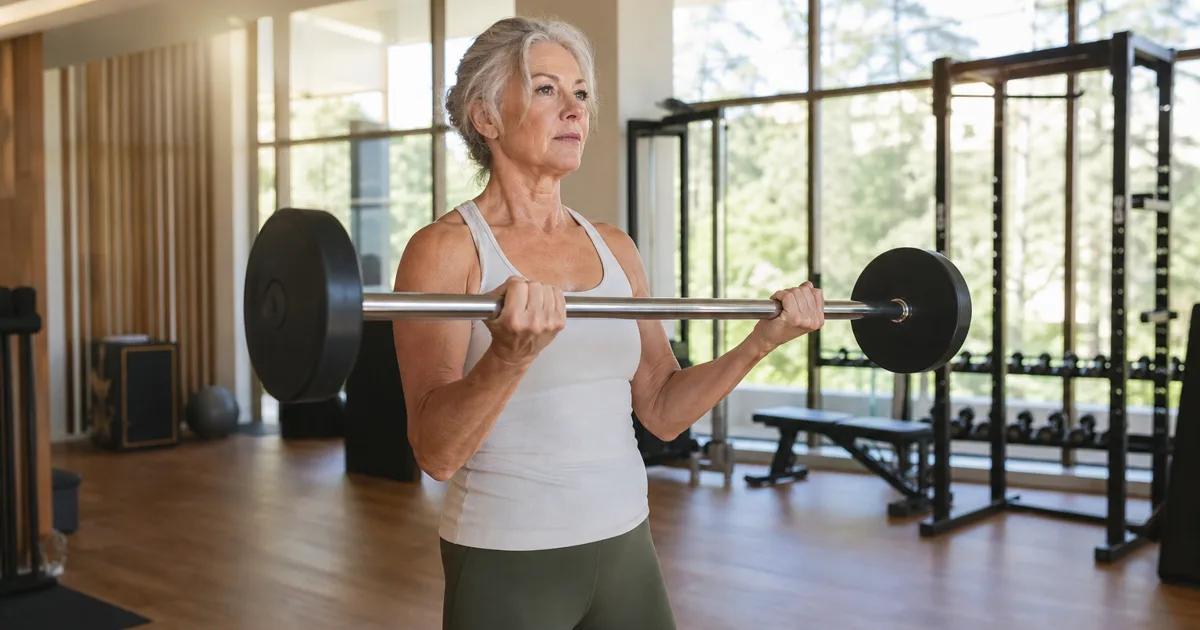
When a bone density scan reports osteopenia or osteoporosis, the conversation almost always turns to calcium and vitamin D, then to precautions: avoid falls, do not carry heavy loads, spare your back. The intention is good, but a second lever, just as well documented, is rarely mentioned.
A randomised trial published in 2018 tested it in women concerned, with results worth knowing. This article sets them out, then specifies the exact role of calcium and protein. It is informational and does not replace your doctor’s advice, who alone can adapt all of this to your situation.
How bone is built, and what it responds to
A living tissue
Bone is not an inert structure: it renews itself constantly, with some cells breaking it down and others rebuilding it. This balance shifts with age and, in women, accelerates markedly after the menopause, when falling oestrogen favours breakdown.
The signal that triggers building
What drives bone to strengthen is mechanical loading. More precisely, bone formation is stimulated by high-intensity loads applied rapidly[1]. That detail changes everything: walking is excellent for general health, but the load applied stays low and so does the signal sent to bone.
The consequence
An adequate supply of material, calcium and vitamin D included, is necessary but not sufficient to trigger building. Without a strong mechanical signal, the materials are not put to work. That is exactly what the trial described below shows.
The lever people forget to offer
The protocol
One hundred and one postmenopausal women with low bone mass, aged 65 on average, were randomly assigned to two eight-month programmes. The first consisted of two supervised thirty-minute sessions a week, combining heavy lifting, five sets of five repetitions at over 85 % of maximum load, with impact exercises. The second was a low-intensity home programme[1].
The results
Lumbar spine bone density rose by 2.9 % in the high-intensity group, while it fell by 1.2 % in the control group. At the femoral neck, it held steady in the first group and dropped by 1.9 % in the second. Cortical thickness at the femoral neck, a measure of strength, rose by 13.6 % against 6.3 %[1].
The detail that stands out
Participants in the intensive group gained 0.2 cm in height, while the others lost 0.2. All functional performance measures, back and leg strength, balance, ability to rise from a chair, improved clearly[1]. Two thirty-minute sessions a week, for eight months.
| Parameter | High intensity | Light programme |
|---|---|---|
| Lumbar bone density | +2.9 % | −1.2 % |
| Femoral neck bone density | +0.3 % | −1.9 % |
| Femoral neck cortical thickness | +13.6 % | +6.3 % |
| Height | +0.2 cm | −0.2 cm |
“But isn’t that dangerous?”
The fear, and what the trial says about it
That is the immediate objection, and the authors anticipate it: this type of training is not traditionally recommended to people with osteoporosis because of a fracture risk perceived as high[1]. The trial specifically monitored adverse events. Result: a single incident, a minor lower-back spasm that cost two sessions out of seventy.
The condition set by the authors
It is explicit and must not be glossed over: these results were obtained under close supervision, in women who were otherwise healthy, selected after excluding conditions and treatments affecting bone[1]. This is not an invitation to load a barbell alone in a basement.
The practical translation
The reasonable approach is to talk to your doctor, then to be coached by a trained professional, a physiotherapist or a specialist in adapted physical activity. Technique and gradual progression make all the difference here, and that is exactly what coaching brings.
The exact role of bone nutrients
The material, essential
Without an adequate supply, no training builds anything: bone needs its components. The authorised claims say it precisely: calcium and vitamin D contribute to the maintenance of normal bones, as does magnesium, and protein plays its part too. These are established contributions, not to be neglected.
What the reviews show
Reviews assessing calcium and vitamin D supplementation for routine prevention, in community-dwelling people without a deficiency, conclude that the benefit on fractures taken in isolation is limited. That finding is not an invitation to go without: it indicates that the nutrient alone, without the mechanical signal, is not enough. Supplementation keeps its full value where intakes are insufficient, where there is a deficiency, or when a doctor prescribes it.
The right way to think about it
Secure intakes first, through food and if necessary through a suitable supplement: dairy products, calcium-rich mineral waters, green vegetables, almonds, sardines with their bones. Then add the lever that triggers building. The two together are worth considerably more than either alone.
Protein, long wrongly accused
The myth of the decalcified bone
For years it was argued that a protein-rich diet acidified the body and made it draw calcium from bone. That hypothesis did not survive later work: in adults, an adequate protein intake goes rather with better bone health, in particular because it supports the muscle mass that applies the loads to bone.
Why this matters especially here
A weakening muscle pulls less hard on bone, and someone losing strength falls more easily. The protein-and-training pairing therefore acts twice over: on bone building and on the risk of falling, which is the immediate determinant of a fracture.
Where to start, concretely
The sensible order
First talk to your doctor about your bone density result and your overall risk, raising physical activity explicitly. Then look for competent coaching rather than an anonymous membership. Finally, check your calcium, vitamin D and protein intakes rather than stacking supplements.
What counts over time
Attendance was high in this trial, with more than nine sessions out of ten attended[1]. Two thirty-minute sessions fit into a diary. That is probably the best argument in this whole file: the most effective lever is also one of the shortest.
Let us hold on to the complementarity. Bone nutrients supply the material, mechanical loading gives the signal, and the trial shows what the latter brings in clear figures: nearly 3 % of lumbar density gained where the control group lost, on two weekly thirty-minute sessions. Securing your intakes and training are not competing strategies, but the two halves of the same one.
To take this further, two articles complement it: our file on sports supplements and recovery, useful if you are starting strength training, and the one devoted to magnesium and sport.
Frequently asked questions
Is strength training dangerous with osteoporosis?
That is the usual fear, and the trial that tested the question did not confirm it. In 101 postmenopausal women with low bone mass followed for eight months, a single adverse event was reported, a minor lower-back spasm. The authors stress, however, that these results were obtained under close supervision, in women who were otherwise healthy. The approach is therefore begun with a doctor and then carried out with qualified coaching.
How much training time is needed?
In this trial, two supervised thirty-minute sessions a week were enough to achieve, over eight months, a 2.9 % gain in lumbar bone density, while the control group lost 1.2 %. Attendance exceeded nine sessions out of ten. It is a volume compatible with an ordinary schedule, which makes it one of the most convincing arguments in the file.
Is walking enough for bone?
It is excellent for general health, but the load it applies stays low. Bone formation, though, is stimulated by high-intensity loads applied rapidly, which walking does not produce. That is precisely what separates a light programme from a resistance and impact programme: in the trial cited, the low-intensity group lost bone density while the other gained it.
Is calcium really useful?
On the contrary, it is essential: without material, nothing gets built. Calcium and vitamin D contribute to the maintenance of normal bones, as do magnesium and protein. What the reviews show is that routine supplementation in people without a deficiency has a limited effect on fractures when taken in isolation. The useful reading is therefore not to do without it, but to pair it with the mechanical signal that puts these materials to work.
Does protein damage bone?
No, that is an old idea which did not survive later work. It was long argued that a high intake acidified the body and made it draw calcium from bone. In adults, an adequate protein intake goes rather with better bone health, in particular because it supports muscle mass, which is exactly what applies the loads that stimulate bone.
At what age is it too late?
The participants in this trial were 65 on average and already had low bone mass. They nevertheless improved their bone density and all their functional performance measures in eight months. The relevant question is therefore not age but supervision, gradual progression and your doctor’s prior agreement.
Which exercises exactly?
The programme combined heavy lifting, five sets of five repetitions at over 85 % of maximum load, with impact exercises. The basic movements loading the hips and spine are the ones that send the signal to the areas most at risk of fracture. The precise choice, the load and the progression are for the professional coaching you: that is the part not to improvise.
Should treatment be stopped if you train?
No, never on your own initiative. The participants in this trial had in fact been selected after excluding treatments affecting bone, which means the question of combining the two was not studied there. Physical activity and treatment are not opposed; how they fit together is decided with the doctor following your bone density scan and your fracture risk.
Sources and references (verified on PubMed)
2 sources- Watson S.L., Weeks B.K., Weis L.J., Harding A.T., Horan S.A., Beck B.R. (2018). High-Intensity Resistance and Impact Training Improves Bone Mineral Density and Physical Function in Postmenopausal Women With Osteopenia and Osteoporosis: The LIFTMOR Randomized Controlled Trial.
- Zhao J.-G., Zeng X.-T., Wang J., Liu L. (2017). Association Between Calcium or Vitamin D Supplementation and Fracture Incidence in Community-Dwelling Older Adults: A Systematic Review and Meta-analysis.