
When to take a course of supplements for severe fatigue?
Quick summary
A course of food supplements is justified when severe fatigue settles in over several weeks and a blood test reveals a deficiency: iron, vitamin D or B-group vitamins in front in Switzerland, according to the menuCH survey.
Key facts
Key points
- Severe fatigue that lasts more than three weeks deserves a blood test before buying any supplement.
- In menstruating women, iron remains the first suspect: a deficiency is present in nearly one woman in five in Switzerland.
- Vitamin D becomes a priority between October and April, because the skin can no longer produce enough of it above the 45th parallel.
- The B-group vitamins take part in the conversion of food into energy, and a deficit weighs on endurance and concentration.
- Rhodiola and ginseng are studied against fatigue with heterogeneous results across studies, and they never replace the correction of a deficiency.
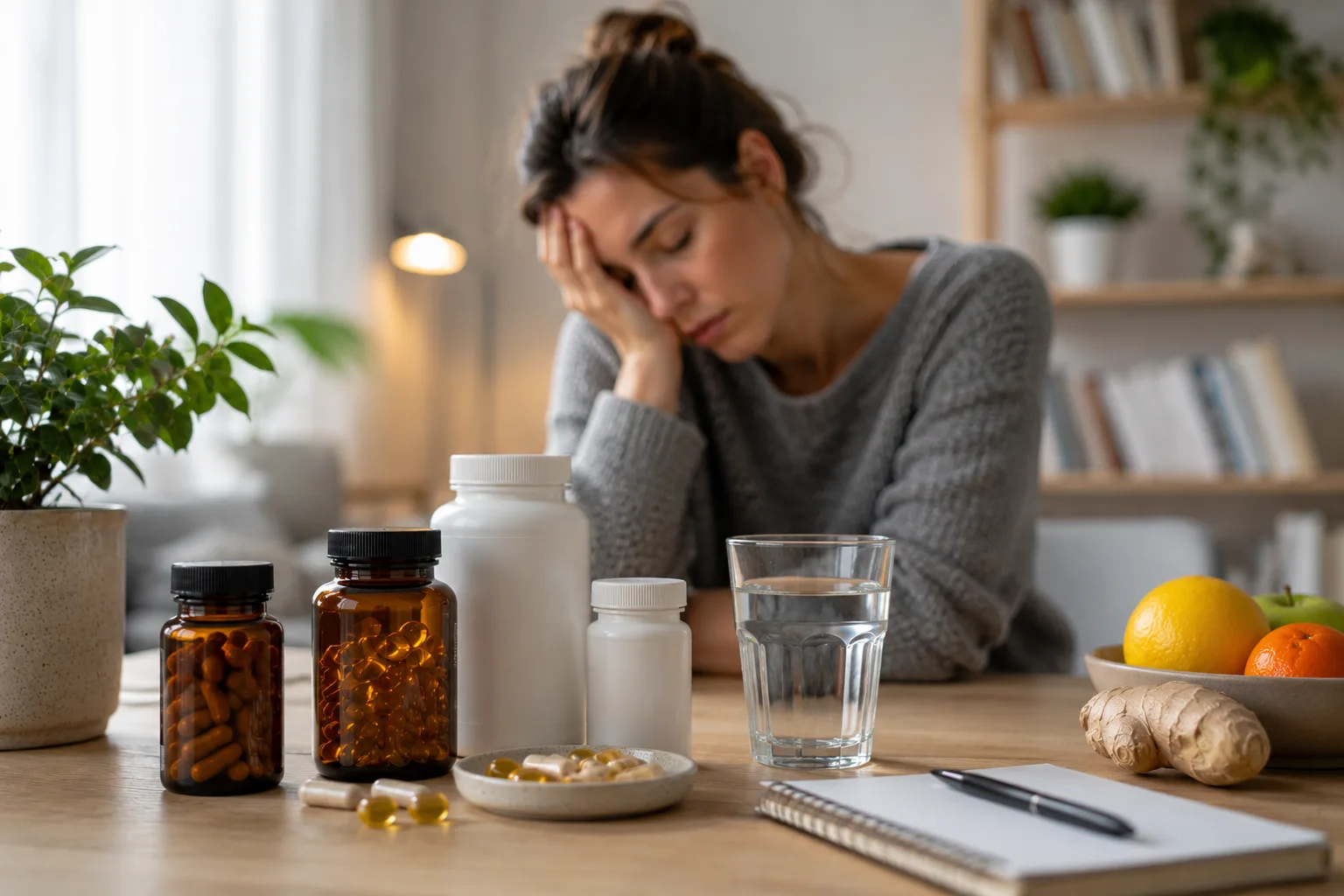
In Switzerland, nearly one woman in five of childbearing age has an iron deficiency, and more than half of the population is short of vitamin D during winter, according to the national menuCH data published by the FSVO. When fatigue settles in over several weeks, despite enough sleep and a reasonable diet, a well-chosen food supplement can help to rebuild depleted reserves. This step nevertheless remains an answer to a targeted deficiency, not a generalist boost: it sits within a broader logic of course of food supplements, to be adapted to the time of year, the personal profile and everyone’s context.
Which signs justify a course of supplements in case of severe fatigue?
How to tell passing fatigue from settled exhaustion?
Fatigue that goes beyond three weeks, despite reasonable sleep and a healthy lifestyle, is no longer a simple dip in energy. It becomes a signal to look into for the body. Doctors then speak of persistent fatigue when rest is no longer enough to restore usual energy, with an impact on mental concentration, motivation or the ability to sustain a physical activity day in, day out.
Conversely, a fatigue of a few days that follows a flu episode, a sleepless night or a period of work overload does not require a supplement. It clears up with two to seven days of recovery, sometimes helped by a balanced diet and a little caffeine in the morning. The useful boundary to tell the two states apart is the duration of symptoms, their impact on everyday tasks and the presence of associated signs such as breathlessness on effort, pallor or repeated headaches.
Why are women of childbearing age most exposed in Switzerland?
Menstruating women concentrate the risk because monthly blood losses drain iron each cycle, creating a need for regular replenishment in the body. A pooled study published in 2025 in the European Journal of Clinical Nutrition[1], which combined the data of 26 Swiss studies on 2,709 women of childbearing age, measures an iron deficiency prevalence of 18.9%, that is to say nearly one woman in five. Some of them already show symptoms, fatigue, drop in attention, discomfort on effort, without established anaemia. Heavy periods amplify this imbalance.
Other profiles are added to this population, depending on the region and the way of life. According to the national menuCH survey published by the FSVO[2], men more often have a zinc deficit, seniors a vitamin B12 deficit, and the population as a whole an insufficient vitamin D status during winter, for want of sufficient sunlight at the Swiss latitude. These data explain why the same symptom, fatigue, can refer to very different nutrients depending on the personal profile, and why consulting a health professional remains the best port of entry.
Which nutrients to target to support the body in case of severe fatigue?
Iron, the first nutrient to check
Iron is the number one nutrient to examine in the face of severe fatigue, particularly in menstruating women, teenage girls, endurance sportswomen and people on a strict vegetarian diet, sometimes low in certain elements. It is used to produce haemoglobin, the protein that transports oxygen to the muscles and the brain; a deficit lowers tolerance to physical activity and weighs on the feeling of fatigue from the first body movements of the day.
A meta-analysis published in 2025 in the journal Neuroscience and Biobehavioral Reviews[3] confirms that iron supplementation helps reduce fatigue, anxiety and improves short-term memory in menstruating women and teenagers, even when anaemia is not yet established. The clearest effect concerns physical well-being and felt vitality day to day. The Cochrane review on iron in the postpartum period, updated in December 2024[4], shows a reduction in fatigue as early as 8 to 28 days of treatment in anaemic women after childbirth.
Magnesium, B vitamins and vitamin D: the energy metabolism trio
Three families of vitamins and minerals are involved in normal energy metabolism from food: magnesium, the B-group vitamins and vitamin D. Magnesium, which is also found as marine magnesium or magnesium bisglycinate in food supplements, takes part in more than 300 enzymatic reactions, including the production of ATP, the energy “currency” of the cells. The B vitamins[5] (B1, B2, B3, B6, B9, B12 in particular) contribute to the normal functioning of the nervous system and act as relays in the conversion of carbohydrates, fats and proteins into energy usable by the body.
Vitamin D acts differently: it regulates the absorption of calcium, but also muscular function and the response of the immune system. The Federal Office of Public Health (FOPH) recalls that more than 60% of the Swiss population has a vitamin D deficiency during winter[6], for want of sufficient sunlight for cutaneous synthesis. The Swiss recommendation for adults swings between 600 and 800 IU per day depending on age, and vitamin D supplementation then becomes a common solution. As for vitamin B12, a deficiency affects about 2 to 3% of adults in the United States according to a clinical review published in 2025[7]; it shows itself through mental fatigue, a cognitive fog, sometimes depression, and, at a more advanced stage, tingling in the hands or feet.
| Nutrient | Most exposed profiles | Indicative course duration |
|---|---|---|
| Iron | Menstruating women, endurance sportswomen, strict vegetarians | 6 to 12 weeks, then a blood test follow-up |
| Vitamin D | Adults in winter, seniors, dark skin, indoor lifestyle | 2 to 3 months, then a winter maintenance dose |
| Magnesium | Sustained stress, sportspeople, a diet low in wholegrain cereals | 4 to 8 weeks |
| Vitamin B12 | Seniors, vegans, people on metformin or PPIs | 3 months minimum, sometimes lifelong depending on the cause |
What do studies say about rhodiola and ginseng?
Rhodiola (or rhodiole) and ginseng are the adaptogenic plants of plant origin most studied to fight fatigue, but the evidence remains debated. A meta-analysis published in 2023 in the Journal of Integrative and Complementary Medicine[8] pooled 19 clinical trials on ginseng and found no statistically significant reduction in fatigue severity compared with the control groups (SMD −0.36; 95% CI −0.82 to 0.11; p = 0.13), with trials that are very heterogeneous in terms of ginseng types and populations. An umbrella review published the same year in Frontiers in Pharmacology[9] reports signals of benefit on fatigue in certain subgroups, with no worrying safety signal, whether in capsule, tablet or ampoule form.
For rhodiola, a randomised, double-blind, placebo-controlled trial published in late 2024[10] tested 16 days of salidroside (the main active compound, 60 mg/day) in 50 active young adults: the treated group held its performance and mood during endurance tests, where the placebo group saw reported fatigue increase. The right word: these plants, sometimes paired with spirulina, guarana or ashwagandha in certain commercial tonic formulas, are studied to support adaptation to stress and to physical and intellectual effort, but they do not correct an iron deficiency nor a vitamin D deficit. They complete an approach, they do not replace it.
How to build an effective course against severe fatigue?
Why must a blood test precede the course?
A targeted blood test remains the necessary step before adding a product to the basket, because it turns a hunch into a documented target for the system and the actual need of the body. In the face of prolonged fatigue, the doctor typically asks for a full blood count, ferritin (iron reserves), sometimes vitamin D, vitamin B12[7] and thyroid hormones. These tests take a few days and cost less than a month of badly chosen anti-fatigue food supplements.
Without this step, two frequent pitfalls lurk. The first consists of supplementing with iron a person who is already well dosed: this person then accumulates an excess that can disturb digestion and favour oxidative stress, with no measurable vitality gain. The second consists of confusing nutritional fatigue with fatigue of thyroid, depressive, infectious or sleep apnoea origin: as many leads as there are other illnesses to rule out. None of these causes is settled by a food supplement, and a delayed diagnosis prolongs the suffering.
Good reflex
Ask your doctor for a ferritin test, not just haemoglobin. A low ferritin reveals a lack of iron sometimes several months before anaemia appears: it is at this stage that the course is most effective.
How long does it take to feel the effects of a course?
The first felt effects usually arrive between two and six weeks, depending on the nutrient, the type of programme followed and the depth of the deficit. For iron, many people describe an improvement starting from the third or fourth week, but biological rebuilding of the reserves often takes 2 to 3 months. For vitamin D, the effect on fatigue, when it exists, appears rather after 4 to 8 weeks of daily intake[6], at a dose adapted to the initial status and the felt energy gap.
The course should be extended beyond the perceived relief, unless a clinician indicates otherwise. Stopping as soon as fatigue lessens exposes you to a relapse within a few weeks, particularly if the cause of depletion of the reserves persists: heavy periods, a diet poor in sources, winter, lack of sleep or a long-term medication. A follow-up blood test after 2 or 3 months secures the decision to stop and avoids needless prolonged supplementation, while keeping in mind that no supplement replaces a varied and balanced diet as the basis of a good lifestyle.
Not to do
Stacking several “energy complexes” from the shop without knowing the precise intakes. This can lead to high cumulative doses of iron, zinc or fat-soluble vitamins, with a risk of toxicity or unanticipated drug interactions.
Frequently asked questions on courses and severe fatigue
Which food supplement should you choose in case of severe fatigue?
The choice depends on the cause. Iron remains the first nutrient to check in menstruating women, followed by vitamin D in winter and B-group vitamins in seniors or people on certain medicines. According to the menuCH survey, these are the three most frequent deficiencies in Switzerland. Without a prior blood test, choosing a supplement remains a gamble: an excess of iron in someone who is not deficient can cause digestive problems and oxidative stress, with no measurable benefit.
How long does a course of supplements for fatigue last?
Count 1 to 3 months in general, depending on the targeted nutrient. Iron often needs 6 to 12 weeks to rebuild reserves, vitamin D several months in case of marked deficiency, magnesium about 4 to 8 weeks. A Cochrane review on iron in the postpartum period shows a reduction in fatigue as early as 8 to 28 days with the intravenous route, slower with tablets. The practical rule: extend until the blood panel returns to normal, then assess the need for a maintenance dose with a healthcare professional.
Can a course be enough if fatigue has lasted for several months?
No, a course alone is rarely enough. Lasting severe fatigue may signal anaemia, a thyroid disorder, a depressive syndrome, sleep apnoea or a chronic infection: none of these causes is settled by a supplement. The European recommendations and the Swiss Society of Nutrition agree on this point: supplementation targets a documented deficiency, not a symptom. Before three months of fatigue, a medical consultation with a blood test remains a priority over any supplement purchase.
Can iron, magnesium and B vitamins be combined at the same time?
Yes, these three families are compatible, but with timing rules. Iron is absorbed better on an empty stomach and with a vitamin C intake, but it can irritate the stomach. Calcium and magnesium reduce iron absorption if taken at the same time, so they should be spaced out by 2 hours. The B vitamins integrate easily into breakfast. In practice, many people take iron in the morning on an empty stomach and magnesium in the evening, which limits interactions and improves tolerance.
Should the course continue if you feel better after two weeks?
Yes in most cases, unless a clinician advises otherwise. The feeling of being better precedes the biological rebuilding of reserves: for iron, ferritin may remain low even when fatigue eases. According to the usual protocol in Swiss centres, the course is extended for 6 to 12 weeks after the first relief, then a follow-up blood test decides what comes next. Stopping too early exposes you to a relapse within a few weeks, particularly in case of heavy menstrual losses or a diet poor in the relevant sources.
Sources and references
10 sources- Herter-Aeberli I, Andersson M, Galetti V, Iron status in women of reproductive age in Switzerland
- FSVO, Swiss Nutrition Bulletin 2021, menuCH data
- Fiani D et al., Psychiatric and cognitive outcomes of iron supplementation in non-anemic children, adolescents, and menstruating adults
- Jensen MCH et al., Treatment for women with postpartum iron deficiency anaemia
- Swiss Society of Nutrition, Nutritional reference values
- FNC/FOPH, Vitamin D deficiency: scientific evidence and recommendations for the Swiss population
- Patel H, McGuirk R, Vitamin B12 Deficiency: Common Questions and Answers
- Li X et al., Ginseng and Ginseng Herbal Formulas for Symptomatic Management of Fatigue
- Li Z et al., Ginseng and health outcomes: an umbrella review
- Schwarz NA et al., Salidroside and exercise performance in healthy active young adults