
Should you take a course of supplements at seasonal change in Switzerland?
Quick summary
Yes, a targeted course is justified at seasonal changes in Switzerland: particularly for vitamin D, which is in deficit in about 60% of the population from October to March according to the FSVO.
Key facts
Key points
- The Swiss latitude (46-47°N) limits the cutaneous production of vitamin D between October and March, because UVB no longer reaches the skin with sufficient intensity.
- A useful seasonal course targets a nutrient that is genuinely insufficient, vitamin D as a priority, not an undifferentiated “detox” protocol applied to the whole population.
- Autumn (September-October) prepares the body for the drop in brightness; spring (March-April) accompanies the metabolic restart.
- The 2024 Swiss food pyramid remains the foundation: a short 4 to 8-week course comes as a complement, never as a substitute.
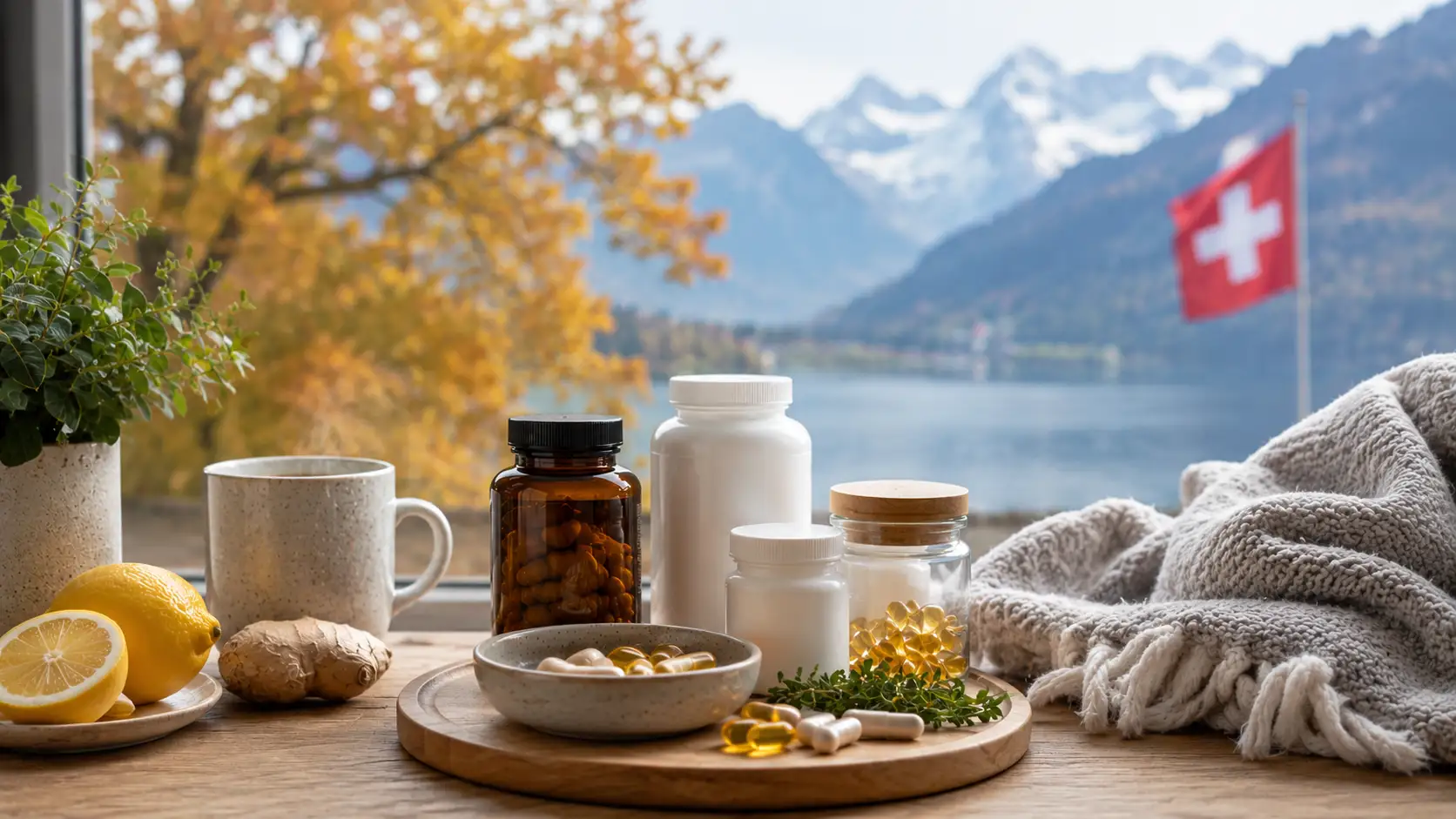
The passage from summer to autumn, then from winter to spring, changes brightness, temperature and the pace of life within a few weeks. In Switzerland, the high latitude and the long winter months reinforce these effects on health. In the world of the food supplement, the seasonal course is one of the most common situations, so much so that the topic comes up systematically when wondering when to opt for a course. The answer is not universal: it depends on the targeted nutrient, the personal profile and the scientific data available.
Why is the body more fragile at seasonal change?
What happens in the body between summer and winter?
The passage from summer to winter imposes two major adjustments on the body: the drop in natural light and the fall in temperature. These signals modify the circadian rhythm, the secretion of melatonin, sleep and mood. Serotonin, a precursor of melatonin, depends on the light captured by the retina; when the days shorten, its production decreases, which contributes to the drop in energy and the seasonal fatigue felt in autumn and early spring.
The infectious risk follows the same curve: the immune system is more heavily called upon during this period. Respiratory infections are more frequent between October and March, and vitamin D deficiency, strongly seasonal in Switzerland according to the FSVO[3], is associated with an increased risk of viral and bacterial infections documented by a systematic review published in Nutrients in 2023[1]. Added to this is the dryness of indoor air due to heating, which dries the respiratory mucous membranes and makes it easier for viruses to penetrate, hence the importance of preserving good hydration.
Why are 60% of Swiss people short of vitamin D in winter?
In Switzerland, about 60% of the population has an insufficient vitamin D level between December and March according to the FSVO[3]. The cause is geographical: at latitudes 46-47°N, the sun is too low for UVB rays to trigger the cutaneous synthesis of vitamin D during these months. Skin covered by clothing and time spent indoors amplify the gap, which creates an increased need for additional intake in winter.
A retrospective study carried out in 2021 on 8,861 inpatients in the canton of Basel-Country confirmed the scale of the deficit: 51% of subjects had a level below 50 nmol/L[4], the threshold deemed insufficient. A global meta-analysis published in 2023 in Frontiers in Nutrition, covering nearly 8 million participants, observed that the prevalence of the deficit in winter and spring is about 1.7 times higher than in summer and autumn[5]. The phenomenon is therefore not anecdotal.
Which courses are relevant in autumn and spring in Switzerland?
Which nutrients to target in autumn before winter?
Autumn is the most relevant window to prepare the body for the winter drop in vitamin D intake and to support fitness before the first cold spells arrive. The FOPH recommends, for adults aged 3 to 60 little exposed to the sun, an additional intake of 600 IU per day, and of 800 IU for those over 60[3]. A systematic review published in Nutrients in 2023 summarised the role of vitamin D in immune function: a blood status maintained above the recommended threshold is associated with better protection against viral and bacterial infections[1].
Other minerals and trace elements may round out the picture depending on the profile. The Swiss reference value for magnesium is 300 mg per day for women and 350 mg for men according to the SSN[7]. A randomised double-blind placebo-controlled trial published in Nutrients in 2022, conducted on patients with fibromyalgia, observed a reduction in stress score in the mild-to-moderate stress subgroup after one month of supplementation with 100 mg of magnesium daily[8].
Zinc is the subject of a Cochrane review published in 2024 covering 34 trials. Curative supplementation at the beginning of a cold is associated with a reduction in the average duration of symptoms of about two days[2], without a clear preventive effect on immunity having been established in healthy people.
Which nutrients to favour in spring?
In spring, the cutaneous production of vitamin D begins to recover, but the deficiency built up during winter takes several weeks to clear. A course of 4 to 8 weeks in March-April usefully prolongs the winter intake and helps to regain vitality, especially for little-exposed profiles (indoor work, covered skin). A persistent fatigue at the end of winter justifies medical advice and a possible iron and ferritin test, rather than an improvised course.
On the plant side, certain preparations used in the inter-seasons, birch sap, dandelion, artichoke, milk thistle, are studied for their effect on digestion or liver function, with no level of evidence equivalent to that of vitamin D supplementation. The FSVO recalls, moreover, that food supplements cannot make up for the gaps of a one-sided and unbalanced diet[9]. The term “detoxification”, often associated with these courses, has no validated medical definition: the liver and kidneys eliminate metabolic waste continuously without specific intervention.
Should you take a “detox” course at seasonal change?
No, not in the medical sense. No Swiss health authority recommends a seasonal “detoxification” protocol of the body, nor a detox course targeted at the elimination of toxins. The FSVO even specifies that food supplements are not intended for the prevention or treatment of human diseases[9]. The practices of mono-diets, juices, fasting or drainage fall under naturopathy and do not have a level of clinical evidence comparable to that which justifies a vitamin D supplementation in the Swiss winter.
This does not mean that a transition towards a healthy diet in autumn or spring is useless. Increasing the share of seasonal fruit and vegetables rich in antioxidants, favouring lightly processed foods, reducing ultra-processed products and monitoring water intake remains coherent with the Swiss food pyramid, updated in September 2024 by the SSN[10]. But an effective course targets a precise nutrient, not a vague goal of purification.
How to organise your seasonal course in practice?
When to start the course and for how long?
The autumn course ideally starts in September or in October, when the duration of sunshine drops below the threshold useful for the cutaneous synthesis of vitamin D. The FOPH recommends an additional vitamin D intake during the winter phase to adults little exposed to the sun[6], a period during which more than 60% of the population has a deficiency according to the federal data[3]. The spring course, shorter, starts in March-April: it extends winter coverage while waiting for the fair weather to restore endogenous production.
The duration of the programme varies according to the nutrient. For vitamin D, a daily intake throughout the winter period is consistent with the federal recommendations[3]. For magnesium or zinc, a 4 to 8-week course is enough in most common situations. Beyond 3 consecutive months, medical advice is useful to reassess relevance and rule out any possible interaction with a treatment.
What precautions should you take before starting?
Three precautions are needed before any seasonal course. First, check that the basic dietary intakes are covered: the 2024 Swiss food pyramid[10] remains the foundation, and a structural dietary deficit is not corrected by a one-off course. Then, choose a precise target nutrient; a complex or a “winter-autumn multivitamin” formula often contains low and redundant doses compared with a targeted supplementation[9].
Finally, certain situations require consulting a health professional before any intake: pregnancy, breastfeeding, regular medication, chronic illness (renal, hepatic, cardiovascular), child under 16 years old. A vitamin D blood test (25-OH-D) is useful before any prolonged high-dose supplementation, to avoid overdose.
To avoid
“Shock” doses of vitamin D (50,000 to 100,000 IU in a single intake) without medical supervision: they bring no benefit higher than a daily intake and expose you to a risk of hypercalcaemia. Iron supplementation without a prior test is also not recommended: an excess of iron favours oxidative stress.
Frequently asked questions on seasonal courses in Switzerland
How often should you take a seasonal course in Switzerland?
Two moments are enough for most adults: autumn (September-October) and spring (March-April). These windows match the brightness transitions that change the cutaneous production of vitamin D and the circadian rhythm. Vitamin D is the exception: the FOPH recommends an extra intake during the winter phase for adults little exposed to the sun. A one-off course always remains secondary to a balanced diet and regular physical activity.
Does a seasonal course replace a balanced diet?
No, never. The FSVO recalls that food supplements cannot make up for an unbalanced diet. They target a specific intake over a limited period, typically 4 to 8 weeks, when diet alone is not enough, such as vitamin D in the Swiss winter. The 2024 Swiss food pyramid remains the foundation: fruit, vegetables, whole grains, dairy products, varied protein sources. A course should be discussed with a professional if symptoms persist.
Vitamin D: which dose for an adult in Switzerland in winter?
The FOPH recommends 600 IU per day for adults from 3 to 60 years old in case of insufficient sun exposure, and 800 IU for those over 60. This dose aims at a blood level above 50 nmol/L. People with dark skin, pregnant women or those little exposed to the sun may need higher doses on medical advice. A blood test (25-OH-D) allows for fine-tuning before any prolonged high-dose intake.
Can you take a seasonal course during pregnancy?
Not without medical advice. Pregnancy changes the needs for several nutrients, iron, iodine, folates, vitamin D, and certain plants or doses are contraindicated. The Federal Nutrition Commission recommends, for pregnant women, a targeted supplementation according to the clinical profile, never a generic naturopathy protocol. A consultation with a doctor or a midwife remains essential before any food supplement intake during pregnancy or breastfeeding.
Should you consult before starting a seasonal course?
For vitamin D at a moderate dose (600-800 IU/day) in a healthy adult, the course can be considered without prior consultation. On the other hand, medical advice is needed in case of a chronic illness, ongoing medication, pregnancy, breastfeeding, or for high doses. A Swiss pharmacist or drugstore specialist can guide on the dosage forms and the common doses. Children always come under the paediatrician, who follows the Swiss paediatric recommendations.
Sources and references
10 sources- Wimalawansa SJ, Infections and Autoimmunity: The Immune System and Vitamin D, A Systematic Review
- Nault D et al., Zinc for prevention and treatment of the common cold
- FSVO, Recommendations concerning vitamin D
- Benhamou J et al., Prevalence of vitamin D deficiency in an inpatient population in the Swiss Canton of Basel-Country
- Cui A et al., Global and regional prevalence of vitamin D deficiency in population-based studies from 2000 to 2022
- FOPH, Vitamin D intake: recommendations for the Swiss population
- SSN / SSNS, Magnesium (Mg) information sheet
- Macian N et al., Short-Term Magnesium Therapy Alleviates Moderate Stress: Randomized Double-Blind Trial
- FSVO, Food supplements: a use reserved for certain situations
- SSN, Swiss nutritional recommendations (food pyramid)