
Which whey protein should you choose?
Quick summary
The right product depends first on your tolerance and your goals: isolate or hydrolysate for stomachs sensitive to lactose, concentrate for good value for money. Purity can be read on the label; the “grass-fed” claim and flavour remain bonuses, not decisive criteria.
Key facts
Key points
- The form (concentrate, isolate, hydrolysate, native) is chosen according to lactose tolerance and budget.
- Purity is read on the label: high protein content, few additives, third-party testing.
- Grass-fed milk brings a slight nutritional bonus, without being decisive.
- For a child, priority goes to solid food; any supplement should be decided with a healthcare professional.
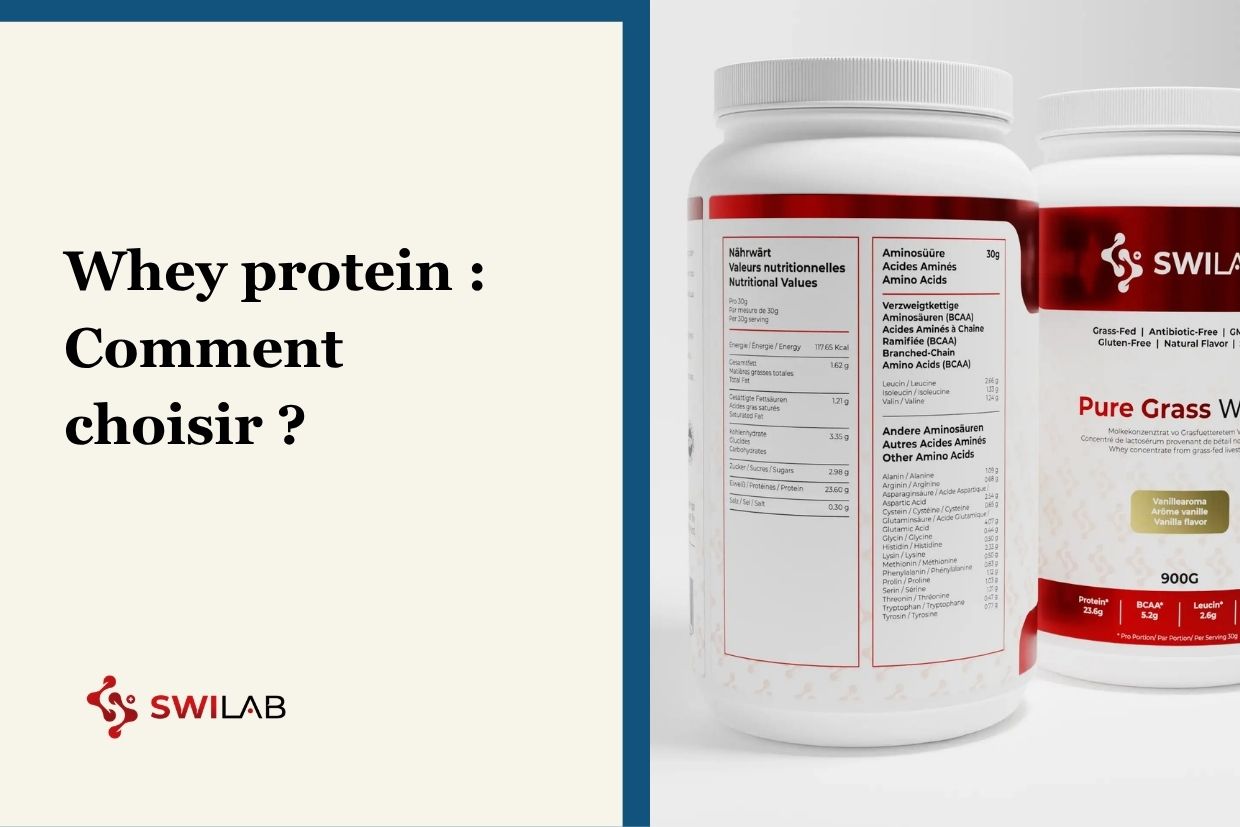
Whey protein, a protein derived from whey, is widely adopted by anyone looking to enrich their diet with protein: athletes and non-athletes alike. But the range is vast, and a single shelf brings together very different products. This page, the entry point to our complete guide to whey protein, reviews the criteria that really matter: form, purity, milk origin, flavour, lactose-free options and the specific case of children.
What are the different forms of whey available?
Whey comes in several forms with distinct characteristics that influence digestion, price and use. The right choice depends mainly on your digestive tolerance and your budget, not on a supposed hierarchy of quality.
Whey concentrate
Whey concentrate is often the most affordable and contains around 70 to 80% protein. It retains some lactose and fat, which may suit anyone seeking a slightly higher calorie intake. If you are lactose intolerant, it is better to explore other options.
Whey isolate
Isolate undergoes an additional filtration process that removes almost all the lactose and fat, for a protein content above 90%. It is a logical choice for a strict diet or digestive sensitivities.
Whey hydrolysate
Hydrolysate is pre-digested into shorter peptides for rapid absorption. This speed is useful for recovery, but it often comes with a higher cost and no clear advantage for most users.
Native whey
Native whey is obtained directly from milk by gentle microfiltration, which preserves the protein structure. For anyone wanting to limit industrial processing, it is an appealing option: often positioned as premium. Each form is explained in detail in the article on the forms of whey available on the market.
| Form | Protein | Lactose / fat | Profile |
|---|---|---|---|
| Concentrate | 70-80% | present | affordable, versatile |
| Isolate | > 90% | near zero | digestive sensitivities |
| Hydrolysate | high | low | rapid absorption, more expensive |
| Native | high | variable | minimally processed, premium |
How to check the purity of your whey
Purity cannot be guessed from the brand name: it must be checked. Three concrete markers make it possible to judge a product without relying on marketing.
A transparent label
Read the label: a quality product clearly states its ingredients, a high protein content per serving and few additives or fillers. Be wary of long lists of flavourings and sweeteners.
Certifications and labels
Labels such as “Grass-Fed”, ISO or NSF can attest to a rigorous manufacturing process, provided they are issued by recognised bodies. They tell you more about the process than about absolute nutritional value.
Independent testing
Some brands submit their batches to independent testing to confirm the absence of contaminants (heavy metals, microbial contaminants) and verify the stated protein content. These checks are covered in detail in the article dedicated to checking the purity of whey.
- 1Check the proportion of protein relative to carbohydrates and fat.
- 2Make sure there are no unnecessary additions (artificial colourings, excess sweeteners).
- 3Favour products subjected to traceable independent testing.
Which flavour is the most popular?
Flavour has no effect on effectiveness, but it shapes adherence: a protein you enjoy drinking is one you consume regularly. The classic chocolate and vanilla still dominate, followed by bolder flavours (salted caramel, mocha coffee, exotic fruits).
Above all a matter of preference
Preferences are shaped by habits and culture, and each brand interprets the same flavour differently. The point, then, is to try several options to find the one that combines taste enjoyment and digestive comfort. For an overview of tastes and trends, see the article on the most popular whey flavours.
Should you favour grass-fed milk?
Whey from grass-fed milk is often highlighted for its nutritional profile: a little more omega-3 and conjugated linoleic acid (CLA), and more environmentally friendly farming practices. It is a worthwhile bonus, but the nutritional difference remains modest on the scale of a serving.
A measured advantage, not a decisive one
This criterion makes the most sense if you care about environmental issues or are looking for the most natural source possible. Check that the “grass-fed” claim is certified by a recognised label. The detailed arguments are set out in the article on whey from pasture-fed milk.
Key point
The “grass-fed” label is a quality and ethical bonus, not a criterion that transforms the effectiveness of whey. Form and tolerance come first.
Is there a lactose-free whey?
Yes. For people who are lactose intolerant, several solutions allow them to enjoy whey without digestive discomfort. Isolate, which is advanced-filtered, contains less than 1% lactose; hydrolysate breaks down the proteins and reduces residual lactose; and some formulas are explicitly guaranteed lactose-free.
Choosing a suitable formula
Look for the wording “sans lactose” or “lactose-free”, and check the nutritional profile and the ingredient list. The alternatives and their advantages are detailed in the article on lactose-free whey for the intolerant.
In case of allergy
Lactose intolerance is not a milk protein allergy. If you have a confirmed milk protein allergy, whey should still be avoided: seek the advice of a healthcare professional.
What criteria for a whey suited to children?
In children, nutritional needs differ from those of adults and are, in the vast majority of cases, met by a varied diet. A protein supplement is only worthwhile in specific situations and must remain supervised.
Composition and tolerance
If a whey is being considered, favour a complete profile of essential amino acids, a low added-sugar content and reliable sources, with no superfluous additives. In case of sensitivity, a low-lactose option (isolate) is preferable.
A professional’s advice first
Before introducing whey into a child’s diet, the advice of a paediatrician or a nutritionist is essential to assess the relevance and safety of this intake. The criteria are explained in the article on choosing a whey suited to children.
Frequently asked questions about choosing whey
Which is the best whey protein to choose?
The choice of the best whey protein depends on your goals, your type of training and your dietary preferences. SwiLab offers a varied range of high-quality whey proteins suited to supporting muscle growth and recovery. Isolate proteins, for example, are good for those seeking a reduced lactose and fat content.
Can whey protein replace a meal?
Whey protein is a dietary supplement and should not replace a full meal. It can, however, be used between meals to increase protein intake or after exercise to stimulate muscle recovery. SwiLab offers proteins that mix easily into nutritious shakes to incorporate into a balanced diet.
What are the advantages of whey isolate?
Whey isolate is a form of whey protein that has undergone processing to remove most of the carbohydrates and fats, retaining a high protein concentration. This makes it ideal for people following a low-lactose diet or seeking to minimise their fat intake. SwiLab offers quality whey isolates with high absorption to maximise post-workout benefits.
When should I consume whey protein?
Whey protein is often consumed after exercise to help with muscle recovery thanks to its rapid absorption. It can also be taken in the morning to complement breakfast, or between meals to maintain a high level of protein. SwiLab products are designed to be flexible and can easily fit into your daily schedule.
Does whey protein have any side effects?
Whey protein is generally well tolerated, but some people may experience digestive discomfort, especially if they are lactose intolerant. SwiLab offers whey isolate options that are low in lactose, thereby reducing the risk of discomfort. As with any dietary supplement, it is advisable to start with a small dose to assess individual tolerance.
Sources & references
4 sources- Jäger R, et al., International Society of Sports Nutrition Position Stand: protein and exercise
- Morton RW, et al.: A systematic review, meta-analysis and meta-regression of the effect of protein supplementation on resistance training-induced gains in muscle mass and strength in healthy adults
- Devries MC, Phillips SM, Supplemental protein in support of muscle mass and health: advantage whey
- Regulation (EU) No 432/2012, list of permitted health claims on foods