
Helicobacter pylori: Symptoms and the Role of Probiotics
In brief
Most people infected with Helicobacter pylori feel nothing. When signs do appear, they are mainly digestive discomfort: pain in the pit of the stomach, nausea, bloating. The real risk is an ulcer and, in the long term, stomach cancer. Treatment relies on antibiotics; probiotics only play a supporting role.
Key facts
Key points
- Most infections are symptomless: only a test confirms the bacterium.
- The most common symptom is persistent digestive discomfort in the pit of the stomach.
- H. pylori is the leading risk factor for stomach ulcer and stomach cancer.
- Treatment relies on antibiotics; a follow-up test confirms the cure.
- As an add-on, probiotics improve eradication and reduce side effects: never instead of treatment.
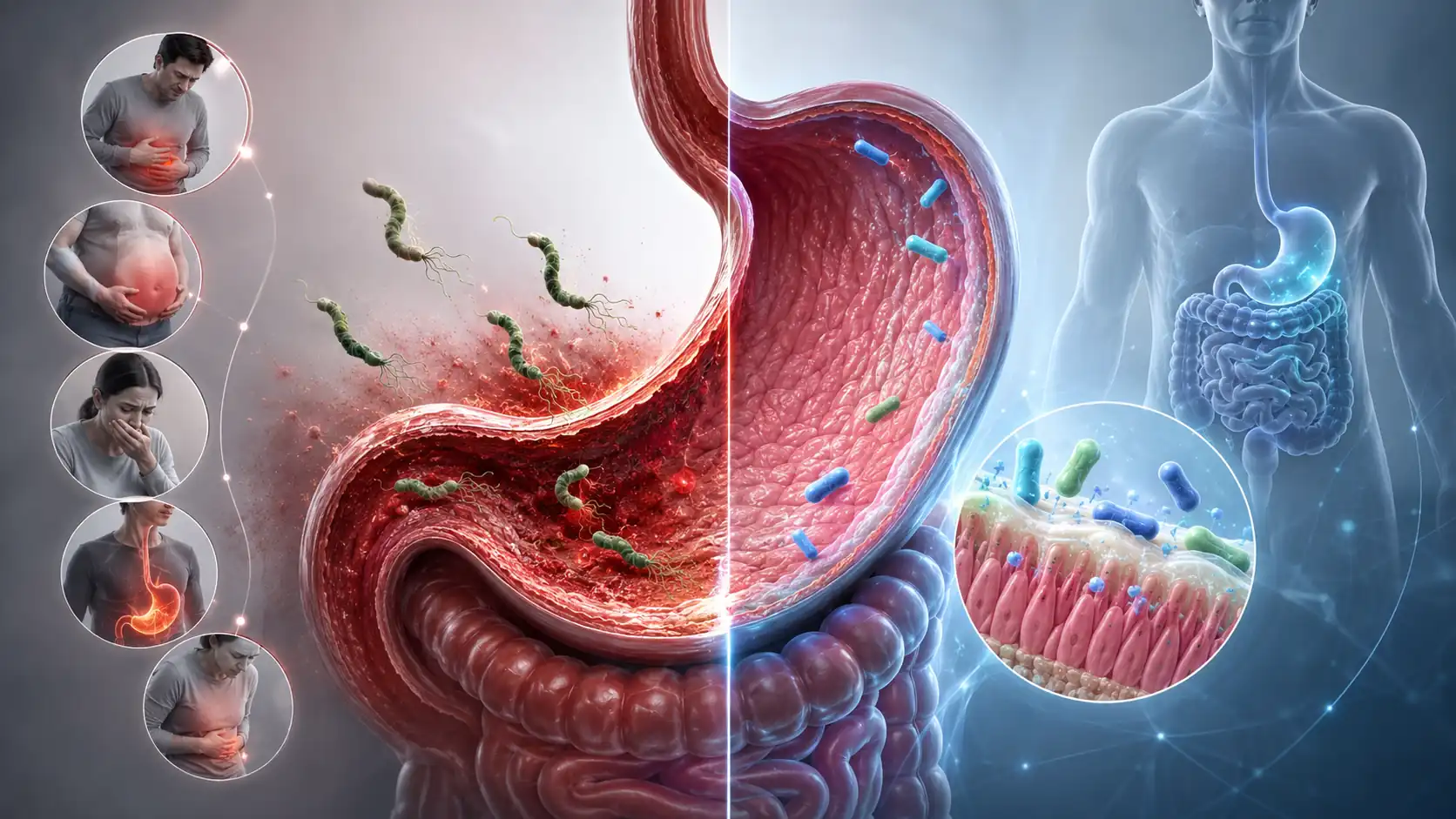
Helicobacter pylori, sometimes called the stomach germ, is a bacterium that settles permanently in the human stomach. One of the most common stomach infections, it affects around 4 in 10 adults worldwide[1], yet most infected people feel nothing. When symptoms do appear, they resemble ordinary digestive complaints: pain in the pit of the stomach, nausea, bloating.
The real issue is not the discomfort, but, in a minority of cases, an ulcer and stomach cancer. This article reviews the symptoms, diagnosis, treatment and the genuine role of probiotics, which only provide support, never a substitute for medical treatment.
What is Helicobacter pylori, and is it dangerous?
A bacterium that colonises the stomach
Helicobacter pylori is a spiral-shaped, gram-negative, microaerophilic bacterium that colonises the epithelial cells of the stomach lining (the gastric mucosa). It produces an enzyme, urease, which neutralises the stomach acid around it and lets it survive in this hostile environment. Once it has infected the lining, it causes a discreet but persistent inflammation of the stomach: chronic gastritis.[2]
The infection affects a large part of the world’s population: a wide-ranging analysis published in 2024 estimates its prevalence in adults at nearly 44%.[1] It spreads from person to person through close contact, mainly in childhood and within the family: oral-oral (saliva), faecal-oral (contaminated water or food) or gastro-oral (vomit). Certain strains carrying the CagA virulence factor are linked to a higher risk of complications.[2]
Why it shouldn’t be overlooked
For the vast majority of carriers, the infection will never cause serious illness. It is not harmless, however: the chronic inflammation favours a peptic ulcer, of the stomach or the duodenum, in some people. An ulcer can rarely be complicated by bleeding or a perforation: an emergency that may require surgery. Above all, H. pylori is the leading risk factor for stomach cancer (gastric cancer), and the World Health Organization classifies it as a proven carcinogen for humans.[2]
These figures describe a population-level risk, not an individual fate. Most infected people will never develop cancer, and eliminating the bacterium lowers this cancer risk.[2]
What are the symptoms of Helicobacter pylori?
The most common digestive signs
Most infected people have no symptoms.[2] When complaints do appear, they almost always take the form of dyspepsia: digestive discomfort centred on the upper abdomen (stomach pain). These signs are non-specific, hence the importance of a test to confirm the infection.[4]
| Sign | Description | Frequency |
|---|---|---|
| Epigastric pain | Pain or burning in the pit of the stomach, sometimes at night | Common |
| Nausea, bloating | Nausea, a bloated feeling, slow digestion | Common |
| Early fullness | Feeling full after the first few bites, belching | Common |
| Loss of appetite | Reduced appetite accompanying the discomfort | Variable |
Helicobacter pylori and fatigue
Fatigue is not a direct symptom of the infection, but it can result from it. When the bacterium causes gastritis or an ulcer, repeated small bleeds or poorer absorption of iron and vitamin B12 can lead to anaemia, which shows as tiredness and pallor.[2]
When to seek help quickly
Unexplained weight loss, repeated vomiting, blood in the vomit or black, tar-like stools, difficulty swallowing or anaemia call for prompt medical advice: they may signal an ulcer or a complication.[2]
How to find out if you’re infected, and how to treat it
Diagnosis: breath test or stool test
A simple test is usually enough: an endoscopy is not essential to confirm the infection. Two non-invasive examinations serve as the reference, both reliable and painless.[2]

| Examination | Principle | When it is used |
|---|---|---|
| Urea breath test | You blow into a tube before and after drinking a solution; a change in the exhaled air reveals the bacterium | Diagnosis and follow-up after treatment |
| Stool antigen test | A stool sample is analysed in a laboratory to detect the bacterium | Diagnosis and follow-up after treatment |
| Endoscopy with biopsy | A thin camera examines the stomach and allows a fragment of lining to be sampled | In case of warning signs or after age 50 |
Some medicines distort the results: stomach protectors (proton pump inhibitors, PPIs), which reduce stomach acid production, must generally be stopped two weeks before the test, and antibiotics four weeks before.[5] It is the doctor, general practitioner or gastroenterologist, who prescribes the examination and interprets the result.
The standard treatment
Treatment of the infection relies on a combination of several medicines taken together for ten to fourteen days: two antibiotics (sometimes three) and a stomach protector, often supplemented with bismuth. This approach, triple therapy or bismuth “quadruple therapy” depending on the case, is now preferred as first-line treatment in line with international guidelines.[14][15] A follow-up test, at least four weeks after the end, confirms that the infection has cleared.[5]
The challenge of resistance
The bacterium is becoming less sensitive to certain antibiotics, particularly clarithromycin, causing some treatments to fail.[5] Added to this are common side effects, diarrhoea, metallic taste, nausea, that sometimes lead to stopping too early. This is where probiotics have been studied as support.
The role of probiotics against Helicobacter pylori
How they work, and what difference they make
Probiotics are live micro-organisms that, taken in sufficient amounts, have a beneficial effect on the body. In the laboratory they compete with H. pylori, hinder its attachment to the stomach wall, produce antibacterial substances and soothe the inflammation of the lining.[6] On their own they do not eliminate the bacterium; added to treatment, however, they bring two measured benefits.
The second benefit is the most consistent: pairing the antibiotics with a probiotic markedly reduces the frequency of side effects, particularly diarrhoea.[8][11] Better tolerated, the treatment is more often completed by patients, which indirectly helps to eliminate the bacterium more effectively.
Which strains are best studied?
The effect depends on the precise strain: not all probiotics are equal. Three avenues stand out from the clinical trials.
| Strain | What the research shows | Level of evidence |
|---|---|---|
| Lactobacillus reuteri | In one trial, the eradication rate rose from about 69% to 91%, with fewer digestive complaints[9] | Promising[10] |
| Saccharomyces boulardii | This yeast improves eradication and reduces the side effects of antibiotics[11] | Consistent |
| Multi-strain blends | Several combinations of lactic ferments are among the most effective, for both eradication and tolerability[7] | Consistent |
Diet, hygiene and pitfalls to avoid
Foods studied and good reflexes
No food eliminates H. pylori on its own, and no diet replaces treatment. Some foods and habits are nonetheless being studied as an add-on, with modest results.
- 1Broccoli sprouts, rich in sulforaphane, reduced the amount of bacteria in a human trial: without, however, eliminating it.[12]
- 2Certain polyphenols (green tea, cranberry, turmeric) might slightly improve treatment results when added to it.[13]
- 3Limiting alcohol, tobacco and the prolonged use of anti-inflammatories (without medical advice) protects the stomach lining.
- 4Hand washing and clean drinking water remain the best prevention against transmission of the bacterium.[2]
The right reflex
Faced with persistent digestive complaints, the useful reflex is not self-medication but a test, on medical prescription. You will know whether H. pylori is involved and get the right treatment, rather than supplements that do not eliminate it.
Pitfalls to avoid
- “Eliminates H. pylori naturally” or “without antibiotics”: not demonstrated.
- “Detox cure that heals the infection”: misleading and, for a supplement, legally prohibited.
- Replacing the prescribed antibiotic treatment with supplements: risky and counterproductive.
Frequently asked questions
Can you get rid of Helicobacter pylori for good?
Yes. A properly conducted antibiotic treatment eliminates the bacterium in the vast majority of cases, and a follow-up test confirms it. In adults, re-infection after cure is rare. If the first treatment fails, often because of antibiotic resistance, the doctor suggests a suitable second course.
Can probiotics eliminate Helicobacter pylori on their own?
No. No data show that probiotics eliminate the bacterium without antibiotics. Added to treatment they slightly improve the chances of success and reduce side effects, but they are not a substitute treatment.
Is Helicobacter pylori contagious within a couple or family?
The bacterium is passed from person to person, mainly within the household and in childhood. Transmission between cohabiting adults is possible but less common. In case of a confirmed infection, the doctor assesses case by case whether close contacts should be tested.
Does Helicobacter pylori cause a bloated stomach?
It can contribute to it. Bloating is among the complaints sometimes linked to the infection, but it is very common and non-specific: only a test shows whether Helicobacter pylori is the cause.
Does Helicobacter pylori cause fatigue?
Not directly. Fatigue, when it occurs, is usually the result of anaemia linked to digestive bleeding or to poorer absorption of iron and vitamin B12. Persistent fatigue with digestive complaints warrants a medical check-up.
What should you eat when you have Helicobacter pylori?
There is no miracle diet. A balanced diet, limiting alcohol, tobacco and foods that worsen the discomfort, protects the lining during treatment. Some foods such as broccoli or green tea are studied as an add-on, but they do not replace the prescribed antibiotics.
Sources and references (verified on PubMed)
15 sources- Chen Y.-C. et al. (2024). Global prevalence of Helicobacter pylori infection and incidence of gastric cancer between 1980 and 2022.
- Malfertheiner P. et al. (2023). Helicobacter pylori infection.
- Collatuzzo G. et al. (2025). Burden of gastric cancer attributable to Helicobacter pylori in 27 countries.
- Rosenstock S. et al. (1997). Relation between Helicobacter pylori infection and gastrointestinal symptoms and syndromes.
- Malfertheiner P. et al. (2022). Management of Helicobacter pylori infection: the Maastricht VI/Florence consensus report.
- Keikha M., Karbalaei M. (2021). Probiotics as the live microscopic fighters against Helicobacter pylori gastric infections.
- Tanashat M. et al. (2024). Efficacy of probiotics regimens for Helicobacter pylori eradication: a network meta-analysis of RCTs.
- Yang Z. et al. (2024). The effects of probiotics supplementation on Helicobacter pylori standard treatment: an umbrella review.
- Ismail N.I. et al. (2023). Probiotic containing Lactobacillus reuteri DSM 17648 as an adjunct treatment for Helicobacter pylori infection.
- Li M. et al. (2024). Lactobacillus reuteri compared with placebo as an adjuvant in Helicobacter pylori eradication therapy: a meta-analysis.
- Liu Y. et al. (2025). The impact of probiotics on Helicobacter pylori eradication with bismuth quadruple therapy: a meta-analysis.
- Yanaka A. et al. (2009). Dietary sulforaphane-rich broccoli sprouts reduce colonization and attenuate gastritis in Helicobacter pylori-infected mice and humans.
- Wang Q. et al. (2023). Effect of polyphenol compounds on Helicobacter pylori eradication: a systematic review with meta-analysis.
- Chey W.D. et al. (2024). ACG Clinical Guideline: Treatment of Helicobacter pylori Infection.
- Fallone C.A. et al. (2016). The Toronto Consensus for the Treatment of Helicobacter pylori Infection in Adults.