
Which supplements for bone health?
Quick summary
Without a deficiency, taking calcium and vitamin D changes mineral density very little in the general population; in older adults with deficiency, it reduces the risk of fracture.
Key facts
Key points
- The FOPH recommends 800 IU of vitamin D for people aged 60 and over, and 600 IU for children and adolescents.
- A meta-analysis of 11 trials on 43,869 postmenopausal women (Cong et al.) shows a modest improvement in pelvic density with calcium + vitamin D, with no clear drop in the number of fractures.
- The VITAL trial (25,871 healthy adults, NEJM) finds no reduction in fractures in non-deficient subjects on 2,000 IU daily of vitamin D.
- In institutionalised and deficient older adults, the combination of calcium + vitamin D reduces the number of fractures (meta-analysis of 19 trials, 69,234 participants).
- In winter, more than 60% of the Swiss population shows vitamin D deficiency according to data from the Federal Office of Public Health.
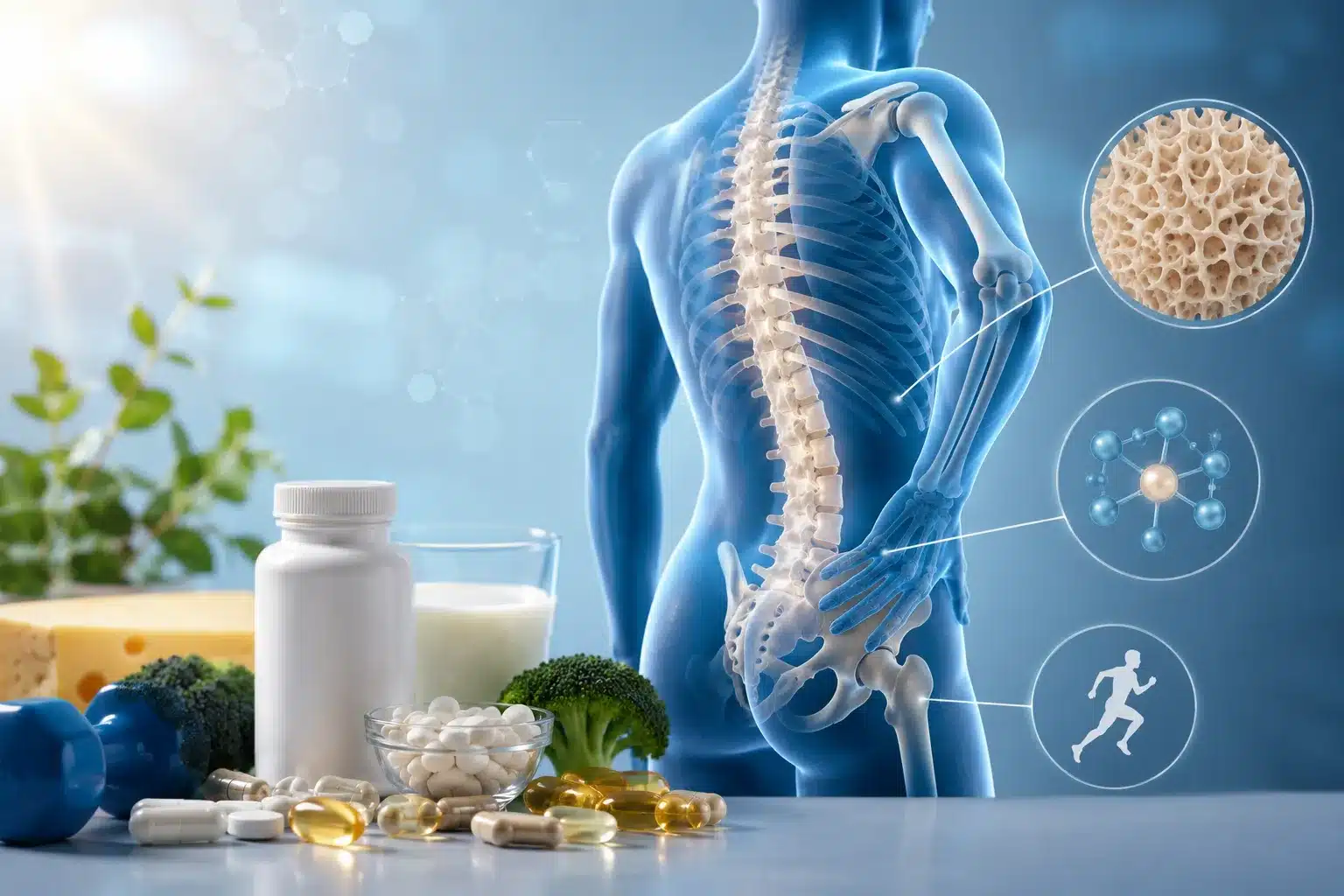
More than 60% of the Swiss population shows a vitamin D deficiency during winter, according to data from the Federal Office of Public Health. On the food supplement shelf, calcium, vitamin D and vitamin K2 occupy a central place among the proven benefits. But between label promises and the conclusions of recent meta-analyses, the reality is more nuanced: supplementation helps some people but remains useless, even risky, for others. This article takes stock of what clinical studies published between 2022 and 2026 actually demonstrate.
Which nutrients influence bone health?
Do calcium and vitamin D form the basic duo?
Together, these minerals maintain the balance needed for skeletal strength, especially after age 50, the period when loss of bone mass accelerates. The adult skeleton contains around 1 kg of calcium, of which 99% is stored in the bones; the remainder circulates in the blood and contributes to muscle contraction and blood clotting. Vitamin D, synthesised by the skin during sun exposure, promotes calcium absorption by the intestine. Without it, even a correct calcium intake remains partly useless. The FOPH notes that in winter, more than 60% of adults show a blood level of 25-hydroxyvitamin D below the recommended threshold of 50 nmol/l[10]. This vitamin is also involved in maintaining the immune system and in the normal functioning of the body.
Does vitamin K2 have a distinct role?
Vitamin K2 activates two key proteins (osteocalcin and matrix-Gla protein) that direct calcium fixation onto the bones and limit its deposition in the arteries, contributing to the mineralisation of the skeleton. A meta-analysis of 16 trials on 6,425 postmenopausal women (Ma et al., 2022)[5] confirms an improvement in lumbar spine density with vitamin K2 supplementation. A more recent meta-analysis (Zhang et al., 2025, Frontiers in Endocrinology)[6] confirms a favourable effect on the biological markers of bone remodelling, but stresses that the direct impact on fracture prevention remains to be confirmed by longer-term trials. Proteins, magnesium and zinc contribute to the bone matrix, but their isolated supplementation has not shown an effect of its own on density in adults without deficiency. Manganese and other trace elements are involved at lower doses in the metabolism of bone tissue.
What effect on density and fracture risk?
Do they really improve bone mineral density?
The effect is real but moderate. A recent meta-analysis of 11 trials on 43,869 postmenopausal women (Cong et al., 2025)[1] finds a slight but measurable improvement in pelvic density thanks to the calcium + vitamin D combination, with no net gain at the lumbar spine or femoral neck. This improvement corresponds to a slowing of natural resorption rather than a spectacular gain. Another meta-analysis of 13 trials (Bai et al., 2025, Nutrients)[2] shows that combining supplementation with physical activity, especially whole-body vibration or Baduanjin, markedly increases lumbar spine and femoral neck density in postmenopausal women, and slows mineral loss linked to menopause. The most marked gains appear between 3 and 6 months of combined intervention. Beyond 12 months, the effect plateaus. Regular weight-bearing exercise helps to strengthen the bones and supports bone capital throughout life.
Do they prevent fractures?
Not in the general population without deficiency. The VITAL trial (25,871 healthy adults, LeBoff et al., New England Journal of Medicine, 2022)[4] showed no reduction in total, non-vertebral or hip fractures with 2,000 IU daily of vitamin D alone, regardless of baseline status. In institutionalised and deficient older adults, however, the calcium + vitamin D combination remains useful for preserving the skeleton: a meta-analysis of 19 trials on 69,234 older subjects (Jiao and Jiang, 2024)[3] shows a reduction in the number of fractures, an increase in mineral density and a normalisation of the blood level of 25-hydroxyvitamin D. The benefit therefore depends heavily on baseline nutritional status: an adult with sufficient intake will gain practically nothing from taking an additional supplement. Lifestyle, regular physical activity, stable body weight, balanced diet, weighs more than supplementation alone.
Which doses to choose according to Swiss recommendations?
What do the FOPH, the FSVO and the SVGO recommend?
The FOPH and the FSVO recommend 600 IU of vitamin D for children and adolescents, and 800 IU from age 60[10]. The Swiss Association against Osteoporosis (SVGO/ASCO), in its 2025 recommendations, targets an intake of 1,000 to 1,200 mg of calcium and 800 IU of vitamin D for people at risk of osteoporosis[11]. These thresholds aim at a serum level of 25-hydroxyvitamin D above 50 nmol/l, considered sufficient to preserve the skeleton. Intake is preferably taken with a meal containing fats, which improves absorption: the dosage form matters less than this timing: capsule, tablet or softgel give equivalent results at the same dose. For calcium, the priority remains diet: a plain yoghurt provides around 150 mg, a glass of milk 250 mg, a 30 g piece of gruyère about 300 mg. Lactose-intolerant people will turn to fortified plant-based drinks, sardines with bones or certain mineral waters.
How to meet needs through diet first?
Two to three servings of dairy products supply about 1,000 mg of calcium; 20 minutes of sun exposure (face and arms) in summer covers vitamin D needs for an adult. For proteins, the recommendation targets 0.8 g per kilo of body weight per day in adulthood, and 1 to 1.2 g/kg after age 65, according to the European recommendations coordinated by Geneva University Hospitals (Chevalley et al., ESCEO 2022)[9]. A rich and varied diet forms the foundation of a strong skeleton: calcium-rich foods such as canned sardines with bones, tofu fortified with calcium sulphate, certain Swiss and French mineral waters (above 300 mg/l) and almonds round out intake. Leafy green vegetables such as kale, as well as fresh seasonal fruits, provide magnesium and complementary vitamins. In winter, the skin no longer synthesises enough vitamin D: supplementation or fortified foods make up this seasonal shortfall, particularly for older people, women who cover their hair and dark-skinned subjects.
What precautions before supplementing?
What risks in case of overdose?
Overdose of vitamin D leads to hypercalcaemia (excess calcium in the blood) and a danger of kidney stones; excess calcium increases constipation and, according to several observational studies, may weigh on cardiovascular health. The upper tolerable limit is set at 4,000 IU daily for vitamin D and 2,500 mg for calcium in adults, according to the European Food Safety Authority (EFSA)[12]. Beyond that, the benefit-risk balance is reversed. A meta-analysis of 14 trials on 985 kidney transplant recipients (Cai et al., 2025)[7] reports that supplementation increases the danger of hypercalcaemia without a clear benefit on overall skeletal density or fracture prevention. For any prolonged intake, an annual blood test for 25-hydroxyvitamin D and serum calcium remains essential to avoid this kind of problem. The quality of the product chosen, its origin and the declaration of doses on the label help to make daily intake safer.
Should supplements be distinguished from medical treatment?
Yes, formally. Food supplements cover nutritional needs but do not treat established osteoporosis. A skeletal fragility confirmed by bone densitometry (T-score below -2.5) requires specific drug management, bisphosphonates, denosumab, raloxifene or teriparatide, prescribed after assessment. A network meta-analysis of 17 trials on 6,932 patients treated for breast cancer (Xu et al., 2026, Frontiers in Oncology)[8] shows that all active drugs clearly outperform calcium + vitamin D alone for preventing mineral loss. In practice, the supplement accompanies the medicine but never replaces it; formulas aimed at strengthening joints or relieving joint pain also do not act on the deep fragility of the skeleton. A medical consultation is required after a low-energy fall followed by a fracture, in cases of persistent joint or bone pain, or where aggravating factors are present (prolonged corticosteroid therapy, early menopause, family history, rheumatoid arthritis). It is best to consult a healthcare professional before starting any course.
Frequently asked questions on supplements and bone health
What is the best food supplement for bones?
No supplement is universally “the best”; the right choice depends on the deficiency identified. The duo of calcium 1,000-1,200 mg + vitamin D3 800 IU daily remains the standard in older adults. A meta-analysis of 19 trials on 69,234 older people (Jiao and Jiang, 2024)[3] confirms a reduction in fractures with this duo when there is a deficiency. Vitamin K2 (45 mcg/day of MK-7) may be added in postmenopausal women. For any prolonged intake, an annual blood test prevents overdose.
Which vitamin rebuilds bone density?
Vitamin D3 (cholecalciferol), provided the person is deficient to start with. It controls intestinal absorption of calcium and directs its fixation onto bone. The FOPH recommends 600 IU daily for children and adolescents, and 800 IU from age 60[10]. The VITAL trial (25,871 adults without deficiency, NEJM 2022)[4] nevertheless showed that vitamin D alone does not reduce fractures in non-deficient subjects. Supplementation therefore primarily targets people whose blood level is below 50 nmol/l.
Which food supplement should you take for osteoporosis?
In confirmed osteoporosis, calcium and vitamin D are systematically combined with medical care, never used on their own. The SVGO (Swiss association against osteoporosis) recommends 1,000 to 1,200 mg of calcium and 800 IU of vitamin D daily[11]. A network meta-analysis (Xu et al., 2026, 17 trials, 6,932 patients)[8] shows that active drugs (bisphosphonates, denosumab) far outperform supplementation alone for the prevention of fractures. Any initiative must be validated by a doctor after bone densitometry.
How can you recover bone density quickly?
No spectacular gain is realistic: mineral density evolves over months, not weeks. The fastest lever combines weight-bearing physical activity (walking, strength training, whole-body vibration) and targeted calcium-vitamin D supplementation. A meta-analysis of 13 trials in postmenopausal women (Bai et al., 2025)[2] shows that the most marked gains appear between 3 and 6 months of combined intervention. Beyond that, the effect plateaus. In confirmed fragility, the doctor may prescribe an anabolic agent such as teriparatide, which acts more quickly.
Are there any risks in taking supplements for bones?
Yes, in cases of prolonged overdose. Excess calcium (above 2,500 mg daily) increases the danger of kidney stones and, according to several studies, may raise cardiovascular events. Excess vitamin D (above 4,000 IU according to EFSA)[12] causes hypercalcaemia. A meta-analysis of 14 trials in kidney transplant recipients (Cai et al., 2025)[7] confirms this risk of hypercalcaemia. For any intake longer than 3 months, an annual blood test for vitamin D and serum calcium is advised, especially in people with impaired kidney function.
Sources and references
12 sources- Cong B, Zhang H. The effects of combined calcium and vitamin D supplementation on bone mineral density and fracture risk in postmenopausal women with osteoporosis: a systematic review and meta-analysis of randomized controlled trials.
- Bai J, Huang W, Yan R, Du X. Effects of Combined Exercise and Calcium/Vitamin D Supplementation on Bone Mineral Density in Postmenopausal Women: A Systematic Review and Meta-Analysis.
- Jiao D, Jiang C. Nutritional therapy of older osteoporotic people with supplemental calcium and vitamin D: side effects, fracture rates, and survival, an internationalised meta-analysis.
- LeBoff MS, Chou SH, Ratliff KA, et al. Supplemental Vitamin D and Incident Fractures in Midlife and Older Adults (VITAL trial).
- Ma ML, Ma ZJ, He YL, et al. Efficacy of vitamin K2 in the prevention and treatment of postmenopausal osteoporosis: A systematic review and meta-analysis of randomized controlled trials.
- Zhang Z, Li Y, Li J, et al. The effect of vitamin K2 supplementation on bone turnover biochemical markers in postmenopausal osteoporosis patients: a systematic review and meta-analysis.
- Cai P, Shu Z, Zhou T, et al. Effects of vitamin D supplements on bone metabolism in kidney transplant recipients: a systematic review and meta-analysis.
- Xu Y, Lai J, Mai M, Tang Y, Wu Z. Comparative effectiveness of bone-protective interventions for aromatase inhibitors-induced bone loss in postmenopausal women with early breast cancer: a network meta-analysis.
- Chevalley T, Brandi ML, Cashman KD, et al. Role of vitamin D supplementation in the management of musculoskeletal diseases, ESCEO recommendations (working group coordinated by Geneva University Hospitals).
- Federal Food Safety and Veterinary Office (FSVO). Recommendations on vitamin D.
- Swiss Association against Osteoporosis (SVGO/ASCO). Osteoporosis: 2025 recommendations, prevention, diagnosis, treatment.
- EFSA Panel on Nutrition, Novel Foods and Food Allergens (NDA). Scientific opinion on the tolerable upper intake level for vitamin D.