
Which supplements for cognitive health?
Quick summary
Food supplements support cognitive health mainly in older adults, those in deficit or with little sun exposure: the preventive effect on decline remains modest but documented for omega-3, multivitamins and vitamin D.
Key facts
Key points
- The Wei (2023) meta-analysis on 103,651 participants associates regular consumption of omega-3 with a fall of around 20% in the overall risk of dementia and cognitive decline.
- The COSMOS trial (Vyas et al., 2024) on 21,442 adults aged over 60 shows that a daily multivitamin improves episodic memory over 2 years, with a slowing of cognitive ageing equivalent to 1.8 years over 3 years in COSMOS-Mind.
- According to the FSVO, around 60% of the Swiss population presents a vitamin D deficiency in winter, a situation associated with an increased risk of neurocognitive disorders.
- The global synthesis Jones (2024) classifies vitamin D deficiency among the 14 modifiable risk factors for neurocognitive disorders; the Lancet Commission 2024 report itself identifies 14 modifiable factors, including physical inactivity, hearing loss and social isolation.
- The Berg (2025) meta-analysis on 17 randomised trials and 5,275 participants confirms a small but robust positive effect of B vitamins (B6, B9, B12) on global cognitive function in older adults.
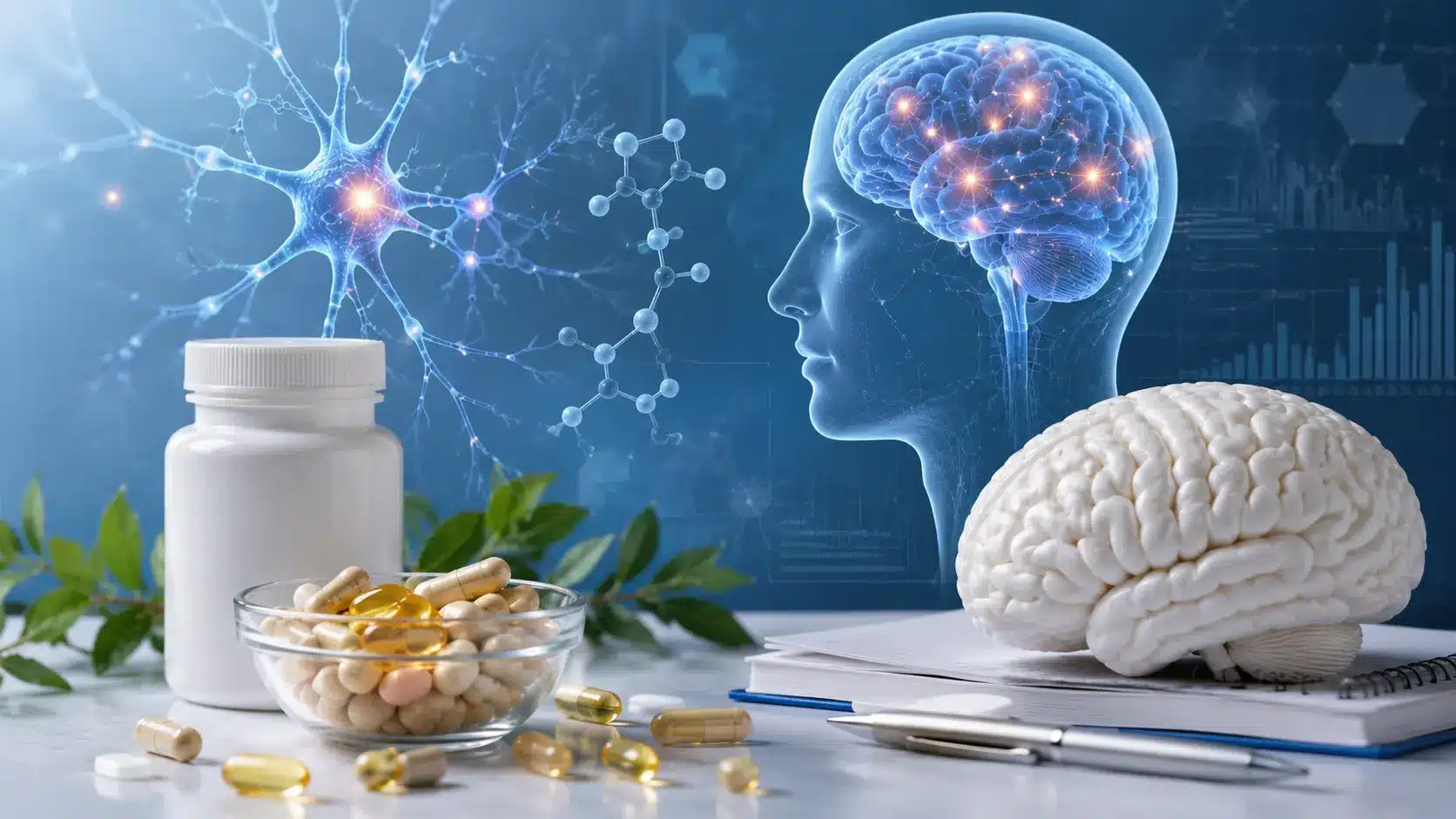
According to the Wei (2023) meta-analysis, compiling 48 studies and 103,651 participants, regular consumption of omega-3 lowers the risk of cognitive decline and dementia by around 20%. In the world of the food supplement, cognitive health is one area where science draws a line between a real effect in older adults and marketing aimed at young subjects. This article forms part of a dossier on the proven benefits of food supplements. It details the nutrients whose cognitive effect is documented by randomised trials, the profiles that draw a measurable benefit from them, and the limits to know about before any supplementation.
Why do supplements support cognitive function?
Which nutrients does the brain use day-to-day?
The brain constantly depends on a stable intake of omega-3, B vitamins, vitamin D, iron and iodine to function properly. These nutrients act at the same time on the structure of neurons, the production of chemical messengers and the regulation of cerebral inflammation.
DHA, an omega-3 fatty acid, is the majority polyunsaturated fatty acid of cerebral phospholipids and supports the fluidity of the membranes of neurons, key cells of cerebral functioning. The B vitamins (B6, B9, B12) participate in the synthesis of serotonin and dopamine, and regulate homocysteine: an amino acid whose elevation is associated with cerebral atrophy in older people[5]. Vitamin D, finally, modulates the expression of genes involved in neuroprotection; its deficit features among the 14 modifiable risk factors for neurocognitive disorders identified by the global synthesis Jones (2024)[10].
Which modern deficiencies weigh on cognition?
A significant share of the Swiss population presents insufficient intakes of several brain micronutrients. Vitamin D deficiency affects around 60% of Swiss residents in winter according to the FSVO[9]. DHA intakes are also often below requirements.
The FSVO recommends 600 IU of vitamin D per day for children and adolescents, and 800 IU from age 60, due to the lower skin synthesis with age[9]. Average dietary intakes cover less than one-third of that quantity. The consumption of oily fish (salmon, mackerel, sardine), the main source of DHA, also remains low in most European countries. These deficits expose older adults, people with little sun exposure and strict vegetarian diets in particular to an increased risk of cognitive disorders[10], in the absence of dietary balance covering these specific needs.
Which food supplements show an effect on cognition?
Omega-3 (DHA and EPA): what do meta-analyses say?
Omega-3, in particular DHA (docosahexaenoic acid), are the best documented food supplements for cognition by clinical studies. The Wei (2023) meta-analysis on 48 studies and 103,651 participants[3] associates regular consumption with a fall of around 20% in the overall risk of cognitive decline and dementia.
Each additional 0.1 g/day band of EPA-DHA is associated with an 8 to 10% fall in the risk of cognitive decline[3]. In patients with Alzheimer’s disease, the Calderon Martinez (2024) meta-analysis on 14 studies and 2,766 subjects observes a slowing of the progression measured by the CDR scale[4]. The benefit appears clearer in prevention than in curative treatment, especially when the diet remains low in seafood.
Multivitamins: what the COSMOS study shows
The COSMOS study, conducted on 21,442 adults aged over 60[1], has highlighted a modest but real benefit of multivitamins on global cognition, with a slowing of cognitive ageing estimated at 1.8 years over 3 years in the COSMOS-Mind sub-study.
The meta-analysis of three COSMOS sub-studies (Vyas et al., 2024)[1] confirms an improvement in episodic memory in the over-60s taking a daily multivitamin for 2 years: a result that suggests a real benefit on long-term memory. The COSMOS-Web study (Yeung et al., 2023) on 3,562 participants translates this gain into an equivalent of 3.1 years of age difference on immediate memory recall[2]. The improvement is more marked when the quality of the varied diet is lower at the outset; supporting memory in this case first goes through the correction of insufficient intakes.
B vitamins, vitamin D and Ginkgo biloba: a more nuanced effect
B vitamins (B6, B9, B12) have a small but confirmed effect on the global cognition of older adults. Ginkgo biloba (standardised EGb extract) shows a cognitive benefit in patients with Alzheimer’s disease. Vitamin D, in isolated supplementation in non-deficient subjects, presents a less clear preventive impact.
The Berg (2025) meta-analysis on 17 clinical trials and 5,275 participants confirms a small but robust positive impact of B vitamins on global cognitive function[5]. The B12 + folic acid (B9) combination emerges as the most effective formula in mild cognitive disorders according to the comparative meta-analysis Zhao (2025)[6]. For Ginkgo biloba, a plant studied for a long time in Alzheimer’s research, the comparative meta-analysis Deng (2024) on 17 trials and 7,214 patients ranks EGb at 120 mg/day as the intervention with the highest efficacy on cognition over more than one year in Alzheimer’s disease[8]. Vitamin D deficiency, associated with the risk of dementia in the global synthesis Jones (2024)[10], does not however translate into a clear preventive effect in isolated supplementation in non-deficient subjects.
Who benefits most from cognitive supplements?
The profiles that respond best to supplementation
The cognitive benefits of food supplements concentrate on three profiles: the over-60s, deficient subjects (vitamin D, B12) and those whose diet brings little oily fish or green vegetables.
Good reflex
Before any prolonged course, a blood test (vitamin D, vitamin B12, ferritin, homocysteine) makes it possible to identify a real deficiency rather than taking a supplement blindly. Supplementation is more effective when it corrects a documented deficit.
In the COSMOS study, the participants with the lowest dietary quality draw the clearest cognitive benefit from the multivitamin[1], with a documented impact on memory and cognitive function. For omega-3, the gain is measured mainly in subjects whose fish consumption is less than one portion per week[3]. Vegetarian or vegan older adults, exposed to a risk of B12 deficiency, also draw a benefit from targeted supplementation[6].
Situations where the effect remains limited
In young subjects, without documented deficiency and with a balanced diet, the impact of food supplements on cognition remains low to nil.
What not to do
Systematic supplementation “to boost the brain” without a context of deficiency is not supported by the scientific literature in the healthy subject. The Lancet Commission 2024 report recalls that no food supplement replaces a consistent lifestyle: physical activity, quality sleep, cognitive stimulation, stress management and active social network.
No meta-analysis has demonstrated that prophylactic supplementation with multivitamins in the healthy young person prevents future cognitive decline. Supplements do not substitute for the 14 modifiable risk factors identified by the Lancet 2024 commission (Livingston et al.)[7]; a healthy lifestyle, balanced diet, regular physical activity, LDL cholesterol control, preserved hearing, sufficient sleep and cognitive stimulation, features among the most powerful prevention levers.
What precautions before using a cognitive supplement?
When to consult before supplementing?
It is advised to consult a healthcare professional, doctor or pharmacist, before any prolonged course, in particular in case of anticoagulant treatment, chronic disease, or for pregnant or breastfeeding women.
Ginkgo biloba can interact with anticoagulants due to its effect on platelet aggregation and blood circulation[8]. The EFSA sets the tolerable upper intake of vitamin D at 4,000 IU (100 µg) per day in adults: beyond, the risk of hypercalcaemia increases. B6 taken in prolonged megadoses can induce peripheral neuropathy, an affection of the central and peripheral nervous system: several health authorities have set the limit at 100 mg/day for those aged over 18. The FSVO recommends respecting the indicated dosages and not stacking several sources of the same nutrient (fortified foods, supplements, medicines)[9].
How to choose a course without falling into marketing?
To choose a food supplement for memory, favour molecules whose effect on cognition is documented by recent meta-analyses, DHA, multivitamins after age 60, B12 + B9 in mild cognitive disorders, and beware of vague claims of the “boosts the brain” or “guaranteed results” type.
No isolated plant nootropic has demonstrated prevention of Alzheimer’s disease in healthy subjects. Formulations combining 8 to 15 natural ingredients at low doses have rarely been assessed in quality clinical trials, and the question of their real absorption remains open. Check the effective dose announced: for example 250 to 500 mg of DHA per day[3], 800 IU of vitamin D from age 60[9], 120 mg of standardised Ginkgo extract[8]: and prefer brands providing purity certificates of analysis.
Frequently asked questions
Which nutrient is the best for memory?
Omega-3 (DHA) are the best documented for memory in older adults. DHA is the majority omega-3 fatty acid of neuronal membranes and supports synaptic transmission. The Wei (2023) meta-analysis on 103,651 participants shows that an increase of 0.1 g/day of DHA or EPA is associated with an 8 to 10% fall in the risk of cognitive decline. In older adults with low fish consumption, a supplement of 250 to 500 mg/day is studied in the literature, to be discussed with a doctor.
How long does it take to see effects?
Between 8 weeks and 2 years depending on the nutrient. Cognitive benefits are not immediate: they stem from the gradual improvement of brain metabolism, the renewal of neuronal membranes and the fall in inflammatory markers. For multivitamins, the effect on episodic memory appears from 1 to 2 years in the COSMOS trial (Vyas et al., 2024). For DHA, cognitive changes are reported after 12 to 24 weeks of regular supplementation.
Can supplements prevent Alzheimer’s disease?
No food supplement has been shown to prevent Alzheimer’s disease in healthy subjects. Recent meta-analyses show a modest slowing of cognitive decline in patients already affected, in particular with omega-3 and Ginkgo biloba EGb 120 mg (Calderon Martinez 2024; Deng 2024), but not prevention in unaffected subjects. The Lancet Commission 2024 report identifies 14 modifiable risk factors for dementia, including vitamin D deficiency, physical inactivity and social isolation.
Does Ginkgo biloba really improve memory?
The effect of Ginkgo biloba is documented in Alzheimer’s disease but remains debated in healthy subjects. The comparative meta-analysis Deng (2024) on 7,214 Alzheimer’s patients ranks the standardised extract EGb at 120 mg per day as the most effective pharmacological intervention on cognition over more than one year. In young adults or those without documented cognitive disorder, trials show no measurable memory improvement at standard dose.
Are multivitamins useful if you eat a balanced diet?
The cognitive benefit is more marked in people with low dietary quality and after age 60. The COSMOS trial (Vyas et al., 2024) shows that the benefits of a multivitamin on episodic memory are clearer in older adults whose diet is less balanced. For a young adult without deficiency and regularly consuming fruits, vegetables, fish and whole grains, the additional intake of a multivitamin presents a low cognitive benefit, not demonstrated in randomised trials in healthy subjects.
Sources and references
10 sources- Vyas CM, Manson JE, Sesso HD, et al. (2024)
- Yeung LK, Alschuler DM, Wall M, et al. (2023)
- Wei BZ, Li L, Dong CW, et al. (2023)
- Calderon Martinez E, Zachariah Saji S, Salazar Ore JV, et al. (2024)
- Berg J, Grant R, Siervo M, Stephan BCM, Tully PJ. (2025)
- Zhao Y, Ge Y, Zhang Z, et al. (2025)
- Livingston G, Huntley J, Liu KY, et al. (2024)
- Deng X, Li D. (2024)
- FSVO, Federal Food Safety and Veterinary Office
- Jones A, Ali MU, Kenny M, et al. (2024)