
What is the bioavailability of a nutrient?
Quick summary
The bioavailability of a supplement measures the share of the nutrient that actually reaches the bloodstream in active form: at the same dose, two different chemical forms can release usable amounts that vary by a factor of three.
Key facts
Key takeaways
- Bioavailability goes beyond simple absorption: it adds up intestinal passage, hepatic metabolism and the share that the body can actually use.
- At the same elemental dose, iron bisglycinate reaches a bioavailability roughly three times higher than iron sulphate in deficient subjects.
- The fat-soluble vitamins A, D, E and K need fat intake to cross the intestinal wall; on an empty stomach, their absorption drops sharply.
- Calcifediol (25-OH-D3) is roughly three to five times more potent than cholecalciferol by oral route in humans (Cesareo review, Nutrients 2019).
- A high dose on the label does not amount to an effective dose: the usable share depends on the chemical form and on the context of intake.
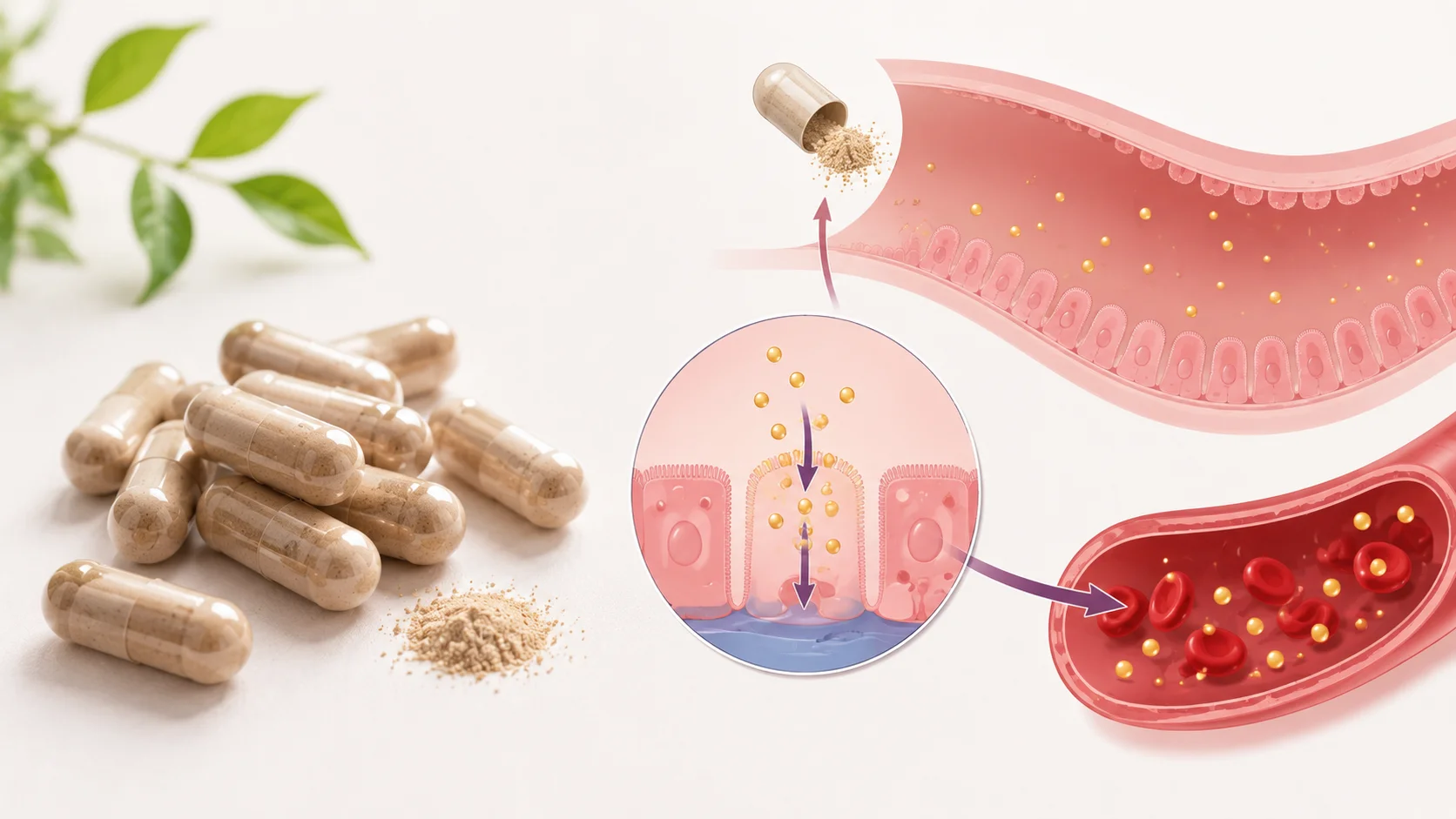
According to the European Food Safety Authority (EFSA), bioavailability refers to the amount of a substance that enters the bloodstream after being ingested through food. In practice, two magnesium capsules dosed at 300 mg do not release the same usable amount depending on whether the salt chosen is oxide, citrate or bisglycinate. To understand the effectiveness of a food supplement, you therefore have to look past the figure printed on the label and examine what actually reaches the circulation. This mechanic is one of the pillars of how a food supplement works, alongside the dosage form and the context of intake.
What bioavailability actually is
How is the bioavailability of a food supplement defined?
Bioavailability is a central concept of pharmacokinetics: it refers to the share of an ingested active substance that reaches the systemic circulation and stays available for the target cells. EFSA, the European reference body, describes it as the amount of a substance that enters the bloodstream after dietary ingestion[1]. It is expressed as a percentage of the ingested dose.
The journey combines three successive stages: the release of the compound in the digestive system, its passage through the intestinal wall, then its survival of the hepatic pass before reaching the general circulation[2]. This sequence determines the real effectiveness of a supplement, well beyond the dose printed on the label. A review published in 2025 in Frontiers in Nutrition stresses that the chemical version chosen changes the picture: calcifediol is more bioavailable than cholecalciferol, and methylfolate more bioavailable than synthetic folic acid[2]. The reference biological marker remains the plasma concentration measured at several intervals after a single dose.
What is the difference compared with simple absorption?
Absorption refers only to the passage of the molecule from the intestine into the blood; bioavailability adds hepatic metabolism and the share of active substance that the tissues can actually use. A compound can be well absorbed but poorly bioavailable if the liver breaks it down quickly before it reaches its targets, which reduces its effect on the body.
The turmeric example is emblematic: curcumin, its main active component, crosses the intestinal barrier but its oral bioavailability stays very low — generally reported as below 1% of the ingested dose in humans[3], due to low solubility, limited intestinal transit and fast hepatic metabolism. Adding black pepper (piperine) or using liposomal and phospholipid formulations can multiply this bioavailability by a factor of 5 to 30 depending on the study[3]. For minerals, the order of magnitude is different but the logic is the same: the intestinal pass is necessary but not sufficient.
How is bioavailability measured?
Bioavailability corresponds to the rate and the amount of a substance reaching the systemic circulation; it is measured by repeated blood tests after a single standardised dose, then compared with a reference. For medicines given intravenously, absolute bioavailability is the benchmark; for nutritional intakes, it is often the best-assimilated chemical version that serves as the comparison point. The result is expressed as a relative percentage or as the area under the plasma curve over time.
A clinical study published in 2024 in Nutrients compared four forms of magnesium in 40 healthy volunteers placed on a depleted diet for seven days: oxide, citrate, bisglycinate and a microencapsulated version[4]. The researchers measured the plasma concentration at 1 h, 4 h and 6 h after ingestion. The microcapsule technical sheet maintained a sustained rise over 6 hours[4], where oxide produced a short peak at 1 h and where bisglycinate did not show a significant plasma increase in this population[4]. This result shows that the measurement depends on the context: nutritional status of the subject, length of observation, biological compartment observed.
Which factors shape bioavailability?
Does the chemical form of the nutrient really matter?
Yes, the chemical nature of the active ingredient is the first of the factors shaping bioavailability, and the most decisive lever. At the same elemental dose, iron bisglycinate reaches an apparent bioavailability of 90.9% against 26.7% for ferrous sulphate in iron-deficient children[5], that is a factor of around 3.4. A 2024 review published in Nutrients also confirmed that zinc bisglycinate and gluconate are better absorbed than zinc oxide[6].
Minerals can be supplied in inorganic form (oxide, sulphate) or as a chelated organic compound (bisglycinate, citrate, gluconate). Chelated salts bind the mineral to an amino acid that protects the complex during digestion and helps it cross the intestinal wall via the amino-acid transporters[7], which favours a better assimilation. For vitamin D, the 2019 Cesareo review published in Nutrients indicates that by oral route, calcifediol (25-OH-D3) is roughly three to five times more potent than classic cholecalciferol in humans, owing to better intestinal absorption and a high affinity for the vitamin-D-binding protein[8].
| Nutrient | Lower-bioavailability form | Higher-bioavailability form |
|---|---|---|
| Iron | Ferrous sulphate (inorganic form) | Iron bisglycinate (chelated form) |
| Zinc | Zinc oxide | Zinc bisglycinate or gluconate |
| Magnesium | Magnesium oxide | Citrate, bisglycinate or microencapsulated |
| Vitamin D | Cholecalciferol (vitamin D3) | Calcifediol (25-OH-D3) |
| Folates | Synthetic folic acid | L-methylfolate (bioactive form) |
Do timing and context of intake make a difference?
Yes, and the gaps are sometimes large. The fat-soluble vitamins A, D, E and K need a meal containing fat to cross the intestinal wall; taken on an empty stomach, their assimilation rate drops sharply. On the other hand, non-haem iron is absorbed better away from meals, but this intake can cause digestive discomfort and calls for optimising bioavailability by suitable fractioning according to real need.
The food matrix modulates nutrient absorption in both directions[2]. The phytates in wholegrains and pulses trap zinc and non-haem iron and reduce their bioavailability. Conversely, vitamin C, in synergy with iron, raises its uptake by reducing ferric iron to ferrous iron, which is better taken up by the enterocyte[2]. This interaction is one of the best-documented examples. Calcium taken at the same time has the opposite effect and hampers this mechanism.
Why do two people not absorb the same way?
Age, the state of the digestive system, the microbiota, certain diseases and several medicines make the bioavailability of the same dose vary by up to a factor of two. Gastric acid secretion falls with age and an imbalanced microbiota reduces the availability of B-group vitamins and vitamin K, two components essential to the smooth functioning of the body.
More than two billion people worldwide have iron-deficiency anaemia, partly linked to the low dietary bioavailability of non-haem iron[9]. Proton-pump inhibitors, prescribed to many patients, reduce the assimilation of vitamin B12 and magnesium; metformin lowers that of B12 over the long run[2]. Pregnancy and breastfeeding, by contrast, raise the intestinal absorption of iron and calcium[2]. These interindividual variations explain why the same dose does not produce the same effect across profiles and lifestyles.
How to recognise a supplement with good bioavailability
What to look at on the label
Three selection criteria guide the reading: the exact chemical nature of the compound (bisglycinate, citrate, methylfolate), the effective elemental dose (different from the total salt dose) and the possible presence of cofactors or coating technologies (microencapsulation, liposomal vitamin C, phospholipid formulations) that alter assimilation. These elements largely determine the real quality of a supplement.
On an iron supplement, the label “iron bisglycinate 50 mg providing 14 mg of elemental iron” gives two distinct pieces of information: the amount of the chelated compound and the amount actually usable. A 2025 systematic review published in Nutrients showed that alternative versions of vitamin C (calcium ascorbate, liposomal forms) raise concentrations in leukocytes without always pushing plasma concentration further[10]. This nuance illustrates that bioavailability depends on the biological compartment observed and that no extract or ingredient can be judged in isolation.
Practical pointer
Spot the word “elemental” on the label: it indicates the amount of pure mineral, regardless of the mass of the salt. Without this mention, the stated dose may overstate the useful amount.
Are premium forms worth the investment?
Not systematically. Patented chelated versions, microencapsulations and liposomes do raise bioavailability in certain situations (proven deficiency, digestive disorders, malabsorption). For someone without a deficiency and without any particular therapeutic need, the clinical benefit of a premium quality over a classic product correctly dosed and properly taken often stays modest.
The 2024 clinical study on magnesium illustrates this nuance: the innovative microcapsule formulation produced a sustained plasma rise over 6 hours and cut the digestive discomfort usually associated with this supplementation[4]. This improvement may justify the extra cost for patients prone to intestinal disorders or with increased physiological needs. For everyday use without any particular issue, the price gap between a standard product and a premium version is not always justified by a benefit that is measurable day to day — the choice should match each person’s profile and real need.
To avoid
Comparing two supplements only on the displayed dose: a product dosed at 500 mg of magnesium oxide may release less usable magnesium than a product dosed at 200 mg of bisglycinate. Form trumps raw quantity.
Frequently asked questions about bioavailability
Which form of magnesium offers the best bioavailability?
No form is universally superior: the result depends on the person and on the context of intake. Bisglycinate is often presented as well tolerated and well absorbed, citrate offers fast absorption, and oxide a lower bioavailability but a high concentration in elemental magnesium. A 2024 clinical study published in Nutrients on 40 healthy volunteers showed that microencapsulated versions maintain a plasma rise over 6 hours, where oxide produces a short peak (Pajuelo et al. 2024). For someone without a proven deficiency, the practical gap between premium and classic forms remains modest.
Does vitamin C really improve iron absorption?
Yes, for the non-haem iron found in plants and in most supplements. Vitamin C reduces ferric iron to ferrous iron, which is better absorbed through the intestinal wall, and limits the inhibitory effect of phytates and polyphenols on this absorption (Richards et al. 2025, Frontiers in Nutrition). A dose of 50 to 100 mg of vitamin C taken at the same time as the iron supplement is usually enough to raise absorption. Calcium taken at the same time, by contrast, hampers this absorption.
Are liposomal supplements more effective?
Yes in some cases, but the gap varies by nutrient. For curcumin, whose oral bioavailability is generally below 1% in humans, liposomal and phospholipid formulations can multiply bioavailability by 5 to 30 depending on the study (Racz et al. 2022). For vitamin C, a 2025 systematic review in Nutrients indicates that alternative forms (calcium ascorbate, liposomal forms) raise leukocyte concentrations without always pushing plasma concentration further (Calder et al. 2025). The clinical interest therefore depends on the nutrient and on the biological target aimed at.
Should supplements be taken on an empty stomach or with a meal?
It depends on the nutrient. The fat-soluble vitamins A, D, E and K need fat intake to be absorbed properly, hence a meal containing lipids. Non-haem iron is absorbed better on an empty stomach, without calcium or tea, but this can cause digestive discomfort. Magnesium is generally well tolerated with a meal, sometimes better in the evening for sensitive people. Reading the leaflet or asking a pharmacist makes it possible to fine-tune the timing according to the form chosen.
Does bioavailability decrease with age?
Yes for several nutrients. Gastric acid secretion drops after age 60, which reduces the absorption of vitamin B12, non-haem iron and calcium (Richards et al. 2025). Some medicines common in older adults, such as proton-pump inhibitors and metformin, sharpen this effect. Pregnancy and breastfeeding, by contrast, raise the intestinal absorption of iron and calcium. These variations explain why the same dose produces different effects depending on the profile.
Sources and references
10 sources- EFSA — Glossary: bioavailability
- Richards, J. D. et al. (2025). Micronutrient bioavailability: concepts, influencing factors, and strategies for improvement.
- Racz, L. Z. et al. (2022). Strategies for Improving Bioavailability, Bioactivity, and Physical-Chemical Behavior of Curcumin.
- Pajuelo, D. et al. (2024). Comparative Clinical Study on Magnesium Absorption and Side Effects After Oral Intake of Microencapsulated Magnesium Versus Other Magnesium Sources.
- Pineda, O., Ashmead, H. D. (2001). Effectiveness of treatment of iron-deficiency anemia in infants and young children with ferrous bis-glycinate chelate.
- Devarshi, P. P. et al. (2024). Comparative Absorption and Bioavailability of Various Chemical Forms of Zinc in Humans: A Narrative Review.
- Joshua Ashaolu, T. et al. (2023). Metal-binding peptides and their potential to enhance the absorption and bioavailability of minerals.
- Cesareo, R. et al. (2019). Hypovitaminosis D: Is It Time to Consider the Use of Calcifediol?
- Kalman, D. et al. (2025). Dietary Heme Iron: A Review of Efficacy, Safety and Tolerability.
- Calder, P. C., Kreider, R. B., McKay, D. L. (2025). Enhanced Vitamin C Delivery: A Systematic Literature Review Assessing the Efficacy and Safety of Alternative Supplement Forms in Healthy Adults.