
Why a food supplement cannot replace a balanced diet?
Quick summary
No, a food supplement does not replace a balanced diet: it provides a few isolated nutrients where a whole food brings thousands, in synergy, with fibre and a protective matrix.
Key facts
Key takeaways
- The FSVO confirms that food supplements cannot substitute for a varied diet that supplies all essential nutrients.
- A whole food contains more than 26,000 identified chemical compounds, while a capsule concentrates only a handful of them.
- Nearly one in three people in Switzerland takes at least one food supplement according to the 2022 FSVO survey, often without any proven deficiency.
- The dietary fibre target of 25 g per day recommended by EFSA is virtually absent from supplements in capsule form.
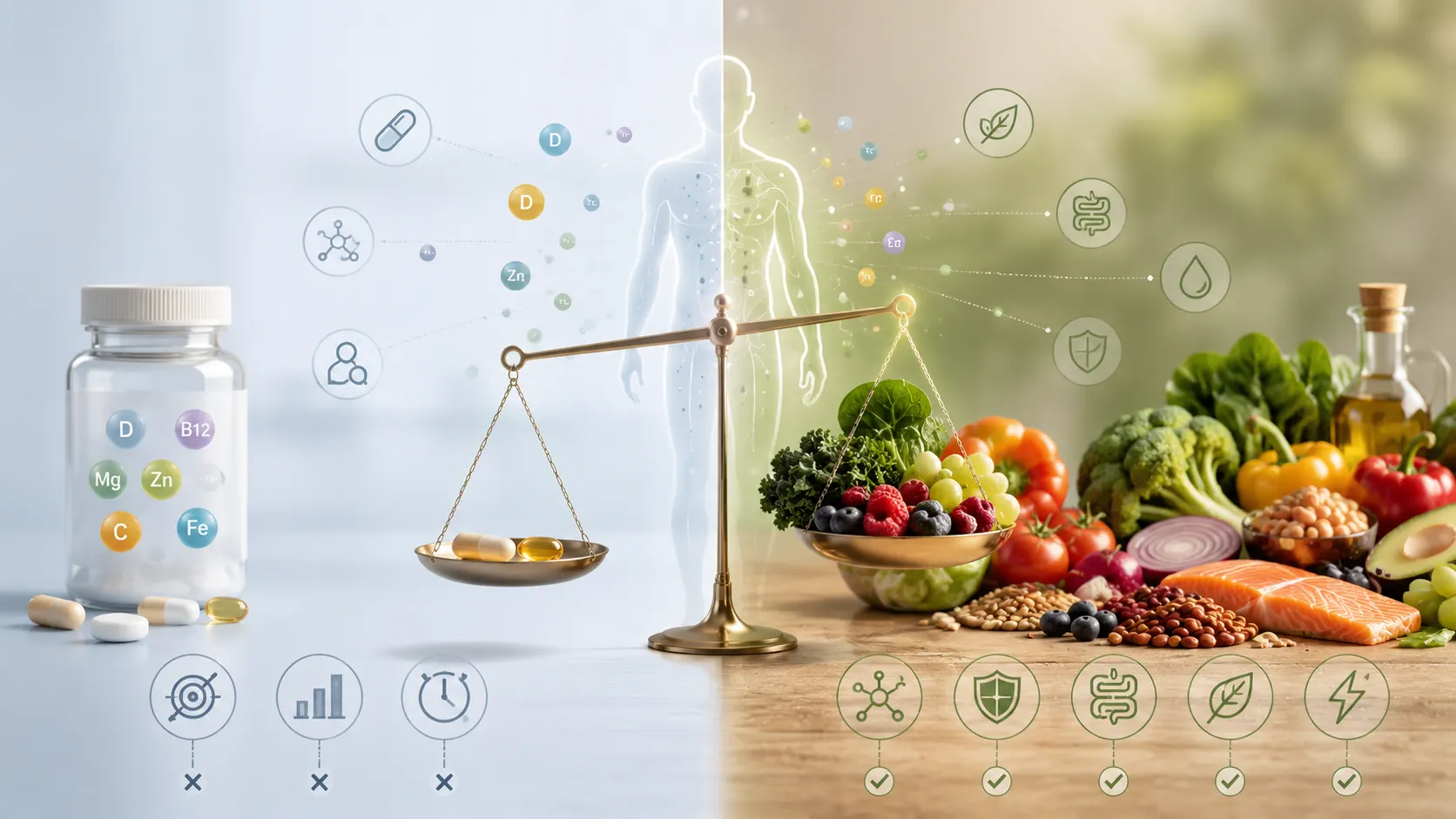
The idea that a daily capsule is enough to make up for an unbalanced plate appeals to nearly one in three people in Switzerland, according to the 2022 national FSVO survey. The federal authority points out, however, that these products never replace a varied diet. In the world of food supplements, understanding how a supplement works makes it clear why a whole food remains irreplaceable: it contains thousands of compounds in interaction, fibre and a natural matrix that the capsule cannot reproduce.
Why can a food supplement not replace a balanced diet?
What does the FSVO say about replacing food with a supplement?
A food supplement does not replace a varied and balanced diet because it was not designed to do so: on the basis of a targeted use, it tops up, for a limited period, the intake of a missing nutrient and plays a focused support role, never a substitute for the normal diet. The Federal Food Safety and Veterinary Office (FSVO) writes explicitly that healthy people who eat varied food generally do not need a supplement[1], and that these products cannot substitute for the diversity of the plate[1]. The 2023 Swiss Nutrition Bulletin confirms this position: from a physiological point of view, a healthy and balanced diet is enough to cover micronutrient needs, with a few rare exceptions[2]. Before any supplementation, it is better to consult a healthcare professional than to sign up to a capsule routine guided by social media.
What does a whole food provide that a capsule does not?
A whole food, a plant or animal foodstuff from a normal diet, contains more than 26,000 identified chemical compounds[7], whereas a tablet or capsule concentrates only a handful of them. Official nutritional databases list only around 150 compounds classified as nutritive substances[7], the rest forming what researchers call the “dark matter” of foods[7]: still partly unknown but essential to the normal functioning of the human body. Antioxidant polyphenols, carotenoids, fermentable fibres, enzymes, organic acids, fatty acids including omega-3, and vitamins and minerals together with their cofactors: no supplement today reproduces this whole set in sufficient quantity and in its natural form.
What is nutrient synergy and why does it matter?
Nutrient synergy refers to the combined effect of several ingredients which, together, produce a nutritional or physiological effect greater than the sum of their isolated effects. The review by Townsend and co-authors in Frontiers in Nutrition[5] cites well-established examples: vitamin C increases the absorption of non-haem iron from plant foods[5], vitamin D, calcium and vitamin K act together on bone health[5], and carotenoids taken with fatty acids see their bioavailability strongly increased[5]. In a plant or animal food, these interactions happen naturally. In an isolated capsule, they disappear, which limits the usefulness of systematic supplementation to support the immune system or the nervous system.
What essential elements does a capsule not provide?
Why are dietary fibres irreplaceable?
Fibre is one of the great absentees of food supplements, whether they are plant-, algae-, fish-oil- or organic-extract-based. EFSA recommends a daily intake of at least 25 g of fibre for an adult[8], to be reached through fruit, vegetables, pulses, oilseeds and wholegrains[8], which together form a natural source of fibre in sufficient quantity. A box of vitamin and mineral tablets does not provide it and cannot do so on that scale: you would have to swallow dozens of capsules a day to come close to the target, at a cost and a price out of step with a basket of vegetables. Yet fibre is linked to a lower risk of cardiovascular diseases, type 2 diabetes and colorectal cancer[8]: benefits inseparable from a diet rich in plant fibre, not from an isolated ingredient.
What is lost when a nutrient is extracted from its matrix?
Extracting a nutritive substance from its source food often changes its bioavailability, that is the share of ingredients assimilable by the human body. A review published in Advances in Nutrition by Miller and co-authors[9] stresses that the food matrix, the physical and chemical arrangement of the components within the foodstuff, shapes the release of nutrients during digestion. The antioxidant anthocyanins of red berries, for example, are better protected from digestive breakdown in the whole fruit than as a purified concentrated source, as a review published in Nutrients in 2024 showed[10]. A tablet can therefore display a high dose without delivering the same effectiveness as a portion of food, which puts into perspective the usefulness of many forms of supplementation for the skin, muscle recovery or fatigue prevention.
When is a food supplement really useful and when does it become a risk?
In which situations is a supplement justified?
A food supplement becomes useful when a specific intake cannot be covered by diet alone, on the advice of a specialist and not simply by a consumer’s choice on a retail website. The FSVO[2] lists a few precise situations: vitamin D up to age three and after age 60 to prevent deficiency, iodine and folic acid in women planning a pregnancy or already pregnant, vitamin B12 for those on a strict plant-based vegan diet. Outside these cases and outside a diagnosed vitamin deficiency, systematic supplementation with omega-3, zinc, magnesium or multivitamins brings no demonstrated health benefit. The 2022 national FSVO survey[3] nevertheless shows that nearly one in three people in Switzerland takes at least one supplement, most often without a diagnosed deficiency and with a consumer profile already attentive to their lifestyle. A 2024 analysis published in JAMA Network Open[4], covering 390,124 healthy US adults followed for over 20 years, found no reduction in mortality among daily multivitamin users, whatever the dose, price or origin.
What are the long-term risks of overdose?
The overdose risk is real for the fat-soluble vitamins (A, D, E, K) and certain minerals that accumulate in the body, with side effects that can be irreversible. EFSA[6] confirmed in 2024 the tolerable upper intake level for preformed vitamin A at 3,000 micrograms RE per day in adults, taking teratogenicity as the critical effect, among the adverse effects also studied, which include liver toxicity and bone damage[6]. Stacking several strongly dosed products, taking the same substance in several forms (capsule, tablet, oil) or extending a course beyond the recommendations are the three most common mistakes flagged by the authorities. Ingredient declarations and legal mentions on the box make it possible to check the amount per dose and to avoid stacking with other supplements. The FSVO[2] states it clearly: there is a health risk linked to excessive intake, especially in consumers who combine several strongly dosed products without consulting a healthcare professional.
Frequently asked questions
Is it good to take food supplements every day?
Not for most healthy adults. The FSVO points out that people eating a varied and balanced diet generally do not need a supplement. A daily intake is justified for a specific indication (deficiency, pregnancy, vegan diet, vitamin D in people over 60) and stays limited in time. Outside those situations, the expected benefit is not demonstrated and the risk of excessive intake rises with strongly dosed or stacked products.
Are food supplements dangerous?
Not at normal doses, but an overdose risk exists. EFSA has set an upper limit of 3,000 micrograms per day for preformed vitamin A because of a risk of liver toxicity and birth defects. The fat-soluble vitamins (A, D, E, K) and some minerals (iron, selenium) accumulate in the body and can become toxic when taken for long periods above the limits. Stacking several strongly dosed products multiplies this risk.
Which food supplements are bad for the liver?
High doses of preformed vitamin A are among the documented causes of liver damage. EFSA has set a limit of 3,000 micrograms RE per day in adults, taking teratogenicity as the critical effect, while also studying liver toxicity and bone effects. Certain concentrated plant extracts (high-dose green tea, kava, hepatotoxic plants listed by the FSVO) have also been linked to hepatitis. The rule remains to respect the doses shown on the label and not to stack several sources of the same nutrient.
Do multivitamins extend life expectancy?
No, recent data do not show this. The 2024 JAMA Network Open analysis, which followed 390,124 healthy US adults for over 20 years, observed no reduction in mortality among daily multivitamin users, neither for all causes combined nor for cardiovascular diseases or cancers. The FSVO shares this conclusion: in someone eating a varied diet, multivitamins bring no demonstrated health benefit.
What does the FSVO recommend for healthy people?
The FSVO first recommends a varied and balanced diet, in line with the Swiss food pyramid. Food supplements are reserved for specific situations: iodine and folic acid for women who are pregnant or planning a pregnancy, vitamin D up to age three and after age 60, vitamin B12 for those on a vegan diet. Outside these cases, systematic intake is not justified from a physiological point of view.
Sources and references
10 sources- FSVO. Food supplements — Federal Food Safety and Veterinary Office
- FSVO. Food supplements – use limited to specific situations
- FSVO. Food supplement use in Switzerland — Swiss Nutrition Bulletin 2023
- Loftfield E. et al. Multivitamin Use and Mortality Risk in 3 Prospective US Cohorts
- Townsend J. R. et al. Nutrient synergy: definition, evidence, and future directions
- EFSA NDA Panel. Tolerable upper intake level for preformed vitamin A and β-carotene
- Aguilera J. M. Food matrices as delivery units of nutrients in processed foods
- EFSA. Recommendation for daily dietary fibre intake (25 g/day for adults)
- Miller G. D., Ragalie-Carr J., Torres-Gonzalez M. Perspective: Seeing the Forest Through the Trees: The Importance of Food Matrix in Diet Quality and Human Health
- Kumkum R., Aston-Mourney K., McNeill B. A., Hernández D., Rivera L. R. Bioavailability of Anthocyanins: Whole Foods versus Extracts