
How does a food supplement work?
Quick summary
A food supplement delivers a concentrated dose of vitamins, minerals or other active substances that travels through digestion, is taken up by the gut, then carried by the bloodstream to the tissues that need it.
Key facts
Key takeaways
- A food supplement follows the same path as a food: digestion, intestinal uptake and distribution through the blood to the target tissues.
- The dosage form (capsule, tablet, liquid) and the chemical composition of the molecule strongly change the amount actually absorbed.
- 30% of the Swiss population takes at least one food supplement, most often vitamins or minerals (FSVO 2022).
- A food supplement does not cure any disease and remains a foodstuff, distinct from a medicinal product under Swiss law.
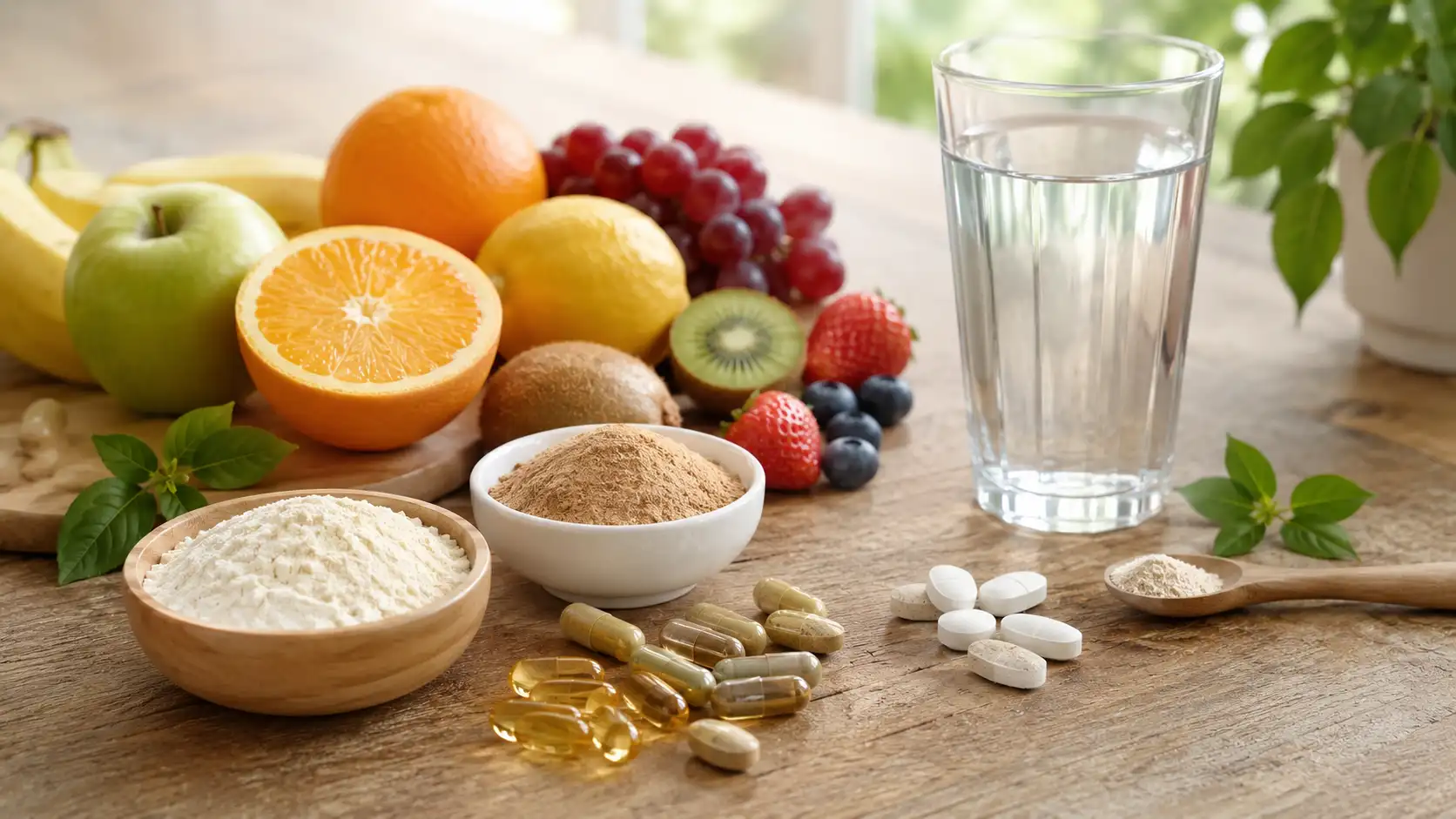
Nearly one in three people in Switzerland takes at least one food supplement, most often vitamins or minerals, according to a national survey carried out by the FSVO in 2022 on 1,282 adults. To understand how these capsules and tablets work, you have to follow the journey of the ingested molecule all the way to the cells that use it. This article is part of the complete guide to food supplements and walks through the four key stages: the dosage form in which it is swallowed, its passage through the gut, the share that is actually absorbed and its real effect on the body.
How does a food supplement enter the body?

In what form is a food supplement taken?
A food supplement is sold in a concentrated and dosed presentation: tablet, hard capsule, soft capsule, powder, liquid ampoule or dropper bottle. Each category covers products whose key ingredients vary, vitamins, minerals, plants or amino acids, and which provide a concentrated intake of essential elements. The FSVO defines these foodstuffs as intended to supplement the diet through an intake of vitamins, minerals or substances with a nutritional or physiological effect[1].
The dosage form influences how comfortable the supplement is to swallow but also how quickly the molecule becomes available in the digestive tract. A liquid ampoule releases its contents in a few minutes whereas a coated tablet can take 30 to 60 minutes to break down. Each dosage form serves a specific purpose: stability of the active ingredient, taste or ease of daily use.
How does the body absorb nutrients?
Once released in the stomach and then in the small intestine, the molecule has to cross the intestinal wall to reach the bloodstream. This crossing is not automatic: most vitamins and mineral salts use specific transporters[2] located on the cells of the digestive system. These transporters play a central role in how much is actually absorbed by the human body.
Haem iron, present in animal-source foods and certain supplements, is absorbed via a specific active pathway involving intestinal haem oxygenase[3], and it crosses into the blood noticeably better than non-haem iron salts. For calcium, the active pathway in the duodenum (TRPV6 channels) accounts for only about 20% of total absorption[4]; the rest goes through passive paracellular diffusion in the ileal loop.
Why effectiveness varies from one person to another
At the same dose, two people do not get the same result because digestive and metabolic function varies from one individual to another. Several factors come into play: age, gut flora, simultaneous food intake, certain medicines, lifestyle and even genetics modify[2] the amount of active molecule that actually reaches the cells. Day-to-day living conditions therefore weigh as much as the capsule itself.
A recent European review on the colonic absorption of calcium and magnesium shows for instance that fermentation of fibres by the microbiota can push colonic absorption from 10% to around 30% of the total (Stumpff & Manneck 2025)[4]. Beyond the everyday diet, this is the reason why the same product can appear effective in one person and have no effect in another.
Why not all supplements are equal
Bioavailability, the key to real effectiveness
Bioavailability refers to the share of the ingested molecule that actually reaches the circulation and can be used by the body. On that basis, a poorly bioavailable formulation can divide the truly available amount by ten, which explains why a cheap supplement is not always a saving.
A clinical study published in 2025 by the Amsterdam University Medical Center compared three curcumin formulations in nine healthy volunteers. Even at a high dose and with added piperine, the concentration of free curcumin in the blood stayed below 2 nanomoles per litre, that is one hundred times less than the concentrations associated with a biological effect in the laboratory (Kroon 2025)[5]. The signal is clear: a high dose on the label does not mean a high dose in the blood.
The factors that modulate absorption
Several elements change how much is absorbed, independently of the dose shown on the label. Chemical form comes first: a single mineral exists as oxide, citrate, bisglycinate or chelate, with absorption rates that differ noticeably depending on the salt used[3].
The food context also matters. The fat-soluble vitamins (A, D, E, K) need fatty acids in the meal to be absorbed: a meal containing omega fats, olive oil or avocado improves their passage through the gut. Vitamin C taken at the same time as non-haem iron increases its passage into the blood in infants and children, according to a 2024 systematic review covering 37 studies and 1,531 participants[6]. Conversely, calcium taken simultaneously can block iron.
How to read a label to spot an absorbable form
The label of a food supplement states the active substance, the recommended daily intake and its precise chemical composition. This information is essential to compare two products: for magnesium, for example, bisglycinate or citrate are better absorbed than the oxide[4], which is however the cheapest salt and the most common in budget multivitamins.
The Swiss Food Supplements Ordinance (RS 817.022.14)[7] obliges the manufacturer to stick to a list of authorised forms and maximum amounts per daily dose. These rules tightly govern labelling: transparency about composition is therefore a legal obligation, not a marketing argument.
Practical pointer
A label that does not state the exact chemical form of the mineral (“magnesium 300 mg” without specifying oxide or bisglycinate) does not allow you to gauge the supplement’s real bioavailability.
Does a supplement replace a balanced diet?

The plate remains the primary source of nutrients
No, a food supplement does not replace a balanced diet. The FSVO recalls[1] that a healthy person eating a balanced diet normally covers their vitamin and mineral needs without resorting to a pill. Whole foods also bring fibre, antioxidants and a synergistic effect between micronutrients that tablets do not reproduce.
A recent Canadian study on multivitamin use (Keshavarz 2026)[8] shows that regular users are already those with the most balanced diet and therefore the least need for supplementation. Here, the supplement plays a complementary role: it comes on top of a good plate, not instead of it.
Situations where supplementation becomes relevant
Some physiological or dietary situations justify a targeted supplement, over a well-defined period and for a specific micronutrient. The FSVO identifies four main cases[9]: pregnancy and women planning a pregnancy (folic acid, iodine), babies and children up to age three (vitamin D), people over 60 (vitamin D) and people following a vegetarian or vegan diet (vitamin B12, iodine).
A 2024 Norwegian study on 165 young people aged 16 to 24 following different diets shows that vegans face a marked risk of insufficient iodine intake (63% of participants), despite already high supplementation in this group (Groufh-Jacobsen 2024)[10]. The supplement here aims to correct a documented deficiency, not to “boost” a healthy body.
The physiological limits of the pill
The body fine-tunes the absorption of most molecules through liver and kidney function, and the immune system also steps in if there is a sustained excess. When stores are full, intestinal uptake decreases and the surplus is excreted by the liver or the kidneys (water-soluble vitamins) or stored in the tissues, sometimes up to a toxic threshold (fat-soluble vitamins, iron). This is why a prolonged overdose can harm health.
The Swiss Food Supplements Ordinance[7] sets maximum amounts per daily dose for the vitamins and minerals concerned, both to limit the overdose risk and to maintain the legal boundary between foodstuff and medicinal product. Above those thresholds, the product would step outside the food-supplement framework and fall under therapeutic-products legislation.
Food supplement vs. medicinal product: what is the difference?
A nutritional purpose, not a therapeutic one
A food supplement is not a medicinal product. Its purpose is to supplement the diet, not to treat, prevent or cure a disease. The FSVO is explicit[1]: these products must not have a pharmacological effect and no medical claim is allowed on the packaging. This is precisely what marks the boundary with medicines: a foodstuff status that rules out any therapeutic purpose.
A medicinal product has a precise therapeutic indication, a proven effective dose and a documented adverse-effect profile before being placed on the market. A supplement, on the other hand, operates within the “nutritional need” space and its role is limited to the health claims regulated by EFSA[11] at European Union level: for example “vitamin D contributes to the maintenance of normal bones”.
Two distinct regulatory frameworks in Switzerland
In Switzerland, food supplements fall under food law: the Federal Act on Foodstuffs and Utility Articles (FSA, RS 817.0), the Foodstuffs and Utility Articles Ordinance (FSUAO) and the specific Swiss Food Supplements Ordinance (RS 817.022.14)[7]. Under these texts, no prior authorisation is required to place a product on the market: responsibility for compliance lies with the manufacturer or distributor, who must keep the research and technical files available for the authorities.
Medicines, by contrast, fall under the Therapeutic Products Act (TPA, RS 812.21) and are overseen by Swissmedic[12], the Swiss equivalent of national medicines agencies. This agency grants marketing authorisation after assessing quality, safety and efficacy. The boundary between the two can be narrow: some products imported from France or the European Union are reclassified as medicinal products when they pass through customs.
What this boundary changes for the consumer
For the consumer, the distinction has three practical consequences. First, watch out for labels: a supplement cannot legally promise a therapeutic effect[1]. A label that claims to “cure” or “treat” signals either a breach of the rules or a product that should be a medicine: the practical advice is therefore to avoid these products and to favour transparent brands.
Second, quality control is not the same: supplements do not go through pharmaceutical manufacturing requirements. Finally, the 2022 national FSVO survey[13] indicates that more than a quarter of supplement purchases consumed in Switzerland are made online, and a national campaign run by the cantonal chemists in 2024[14] on 127 products sold by Swiss and Liechtenstein online shops, with each website inspected one by one, resulted in 113 sales bans, i.e. 89%, for unauthorised ingredients or a health risk.
Caution
A food supplement that promises an action on a specific disease (“relieves arthritis”, “cures insomnia”, “treats depression”) falls outside the Swiss legal framework. Either the claim is illegal, or the product actually falls under medicines legislation.
Frequently asked questions
How long does a food supplement take to work?
The timeframe ranges from a few hours to several weeks. Water-soluble vitamins such as vitamin C or the B-group vitamins reach the bloodstream within 1 to 3 hours of the first doses. Molecules that accumulate in tissues, like vitamin D or iron, take 4 to 12 weeks to shift blood-test results. The Federal Food Safety and Veterinary Office (FSVO) points out that a supplement only corrects a deficiency if the dose and duration are matched to the targeted molecule.
Should a food supplement be taken on an empty stomach or with a meal?
It depends on the molecule. The fat-soluble vitamins A, D, E and K, as well as coenzyme Q10 and curcumin, need dietary fats to cross the intestinal wall. Minerals such as iron are absorbed better on an empty stomach, unless the stomach is sensitive. The water-soluble B and C vitamins are tolerated in either context. The supplement label or a pharmacist’s advice settles the question case by case.
Why do two supplements containing the same vitamin not have the same effect?
Because chemical form changes everything. A vitamin or mineral exists as several different salts, each absorbed differently by the gut. Animal-source haem iron, for example, uses a dedicated transporter and reaches the bloodstream far better than non-haem iron salts (Kalman 2025). The price of a supplement does not systematically reflect its absorption quality: the detailed composition has to be read.
Can a food supplement have side effects?
Yes, especially in the case of overdose or interaction. Tox Info Suisse recorded around 1,200 enquiries linked to food supplements between 2014 and 2019, many of them for accidental ingestion by children. A chronic excess of vitamin A, iron or calcium can harm health. The federal Swiss Food Supplements Ordinance sets maximum daily-dose amounts to limit this risk. A course should never stack supplements without professional advice.
Are food supplements checked in Switzerland before being placed on the market?
No, there is no prior authorisation procedure. Safety of the supplement is the responsibility of the manufacturer or distributor, who must comply with the Swiss Food Supplements Ordinance (RS 817.022.14) and the Ordinance on the Addition of Vitamins, Mineral Substances and Other Substances to Foodstuffs. Cantonal authorities run spot checks on products already on sale. For consumers, this means favouring brands that are transparent about composition, dosage form and origin.
Sources and references
14 sources- FSVO, Food supplements: definition and legal framework
- Hossain MS et al., Dietary Phytochemicals in Health and Disease: Mechanisms, Clinical Evidence, and Applications
- Kalman D et al., Dietary Heme Iron: A Review of Efficacy, Safety and Tolerability
- Stumpff F, Manneck D, Prebiotics as modulators of colonic calcium and magnesium uptake
- Kroon MAGM et al., A pharmacokinetic study and critical reappraisal of curcumin formulations enhancing bioavailability
- Gallahan S et al., A Systematic Review of Isotopically Measured Iron Absorption in Infants and Children Under 2 Years
- FDHA Ordinance on Food Supplements (RS 817.022.14)
- Keshavarz P et al., Bottle to body: how multivitamin/mineral supplements shape Canadian nutrient intake
- FSVO, Food supplements: use limited to specific situations
- Groufh-Jacobsen S et al., Micronutrient intake and status in young vegans, vegetarians, pescatarians, flexitarians, and omnivores
- European Commission, EU Register of nutrition and health claims (Regulation EC 1924/2006)
- Swissmedic / FSVO, Criteria for the demarcation between foodstuffs and therapeutic products
- Solliard C et al., Food supplement use in Switzerland
- Swiss cantonal chemists, Food supplements sold online: 2024 national campaign