
What are the different dosage forms of food supplements?
Quick summary
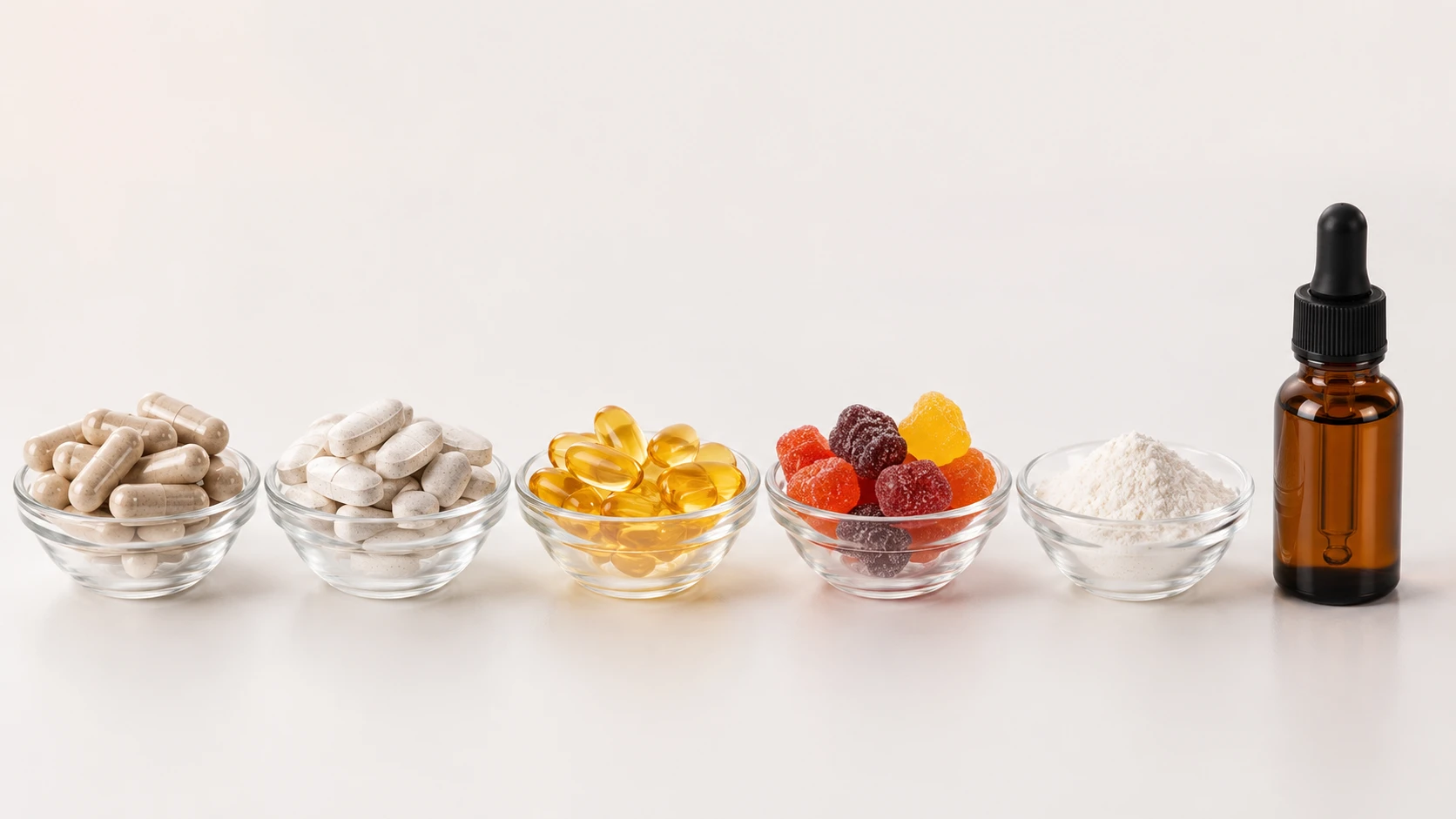
Food supplements come in six main dosage-form families – capsules, tablets, soft capsules, gummies, powders and liquid forms – all framed by the Swiss Food Supplements Ordinance (RS 817.022.14).
Key facts
Key takeaways
- The Swiss Food Supplements Ordinance authorises capsules, tablets, pills, powder sachets, liquid ampoules and dropper bottles as reference dosage forms.
- Classic solid forms (capsules, tablets) still dominate the Swiss market, but are losing ground to gummies, sticks and liquids, which are growing fast.
- The dosage form drives the absorption kinetics: an orodispersible vitamin D3 raises the blood 25(OH)D level faster than an equivalent soft capsule, according to Bano et al. (2023).
- Soft capsules are mostly used for fat-soluble actives (omega-3, vitamins A, D, E, K); effervescent tablets are typical for magnesium or vitamin C dosed in several hundred milligrams.
In Switzerland, nearly one third of the population reports having consumed at least one product in this category over the past seven days, according to an FSVO survey carried out in 2022 on 1,282 adults. These products, sold as food supplements, share a common regulatory feature: they must be offered in measured doses, in line with article 2 of the Swiss Food Supplements Ordinance. The final presentation, capsule, tablet, liquid or gummy, is not neutral: it shapes the stability of the active ingredient, the absorption kinetics and the ease of daily use. Understanding how a food supplement works therefore starts with the choice of dosage form.
Which dosage forms exist and what does the Swiss Food Supplements Ordinance say?
What are the common solid forms?
Solid presentations cover four main families intended for oral intake: capsules, tablets (including chewable tablets and orodispersible ones), soft capsules and gummies, to which can be added powders in sachets or jars, all popular formats on the food-supplement market[1]. A capsule is a two-part shell, often made from plant material (HPMC), that contains a powder: a mix of ingredients or a plant extract; the tablet, for its part, is obtained by compressing a dry material, sometimes coated to make swallowing easier and provide protection against moisture. Soft capsules, or softgels, contain an oil and are suitable for fat-soluble actives[2] such as omega-3 or vitamin D3, whose uptake benefits from this lipid matrix. Gummies, jelly-like sweets based on pectin or gelatine, have taken a significant place in the consumer segment[3] thanks to a pleasant, playful intake method and good acceptance by younger users: their sugar content remains, however, a point of attention. Powders, finally, are used for proteins, creatine or amino acids, whose daily intake often runs into several grams: a volume incompatible with a single hard capsule, and which justifies this powdered packaging.
Which liquid and alternative forms are authorised?
Liquid presentations include drinkable ampoules, syrups, dropper bottles and oral or sublingual sprays, all framed at European level and by article 2 of the Swiss Food Supplements Ordinance[4], which explicitly mentions “dropper bottles” and “liquid preparations in small measured units”. A drinkable ampoule concentrates a few millilitres of solution in a sealed glass container, which protects the active substance from oxidation and light and extends shelf life; the dropper system allows precise dosing to fine-tune each intake, a frequent technique for oil-based vitamin D3. Sublingual sprays release the active ingredient under the tongue where the mucosa is highly vascularised, a route used in particular for vitamin B12, with fast absorption. On the hybrid side, orodispersible sticks, handy for use on the go, lozenges and effervescent versions round out the offer and illustrate the difference between forms meant to be swallowed whole or dissolved. A randomised clinical study published in Frontiers in Nutrition in 2023 compared an orodispersible vitamin D3, a chewable tablet and a classic soft capsule across 45 deficient adults in total, over two successive trials: the orodispersible form led to a more marked and more lasting rise in the blood 25(OH)D level over six weeks[5].
How does the dosage form influence effectiveness?
What role does the form play in bioavailability?
Galenic design clearly changes the amount of nutrient that actually reaches the bloodstream[6], a crucial factor for assessing the real nutritional or physiological effect and the stability of the active ingredients. Three mechanisms explain this effect: the speed of disintegration in the digestive tract, the solubility of the active substance in the gastrointestinal fluids, and the presence or absence of a protective matrix (oil, microcapsule, lipid) that may target sustained release or, on the contrary, fast absorption. A randomised cross-over study published in Nutrients in 2024 compared four magnesium sources in 40 adults, oxide, citrate, bisglycinate and microencapsulated, and observed that the microencapsulated version maintained higher plasma concentrations over six hours than the others[7], while reducing unpleasant digestive effects such as diarrhoea or bloating. A comparative study on human intestinal epithelial cells (Caco-2), published in the same journal in early 2026, confirms that not all presentations are equal, even at the same elemental dose: the salt used and the transport matrix change the passage through the digestive barrier[8] and the uptake of the active ingredient by the body.
| Dosage form | Main strengths | Observed limits |
|---|---|---|
| Capsule (hard capsule) | Neutral taste, precise dose, plant version (HPMC) possible | Swallowing difficulty for children and older adults |
| Tablet / orodispersible | High doses possible, fast melting for the orodispersible version | Many binders and lubricants, high sodium in effervescent forms |
| Soft capsule (softgel) | Ideal for oily actives (omega-3, vitamins A, D, E, K) | Animal-source gelatine common, sensitivity to heat |
Which excipients accompany each form?
Each galenic design calls for specific excipients, which are not trivial for the attentive consumer. Tablets generally contain binders (microcrystalline cellulose), lubricants (magnesium stearate) and sometimes colourings; capsules require a shell of animal origin (gelatine) or plant origin (HPMC); soft capsules integrate glycerine and vegetable oil; gummies add sucrose, glucose syrup and flavourings: their sugar content typically reaches 1 to 5 g per unit depending on the brand[3], compared with zero for an equivalent hard capsule. The Swiss Food Supplements Ordinance specifies that these secondary ingredients are considered as foodstuffs and subject to the labelling rules applicable to foodstuffs (referring to the Ordinance on Food Information, RS 817.022.16)[4], in line with the European regulation on consumer information. The excipient profile therefore becomes a selection criterion: an effervescent form may, depending on its formulation, bring several tens to several hundreds of milligrams of sodium per intake, which can represent up to one fifth of the maximum daily intake of 2 g of sodium recommended by the WHO for adults[10].
How to choose the right form for your needs?
Which practical criteria should be favoured?
The choice of a galenic presentation rests on four concrete criteria, different depending on the context of use: the chemical nature of the active ingredient (water-soluble or fat-soluble), the daily intake required to complement the diet, the consumer profile (ability to swallow, personal constraints and preferences, taste sensitivity) and the lifestyle (mobility, travel, intake on the move, intake at work). For fat-soluble actives such as the fat-soluble vitamins and minerals A, D, E, K and omega-3, the oily soft capsule remains the reference: it protects the active ingredient from oxidation and supports its uptake with the lipid fraction of the meal, a clear advantage over dry material. A 2025 review on algae oil (a concentrated plant-based source of DHA) confirms that lipid encapsulation improves the oxidative stability and the bioavailability of these sensitive actives[9]. For minerals at high doses (magnesium, calcium), the tablet or the powder are more realistic than a single hard capsule, with easier dose adjustment. For nutrients with a moderate daily intake (B-group vitamins, iron, zinc), the capsule remains versatile: its low production cost, its ease of transport and its ability to be carried in a bag make it an easy option to integrate into daily life.
Caution with gummies and effervescent forms
A vitamin gummy can deliver 1 to 5 g of added sugars per unit depending on the brand: to be added to the daily count for children and people with diabetes. An effervescent tablet releases several tens to several hundreds of mg of sodium per dose depending on its formulation: to be avoided in case of high blood pressure or heart failure, or to be chosen from the reduced-sodium versions labelled accordingly.
Good label-reading practice
On any supplement, first check the elemental dose of the active ingredient (for example 200 mg of elemental magnesium and not 1,000 mg of magnesium oxide), then the full list of excipients: sugars, sweeteners, colourings, gelatine. The most effective dosage form is the one whose label is clear and whose actual dose is traceable.
What precautions according to the consumer profile?
Some audiences call for particular attention in the choice of presentation and require adapted precautions of use. Young consumers and people for whom swallowing a capsule remains difficult benefit from orodispersible versions, melting sticks or liquids rather than classic capsules or tablets, which are more pleasant to take. People with diabetes or following a carbohydrate-controlled diet should scrutinise the label of gummies, whose sugar content can weigh in a normal diet[3]. Pregnant women, older adults on multiple medications and patients with chronic diseases are concerned by possible interactions between certain plants contained in supplements (notably St John’s wort, a known enzyme inducer) and their ongoing treatments, including probiotics that act on the gut flora, a topic on which the FSVO maintains public recommendations[11] and an advice of caution. For athletes and users of high doses, powder offers an adjustment flexibility that the hard capsule or the tablet cannot match, but requires precise measurement. Storage conditions also play a role: protecting oil softgels from light, monitoring temperature and humidity to preserve shelf life. The right reflex remains, in any case, to ask a pharmacist’s advice in case of doubt.
- Nature of the active ingredient: water-soluble (B vitamins, C) or fat-soluble (A, D, E, K, omega-3): solubility dictates the optimal format.
- Daily dose: beyond 500 mg of active ingredient, a single capsule is often insufficient: prefer a tablet, a sachet or a powder.
- Consumer profile: swallowing ability, dietary constraints (sugar-free diet, no animal gelatine), personal taste.
- Context of use: travel, intake at work, short course or long-term supplementation shape the practical format.
Frequently asked questions about dosage forms
Are gummies as effective as capsules?
Not systematically. Gummies offer good convenience and better acceptance, especially among children, but their active-ingredient content is often lower than classic capsules or tablets for reasons of stability and taste. A market analysis published in 2025 underlines that formats alternative to capsules now dominate new product launches in Europe, but their added-sugar content can reach 1 to 5 grams per unit depending on the brand. For very high-dose active ingredients (magnesium, iron, high-dose vitamin D), the capsule, the tablet or the liquid form remain more suitable.
Is an effervescent form suitable for everyone?
No, especially not for people with high blood pressure or on low-sodium diets. Effervescent tablets quickly release their active ingredient in a large glass of water, which makes intake and gastric digestion easier, but they contain sodium bicarbonate or carbonate to produce the effervescence. The sodium content varies from several tens to several hundreds of milligrams per dose depending on the formulation, that is up to one fifth of the maximum daily intake recommended by the WHO (2 g of sodium). People on a low-sodium diet, with high blood pressure or with heart failure should check the sodium-content label or favour other forms.
Why offer an orodispersible or sublingual form?
To bypass the digestive tract and speed up the availability of the active ingredient. Orodispersible forms melt on the tongue or dissolve quickly, and sublingual forms place the active ingredient under the tongue, where the highly vascularised mucosa allows fast passage into the blood. A 2023 clinical study on vitamin D3 observed a faster and more lasting rise in blood 25(OH)D with an orodispersible form than with a classic soft capsule. It is also a practical answer for people who have trouble swallowing tablets.
Is powder more adjustable than a capsule?
Yes, powder allows the dose to be adjusted to the gram. It is particularly suitable for active ingredients with a high daily dose such as creatine, proteins, certain amino acids or magnesium in intensive courses: a sachet or a measuring spoon replaces the equivalent of several capsules. The downside concerns measurement: without a scale or calibrated spoon, dosing becomes approximate. Powders dissolve in water or juice, which makes intake easier but exposes certain light- or oxygen-sensitive active ingredients once reconstituted.
Is a liquid form systematically better absorbed?
Not always, contrary to a widely held idea. Liquid forms often show fast absorption because the active ingredient is already dissolved, but the final bioavailability depends on the salt used, the matrix (oily or aqueous) and the timing of intake. A comparative magnesium study published in Nutrients in 2024 showed that a microencapsulated form maintained higher plasma concentrations over six hours than an oxide, a citrate or a bisglycinate, at equivalent elemental dose. The choice therefore depends on the salt-matrix pairing, not on the sole fact of being liquid or solid.
Sources and references
11 sources- FDHA Ordinance on Food Supplements (Swiss Food Supplements Ordinance)
- Salinas-Arellano E. et al. (2023). Phytochemical Profiles and Biological Studies of Selected Botanical Dietary Supplements Used in the United States.
- UCLA Health. Should you take gummy vitamins?
- Swiss Food Supplements Ordinance, art. 1 and 2, Definition and forms placed on the market.
- Bano A. et al. (2023). A comparative absorption study of sucrosomial orodispersible vitamin D3 supplementation vs. a reference chewable tablet and soft gel capsule vitamin D3.
- FSVO (2022). Online survey on food-supplement use in Switzerland.
- Pajuelo D. et al. (2024). Comparative Clinical Study on Magnesium Absorption and Side Effects After Oral Intake of Microencapsulated Magnesium Versus Other Magnesium Sources.
- Demehin O.A. et al. (2026). A Comparison of Marine and Non-Marine Magnesium Sources for Bioavailability and Modulation of TRPM6/TRPM7 Gene Expression in a Caco-2 Epithelial Cell Model.
- Tang W. et al. (2025). A comprehensive review on algae oil: Resources, production, encapsulation and application in food.
- World Health Organization (WHO). Sodium reduction, fact sheet.
- FSVO. Food supplements: consumer information and recommendations for use.