What is the difference between a food supplement and a medicine?
Quick summary
A medicine prevents or treats a disease under Swissmedic authorisation, whereas a food supplement only supplements the diet with no therapeutic claim and falls under Swiss foodstuffs legislation (Federal Act on Foodstuffs and Utility Articles, FSA).
Key facts
Key takeaways
- The legal difference rests on purpose: a medicine heals, a food supplement nourishes, with no claim of cure or treatment.
- A medicine receives a marketing authorisation from Swissmedic after evaluation of efficacy and toxicity, whereas a food supplement is placed on the market under the sole responsibility of the manufacturer, with no prior authorisation.
- Nearly one in three Swiss residents takes at least one food supplement over the course of a week, mostly vitamins and minerals bought at the pharmacy or the drugstore (FSVO, Swiss Nutrition Bulletin).
- A study published in JAMA Network Open identified 15.6 million US adults exposed over 30 days to at least one botanical associated with a liver risk, illustrating the blind spot specific to food supplements (Likhitsup et al.).
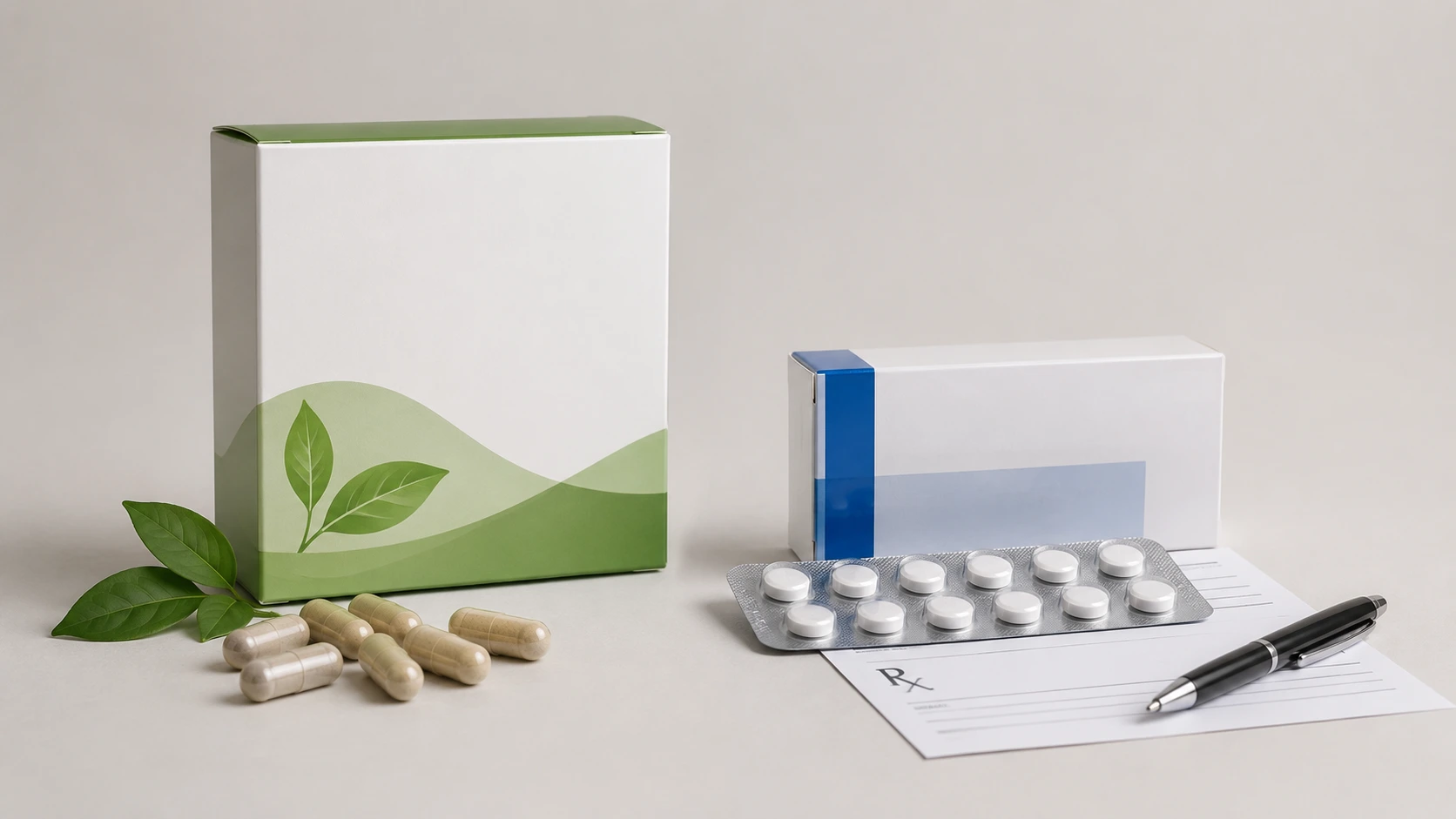
Nearly one third of the Swiss population takes at least one food supplement over the course of a week according to the survey carried out for the FSVO on 1,282 adults, and the boundary with the medicine remains blurred for many consumers. In the world of food supplements, the Swiss legal framework is, however, clear-cut: two distinct federal acts, two authorities, two control logics. Understanding how a food supplement works means clearly distinguishing it from the medicine, whose definition, authorisation and placing on the market follow much stricter rules set out in the Therapeutic Products Act (TPA).
How does Swiss law distinguish a food supplement from a medicine?
What is a food supplement under Swiss legislation?
A food supplement is legally a foodstuff that constitutes a concentrated source of nutrients, intended to supplement the normal diet with vitamins, minerals or substances with a nutritional or physiological effect, without any therapeutic purpose[1]. The FSVO specifies that a supplement can neither prevent, treat nor relieve a disease[1]. The FDHA Ordinance on Food Supplements (Swiss Food Supplements Ordinance, RS 817.022.14) frames the admitted ingredients, the forms of administration, capsules, tablets, ampoules, dropper bottles, and the maximum amounts per recommended daily dose. The wording “food supplement” must compulsorily appear on the packaging, and the exhaustive list of authorised vitamins and mineral salts is set out in annex 1 of the Swiss Food Supplements Ordinance. The overall framework is the Federal Act on Foodstuffs and Utility Articles (FSA, RS 817.0), which lays down the simple principle: a foodstuff must neither endanger health nor mislead the consumer.
What is a medicine under the Therapeutic Products Act (TPA)?
A medicine is a product of chemical or biological origin intended to have a medical action on the human or animal body, or presented as such, used in particular to diagnose, prevent or treat a disease, injury or disability[2]. The Federal Act on Medicinal Products and Medical Devices (Therapeutic Products Act, TPA, RS 812.21) sets out its definition in article 4, which covers medicines for human use as well as for veterinary use; blood and blood products are also considered medicines[2]. The category covers chemical synthetic medicines, phytomedicines, preparations based on plant substances with a stated indication, and complementary medicines such as homeopathy[2]. The notion covers both the objective composition of the product, active ingredients, dosages, and its subjective presentation: claims, labelling, advertising, therapeutic indications asserted. As soon as a product claims a therapeutic effect, it automatically shifts into the therapeutic-products regime, even if its composition could technically pass for a foodstuff[8].
Which criteria push a product from one category to the other?
The boundary rests on four criteria examined together: composition, dosage, presentation (labelling and advertising) and intended use. Products that contain an active ingredient at an effective dose, or that display a therapeutic claim, will be classified as a medicine: even if they are marketed under the “food supplement” label[8]. The emblematic case is red yeast rice (Monascus purpureus), a plant substance whose monacolin K is chemically identical to lovastatin, a prescribed statin[9]. Switzerland has made a restrictive choice: since 2017, the substance has been listed in annex 4 of the Ordinance on the Addition of Vitamins, Mineral Substances and Other Substances to Foodstuffs, which prohibits its marketing as a food supplement[9], while no medicine containing lovastatin or monacolin K has been authorised to date either[9]. The European Union has opted for an intermediate regime by capping the daily dose in food supplements at less than 3 mg of monacolin K (Regulation EU 2022/860). An inter-authority expert panel, Swissmedic, FSVO, FOPH, cantonal pharmacists and chemists, decides demarcation cases to harmonise enforcement across the whole of the Swiss territory[8].
Why does the regulatory control differ between the two categories?
How does a medicine obtain its marketing authorisation?
A medicine must obtain a prior authorisation from Swissmedic before any placing on the market: the manufacturer files an application accompanied by a dossier that must prove the efficacy and safety of the product, as well as its quality of use[2]. This marketing authorisation rests on structured clinical and toxicological trials, conducted in the laboratory under strict requirements. The evaluation covers pharmaceutical quality, composition, raw materials, manufacturing, stability, preclinical data in animals and clinical trials in humans. The dossier must demonstrate a favourable benefit-risk ratio for the indication claimed. This procedure has a considerable financial and time cost, which explains why many active ingredients never cross this regulatory step and remain confined to alternative frameworks.
Why do food supplements have no prior authorisation?
Food supplements are not subject to any authorisation procedure before being placed on the Swiss market; the regulation places responsibility for their compliance on the manufacturer and the distributor, under the principle of self-inspection set out in the Federal Act on Foodstuffs and Utility Articles[3]. The FSVO specifies in its consumer FAQ: “If such a procedure were required, health safety would have to be proven before the product is placed on the market.”[3] Cantonal enforcement authorities run spot checks after the fact, never before placing on the market[3]. This type of food logic, declarative rather than authorisation-based, is common to the EU and Switzerland, but it leaves a grey area: a product can be marketed without a demonstration of efficacy, provided it is neither harmful nor misleading.
What practical consequences for the consumer?
Claims, labelling and points of sale: what changes in concrete terms
A food supplement may not display any therapeutic claim or claim of cure: it may only repeat nutrition or health claims approved by the FSVO, for example “vitamin D contributes to the maintenance of normal bones” or “magnesium contributes to normal muscle function”[1]. A medicine, for its part, states its exact therapeutic indications on the package leaflet. The place of sale also differs: medicines remain largely restricted to the pharmaceutical circuit, on medical prescription or over the counter according to the dispensing list, whereas food supplements are found in pharmacies, drugstores, supermarkets and online: including on foreign websites, which increases the risk of products that do not comply with Swiss law. Coverage by mandatory health insurance is, moreover, reserved for reimbursed medicines listed in the specialities list, never for food supplements.
| Criterion | Medicine | Food supplement |
|---|---|---|
| Legal purpose | Prevent, diagnose or treat a disease | Supplement a diet, provide a nutritional or physiological effect |
| Supervisory authority | Swissmedic | FSVO, cantonal chemists |
| Prior authorisation | Marketing authorisation mandatory (TPA, RS 812.21) | None: manufacturer self-inspection (FSA, RS 817.0) |
| Authorised claim | Precise therapeutic indication | Nutrition or health claims approved |
| Insurance reimbursement | Yes, if listed in the specialities list | Never |
| Points of sale | Mainly pharmacy (with or without prescription) | Pharmacy, drugstore, supermarket, online |
Why interactions between supplements and medicines remain a blind spot
Plant-based food supplements can interact with prescribed medicines, and this risk area is recognised by health authorities. A US study published in JAMA Network Open estimated at 15.6 million the number of adults exposed over 30 days to at least one of six botanicals associated with a liver risk: a figure close to the number of patients on lipid-lowering statins[5]. Several recent reviews document clinically significant plant-medicine interactions[6], in particular in oncology patients on chemotherapy[7]. In Switzerland, the FSVO specifically warns against supplements bought on foreign websites, which may contain undeclared or pharmacologically active substances[3]. Before combining a supplement with a treatment, it is wise to consult a health professional, pharmacist or family doctor, who assesses possible interactions downstream of placing on the market.
Warning: drug interactions
Oral anticoagulants, antidepressants, immunosuppressants: systematically tell your doctor and pharmacist about any food supplement in use, including “natural” ones. Supplements based on St John’s wort, red yeast rice or ginkgo biloba alter the effect of several treatments.
Frequently asked questions
Can a food supplement replace a medicine?
No, never. A food supplement is legally a foodstuff: it cannot claim to prevent, treat or relieve a disease[1]. Only medicines authorised by Swissmedic carry a recognised therapeutic indication, after clinical evaluation of efficacy and safety. The FSVO also recalls that a supplement does not make up for the shortfalls of an unbalanced diet[3]. In the case of a diagnosed condition, only a doctor can decide on a suitable treatment; the supplement may serve as nutritional support, never as a substitute for a prescribed medicine.
Why can a food supplement not claim to cure a disease?
Because Swiss law expressly forbids it. Article 4 of the Therapeutic Products Act (TPA) reserves any claim of prevention, diagnosis or treatment to authorised medicines[2]. Any therapeutic claim on a supplement package automatically shifts the product into the therapeutic-products regime and exposes the manufacturer to a Swissmedic action[8]. The only claims allowed on a supplement are those approved by the FSVO, such as the role of vitamin D in bone structure or of magnesium in normal muscle function[1].
How many Swiss residents take food supplements?
Around one third of the adult population. The survey carried out for the FSVO on 1,282 Swiss adults, published in the Swiss Nutrition Bulletin, shows that 30% of participants took at least one supplement during the last seven days, and 28% during the last twelve months[4]. Vitamins, vitamins combined with minerals and mineral salts form the most consumed trio. Urban women, with high income and education levels, are clearly over-represented among users.
Are plant-based supplements closer to medicines?
Closer biologically, but distinct legally. Some plant substances act pharmacologically, such as red yeast rice (Monascus purpureus) whose monacolin K is chemically identical to lovastatin, a prescribed statin[9]. Switzerland has made a restrictive choice: the substance has been listed in annex 4 of the Ordinance on the Addition of Vitamins, Mineral Substances and Other Substances to Foodstuffs since 2017 and can be marketed neither as a food supplement nor as a medicine[9]. The EU, for its part, caps supplements at less than 3 mg of monacolin K per daily dose (Regulation EU 2022/860). Phytomedicines of traditional use, by contrast, fall under a specific authorisation procedure in Switzerland, based on at least thirty years of established medical use, including fifteen years in the EU or EFTA[2].
What should I do if I take both a medicine and a food supplement?
Systematically tell your doctor and pharmacist about it. Several supplements interact with common treatments: St John’s wort reduces the effect of many medicines via enzyme induction, ginkgo biloba potentiates anticoagulants, and red yeast rice adds to statins. A 2024 US study identified around 15.6 million adults exposed over 30 days to at least one botanical associated with a liver risk (Likhitsup, JAMA Network Open)[5]. A prior pharmaceutical check noticeably reduces this interaction risk.
Sources and references
9 sources- FSVO, Food supplements (official page)
- Swissmedic & FSVO (2021). Demarcation criteria between therapeutic products and foodstuffs
- FSVO, Consumer FAQ on food supplements
- Solliard C, Benzi Schmid C, König SLB. Food supplement use in Switzerland
- Likhitsup A, Chen VL, Fontana RJ (2024). Estimated Exposure to 6 Potentially Hepatotoxic Botanicals in US Adults
- Koturbash I, Yeager RP, Mitchell CA, et al. (2024). Botanical-induced toxicity: liver injury and botanical-drug interactions
- Langley BO, Rillamas-Sun E, Huang Y, et al. (2024). Validation of Drug-Nutrient Interaction in Dietary Supplements
- Swissmedic, Demarcation questions (inter-authority expert panel)
- FSVO & Swissmedic, Red yeast rice (Monascus purpureus): status in Switzerland