
Which food supplements can support weight loss?
Quick summary
Without a calorie deficit, no food supplement makes you lose weight: recent meta-analyses limit their effect to -0.3 to -2 kg on average, far from the marketing promises.
Key facts
Key points
- Weight loss rests first and foremost on a calorie deficit: spending more energy than is consumed. No supplement bypasses this basic principle (Lafontan 2014, INSERM Toulouse).
- The reference Shahinfar 2023 meta-analysis on 111 trials and 6,171 adults places the average weight loss attributable to a supplement between -0.3 and -3.7 kg depending on the compound: psyllium and glucomannan top the list.
- Astaxanthin and CLA, popular as “fat burners”, show no clinically useful effect in recent meta-analyses (Laurindo 2025, Asbaghi 2023).
- The FSVO bans three substances commonly associated with weight loss in Switzerland: DNP, DMAA and DHEA, along with red yeast rice.
- In 2022, 43% of the Swiss population was overweight or obese: a BMI ≥ 30 requires medical care and not self-medication.
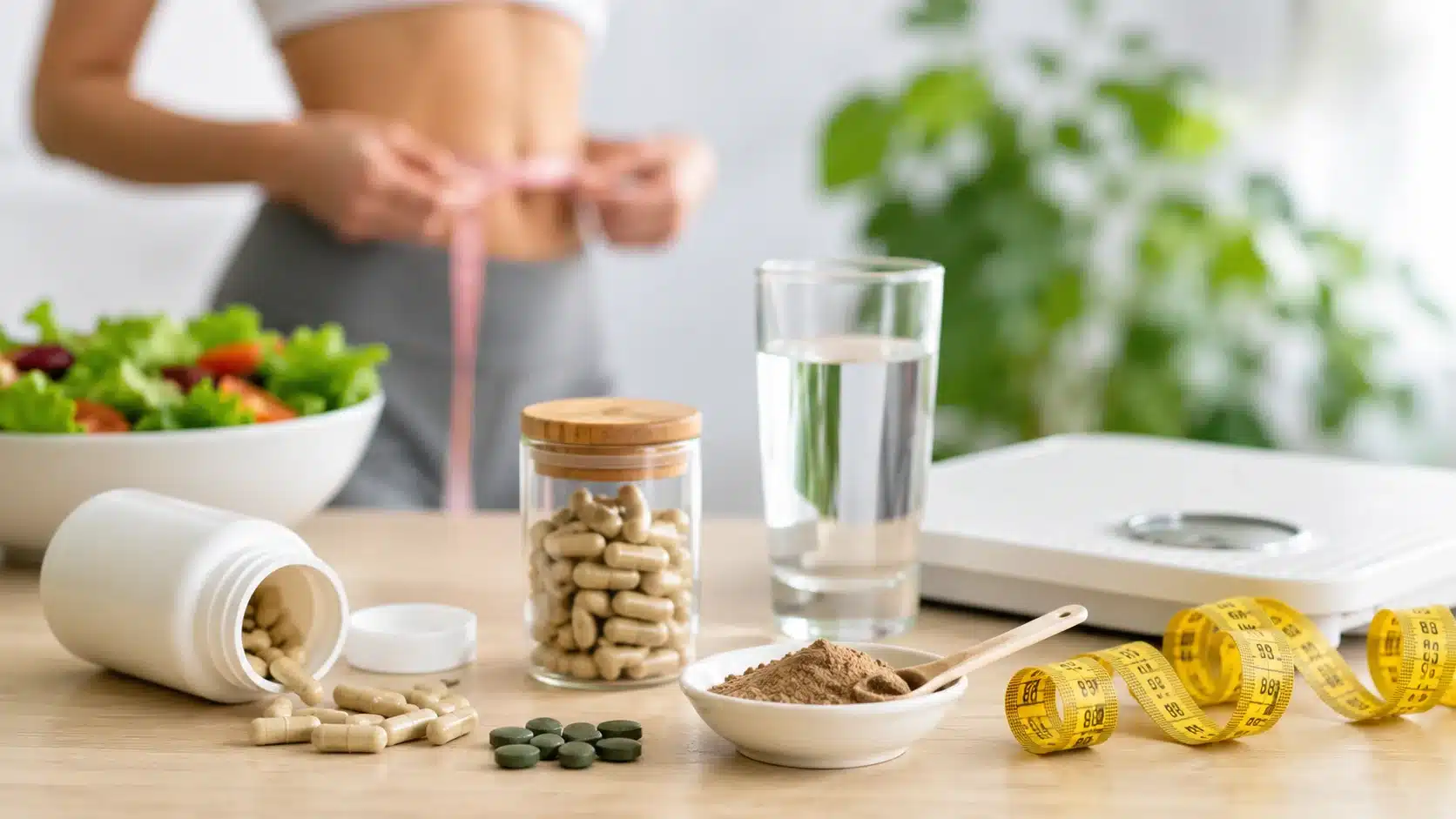
In 2022, 43% of the Swiss population was overweight or obese, according to the Federal Statistical Office[2]. Faced with this picture, pharmacy shelves and online shops overflow with slimming promises. Yet the mechanism of weight loss remains simple: you have to consume fewer calories than you spend. As researcher Max Lafontan (INSERM Toulouse) reminds us, the treatment of obesity rests above all on diet and physical activity[13]. Before turning to a food supplement for losing weight, it is better to understand what the studies really measure: and to place the proven benefits of food supplements within an overall approach.
What do recent studies say on the effectiveness of food supplements for weight loss?
How many kilos can be lost on average with a food supplement?
The average weight loss attributable to a food supplement lies between -0.3 and -2 kg over several months. All these results share a common feature: they were obtained in participants who were already eating less or moving more[13]. Food supplements for weight loss play at best a supporting role alongside a calorie deficit, never that of a miracle fat burner. A network meta-analysis published in 2023 in Pharmacological Research pooled 111 randomised clinical trials and 6,171 overweight or obese adults[1]. Out of 18 nutraceuticals evaluated, psyllium comes top with an average loss of -3.7 kg[1]. Next come Nigella sativa (-2.1 kg) and spirulina (-1.8 kg)[1]. Glucomannan reaches -1.36 kg and green tea -1.25 kg, with a level of evidence rated as low in both cases[1]. Several other ingredients show no significant effect on weight management, whatever the form of the formula (capsule, powder or drinkable solution).
Why is a statistical effect not always a useful effect in practice?
A statistically significant effect is not always a useful effect in practice. When a meta-analysis measures -0.35 kg over 12 weeks between a product and a placebo, the result is mathematically real but clinically negligible compared with a goal of several kilos. This is exactly what Asbaghi 2023 concludes on conjugated linoleic acid (CLA): 70 randomised trials, 4,159 participants, and an effect “that may not reach clinical importance”[11]. The higher-quality studies also show no effect of CLA on fat mass or muscle mass[11]. In plain terms: a supplement that helps you lose a few hundred grams neither transforms the silhouette nor changes the basic energy expenditure, and its nutritional effect remains insignificant on the body over the medium term.
Which supplements offer the strongest evidence in 2026?
Do glucomannan and satiety fibres have a documented effect?
Glucomannan and satiety-promoting fibres have the most tangible evidence among supplements, without being miraculous. Glucomannan is a plant fibre extracted from konjac that swells on contact with water in the stomach, prolongs the feeling of fullness and helps to reduce appetite between meals. In the Shahinfar 2023 meta-analysis, this ingredient leads to an average loss of -1.4 kg, with a level of evidence rated as low[1]. A randomised trial published in 2024 combined glucomannan, inulin and psyllium in 112 obese adults over 180 days[9]. Participants lost on average 4.9% of their body weight and 13% of fat mass compared with placebo[9]. The downside: 74.6% of the active group reported at least one adverse effect, mainly digestive (flatulence and abdominal discomfort, generally mild to moderate)[9]. The effect exists, but the digestive comfort limits long-term use.
Do green tea and caffeine really help burn fat?
Green tea and caffeine have a real but marginal effect on fat loss, only when combined with an active lifestyle. A Gholami 2024 meta-analysis compared an exercise programme with or without extract of this plant in overweight adults, across 10 randomised trials[8]. Adding green tea, combined with regular physical activity, brings an additional “small but consistent” reduction in weight and fat mass[8]. No effect was observed on the lipid profile (cholesterol, triglycerides)[8]. At high doses, the EGCG of green tea may be linked to rare but documented liver damage: watch out above 800 mg per day. Without sport or physical activity to support metabolism, the thermogenic effect of caffeine or catechins remains anecdotal on the scales and on basal metabolism.
Are probiotics and berberine effective for weight loss?
Probiotics and berberine give modest results, highly dependent on context. On berberine, whose tablets are sometimes used to act on blood sugar, an Elahi Vahed 2025 meta-analysis pooled 23 randomised trials and observed -0.88 kg of weight, -0.48 point of BMI and -1.3 cm of waist circumference[10]. No effect was detected on the waist-to-hip ratio[10]. On probiotics, results are contradictory depending on the strain used. A systematic review of 87 trials and 6,086 adults associates certain strains with a modest reduction in weight and fat mass[5]. The authors stress, however, that evidence of a causal link remains limited[5]. Conversely, 13 trials on 693 patients after bariatric surgery show no effect on excess weight loss[6]. In metabolic syndrome, probiotics and synbiotics deliver -0.79 kg and -1.04 cm of waist circumference across 24 trials[7]. The result therefore depends on the patient’s profile and the strain.
Which supplements are disappointing or risky for weight loss?
Which popular supplements lack evidence of effectiveness?
Several very popular supplements show no significant effect in rigorous studies. Astaxanthin, an antioxidant often sold as a slimming or anti-cellulite aid by certain slimming-product brands, brought no significant reduction in BMI or weight in the Laurindo 2025 meta-analysis, which pools 9 clinical trials[12]. No dose-response correlation was detected either[12]. CLA (conjugated linoleic acid), long presented as the best miracle fat-burning supplement, reaches only an effect of -0.35 kg considered without clinical relevance[11]. Products labelled “fat burner”, “fat binder”, “drainer” or “appetite suppressant” without specifying their composition or providing a clinical study reference rarely rest on solid evidence.
Which substances are banned in Switzerland for weight loss?
Three substances commonly associated with weight loss are strictly banned in Switzerland. The FSVO (Federal Food Safety and Veterinary Office) prohibits 2,4-dinitrophenol (DNP)[4], an industrial chemical that can cause fatal poisoning, dimethylhexanamine (DMAA)[4], and dehydroepiandrosterone (DHEA)[4], an anabolic steroid. These substances regularly reappear in products ordered for sale on foreign websites, outside the Swiss or European pharmacy circuit, and not labelled in French, German or Italian: a major point of caution for the consumer. Red yeast rice is praised for its effects on cholesterol and sometimes on weight. It is, however, not compliant with Swiss regulations, either as a foodstuff or as a medicine, because of serious doubts about its safety[4].
How can you integrate a food supplement into a weight-loss approach?
In which cases can a supplement really help?
A supplement can support a weight-loss approach only if it is added to a genuine calorie deficit. The French researcher Max Lafontan, a global reference on adipose tissue, is explicit: the treatment of obesity rests above all on “behavioural approaches”, that is, a balanced diet and regular physical activity[13]. No recent meta-analysis shows a significant effect of supplements taken “alone”, without a change in healthy lifestyle or eating habits[1]. Fibres such as glucomannan can help to better manage hunger between meals and limit snacking or extras during a diet, while green tea adds a marginal effect to physical exercise. But the FSVO points out that people who follow a varied and balanced diet do not, as a rule, need food supplements to support a healthy diet[3]. For weight loss, expectations must remain modest: and the scales secondary to the fork and the running shoes.
When should you consult a professional rather than self-supplement?
Medical advice is essential in cases of obesity (BMI ≥ 30), chronic disease or ongoing treatment. Obesity is recognised by the WHO as a chronic disease[2] and calls for medical management, not self-medication or advice picked up online. Several supplements interact with common medicines: St John’s wort with antidepressants and the contraceptive pill, berberine with antidiabetic drugs, fibres with the absorption of certain thyroid medicines. In pregnant or breastfeeding women, pregnancy also requires specific precautions. In obesity with comorbidities, validated and supervised pharmacological treatments (GLP-1 analogues, for example) or bariatric surgery deliver results far beyond those of any supplement. Before choosing a product, contacting a doctor or pharmacist, or a dietitian service, helps to avoid false leads, risky interactions and tolerance problems.
Frequently asked questions
Are food supplements for losing weight effective?
Their effectiveness remains weak and inconsistent. Recent meta-analyses measure average losses of -0.3 to -2 kg over several months: effects that are statistically significant but often without real clinical relevance. Across 111 randomised clinical trials and 6,171 participants compiled by Shahinfar 2023, no supplement reproduces the effect of a calorie deficit or regular physical activity. Supplements can support an overall approach, but never replace it.
Which food supplements are the most effective for losing weight?
Psyllium, spirulina, Nigella sativa, glucomannan and green tea show the most measured effects in the literature. These compounds act through different mechanisms: satiety through fibre for psyllium and glucomannan, modulation of metabolism for green tea. According to Shahinfar 2023, psyllium reaches -3.7 kg on average, but the heterogeneity of the studies and the quality of the trials limit these conclusions. None of these supplements is effective without a lasting change in diet and physical activity.
How long should you take a food supplement to observe an effect?
Most clinical trials last between 8 and 24 weeks before a measurable difference appears. Fibre-based supplements like glucomannan can change satiety within a few days, but the effect on the scales takes at least 12 weeks. Reference trials on probiotics or berberine often run for 12 to 16 weeks. Beyond 6 months without a tangible result, continuing has no value and medical advice is required.
How can you lose 10 kilos in 1 month with a food supplement?
This goal is neither achievable nor recommended with a food supplement. A loss of 10 kg in 4 weeks assumes an extreme calorie deficit, which carries a high risk of nutritional deficiencies, muscle loss, gallstones and rebound effect. Medical recommendations place healthy weight loss between 0.5 and 1 kg per week, i.e. 2 to 4 kg per month depending on the starting weight. Lasting weight loss rests on a moderate calorie deficit combined with regular physical activity: never on a supplement alone.
Are food supplements controlled in Switzerland?
Yes, but without a mandatory prior authorisation procedure. In Switzerland, food supplements are governed by Swiss food legislation. The manufacturer or importer is responsible for compliance, and the cantonal authorities check products by sampling (FSVO 2024). Three substances are strictly banned for weight loss: DNP, DMAA and DHEA. Red yeast rice is also not authorised. Purchases on foreign websites expose consumers to non-compliant or dangerous products.
What are the side effects of food supplements for losing weight?
The most frequent are digestive: flatulence and abdominal discomfort, generally mild to moderate, observed in 74.6% of participants in the Pokushalov 2024 study on combined fibres. High-dose green tea (above 800 mg of EGCG per day) can cause rare but documented liver damage. Excess caffeine triggers palpitations, anxiety and insomnia. Undeclared products sold online sometimes contain banned substances such as DNP, which the FSVO indicates can be fatal.
Sources and references
13 sources- Comparative effects of nutraceuticals on body weight in adults with overweight or obesity
- Overweight and obesity, 2022 Swiss Health Survey
- Food supplements, official page
- Substances banned in food supplements
- Impacts of Lifestyle and Microbiota-Targeted Interventions for Overweight and Obesity
- Effect of probiotics on weight management after metabolic and bariatric surgery
- Efficacy and safety of probiotic and synbiotic supplementation in metabolic syndrome
- Green tea catechin and exercise training in overweight and obese individuals
- Impact of Glucomannan, Inulin, and Psyllium Supplementation on Weight Loss
- The effect of berberine on obesity indices: a systematic review and meta-analysis
- Effects of conjugated linoleic acid on anthropometrics and body composition
- Therapeutic Potential of Astaxanthin for Body Weight Regulation
- Adipose tissue and adipocyte dysregulation