
How are the nutrients in supplements absorbed by the body?
Quick summary
The absorption of a food supplement follows three stages: dissolution in the stomach, passage through the wall of the small intestine via specific transporters, then distribution by blood or lymph — with a final filtering step by the liver.
Key facts
Key takeaways
- The small intestine absorbs the vast majority of the nutrients from a food supplement, after a mandatory dissolution step in the stomach.
- The fat-soluble vitamins A, D, E, K need a little fat in the meal to cross the intestinal wall.
- Vitamin C raises iron absorption by around 30%, while a coffee with a meal lowers it by 54% according to the 2023 von Siebenthal study.
- Each nutrient has dedicated transporters on the intestinal wall (DMT1 for iron, ZIP4 for zinc, TRPV6 for calcium), whose amount is itself regulated by the body.
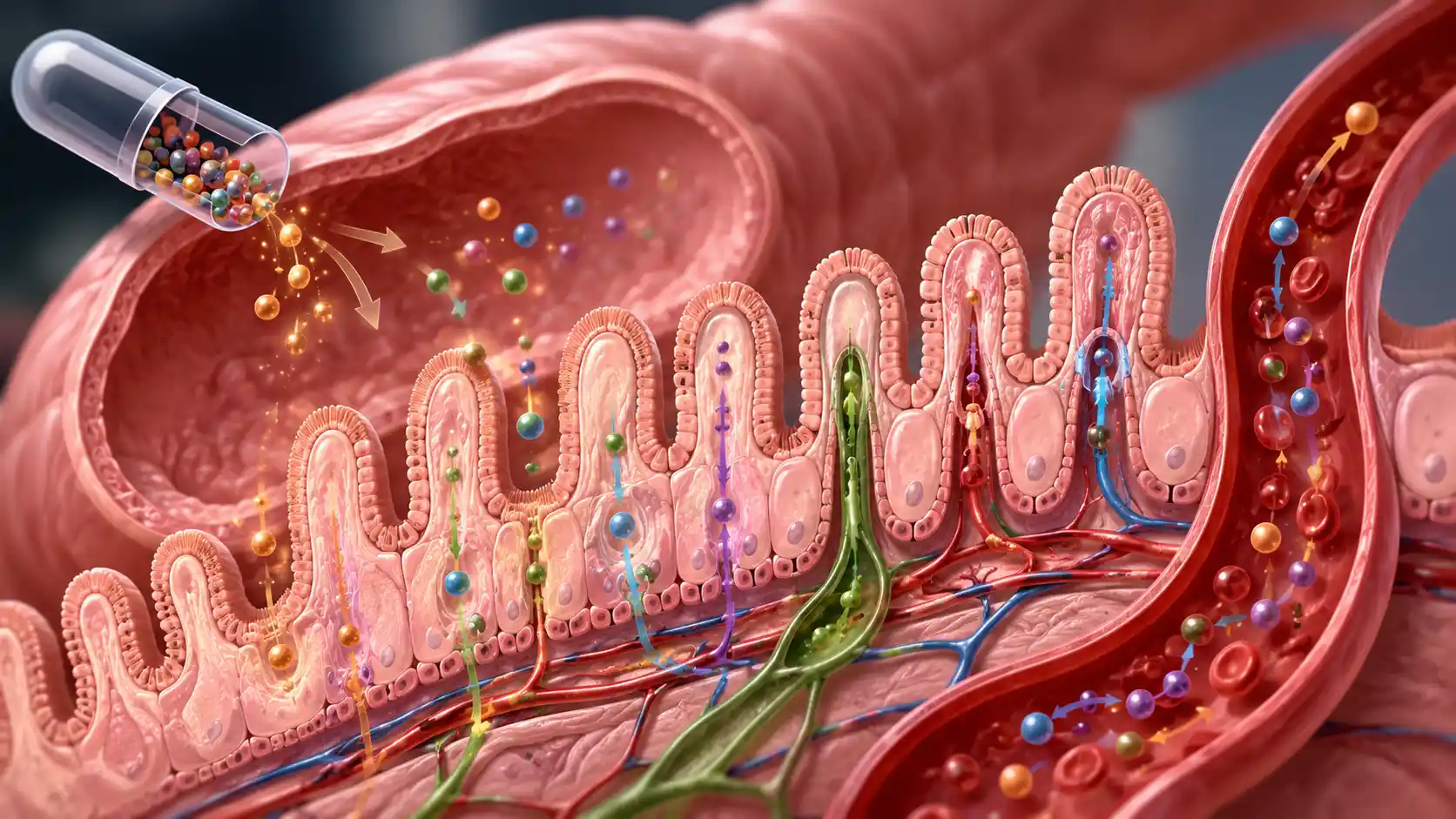
Nearly one in three people in Switzerland takes at least one food supplement according to the national FSVO survey. But once the capsule is swallowed, how do the vitamins, minerals or plants contained in a food supplement reach the bloodstream and then the cells? The journey follows precise biological stages, each of which can be helped along or slowed down. This article describes the concrete route, from the stomach to the liver, and places it within the broader framework of how a food supplement works, to understand what determines the share that the body can actually use.
The journey of a nutrient, from intake to cell
What happens in the stomach?
The stomach dissolves the dosage form of the supplement; at this digestive stage, the absorption of nutrients there is marginal. Generally between 15 minutes and over an hour depending on the format, the gastric acidity (pH 1.5 to 3.5 in a fasting adult) and the enzymes break down the capsule, tablet or liquid to release the active ingredients. This first step of the digestive process shapes what comes next: a tablet that is poorly dissolved reaches the intestine intact and is not absorbed. According to a study published in Methods[1], the gastric solubility of magnesium and calcium salts, two mineral substances commonly used in supplements, varies noticeably according to the raw material used, which shapes the amount actually available for intestinal absorption.
How do nutrients cross the intestinal wall?
The small intestine is the main absorption site. Its inner lining, folded into folds and villi, reaches around 30 square metres in an adult — far more than the skin. The absorption mechanisms take two paths: the transcellular route through the enterocytes via specific transporters, and the paracellular route between the cells for water and certain ions.
Each enterocyte carries dedicated transporter proteins: DMT1 for iron, ZIP4 for zinc, TRPV6 for calcium. According to a review published in Acta Physiologica[3], around 20% of absorbed calcium uses TRPV6 in the upper part, while the majority takes the paracellular route in the ileum. For iron, a review published in Clinical Laboratory in 2025[2] explains that it is exported into the blood via ferroportin, whose amount is set by hepcidin — a liver hormone that fine-tunes iron entry according to the body’s needs.
Vitamins A, D, E, K and carotenoids follow a separate path. They only cross the wall once dissolved in micelles formed by bile salts and a little fat — hence the advice to take them with a meal containing some fat. Inside the enterocyte, they are re-packed into chylomicrons that leave via the lymph before reaching the blood. According to a review published in Biomedicines in 2024[4], a defect in this intracellular trafficking leads to severe malabsorption of fats and fat-soluble vitamins.
Why do nutrients go through the liver?
The liver filters the majority of absorbed nutrients before they join the general circulation of the human body. Blood from the small intestine first travels through the hepatic portal vein, where the liver inspects the molecules, transforms certain vitamins (for example vitamin D into its circulating 25(OH)D form), stores reserves of iron and fat-soluble vitamins, and neutralises unwanted compounds. The fat-soluble vitamins A, D, E, K and some fats follow a partly different route through the digestive system: absorbed into chylomicrons, they first pass through the lymph before reaching the bloodstream and the liver.
What can modulate or slow absorption?
Which luminal factors change this passage?
The chemical environment of the intestine strongly shapes the absorption of minerals and vitamins. Three documented mechanisms combine at mealtime: vitamin C converts Fe³⁺ iron into Fe²⁺, a form much better recognised by the DMT1 transporter; the tannins in coffee and tea form insoluble complexes with iron in the intestinal lumen; calcium competes with iron for the enterocyte transporters. A Swiss study run at ETH Zurich (von Siebenthal et al., published in 2023 in American Journal of Hematology)[5] quantified these effects in 34 iron-deficient women: 80 mg of vitamin C raises iron absorption by 30%, a coffee with the meal cuts it by 54%, and a classic breakfast with coffee drops absorption by 66% despite 90 mg of vitamin C from orange juice — a fruit rich in ascorbic acid. According to a review published in Nutrients in 2025[6], the haem iron in animal foods follows a distinct path, catalysed by an enzyme called haem oxygenase in the enterocyte, which sets it apart from non-haem iron with regard to these luminal factors.
What role does the gut microbiota play?
The gut microbiota, sometimes called gut flora, modulates the absorption of several nutrients, especially in the colon. The bacteria ferment dietary fibre and release short-chain fatty acids that locally acidify the medium and favour the passive absorption of calcium and magnesium, two essential micronutrients. A review published in Acta Physiologica in 2025[3] reports that adding prebiotics can shift colonic calcium absorption from around 10% to close to 30% of the daily total. The bacteria also turn certain polyphenols and plants into active metabolites. A chronic dysbiosis (microbiota imbalance) or an inflammatory bowel disease can therefore reduce the real absorption of a supplement, even a well-formulated one.
Which signs may suggest poor absorption?
Several signals may suggest insufficient absorption: persistent fatigue, recurring digestive disorders (bloating, diarrhoea, fatty stools), unexplained weight loss, brittle nails, or blood tests that show a deficiency despite regular supplementation. These signs are never specific to a single nutrient and can also reflect other health issues such as coeliac disease, a chronic inflammatory disorder or an enzyme deficiency. The FSVO[7] recalls that targeted supplementation can be relevant for a limited time when certain nutrients are not absorbed in sufficient quantity from a person’s everyday diet. Only a medical assessment by a healthcare professional, with a blood test and, if needed, a digestive examination, can identify the cause.
Practical pointer
Keeping a simple journal over 2 to 4 weeks (supplements taken, meals together with them, timing, symptoms) helps to identify an absorption issue and to work with a healthcare professional.
Frequently asked questions
How does the body absorb the nutrients from a food supplement?
Absorption mainly takes place in the small intestine, after dissolution in the stomach. Nutrients cross the intestinal wall through specialised cells and specific transporters, then enter the bloodstream or the lymphatic system. The liver then filters most of them before they reach the cells. The FSVO recalls that this absorption depends on the form of the supplement, the meal taken with it and the state of gut health.
Which organ takes care of nutrient absorption?
The small intestine handles nearly 90% of the absorption of the nutrients from a food supplement. Its folds and villi unfold an exchange surface of roughly 30 square metres in an adult. The colon then takes over for certain minerals and water. The stomach itself mainly dissolves the dosage form and starts protein digestion before the intestinal stage.
Should supplements be taken before, during or after a meal?
The timing depends on the type of nutrient. The fat-soluble vitamins A, D, E, K need a meal containing some fat to be absorbed properly. Iron salts are better taken on an empty stomach in the morning with a juice rich in vitamin C: the 2023 von Siebenthal study shows absorption raised by 30% versus water alone, and reduced by 54% with a coffee. The exact rule often appears on the product leaflet.
Does the body absorb every nutrient from a supplement?
No, absorption is partial and variable. Depending on the molecule, the dosage form and the state of the gut, the absorption rate can range from a few percent to more than 90%. For non-haem iron, for instance, the body usually absorbs only 10 to 15% of the ingested dose, the rest being excreted in stools. This actually usable fraction has a name — bioavailability — and depends as much on the form of the supplement as on the state of the intestinal wall.
Which signs may indicate poor absorption?
Several signals may suggest incomplete uptake: persistent fatigue, brittle nails, recurring digestive disorders, fatty stools, unexplained weight loss or deficiencies confirmed by a blood test despite regular supplementation. These symptoms may also point to other disorders: only a medical opinion, with targeted tests, can tell malabsorption apart from another cause.
Sources and references
7 sources- Dowley A et al. — The bioaccessibility and tolerability of marine-derived sources of magnesium and calcium.
- Enko D — Physiology of Iron Metabolism.
- Stumpff F, Manneck D — Prebiotics as modulators of colonic calcium and magnesium uptake.
- Levy E et al. — Unraveling Chylomicron Retention Disease: insight into intracellular chylomicron trafficking and fat-soluble vitamin absorption.
- von Siebenthal HK et al. — Effect of dietary factors and time of day on iron absorption from oral iron supplements in iron deficient women.
- Kalman D et al. — Dietary Heme Iron: A Review of Efficacy, Safety and Tolerability.
- Federal Food Safety and Veterinary Office (FSVO) — Food supplements.