
Which digestive disorders linked to food supplements?
Quick summary
Yes. Food supplements frequently cause digestive disorders, nausea, diarrhoea, constipation, bloating, especially with iron, high-dose vitamin C, magnesium oxide and certain laxative plants.
Key facts
Key takeaways
- Oral iron causes digestive effects in about 1 user in 3 with ferrous sulfate, with effects reported from 50-60 mg of elemental iron per day according to EFSA.
- Vitamin C exceeds digestive tolerance from 1,000 mg/day in supplementation, by an unabsorbed osmotic effect.
- Magnesium oxide and citrate have a marked laxative effect that bisglycinate does not reproduce at an equivalent dose.
- Plant-based ‘slimming’ supplements (senna, cascara, laxative herbal medicine) remain the most reported to Tox Info Suisse.
- Stopping the supplement resolves the symptoms within 24 to 72 hours in most uncomplicated cases.
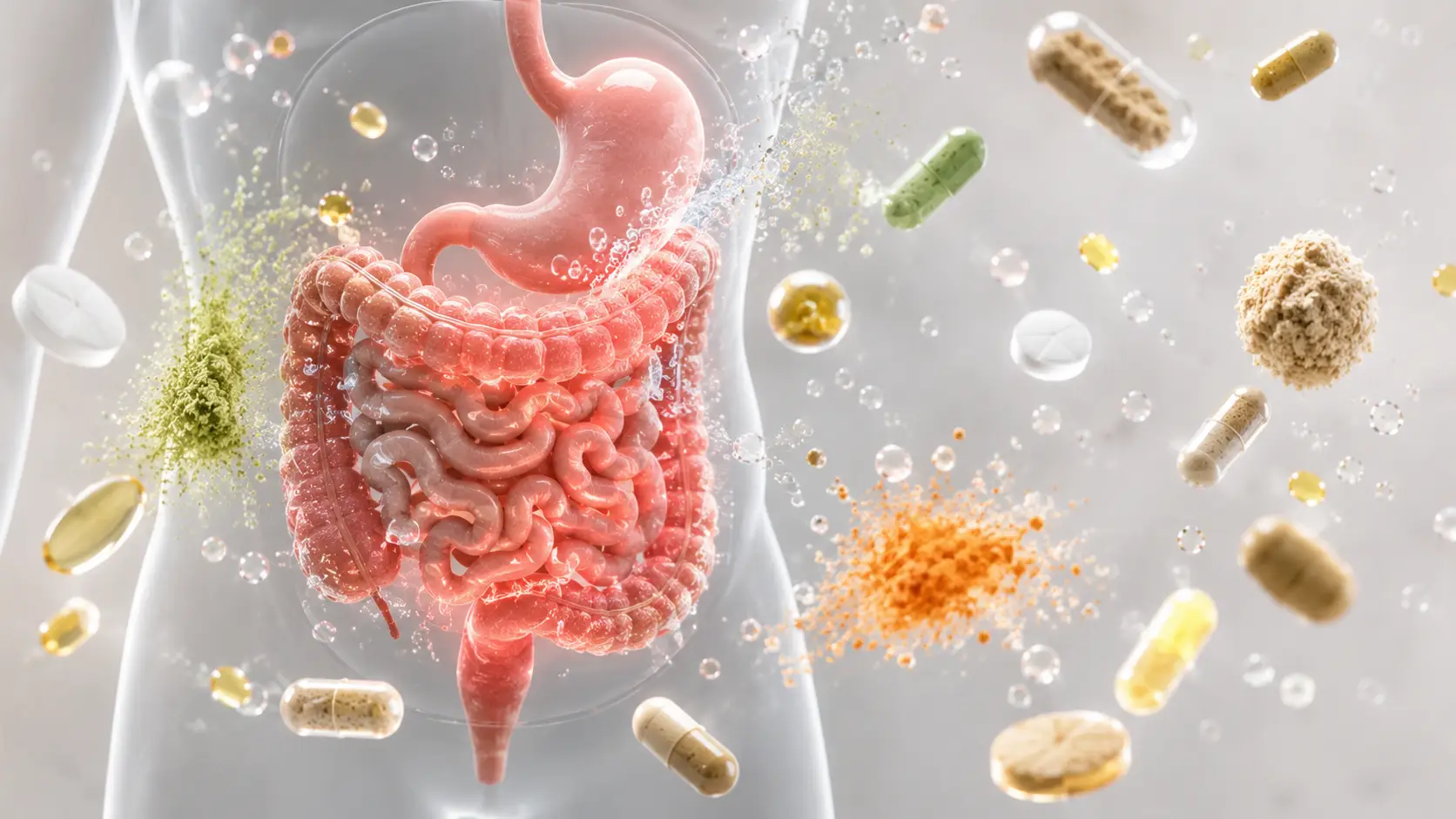
Between 2014 and 2019, Tox Info Suisse recorded nearly 1,200 enquiries linked to food supplements, of which a majority involved digestive symptoms. In the world of the food supplement, the gastrointestinal tract concentrates the majority of documented adverse effects: well ahead of liver or kidney damage. This overview of side effects of food supplements details the nutrients most often involved and the underlying mechanisms. It draws on Swiss data (FSVO, Food Supplements Ordinance) and the recent clinical literature.
Which digestive symptoms are reported and how frequent are they
What are the main digestive disorders observed
Nausea, diarrhoea, constipation and abdominal pain dominate among the main forms of digestive discomfort reported. An Italian analysis published in 2024 covered 129 cases of adverse effects linked to supplements bought or reported online, selected from 2,367 reports from the national phytovigilance system.[1] The digestive tract accounted for 31.4% of these effects,[1] the first system affected, far ahead of the central nervous system at 17.6%.
The clinical picture remains mostly benign and self-limiting, without overall danger to digestive health. Nausea, bloating and loose stools arise in the hours following intake, signs of transient difficult digestion. Constipation sets in over several days, in particular with iron-based supplements. Bloating and flatulence often accompany prebiotic fibres and probiotic strains at the start of a course,[2] the time needed for the gut flora to adapt.
How many people are concerned in Switzerland
About 30% of Swiss adults consume at least one food supplement every week,[3] according to the 2023 Swiss Nutrition Bulletin published by the FSVO, the federal food safety authority. Tox Info Suisse recorded nearly 1,200 enquiries linked to these products between 2014 and 2019.[4] A significant share concerned moderate to severe gastrointestinal symptoms, in particular associated with caffeine, with so-called ‘slimming’ products and with certain over-the-counter ranges.[4]
The absence of a national nutrivigilance system in Switzerland limits the epidemiological precision. The cases reported to Tox Info Suisse very likely represent a fraction of the patients actually affected, most consumers not declaring their benign digestive discomforts or attributing them to their diet, to stress or to everyday fatigue.
Which food supplements are involved as a priority
Iron, the first documented culprit
Oral iron causes digestive effects in about a third of users on a course of treatment for a vitamin and mineral deficiency. A meta-analysis of 43 randomised trials on 6,831 adults confirms a significantly increased risk with ferrous sulfate: an odds ratio of 2.32 versus placebo.[11] Pooled tolerance reviews also report an incidence of around 32% with ferrous sulfate and up to 47% with fumarate. The Pantopoulos review published in Haematologica in 2024 confirms that these effects reduce compliance[5] and sometimes require switching to an intravenous route.
The dosage form changes tolerance and daily digestive comfort. Two randomised, double-blind trials, pooled over 482 pregnant women, compared fumarate, bisglycinate and ferrous sulfate.[6] At their respective prophylactic doses, bisglycinate at 25 mg of elemental iron showed the best profile on the gastric mucosa. The rate of black stools across the comparison arms reached 31% with sulfate at 50 mg versus 8% with bisglycinate at 25 mg.[6]
| Supplement | Typical digestive effects | Documented tolerance threshold |
|---|---|---|
| Iron (sulfate, fumarate) | Constipation, nausea, black stools | GI effects reported at 50-60 mg elemental iron/day (EFSA 2024)[10] |
| Vitamin C | Osmotic diarrhoea, cramps | Beyond 1,000 mg/day in supplementation |
| Magnesium oxide, citrate | Loose stools, laxative effect | Variable, dose-dependent from 350 mg/day |
| Calcium carbonate | Constipation, bloating | Frequent effects from 1,000 mg/day |
| Plant-based ‘slimming’ supplements | Diarrhoea, intestinal cramps | Pharmacological effects even at low doses |
Vitamin C, magnesium, calcium and laxative plants
Vitamin C exceeds digestive tolerance from 1,000 mg/day in supplementation, a dose that a balanced and varied diet never reaches. Beyond this, the unabsorbed excess draws water into the lumen of the small intestine and triggers osmotic diarrhoea with cramps and abdominal pain. EFSA, the European authority of reference in food science, could not set a formal upper limit but retains this threshold of 1,000 mg[7] as a practical cap without gastrointestinal effects.
Calcium in supplementation frequently causes digestive problems,[8] sometimes serious according to the Reid review published in 2025. Constipation and bloating are reported in a significant proportion of users, and the risk of kidney stones increases. Plant-based slimming supplements remain the most reported to Tox Info Suisse,[4] through a pharmacological laxative effect (senna, buckthorn) or through contamination by banned substances that can lead to severe digestive impairment.
Why these digestive disorders arise
Pharmacological and osmotic mechanisms
Three mechanisms dominate: direct irritation of the mucosa, osmotic effect and modification of the gut microbiota. Ferrous iron releases reactive oxygen species on contact with the gastric epithelium,[5] which explains the nausea and heartburn. Unabsorbed vitamin C and magnesium oxide retain water in the digestive tract through an osmotic effect,[7] speeding up intestinal transit.
Probiotics act by modifying the colonic bacterial ecosystem, contributing in time to overall digestive balance. A 2024 Nutrients review documents transient bloating and flatulence in a fraction of users during the first two weeks of a course,[2] before the gut flora adapts and the beneficial bacteria stabilise their action.
Common mistakes that worsen the symptoms
Three practices amplify digestive disorders. First, taking irritant minerals such as iron on an empty stomach in fragile subjects. Then, stacking several supplements containing the same nutrient, and failing to follow the stated dosage. The FSVO recommends always checking the total cumulative intake between diet and supplementation.
The role of dose, form and timing of intake
The single dose determines the onset of symptoms more than the total daily dose, an essential point for preventing discomfort. A split dose of iron improves tolerance compared with an equivalent single dose,[9] according to the 2024 recommendations of the American Gastroenterological Association. Taking it with a meal reduces nausea and gastric burning for most minerals, without significantly cancelling the absorption or the expected nutritional effect.
The chemical form of the nutrient directly influences tolerance and the way the body will digest the supplement. Iron bisglycinate outperforms sulfate, magnesium bisglycinate is better tolerated than oxide, and calcium citrate causes less constipation than carbonate at an equivalent dose.[8] Choosing a better-tolerated food supplement thus contributes to bringing relief to sensitive patients.
How to avoid these disorders and when to consult
Validated prevention measures
Five levers significantly reduce the digestive risk linked to taking food supplements.[9] In order of effectiveness: strict adherence to the dosage, intake during a meal, choice of better-tolerated forms, splitting of doses, gradual introduction at the start of a course. Combining these measures with a healthy diet and regular physical activity favours better long-term digestive comfort.
- Adhere to the indicated daily dose: the Food Supplements Ordinance sets maximum quantities for each vitamin and mineral authorised in Switzerland.
- Take the supplement with a meal for most minerals, unless otherwise indicated by the manufacturer.
- Favour chelated forms (bisglycinate) over inorganic salts (oxide, sulfate) in case of digestive sensitivity.
- Split high doses into two or three daily intakes rather than a single intake.
- Introduce the supplement gradually over 5 to 7 days, at an initial half-dose, then increase according to tolerance.
Which signals justify medical advice
Stopping the supplement resolves the symptoms within 24 to 72 hours in most uncomplicated cases. Beyond this delay, or in the presence of signs of severity, it is essential to consult a healthcare professional to rule out another underlying condition, an intolerance, an irritable bowel syndrome or a systemic reaction. It is also advisable to consult in case of an ongoing medical treatment or liver fragility.
- Diarrhoea persisting more than 5 days after stopping the supplement.
- Blood in the stools, repeated vomiting, intense abdominal pain.
- Onset of a skin rash, facial swelling or associated breathing difficulty.
- Pregnant woman, breastfeeding mother, child or person on a medical treatment with a possible interaction.
Day-to-day intake advice
For iron as for magnesium, intake every other day rather than daily improves digestive tolerance. Fractional absorption remains comparable, or even higher, according to the AGA 2024 recommendations and the recent trials on hepcidin kinetics.
Frequently asked questions
How long do digestive disorders linked to a food supplement last?
Symptoms generally disappear within 24 to 72 hours after stopping the supplement. The delay depends on the nutrient, the dose ingested and individual digestive motility. Iron frequently prolongs constipation beyond a week, by an effect on transit. If the disorders persist beyond 5 days after stopping, consult a doctor to rule out another cause.
Should you take supplements on an empty stomach or with meals?
With meals for most minerals, on an empty stomach for iron if tolerated. Iron is better absorbed on an empty stomach, but taking it with a meal reduces nausea and gastric burning without cancelling effectiveness (DeLoughery 2024). Magnesium, zinc and calcium are better tolerated during a meal. Vitamin C is neutral.
Can vitamin C really cause diarrhoea?
Yes, from around 1,000 mg per day in supplementation. Unabsorbed vitamin C causes osmotic diarrhoea: the excess draws water into the intestine (NIH 2024). EFSA considers 1,000 mg/day as the limit without digestive effects; the NIH retains a UL of 2,000 mg/day. Tolerance is individual: some adults develop loose stools from 1,500 mg taken in one go.
Is iron bisglycinate better tolerated than ferrous sulfate?
Yes, clinical trials confirm this. At the prophylactic doses used in pregnant women, 25 mg of iron as bisglycinate causes significantly fewer digestive complaints than 50 mg as sulfate (Milman 2024). Black stools fall from 31% with sulfate to 8% with bisglycinate. The chelated form remains, however, more expensive.
Which food supplements are most at risk of causing digestive disorders?
Iron, high-dose vitamin C, magnesium oxide, calcium and plant-based ‘slimming’ supplements. Italian pharmacovigilance reports attribute 31.4% of supplement adverse effects to the digestive tract (Ippoliti 2024). In Switzerland, Tox Info Suisse confirms that slimming and sports products concentrate the moderate to serious cases.
Sources and references
11 sources- Ippoliti I et al. (2024). Adverse reactions to dietary supplements purchased online, Italian Phytovigilance System.
- Rau S, Gregg A, Yaceczko S, Limketkai B (2024). Prebiotics and Probiotics for Gastrointestinal Disorders.
- Solliard C, Benzi Schmid C, König SLB (2023). Food supplement consumption in Switzerland.
- FSVO / Tox Info Suisse (2023). Enquiries addressed to Tox Info Suisse on food supplements, slimming products and foods for athletes, 2014-2019.
- Pantopoulos K (2024). Oral iron supplementation: new formulations, old questions.
- Milman NT, Bergholt T (2024). Low-Dose Prophylactic Oral Iron Supplementation in Pregnancy, Randomized Trial.
- EFSA NDA Panel (2004, reaffirmed 2024). Tolerable Upper Intake Level of Vitamin C, UL summary.
- Reid IR (2025). Calcium Supplementation, Efficacy and Safety.
- DeLoughery TG, Jackson CS, Ko CW, Rockey DC (2024). AGA Clinical Practice Update on Management of Iron Deficiency Anemia.
- EFSA NDA Panel (2024). Scientific opinion on the tolerable upper intake level for iron.
- Tolkien Z, Stecher L, Mander AP, Pereira DI, Powell JJ (2015). Ferrous Sulfate Supplementation Causes Significant Gastrointestinal Side-Effects in Adults: Systematic Review and Meta-Analysis.